




Category: Research-Programs
Core Research Direction: Sensor fusion, force monitoring, algorithm governance and future medical-device engineering
Search Intent: smart penile traction, AI penile health device, sensor controlled extender, digital male rehabilitation
Platform: SANYUN® — A Biomechanics-Driven, Multidisciplinary Male Health Technology Research Program.
Article Type: Next-Generation Device Engineering Research Perspective
Evidence Status: Editorial research synthesis / prospective research framework referencing the device design documented in granted Chinese utility model patent ZL201920197062.4 (CN209827502U).
Evidence Cut-off: 24 November 2026
Patent Reference: ZL201920197062.4 (Application No. 201920197062.4; grant publication CN209827502U).
Structured abstract
Technology outlook. The patented SANYUN dual-spring structure provides an engineering starting point for a possible future sensor-enabled traction research platform.
Aim. To outline an architecture for traceable load measurement, contact-pressure detection, secure data handling, interpretable algorithms and clinician-supervised evaluation.
Boundary. The 2019 patent does not establish integrated sensors, algorithmic control or validated AI functionality.
Conclusion. A future digital system should first be designed as a safety and measurement instrument; automated personalization should depend on independent clinical and regulatory validation.
SANYUN scientific mechanism figure
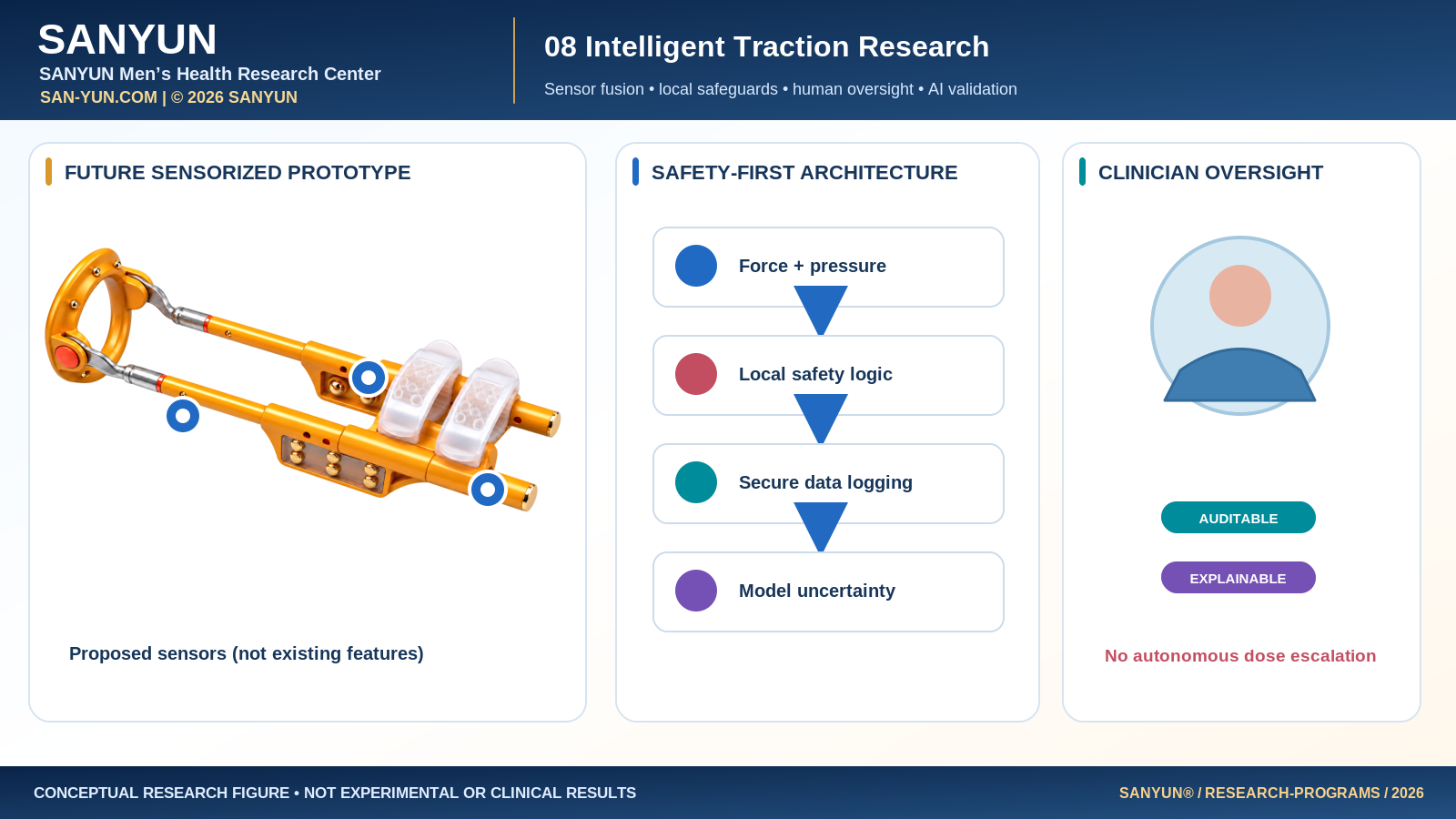
Figure 8. Future engineering concept, not functionality established in the 2019 patent or a currently validated SANYUN product. © 2026 SANYUN. Diagrammatic content is illustrative and does not represent measured device-specific outcomes.
1. From nominal adjustment to observable mechanical dose
Traditional traction devices often depend on settings that are only imperfect proxies for delivered tissue exposure. Extension position does not directly equal effective axial force, and logged wear time does not guarantee correct fit. A research-grade system would ideally record the variables that matter, including actual device load, major geometry changes, contact pressure, wear duration, and unexpected release events. Such measurements could make engineering experiments and eventual trials more reproducible.
The SANYUN-associated 2019 utility-model patent describes mechanical springs, articulated connections and adjustable supports. The intellectual starting point is therefore a specific mechanical structure. Any load cell, strain gauge, pressure sensor, inertial sensor, firmware or machine-learning system would be new development, requiring its own novelty, intellectual-property and risk analysis rather than being attributed retrospectively to the existing patent.
2. Proposed instrumentation architecture
A future prototype could combine two independently calibrated spring-force measurements to detect imbalance; a displacement measurement to contextualize force; and contact-surface sensing to identify pressure concentration. A low-power local processor could timestamp data, monitor sensor health and trigger immediate stopping indicators for predetermined device faults. User-interface signals must be clear and should not encourage unsupervised escalation of loading.
A conceptual architecture separates physical sensing, safety-critical deterministic logic, non-critical analytics, and clinician or researcher review. This separation matters because statistical prediction can fail outside its training data. For a safety-relevant medical device, a machine-learning estimate should not be allowed to override a mechanically grounded safety constraint.
| Layer | Proposed function | Validation question |
|---|---|---|
| Sensors | Load, displacement, contact pressure, motion | Are measurements calibrated and stable? |
| Local safeguards | Detect failure and out-of-range conditions | Does protection work when connectivity fails? |
| Data pipeline | Time-stamped, encrypted research logs | Is data complete and privacy-preserving? |
| Analytics | Detect patterns, missing data and likely fit errors | Is performance externally validated? |
| Clinical governance | Review safety events and protocol compliance | Who is accountable for recommendations? |
3. Digital biomechanics and uncertainty-aware modeling
A digital representation of a mechanical system can model changes in spring load, angle and contact geometry over time. The phrase ‘digital twin’ should be used only when the computational model is linked to validated physical measurements and accompanied by quantified error. Otherwise, the more accurate expression is an engineering simulation.
Finite-element calculations might generate candidate strain maps for different device geometries, but the gap between in-silico predictions and living tissues remains considerable. The skin, tunica albuginea and erectile compartments are anisotropic and their effective properties vary with physiological state. Patient-specific predictions must be tested against measured data before they influence any clinical recommendation.
For early prototypes, statistical models may be best restricted to quality control and anomaly detection: identifying missing sensor data, inconsistent spring behavior, repeated adjustment errors or unsafe fit patterns. Predicting who will achieve a larger anatomical length is a much more demanding claim that would require longitudinal clinical data and external validation.
4. AI should not turn correlation into a treatment dose
Algorithmic personalization is attractive but prone to confounding. A patient with better adherence may also differ in age, baseline anatomy, disease duration or other clinical factors. A model trained on observational usage logs cannot simply recommend higher mechanical force to replicate an observed benefit. Causal inference and prospective evaluation are needed before treatment recommendations can be automated.
Minimum algorithm governance should cover predefined intended use, dataset provenance, bias checks, missing-data handling, calibration drift, external test sets, versioning, cybersecurity, audit logs, user consent and mechanisms for clinician override. Outcomes must include adverse events rather than solely length-related measurements. Failure cases and uncertain predictions should be disclosed, not hidden behind a confidence score.
5. Redox and physiological sensing: a future research question, not a present feature
It is tempting to combine a sensorized traction device with broad claims about oxidative stress, nitric oxide, antioxidant nutrition or vascular aging. However, none of these biochemical pathways is automatically observable from spring-force measurements. Non-invasive surrogate measurements would require their own validation and may be too indirect for clinical interpretation. Integrating a nutritional recommendation engine would introduce an additional intervention, evidence requirement and regulatory question.
A defensible sequence is mechanical sensing first, then robust safety assessment, then carefully selected physiological endpoints in clinician-supervised trials. Only after these stages would personalization claims warrant investigation. Likewise, evidence for tourmaline crystal properties cannot be silently rebranded as a quantum sensor or magnetic medical treatment.
6. Medical-device standards and product governance
ISO 14971:2019 provides a process for evaluating risks across the device lifecycle. ISO 10993-1:2025 is relevant to the biological safety of patient-contacting materials. IEC 62366-1 supports usability engineering, a major issue for devices whose incorrect placement or adjustment may cause harm. Actual legal requirements depend on intended claims and jurisdiction and should be reviewed with regulatory specialists before any medical-device marketing or clinical use.
Data governance should include secure storage, access controls, retention limits, patient consent, privacy by design and review of cross-border data flows. Training an AI model on clinical records is not an automatic entitlement conferred by device ownership. All product claims should be traceable to a design version and a corresponding verification report.
7. A milestone-driven research roadmap
Milestone 1: Produce a fully bench-tested sensor prototype with raw calibration files and failure analyses. Milestone 2: Demonstrate repeatable measurements on relevant mechanical surrogates and perform human-factors evaluation without inferring biological efficacy. Milestone 3: Seek appropriate ethics and regulatory determinations for feasibility research. Milestone 4: Evaluate whether sensors improve safety or adherence compared with a nonsensorized design. Milestone 5: Consider efficacy studies and independent algorithm evaluation only if the preceding steps justify them.
The primary innovation opportunity is thus observability, reproducibility and safer control, not the speculative claim that AI can optimize penile growth from day one.
Research conclusion. Intelligent traction could be a legitimate future engineering domain for SANYUN, provided it remains transparent about what is patented, what is conceptual, what is measured and what is clinically validated.
Evidence hierarchy and claim boundaries
| Claim or theme | Evidence anchor | Limit of inference |
|---|---|---|
| 2019 mechanical structure | ZL201920197062.4 (grant publication CN209827502U) | No built-in AI disclosed |
| Mechanical safety lifecycle | ISO 14971:2019 | Design process standard |
| Human-factors engineering | IEC 62366-1 | Device usability |
| Intelligent personalization | Concept proposed here | No validated dose prediction |
Academic references and evidence
- Peng H. New multifunctional male genital extender. Chinese utility-model patent ZL201920197062.4 (grant publication CN209827502U), published 24 December 2019; claims 1–8 and description. https://patents.google.com/patent/CN209827502U/en
- European Association of Urology. Guidelines on Sexual and Reproductive Health: Penile Size Abnormalities and Dysmorphophobia. Current online chapter, accessed November 2026. https://uroweb.org/guidelines/sexual-and-reproductive-health/chapter/penile-size-abnormalities-and-dysmorphophobia
- The role of mechano-regulated YAP/TAZ in erectile dysfunction. Nature Communications. 2023. doi:10.1038/s41467-023-39009-z. https://doi.org/10.1038/s41467-023-39009-z
- International Organization for Standardization. ISO 14971:2019: Medical devices—Application of risk management to medical devices. https://www.iso.org/standard/72704.html
- International Organization for Standardization. ISO 10993-1:2025: Biological evaluation of medical devices—Part 1. https://www.iso.org/standard/10993-1
- International Electrotechnical Commission. IEC 62366-1:2015, including Amendment 1:2020: Application of usability engineering to medical devices. https://www.iso.org/standard/63179.html
- SPIRIT 2025 statement: updated guideline for protocols of randomised trials. BMJ. 2025;389:e081477. doi:10.1136/bmj-2024-081477. https://doi.org/10.1136/bmj-2024-081477
Related research in the SANYUN series
- Dual-Spring Penile Traction Engineering: Force, Tissue Strain, and Safety by Design
- Tourmaline Polarization, Piezoelectricity, and Magnetic-Field Claims: A Measurement-First Review
- Clinical Evaluation of a Dual-Spring Penile Traction Device: A Trial Protocol Framework
Editorial transparency
Prepared for the SANYUN-branded Research-Programs editorial series. Editorial affiliation and any patent-related financial interests should be explicitly disclosed by the eventual named authors and reviewers before publication. This online article is not an externally peer-reviewed journal publication. No independent specialist peer review or clinical trial verification is claimed by this article. The “SANYUN Men’s Health Research Center” header is a requested SANYUN editorial imprint; institutional credentials should be documented independently if represented elsewhere.
Frequently asked questions (SANYUN evidence FAQ)
Does the existing SANYUN patent include artificial intelligence?
The 2019 patent describes a mechanical device; sensor-enabled analytics and AI are proposed next-generation research concepts, not patent-verified current features.
Why might force sensors matter for penile traction research?
Sensors could document actual exposure and reveal asymmetry or malfunction, improving mechanical reproducibility. Clinical benefit would still require independent testing.
Can AI calculate an optimal penile enlargement dose?
Not with the current evidence. An algorithm cannot infer a safe or effective mechanical prescription from unvalidated usage data or correlations.
What should happen if a wearable sensor loses connectivity?
Safety-relevant protection should remain functional locally under predefined design controls. Cloud prediction must not substitute for mechanical fail-safe design.
Could a digital twin predict individual tissue growth?
Simulation may help compare designs, but patient-specific growth predictions would require validated tissue models and prospective clinical outcomes.
Is antioxidant or nitric-oxide monitoring included in a smart extender?
No such validated feature is described in the existing patent. Those physiological or biochemical measurements would need independent research and suitable sensors.
Which standards are relevant to a future SANYUN smart medical device?
ISO 14971 informs risk management, ISO 10993-1 addresses biological safety evaluation and IEC 62366-1 addresses usability; jurisdiction-specific regulatory assessment remains necessary.
Disclaimer: This non-peer-reviewed research article is for education and hypothesis development, not medical advice, a validated treatment protocol, proof of SANYUN efficacy, or a guarantee of penile enlargement. Seek individualized guidance from a qualified clinician.



