




Category: Latest Research
Core Research Direction: Whether intracavernosal platelet-rich plasma (PRP) or platelet-rich fibrin matrix (PRFM) improves erectile function versus placebo in men with erectile dysfunction, and what a 2025 meta-analysis of randomized placebo-controlled trials can and cannot establish
Search Intent: Does injecting platelet-rich plasma into the penis actually improve erectile function compared with placebo, and how strong is that evidence?
Platform: SANYUN Science Center
Evidence reviewed through: 2026-11-26
Executive Summary
A 2025 systematic review and meta-analysis pooled six randomized placebo-controlled trials of intracavernosal platelet-rich plasma (PRP) and platelet-rich fibrin matrix (PRFM) in men with erectile dysfunction. The review included 179 patients in the PRP/PRFM arms and 180 in the placebo arms, and its stated objective was to assess efficacy and safety against placebo. The authors report that PRP/PRFM was associated with higher International Index of Erectile Function (IIEF) scores at six months of follow-up or later, and that a greater proportion of men reached the minimal clinically important difference on the IIEF erectile function domain from the first month onward. Sexual and overall satisfaction, peak systolic velocity and end-diastolic velocity were comparable between groups. The authors caution that the findings are limited by a small sample, notable variability in injection protocols and an indirect comparison between PRP and PRFM, and they call for further well-designed trials.[1]
Why This Matters
Erectile dysfunction is common, and men increasingly encounter regenerative-sounding options such as penile PRP injections outside or alongside established treatments. The appeal is intuitive: a product made from the man's own blood, delivered locally, framed as restorative rather than symptomatic. That framing makes placebo-controlled evidence especially important, because expectations, injection rituals and clinical attention can all influence self-reported sexual outcomes.
The 2025 meta-analysis is useful precisely because it restricted inclusion to randomized placebo-controlled trials and examined both patient-reported and physiological outcomes. It is not a new trial and it does not establish that PRP restores erectile tissue. It is a pooled interpretation of a small evidence base, and its mixed results are as informative as its positive ones. Men considering these injections, and clinicians discussing them, need to understand which outcomes improved, which did not, and why the authors themselves advise caution.
It also helps to place this in the wider context of erectile dysfunction care, where established oral and non-oral options have undergone far more extensive evaluation than autologous platelet concentrates.
What PRP and PRFM Are, and the Mechanism Proposed for Them
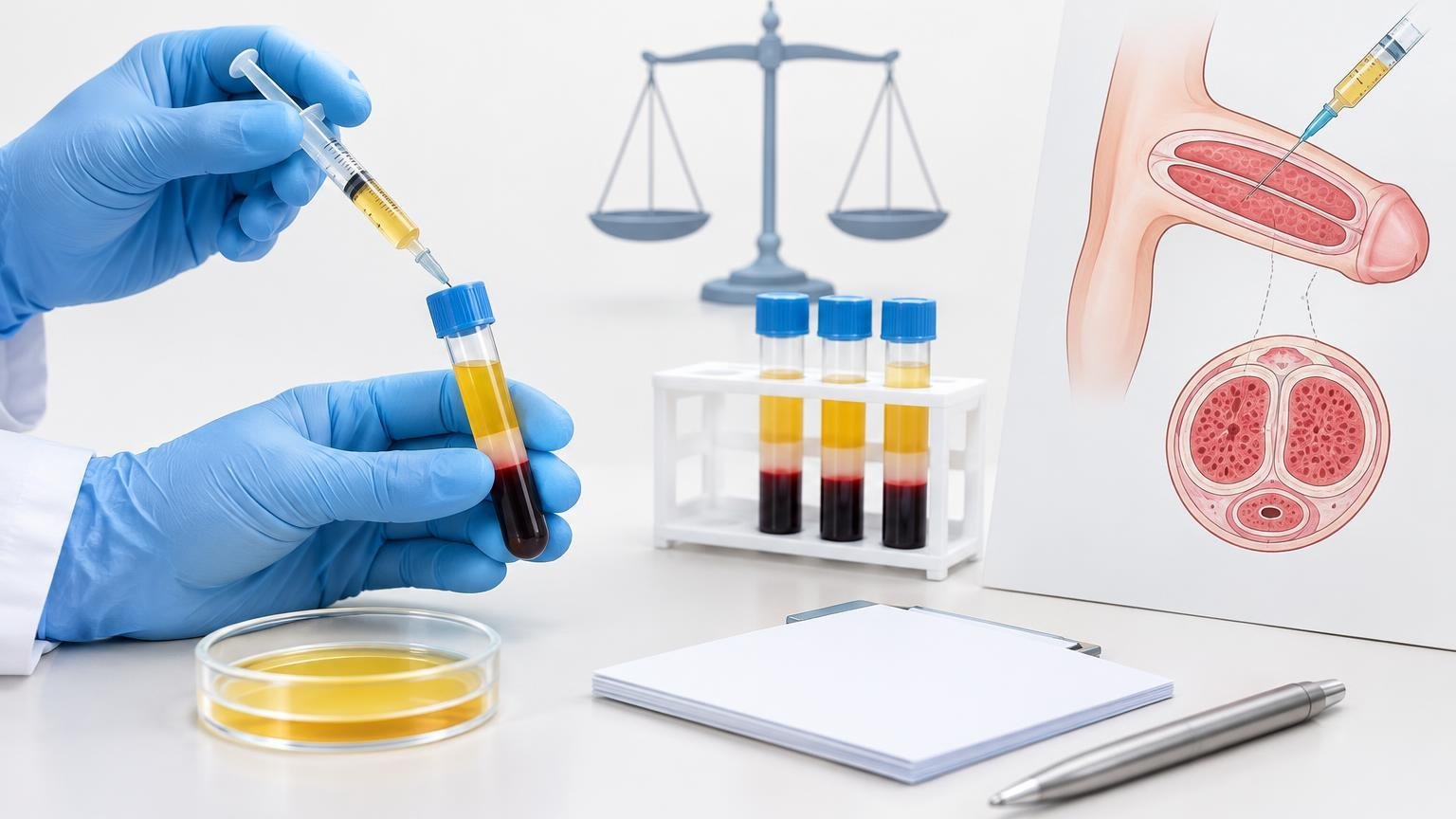
Platelet-rich plasma is prepared by concentrating platelets from a sample of the patient's own blood. Platelet-rich fibrin matrix is a related autologous preparation with a fibrin-based scaffold. Both are injected directly into the cavernosal tissue of the penis, the erectile bodies that fill with blood during an erection.
The proposed rationale is regenerative: platelets release growth factors and other signaling molecules that might, in theory, support tissue repair, improve endothelial function or encourage angiogenesis in cavernosal tissue. The meta-analysis does not test these biological mechanisms directly. It measures clinical scores and Doppler blood-flow velocities, which are downstream and indirect reflections of whatever biology may be occurring. The finding that IIEF scores differed while peak systolic velocity and end-diastolic velocity were comparable is a useful reminder that symptom scores and vascular measurements do not always move together, and it does not by itself confirm a regenerative effect.
How the Evidence Was Assembled
The authors followed PRISMA guidance and searched PubMed and Scopus from database inception to February 2025. Eligible studies were randomized controlled trials in men with erectile dysfunction that compared PRP or PRFM with placebo and reported the IIEF score, sexual and overall satisfaction, peak systolic velocity, end-diastolic velocity or complication rates. Six trials met the criteria, contributing 359 men in total. This is a narrow evidence base: six trials, roughly 60 men per arm on average, and a search limited to two named databases.
| Outcome or feature | What the review reported | How to interpret it |
|---|---|---|
| IIEF score at 6 months or later | Higher with PRP/PRFM than placebo | A pooled association in a small sample; not proof of a durable restorative effect |
| Proportion reaching the minimal clinically important difference on IIEF erectile function | Favored PRP/PRFM from the first-month follow-up | Suggests some men reported a meaningful change, but the number of trials and men is small |
| Post-injection visual analog scale scores | Favored PRP/PRFM | The review summary does not specify the scale's exact use, so the clinical meaning is uncertain |
| Sexual and overall satisfaction | Comparable between groups | A null finding that qualifies the positive IIEF signal |
| Peak systolic velocity and end-diastolic velocity | Comparable between groups | No clear pooled difference in these Doppler measures |
| Subgroup comparison: PRP versus PRFM | IIEF difference significant for PRP only, not PRFM | Based on an indirect comparison, not a head-to-head trial |
| Protocol consistency | Notable variability in injection protocols | Dose, preparation, timing and number of injections may differ across trials |
What the Evidence Shows
The clearest positive signal is in the IIEF, a validated patient-reported measure of erectile function. Pooled analysis found higher IIEF scores with PRP/PRFM than placebo at six months of follow-up or later. The review also reports that a greater percentage of men in the PRP/PRFM group reached the minimal clinically important difference on the IIEF erectile function domain from the first-month follow-up, and that post-injection visual analog scale scores favored PRP/PRFM. These findings suggest that some men reported improvements that were both statistically detectable in the pooled data and, at least by the MCID threshold, potentially meaningful to patients.
The picture is less consistent elsewhere. Sexual satisfaction and overall satisfaction were comparable between PRP/PRFM and placebo, and so were peak systolic velocity and end-diastolic velocity. The authors also report that PRP and PRFM were well tolerated. In subgroup analysis, the IIEF difference at the end of follow-up was significant only for PRP, not for PRFM, which led the authors to suggest that PRP may outperform PRFM versus placebo, particularly beyond six months. That suggestion, however, rests on an indirect comparison between two different products across separate trials rather than on a trial that randomized men to PRP versus PRFM.
Statistical Signal Versus Clinical Meaning
A statistically significant pooled difference in a score does not automatically translate into an erection that is reliably adequate for intercourse, and a null result in a small trial pool does not prove that no effect exists. The review's use of the minimal clinically important difference is helpful because it asks whether the change was large enough that patients might notice or value it. Even so, the MCID is a threshold applied to group data; individual responses can vary widely, and the review does not report how many men in each arm achieved a genuinely satisfactory response.
The discrepancy between improved IIEF scores and unchanged Doppler velocities also deserves restraint. Peak systolic velocity and end-diastolic velocity are ultrasound-derived measures of penile blood flow, and they can be affected by technique, timing, arousal and the drug used to induce erection during testing. A patient-reported improvement alongside unchanged vascular measures could reflect effects on sensation, confidence, placebo response or measurement limitations rather than a demonstrable change in cavernosal blood flow.
Interpretation and Limitations
The authors are explicit about the main limitations: a small sample size, heterogeneity in injection protocols and an indirect comparison between PRP and PRFM. Each of these matters. With 359 men across six trials, the pooled estimate is sensitive to the results of any single study, and subgroup analyses become especially fragile. Variability in how PRP and PRFM were prepared, how much was injected, how often, and over what follow-up period means that the pooled result describes an average across rather than a single, reproducible protocol.
The comparison between PRP and PRFM is indirect because no included trial appears to have randomized men head-to-head between the two products. Indirect comparisons are vulnerable to differences in trial populations, placebo preparations, injection schedules and outcome timing. The authors therefore describe PRP's possible superiority as a hypothesis rather than a demonstrated head-to-head advantage. Their conclusion that further well-designed clinical trials are warranted is a fair summary of where the evidence stands.
Safety reporting also has limits. The review describes PRP and PRFM as well tolerated, but the abstract-level summary does not quantify complication rates or describe how they were ascertained. Because these are autologous preparations injected into the penis, procedural risks such as pain, bruising, infection or hematoma are plausible on general grounds, but the review does not provide the pooled numbers needed to estimate their frequency. Men should not interpret 'well tolerated' as a quantified safety profile.
Research Outlook
The most useful next steps are straightforward: larger randomized placebo-controlled trials with standardized PRP and PRFM preparation, agreed injection protocols and follow-up long enough to test durability beyond six months. Trials that randomize men directly between PRP and PRFM would answer the question the current review can only raise indirectly. Consistent reporting of MCID attainment, satisfaction, Doppler measures and complications would also let future meta-analyses say more than 'well tolerated'.
Key Takeaways
- A 2025 meta-analysis of six randomized placebo-controlled trials found that intracavernosal PRP/PRFM was associated with higher IIEF scores than placebo at six months or later, with a greater proportion of men reaching the minimal clinically important difference on the erectile function domain from the first month.
- Sexual and overall satisfaction, peak systolic velocity and end-diastolic velocity were comparable between PRP/PRFM and placebo, so the positive self-reported signal is not mirrored across all outcomes.
- The subgroup finding that only PRP, not PRFM, differed significantly from placebo on end-of-follow-up IIEF scores rests on an indirect comparison and should be treated as a hypothesis.
- Small sample size (179 PRP/PRFM and 180 placebo participants), notable variability in injection protocols and the absence of head-to-head trials limit the strength of these conclusions.
- The authors call for further well-designed clinical trials, and the current evidence does not establish penile PRP or PRFM as a proven treatment for erectile dysfunction.
Questions and Answers
What are platelet-rich plasma (PRP) and platelet-rich fibrin matrix (PRFM) injections for erectile dysfunction?
PRP and PRFM are autologous preparations made by concentrating platelets and, for PRFM, fibrin from the man's own blood. In erectile dysfunction research they are injected directly into the cavernosal tissue of the penis. The proposed rationale is that platelet-derived growth factors might support tissue repair or blood-vessel function, but the 2025 meta-analysis measured clinical scores and Doppler velocities rather than confirming a specific biological mechanism.
Did penile PRP injections improve erectile function compared with placebo in the 2025 meta-analysis?
The meta-analysis found that PRP/PRFM was associated with higher IIEF scores than placebo at six months of follow-up or later, and a greater percentage of men reached the minimal clinically important difference on the IIEF erectile function domain from the first month. However, sexual and overall satisfaction and penile Doppler velocities were comparable between groups, and the authors caution that the small sample and protocol variability limit the findings.
How strong is the evidence that penile PRP works for erectile dysfunction?
The evidence is early and limited. The review pooled only six randomized placebo-controlled trials with 359 men in total, found notable variability in injection protocols and relied on an indirect rather than head-to-head comparison between PRP and PRFM. Its positive IIEF findings are associations in a small dataset, and the authors themselves describe the results as requiring caution and call for further well-designed clinical trials.
Does the PRP meta-analysis show that platelet-rich fibrin matrix works as well as platelet-rich plasma?
No. In subgroup analysis, IIEF scores at end of follow-up differed significantly from placebo only for PRP, not for PRFM. But this was an indirect comparison across separate trials, not a trial that randomized men to PRP versus PRFM. The authors therefore describe PRP's possible superiority over PRFM as a hypothesis, particularly beyond six months, rather than a demonstrated head-to-head advantage.
What are the limitations of the 2025 meta-analysis of PRP and PRFM for erectile dysfunction?
The authors cite a small sample size (179 men in the PRP/PRFM group and 180 in the placebo group), notable variability in injection protocols and an indirect comparison between PRP and PRFM. The review searched only PubMed and Scopus and relied on abstract-level outcome reporting, so complication rates are not quantified. These limitations mean the pooled results should be read as preliminary signals rather than definitive treatment effects.
If IIEF scores improved with PRP but Doppler blood-flow measures did not, what does that mean?
It means the self-reported and physiological outcomes told different stories. Higher IIEF scores suggest some men reported better erectile function, but comparable peak systolic and end-diastolic velocities mean the review did not detect a pooled difference in ultrasound-measured penile blood flow. That pattern could reflect placebo or expectation effects, measurement limitations, or effects not captured by Doppler, and it does not confirm a regenerative mechanism.
Sources and References
SANYUN Science Center explains published research on men's reproductive and sexual health, connecting scientific evidence with everyday questions while making sources and limitations clear.
Disclaimer: This article is for scientific education and research communication only. It does not provide medical advice, diagnosis, or individualized treatment recommendations, and does not endorse any medication, supplement, device, penile enlargement procedure, or other intervention. Decisions about sexual and reproductive health should be made in consultation with a qualified healthcare professional. Do not delay seeking professional care because of information in this article.
Original Content & Copyright Notice
- This article is prepared for SANYUN Science Center, drawing on published research and publicly available academic literature on men’s sexual and reproductive health. Its editorial explanations and presentation are developed for this platform.
- Copyright in the original editorial content, selection, and arrangement is reserved by SANYUN Science Center to the extent protected by applicable law. Referenced research, quotations, and third-party materials remain subject to the rights of their respective owners. This notice does not claim ownership of scientific facts or third-party research.
- Except where permitted by applicable law or an applicable license, prior written permission is required to reproduce, republish, translate, adapt, redistribute, or commercially reuse protected content. Attribution alone does not grant permission for such reuse.
- For permitted quotation or authorized reuse, clearly identify the source and retain a link to the original article.
- Source: SANYUN Science Center
- Original URL: Retain the original article URL on science.san-yun.com.
- Copyright Holder: SANYUN Science Center, for its own protected editorial content.
- Quotation, excerpts, or authorized reuse must not distort the scientific meaning, omit material limitations or disclaimers, or imply unverified medical claims, product efficacy, or endorsement by SANYUN Science Center.



