




Category: Health Academy
Core Research Direction: Why guideline-concordant diagnosis of hypogonadism (confirmed low morning testosterone plus gonadotropin testing, contraindication screening) is often incomplete before testosterone therapy begins, and what that means for interpreting treatment.
Search Intent: Before starting testosterone therapy, what testing and safety screening should precede a prescription, and how often do real-world prescriptions follow those steps?
Platform: SANYUN Science Center
Evidence reviewed through: 2026-11-26
Executive Summary
Testosterone prescribing has become common in adult men, but the diagnosis it depends on has not become easier to confirm. A retrospective chart review of 200 men who were diagnosed with hypogonadism and given an initial testosterone prescription at a large academic health system between January 2020 and January 2025 found that only 12% had documentation meeting a combined standard: two low morning testosterone levels, luteinizing hormone and/or follicle-stimulating hormone testing, and no documented contraindications.[1]
The same review reported incomplete safety assessment before treatment. In the year before the first prescription, 62% had prostate-specific antigen testing and 77% had a complete blood count. Before testosterone initiation, 55% had documented obstructive sleep apnea, 4% had prostate cancer, and 1.5% had PSA levels above 4 ng/mL.
These are conference findings presented at ENDO 2026 and reported by news outlets; they are preliminary until peer review and publication in a medical journal, and they come from a single academic center. They do not prove that 88% of men nationally receive inadequate care. They do show, within one system, a wide gap between guideline language and what appears in the chart — a gap that changes how a man should read his own prescription and how clinicians might interpret a trial of therapy.[2][3]
Why the Diagnostic Gap Matters
Testosterone therapy replaces a hormone. It is not a general treatment for fatigue, aging or reduced motivation, and the regulatory indication is narrower than the marketing: FDA labelling describes approved products for men with low or absent testosterone associated with a medical condition, and the 2025 labelling action retained limitations concerning age-related hypogonadism.[4]
The interpretive problem is that the reasons men present overlap heavily with reasons that have nothing to do with androgen deficiency. In the reviewed charts, evaluation was most often prompted by fatigue (63%), erectile dysfunction (62%), decreased libido (54%) or patient request (25%). Those are legitimate reasons to test, but none of them is a diagnosis.
The cohort was also medically complex, which matters because testosterone is not a risk-free intervention in such men. Obesity was documented in 63% (mean BMI 33.0), hypertension in 52%, depression in 40%, diabetes in 28% and arthritis in 28%. Fatigue, low libido and erectile difficulty are common in exactly this population for many reasons, so a biochemical result has to be unusually solid before it can carry the diagnosis alone.
The report frames the concern plainly: testosterone use has risen sharply while hypogonadism diagnosis rates have stayed stable, raising the possibility that some men are exposed to avoidable risks without clear biochemical evidence of androgen deficiency. That framing is a hypothesis about population-level prescribing rather than a measured outcome of this review, and it should be read as such.
There is a practical reason to care beyond the individual prescription. If the pre-treatment record does not show what the diagnosis was based on, then later interpretation becomes guesswork. A poor response, a side effect, or a decision to stop all become harder to reason about when nobody can say what was being treated. For a broader checklist of what should be settled before a first prescription, see the guide to questions before starting testosterone replacement therapy.
What Guideline-Concordant Evaluation Actually Requires
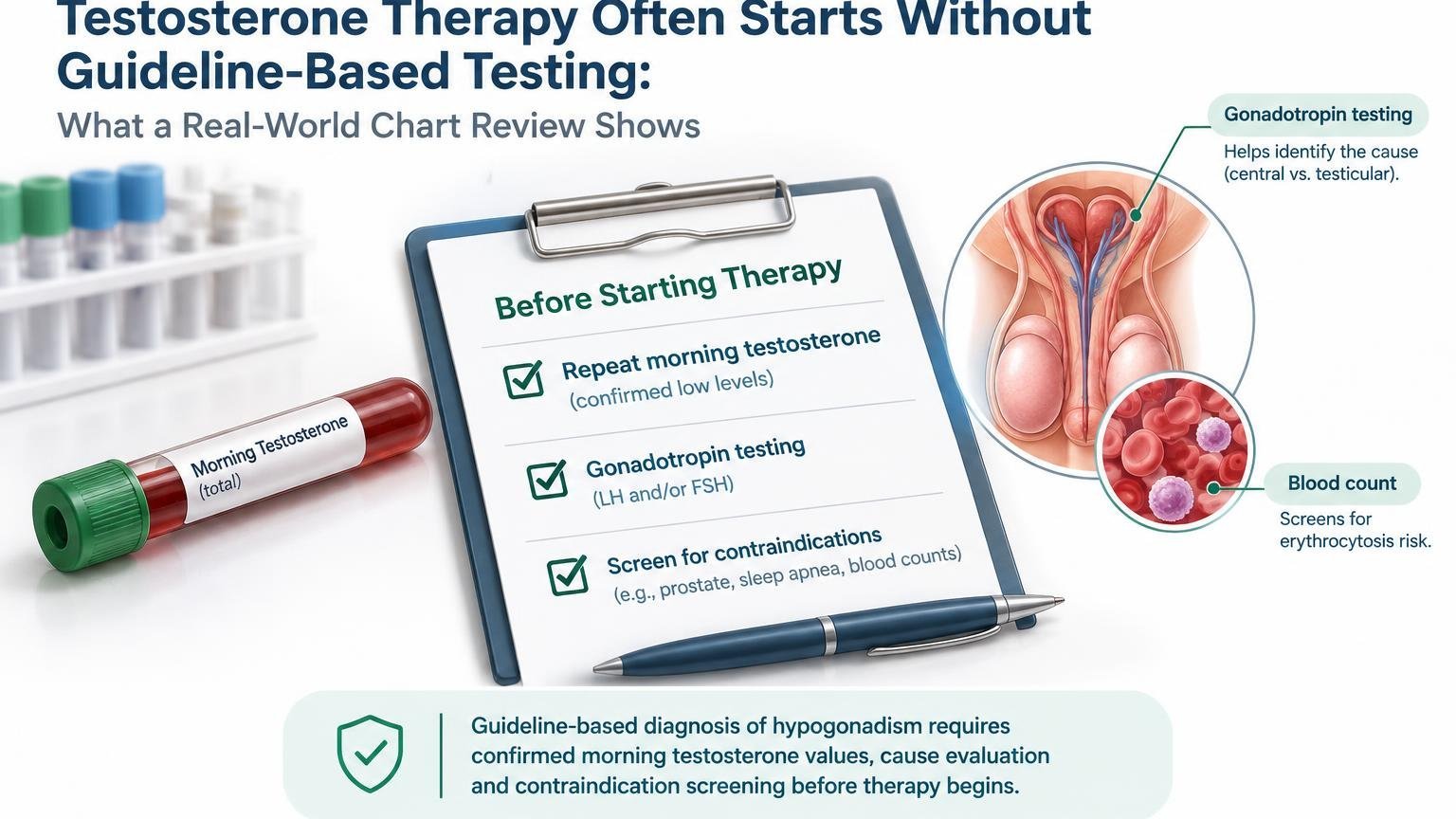
The Endocrine Society guideline approach is not a single blood test. It recommends diagnosing hypogonadism when compatible symptoms and signs occur together with consistently low testosterone, confirming a low result with repeat morning testing, and evaluating the cause.
Each element in that sentence carries weight. Symptoms and signs supply the clinical context. Consistency addresses the fact that testosterone fluctuates and that a single value can mislead. Repeat morning testing reflects the diurnal pattern of the hormone. Evaluation of the cause is what separates a primary testicular problem from a central one, and it is where gonadotropins enter the picture.
That last step is not optional bookkeeping. Luteinizing hormone and follicle-stimulating hormone indicate whether the testes are being instructed to produce testosterone and sperm. A low testosterone with low or inappropriately normal gonadotropins points toward a pituitary or hypothalamic contribution; a high gonadotropin pattern points toward testicular failure. These distinctions change the differential, the need for further investigation, and sometimes whether hormone replacement is the right intervention at all. The classification logic is examined more closely in the review of adding LH to total testosterone for classifying hypogonadism.
Laboratory interpretation also needs context that a number alone cannot supply. A testosterone test by itself cannot diagnose a condition; results are interpreted alongside symptoms and other information. Assay method, timing and the reason for testing are all part of reading the result correctly. For why total and calculated free values can diverge, the comparison of total versus free testosterone blood tests and repeat morning testing is a useful companion.
The threshold language used in the reporting is equally worth knowing, because it shows how a "low" result is operationalised in practice: total testosterone below 300 ng/dL, free testosterone below 70 pg/mL, or low bioavailable testosterone, on samples drawn between 05:00 and 10:00. Those cut-offs are the ones the reviewed study applied when judging whether documentation met the standard.
Contraindication and risk screening is the fourth pillar, and it is where the reviewed charts were weakest. The pre-treatment steps described include confirming the two low morning levels, gonadotropin evaluation when appropriate, and screening for contraindications and safety risks.
How Often the Real-World Record Matched the Standard
The review examined 200 adult male patients at Michigan Medicine with a hypogonadism diagnosis who received an initial testosterone prescription between January 2020 and January 2025. Mean age at prescribing was 52.5 years, with a range of 18 to 87.
| Pre-treatment measure | Reported result | What the result describes |
|---|---|---|
| Combined documentation standard (two low morning levels, LH and/or FSH, no contraindications) | 12% of men | The headline adherence figure; fails if any one component is undocumented |
| PSA testing in the year before first prescription | 62% | Prostate safety baseline; absent in a substantial minority |
| Complete blood count in the year before first prescription | 77% | Haematocrit baseline relevant to erythrocytosis risk on therapy |
| Documented obstructive sleep apnea before initiation | 55% | A condition that testosterone therapy can worsen |
| Documented prostate cancer before initiation | 4% | A history requiring explicit risk discussion rather than routine prescribing |
| PSA above 4 ng/mL before initiation | 1.5% | A signal that should prompt urological assessment before treatment |
| Prescriptions written in primary care / urology / endocrinology | 45% / 35.5% / 18% | Most first prescriptions originated outside specialist endocrine care |
| Topical testosterone as formulation | 68.5% of prescriptions | Formulation mix in this cohort, not an efficacy comparison |
Two features of the headline figure deserve emphasis. First, the 12% is a composite: a chart that documented two low morning levels and a normal prostate assessment but no gonadotropin testing would not count as concordant. The figure therefore measures complete documentation of a multi-part standard, not the prevalence of each individual step.
Second, incomplete safety monitoring is a separate finding from incomplete diagnosis. PSA and complete blood count coverage of 62% and 77% describes baseline assessment, not follow-up. A missing baseline makes later change harder to attribute, particularly for haematocrit and prostate markers.
The comorbidity findings are the ones most likely to be misread. The presence of sleep apnea in 55%, prostate cancer in 4% and PSA above 4 ng/mL in 1.5% does not mean testosterone caused these conditions. It means they were present in the records before treatment started — which is precisely when a prescriber needs to know about them.
Interpreting the Numbers Without Overreading Them
The first limitation is study type. This is a retrospective chart review presented at a scientific meeting, and research presented at meetings should be considered preliminary until peer-reviewed and published. Abstracts typically compress methods, and the full paper may change details of definition, sampling and analysis.
The second limitation is the setting. Two hundred charts from one academic health system are not a national sample, and the demographic profile reported — 85% White, 95% non-Hispanic, 66% married, 67% sexually active — is narrow. Prescribing patterns in other systems, countries and insurance environments may differ substantially.
The third limitation is the reliance on documentation. A clinician may have confirmed a low morning level verbally, reviewed outside results, or discussed a contraindication without recording it in the fields the researchers abstracted. Documentation-based measures tend to underestimate care that was delivered and overestimate care that was not. This does not neutralise the finding, since a diagnosis that cannot be reconstructed from the record is also a diagnosis that cannot be audited or handed over — but it does mean the 12% should be read as a documentation floor, not a precise measure of clinical behaviour.
The fourth limitation is the absence of outcome data. Nothing in the packet links the documentation gap to a measured harm such as erythrocytosis, sleep apnea worsening or prostate events. The concern about avoidable risk is a reasoned inference, not an observed association in these data.
Finally, the prescriber distribution complicates any simple story about who is at fault. With 45% of first prescriptions written in primary care and 18% in endocrinology, the gap is spread across specialties rather than localised to one. That pattern is more consistent with a systems problem — time pressure, unclear ownership of the workup, absent decision support — than with individual ignorance.
What the Gap Means for Reading a Treatment Trial
If a man starts testosterone without a confirmed biochemical diagnosis, his subsequent experience becomes difficult to interpret in both directions. Improvement in energy or libido may be a placebo response, regression to the mean, or the resolution of an unrelated problem. Conversely, a poor response may simply mean the original diagnosis was wrong.
This is not an argument against treatment. It is an argument for knowing what is being treated. The guideline structures — confirmed low morning values, cause evaluation, risk screening — exist so that the treatment decision and its later assessment rest on something more durable than a single number taken on a bad morning.
Fertility deserves separate mention because it is often the most time-sensitive consideration. Fertility plans, risks and follow-up should be discussed before a medication is chosen, not after months of therapy have passed. A man who may want children later needs that conversation at the start, when options remain open.
For readers preparing for an appointment, the practical implication is to ask what the diagnosis rests on and whether anything further is needed before treatment. Those conversations go better when the man has already thought about what he wants to discuss; the guidance on talking to a doctor about erectile dysfunction, low testosterone and prostate concerns addresses that preparation directly.
Research Outlook
The authors frame their findings as a quality-improvement opportunity, suggesting that clinical decision support tools could promote more consistent, guideline-concordant prescribing. That is a plausible next step, though whether such tools change documented practice — and whether better documentation translates into fewer adverse events — remains untested in the material available here.
Peer-reviewed publication of the full analysis would allow readers to examine how the composite criterion was operationalised, how missing data were handled, and whether the 12% varies by prescriber specialty or by whether gonadotropins were ordered. Those subgroup questions are not answerable from the conference report.
A second open question is whether the pattern described here is stable over time. The review window spans January 2020 to January 2025, a period that includes both rapid growth in telehealth prescribing and the 2025 FDA labelling action. Whether documentation improved, worsened or stayed flat across those five years is not reported.
Key Takeaways
- Guideline-concordant diagnosis of hypogonadism combines compatible symptoms with consistently low testosterone, confirmed by repeat morning testing, plus evaluation of the cause — not a single low value.
- In a 2026 conference review of 200 men at one academic health system, only 12% had documented two low morning levels, LH and/or FSH testing, and no contraindications before an initial testosterone prescription.
- Baseline safety assessment was also incomplete: 62% had PSA testing and 77% had a complete blood count in the prior year, while 55% had documented sleep apnea, 4% prostate cancer and 1.5% PSA above 4 ng/mL.
- The findings are preliminary conference data from a single centre and rely on chart documentation, so they indicate a quality gap rather than prove a national standard of care or a causal harm.
- Fertility intentions, contraindications and the planned follow-up should all be settled before a formulation is chosen, because a treatment whose diagnosis is unclear is also a treatment whose response is hard to judge.
Questions and Answers
What does guideline-concordant testosterone testing before therapy involve?
It means more than one blood test. The Endocrine Society approach pairs compatible symptoms and signs with consistently low testosterone, confirms a low result using repeat morning testing, and evaluates the cause. Where appropriate this includes luteinizing hormone and follicle-stimulating hormone testing, alongside screening for contraindications such as prostate history, elevated PSA and sleep apnea before any prescription.
How many men had proper testing before starting testosterone in the 2026 Michigan review?
Only 12% of the 200 reviewed men had documentation of two low morning testosterone levels, LH and/or FSH testing, and no contraindications before their initial prescription. Separately, 62% had PSA testing and 77% had a complete blood count in the year before prescribing. The study was a conference abstract from one academic centre and is preliminary.
How strong is the evidence that testosterone is often prescribed without adequate testing?
It is suggestive but not definitive. The data come from a retrospective chart review of 200 patients at a single academic health system, presented at ENDO 2026 and not yet peer-reviewed. Documentation-based measures can undercount care that happened but was not recorded, and the sample is demographically narrow, so the 12% figure should not be generalised to all practice settings.
Why does gonadotropin testing matter when testosterone is low?
Luteinizing hormone and follicle-stimulating hormone show whether low testosterone originates in the testes or reflects reduced signalling from the pituitary and hypothalamus. That distinction changes the differential diagnosis and the appropriate next step. Without it, a low testosterone value identifies a finding but not a cause, and treatment selection rests on incomplete information.
What safety issues were already present before testosterone was started?
In the reviewed charts, 55% of men had documented obstructive sleep apnea, a condition testosterone can worsen; 4% had prostate cancer; and 1.5% had PSA above 4 ng/mL. These are prevalence findings before treatment, not treatment harms. Their presence at baseline is exactly why screening and baseline PSA and haematocrit values are recommended before a first prescription.
If my testosterone was low once, is that enough to start therapy?
Generally not. A single low result does not by itself identify a cause or select a treatment, and a testosterone test alone cannot diagnose a condition. Guideline practice confirms low values on repeat morning samples and evaluates the cause. A man should also discuss fertility plans, risks and follow-up before choosing a medication rather than after therapy has begun.
Sources and References
- Maria Papaleontiou; Sinha S. Testosterone therapy often prescribed without guideline-based testing. 2026
- Dennis Thompson. Many Men Are Prescribed Testosterone Without Proper Testing. 2026
- Maria Papaleontiou. テストステロン処方前、ガイドラインに沿った診断は12%. 2026
- Testosterone therapy: evaluation comes first.
SANYUN Science Center explains published research on men's reproductive and sexual health, connecting scientific evidence with everyday questions while making sources and limitations clear.
Disclaimer: This article is for scientific education and research communication only. It does not provide medical advice, diagnosis, or individualized treatment recommendations, and does not endorse any medication, supplement, device, penile enlargement procedure, or other intervention. Decisions about sexual and reproductive health should be made in consultation with a qualified healthcare professional. Do not delay seeking professional care because of information in this article.
Original Content & Copyright Notice
- This article is prepared for SANYUN Science Center, drawing on published research and publicly available academic literature on men’s sexual and reproductive health. Its editorial explanations and presentation are developed for this platform.
- Copyright in the original editorial content, selection, and arrangement is reserved by SANYUN Science Center to the extent protected by applicable law. Referenced research, quotations, and third-party materials remain subject to the rights of their respective owners. This notice does not claim ownership of scientific facts or third-party research.
- Except where permitted by applicable law or an applicable license, prior written permission is required to reproduce, republish, translate, adapt, redistribute, or commercially reuse protected content. Attribution alone does not grant permission for such reuse.
- For permitted quotation or authorized reuse, clearly identify the source and retain a link to the original article.
- Source: SANYUN Science Center
- Original URL: Retain the original article URL on science.san-yun.com.
- Copyright Holder: SANYUN Science Center, for its own protected editorial content.
- Quotation, excerpts, or authorized reuse must not distort the scientific meaning, omit material limitations or disclaimers, or imply unverified medical claims, product efficacy, or endorsement by SANYUN Science Center.



