




Category: Reproductive Care
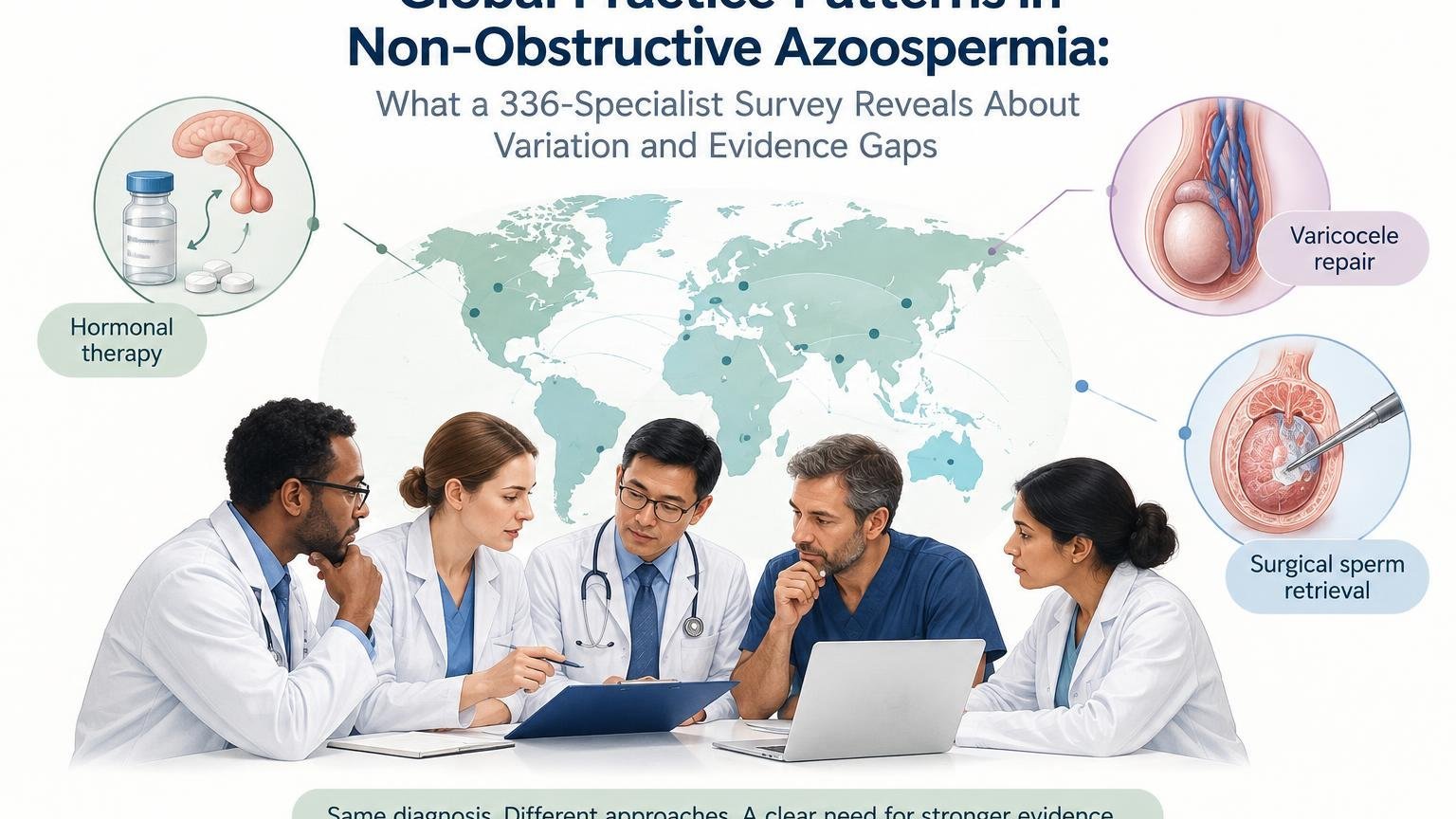
Core Research Direction: Global variation in specialist practice for managing non-obstructive azoospermia (NOA), including hormonal pretreatment, varicocele repair, and surgical sperm retrieval strategies, compared against guidelines.
Search Intent: When experts worldwide treat men with non-obstructive azoospermia, how much do their approaches to hormonal therapy and surgical sperm retrieval differ, and what does that variation reveal about the strength of the underlying evidence?
Platform: SANYUN Science Center
Evidence reviewed through: 2026-11-25
Executive Summary
Non-obstructive azoospermia (NOA) is a severe form of male infertility in which the testes fail to produce measurable sperm in the ejaculate despite intact reproductive tract anatomy. It is described in the research literature as a complex condition with multiple therapeutic options, a lack of clear guidelines, and marked variation in how specialists manage it. That description is not just a framing device. A 56-question online survey distributed to specialists worldwide, with 336 valid responses from 49 countries, set out to capture how real-world clinicians actually approach medical and surgical management. The results show substantial disagreement on hormonal pretreatment before surgical sperm retrieval, on the role of varicocele repair in NOA, on the use of testicular ultrasound guidance, on surgical staging, and on which follicle-stimulating hormone (FSH) thresholds, if any, predict a successful retrieval.[1]
The survey does not test which approach is superior. It maps practice variation and compares patterns against current guidelines, with expert recommendations developed through a Delphi process. Its central contribution is to make visible how much of NOA care rests on clinician judgment rather than robust comparative evidence. For patients, that variation is not an abstract academic issue: it means the treatment pathway offered for the same diagnosis can differ meaningfully depending on where in the world a man is seen.
Why This Matters
NOA is not rare in the context of male infertility evaluations, yet it sits at the difficult end of reproductive medicine. Unlike obstructive azoospermia, where a physical blockage can sometimes be corrected surgically, NOA reflects a failure of sperm production within the testis. The primary path to biological fatherhood is often surgical sperm retrieval combined with intracytoplasmic sperm injection, but success is uncertain and the procedure can require multiple attempts or more invasive techniques such as microdissection testicular sperm extraction (mTESE).
When evidence for a treatment is weak and guidelines are not definitive, clinical practice tends to drift toward local tradition, individual training, and expert opinion. The survey captures that drift. About 29.6% of respondents suggested 3 to 6 months of hormonal therapy before surgical sperm retrieval for men with normogonadotropic hypogonadism, and 23.6% did so for hypergonadotropic hypogonadism. Those figures mean the majority did not routinely recommend that pretreatment across those categories, even though a substantial minority did. For the same diagnosis and hormonal profile, two clinicians could reasonably offer different preparatory regimens.
The variation extends to how sperm retrieval is planned. One-third of respondents proceed directly to mTESE in every case of NOA, while others use a staged approach that typically begins with a less invasive retrieval attempt. After a failed conventional testicular sperm extraction (TESE), 23.8% of respondents wait 3 months before proceeding to mTESE, while 33.1% wait 6 months. The choice of interval affects time to treatment, surgical scheduling, and the emotional and financial burden on couples. The survey cannot say which interval produces better outcomes, because it measured practice rather than patient results.
Biological and Clinical Mechanism
Understanding why NOA management varies requires a basic grasp of the hormonal and testicular pathways involved. Sperm production depends on the hypothalamus, pituitary, and testes working in sequence. Gonadotropin-releasing hormone drives pituitary release of luteinizing hormone and FSH. Luteinizing hormone stimulates testicular Leydig cells to produce testosterone, while FSH supports the Sertoli cells that nurture developing sperm. In NOA, this system is disrupted at some level, but the exact site and reversibility differ widely between men.
Normogonadotropic hypogonadism refers to low sperm production with gonadotropin levels in the normal range. Hypergonadotropic hypogonadism refers to elevated gonadotropins, typically reflecting testicular failure and reduced negative feedback from the testes. The distinction matters because hormonal pretreatment is sometimes proposed as a way to optimize the testicular environment before retrieval, but the survey shows only a minority routinely use 3 to 6 months of therapy for these profiles. The rationale for pretreatment is biologically plausible in selected men, yet the survey does not establish that it improves retrieval rates or live birth outcomes.
Klinefelter syndrome, a chromosomal condition that commonly causes hypergonadotropic hypogonadism and NOA, illustrates the diagnostic and prognostic uncertainty. Among respondents, 46.0% reported successful sperm retrieval in fewer than 10% of men with Klinefelter syndrome. That figure describes what clinicians say they observe in their practice, not a controlled outcome rate. It also helps explain why 41.3% routinely recommended preimplantation genetic testing, a step that reflects reproductive planning considerations beyond the retrieval procedure itself.
FSH is a common component of the NOA workup, but its usefulness as a retrieval predictor is contested. Respondents reported different FSH cut-offs for a positive retrieval: 22.5% cited 12 to 19 IU/mL, 27.8% cited 20 to 40 IU/mL, and 31.8% reported no upper limit at all. This dispersion suggests that no single threshold has been accepted as reliable across expert communities. A man with a given FSH level could be told different things about his retrieval prognosis depending on the clinician interpreting the number.
What the Evidence Shows
The survey's design is a cross-sectional online questionnaire sent to specialists globally. It is not a clinical trial, a systematic review, or a prospective cohort with patient outcomes. Its strength lies in breadth: 336 valid responses from 49 countries make it the largest survey to date on real-world medical and surgical NOA management by reproductive experts, according to the authors. Its limitation is equally clear: self-reported practice can reflect beliefs, availability of technology, and local norms rather than verified clinical behavior or outcomes.[2]
The reported surgical sperm retrieval rate itself varied in how it was described. Between 26.0% and 50.0% of participants reported an SSR rate of 50.0%. That range is best understood as a description of clinician-reported success figures rather than a pooled outcome estimate. The phrasing in the source is unusual and should be read carefully: it indicates that a subset of respondents, itself spanning a range in the abstract's summary, reported a 50.0% retrieval rate. The survey did not verify those rates against individual patient records or define uniform inclusion criteria for what counted as a retrieval attempt.
Varicocele repair before surgical sperm retrieval was recommended by 57.7% of respondents. This is a notable majority, yet it occurs in a condition where evidence for varicocele repair specifically in NOA is debated and guidelines are not definitive. The survey records the recommendation pattern but does not test whether repair improves retrieval rates, pregnancy rates, or live birth. It is an example of how expert communities can converge on a practice before definitive comparative evidence is available.
Technical approaches to retrieval also diverge. 57.4% of respondents reported using ultrasound to identify the most vascularized areas in the testis for SSR. The logic is that increased vascularity may correlate with areas of active spermatogenesis, potentially improving the chance of finding sperm. But the survey captures use of the technique, not its diagnostic accuracy or effect on outcomes. Similarly, the split between universal mTESE and a staged approach reflects different philosophies about balancing invasiveness against the likelihood of success.
| Management area | Reported practice pattern | What the survey cannot show |
|---|---|---|
| Hormonal therapy before SSR for normogonadotropic hypogonadism | 29.6% suggested 3 to 6 months of treatment | Whether pretreatment improves retrieval or live birth |
| Hormonal therapy before SSR for hypergonadotropic hypogonadism | 23.6% suggested 3 to 6 months of treatment | Whether pretreatment improves retrieval or live birth |
| Varicocele repair before SSR | 57.7% recommended it | Whether repair improves retrieval outcomes in NOA |
| Ultrasound to identify vascularized testicular areas | 57.4% reported using it | Whether it improves sperm detection or pregnancy rates |
| Surgical strategy | One-third proceed directly to mTESE in every NOA case; others use a staged approach | Which strategy yields better outcomes or fewer invasive procedures per success |
| Wait after failed conventional TESE | 23.8% wait 3 months; 33.1% wait 6 months before mTESE | Which interval is associated with better retrieval or safety |
| FSH cut-off for positive SSR | 22.5% cited 12 to 19 IU/mL; 27.8% cited 20 to 40 IU/mL; 31.8% reported no upper limit | Which threshold, if any, reliably predicts retrieval |
Interpretation and Limitations
The survey's authors conclude that NOA management demonstrates diverse practice patterns and highlights the need for evidence-based international consensus guidelines. That conclusion is reasonable given the data, but it should be read with the study design in mind. An online survey of specialists who choose to respond is vulnerable to self-selection. Clinicians with a particular interest in NOA or with access to advanced technology may be overrepresented. The responses describe what clinicians say they do, not what they actually do in every case, and not what happens to patients as a result.
There is also a citation nuance worth noting for readers who encounter the paper in different databases. One repository record lists the article in World Journal of Men's Health volume 42 with a 2024 publication status, while the indexed journal record places it in volume 43, issue 1, pages 92 to 122, in 2025. Both records describe the same survey with 336 valid responses from 49 countries. The discrepancy is bibliographic rather than scientific, but it illustrates why readers should verify the version of record when citing the work.
A further limitation is that the survey compared results to current guidelines and used a Delphi process to generate expert recommendations. Delphi methods synthesize expert opinion through structured rounds of feedback; they do not generate the same level of evidence as randomized trials or large prospective cohorts. The recommendations should therefore be understood as expert consensus where evidence is thin, not as proof that one approach outperforms another. The survey maps the variation; it does not resolve it.
Research Outlook
The clear next step implied by the survey is comparative research that links specific management choices to patient outcomes. Questions that remain unanswered include whether 3 to 6 months of hormonal pretreatment before surgical sperm retrieval improves retrieval rates or live birth in normogonadotropic or hypergonadotropic hypogonadism, whether varicocele repair before SSR changes outcomes in NOA, and whether ultrasound-guided identification of vascularized testicular areas actually increases sperm detection. Prospective cohort studies and, where feasible, randomized designs would help distinguish effective strategies from widely practiced ones.
There is also a need for standardization in how outcomes are defined and reported. The variability in FSH cut-offs, with 22.5% citing 12 to 19 IU/mL, 27.8% citing 20 to 40 IU/mL, and 31.8% reporting no upper limit, reflects a lack of agreed prognostic thresholds. A consensus on which hormonal and clinical variables should be collected, and how retrieval success should be defined, would make future studies more comparable. Until then, clinicians and patients will continue to navigate a field where expert judgment fills gaps left by limited evidence.
Key Takeaways
- A 56-question global survey with 336 valid responses from 49 countries is the largest to date on real-world NOA management, but it measures reported practice rather than patient outcomes.
- Hormonal pretreatment for 3 to 6 months before surgical sperm retrieval was suggested by 29.6% of respondents for normogonadotropic hypogonadism and 23.6% for hypergonadotropic hypogonadism, meaning most did not routinely recommend it.
- Varicocele repair before SSR was recommended by 57.7%, while 57.4% reported using testicular ultrasound to identify vascularized areas, showing convergence on some practices despite limited comparative evidence.
- FSH thresholds for predicting positive retrieval varied widely: 22.5% cited 12 to 19 IU/mL, 27.8% cited 20 to 40 IU/mL, and 31.8% reported no upper limit, underscoring the absence of a validated cut-off.
- For patients, these findings mean that the same NOA diagnosis may lead to different preparatory and surgical plans depending on the clinician and region; asking about the evidence behind each recommendation is reasonable.
Questions and Answers
What is non-obstructive azoospermia and why is its management so variable?
Non-obstructive azoospermia is a condition in which the testes do not produce measurable sperm in the ejaculate despite an intact reproductive tract. Management varies because the condition has multiple therapeutic options, a lack of clear guidelines, and considerable controversy, as described in the survey literature. Clinicians therefore rely on training, local practice, and expert opinion, producing marked global variation.
How many specialists responded to the global survey on non-obstructive azoospermia management?
The survey received 336 valid responses from specialists in 49 countries. It used a 56-question online questionnaire covering evaluation and management of NOA. The authors describe it as the largest survey to date on real-world medical and surgical NOA management by reproductive experts. The design captures self-reported practice, not verified clinical outcomes or a representative sample of all specialists.
Do most specialists recommend hormonal therapy before sperm retrieval for non-obstructive azoospermia?
No. Only 29.6% suggested 3 to 6 months of hormonal therapy before surgical sperm retrieval for normogonadotropic hypogonadism, and 23.6% for hypergonadotropic hypogonadism. That means most respondents did not routinely recommend pretreatment for these profiles. The survey did not test whether pretreatment improves retrieval rates or live birth, so the variation reflects opinion rather than proven comparative benefit.
What does the survey show about varicocele repair and ultrasound use before sperm retrieval in NOA?
57.7% of respondents recommended varicocele repair before surgical sperm retrieval, and 57.4% reported using ultrasound to identify the most vascularized areas of the testis for retrieval. These are practice patterns, not evidence of effectiveness. The survey did not measure whether either approach improves sperm detection, retrieval success, or pregnancy rates in men with non-obstructive azoospermia.
How reliable is FSH as a predictor of successful sperm retrieval in non-obstructive azoospermia?
The survey shows no consensus. Respondents reported different FSH cut-offs for positive retrieval: 22.5% cited 12 to 19 IU/mL, 27.8% cited 20 to 40 IU/mL, and 31.8% reported no upper limit at all. This dispersion suggests that no single threshold is accepted as reliably predictive across expert communities. The survey records opinions and reported practice, not validated diagnostic accuracy.
What are the main limitations of the global survey on NOA practice patterns?
The survey is a cross-sectional online questionnaire with self-selected respondents, so it may not represent all specialists. It records what clinicians say they do rather than verified behavior or patient outcomes. Expert recommendations were developed through a Delphi process, which synthesizes opinion but does not provide trial-level evidence. The authors themselves conclude that diverse practice patterns highlight the need for evidence-based international consensus guidelines.
Sources and References
- Global Andrology Forum. Global Practice Patterns and Variations in the Medical and Surgical Management of Non-Obstructive Azoospermia: Results of a World-Wide Survey, Guidelines and Expert Recommendations. World Journal of Men's Health. 2024 42 DOI: 10.5534/WJMH.230339.
- Rambhatla, Amarnath; Shah, Rupin; Ziouziou, Imad; Kothari, Priyank; Salvio, Gianmaria; Gul, Murat; Hamoda, Taha; Kavoussi, Parviz; Atmoko, Widi; Toprak, Tuncay. Global Practice Patterns and Variations in the Medical and Surgical Management of Non- Obstructive Azoospermia: Results of a World-Wide Survey, Guidelines and Expert Recommendations. The World Journal of Men's Health. 2025 43(1):92-122 DOI: 10.5534/wjmh.230339.
SANYUN Science Center explains published research on men's reproductive and sexual health, connecting scientific evidence with everyday questions while making sources and limitations clear.
Disclaimer: This article is for scientific education and research communication only. It does not provide medical advice, diagnosis, or individualized treatment recommendations, and does not endorse any medication, supplement, device, penile enlargement procedure, or other intervention. Decisions about sexual and reproductive health should be made in consultation with a qualified healthcare professional. Do not delay seeking professional care because of information in this article.
Original Content & Copyright Notice
- This article is prepared for SANYUN Science Center, drawing on published research and publicly available academic literature on men’s sexual and reproductive health. Its editorial explanations and presentation are developed for this platform.
- Copyright in the original editorial content, selection, and arrangement is reserved by SANYUN Science Center to the extent protected by applicable law. Referenced research, quotations, and third-party materials remain subject to the rights of their respective owners. This notice does not claim ownership of scientific facts or third-party research.
- Except where permitted by applicable law or an applicable license, prior written permission is required to reproduce, republish, translate, adapt, redistribute, or commercially reuse protected content. Attribution alone does not grant permission for such reuse.
- For permitted quotation or authorized reuse, clearly identify the source and retain a link to the original article.
- Source: SANYUN Science Center
- Original URL: Retain the original article URL on science.san-yun.com.
- Copyright Holder: SANYUN Science Center, for its own protected editorial content.
- Quotation, excerpts, or authorized reuse must not distort the scientific meaning, omit material limitations or disclaimers, or imply unverified medical claims, product efficacy, or endorsement by SANYUN Science Center.



