




Category: Latest Research
Core Research Direction: Male-factor fertility evidence relevant to men's reproductive health: antioxidant supplement efficacy in subfertile men, sperm separation methods and DNA fragmentation, and sperm DNA fragmentation thresholds for embryo development
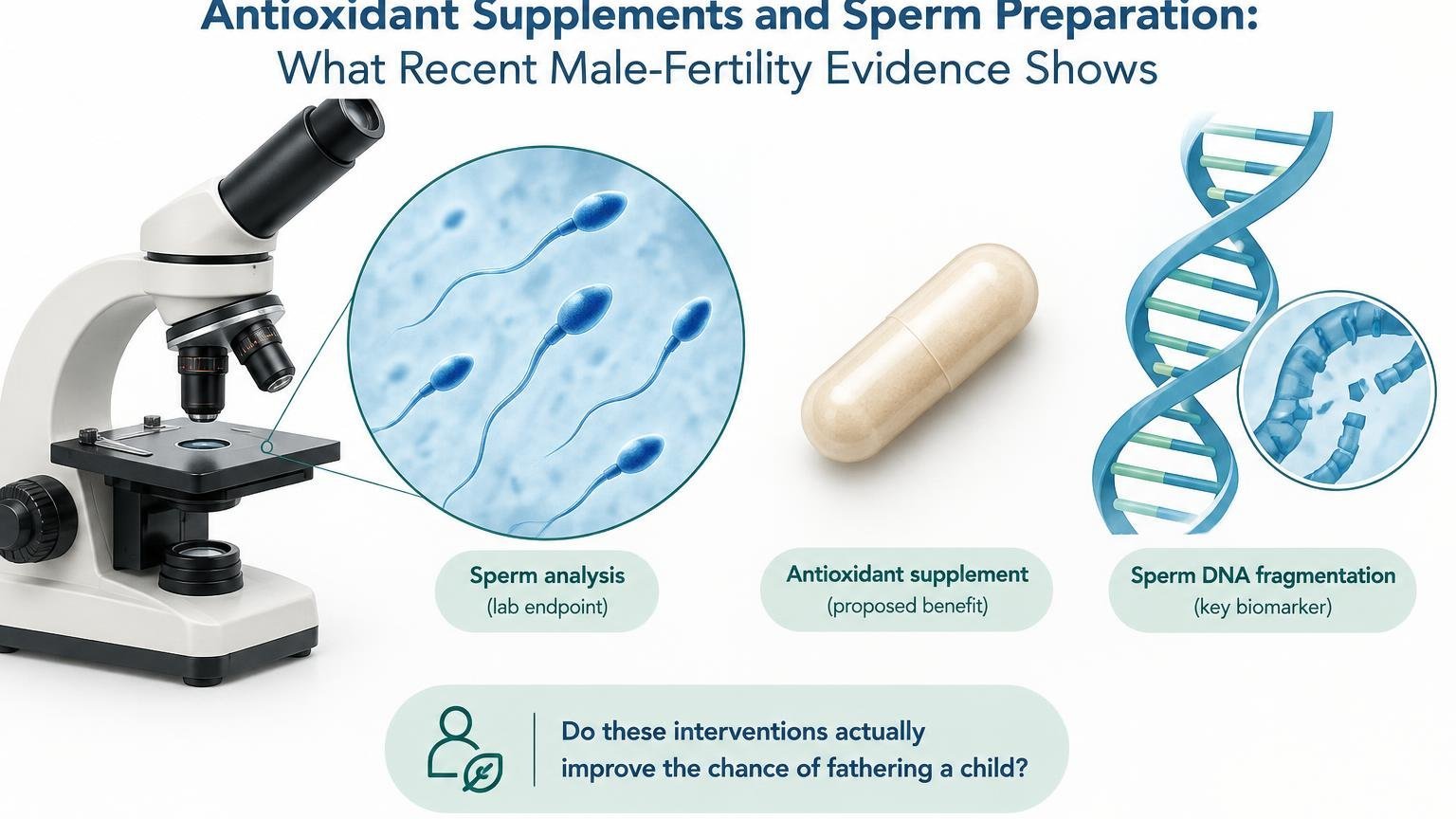
Search Intent: Do common antioxidant fertility supplements, sperm-preparation techniques, or sperm DNA fragmentation levels actually change a subfertile man's chances of fathering a child?
Platform: SANYUN Science Center
Evidence reviewed through: 2026-11-26
Executive Summary
Men dealing with subfertility are frequently offered three plausible-sounding interventions: an antioxidant supplement to lower oxidative stress, a particular laboratory sperm-preparation technique to select better sperm, and a sperm DNA fragmentation test to explain why embryos fail. Recent evidence complicates all three assumptions. In the SUMMER randomized trial, a combined antioxidant supplement taken daily for six months did not improve ongoing pregnancy and produced no measurable benefit in semen parameters or sperm DNA fragmentation; in one analysis window, pregnancy rates were lower than with placebo.[1]
A 2026 systematic review and meta-analysis of sperm separation methods identified only small laboratory differences between density gradient, swim-up and a combined approach, and its authors concluded that no robust clinical recommendations are possible yet. The most consistent clinical signal in this evidence concerns sperm DNA fragmentation: values above roughly 20% have been linked to poorer embryo development, even without an obvious decline in fertilization rates.[2][3]
- The SUMMER trial enrolled 1,171 men across 21 centers in the Netherlands; ongoing pregnancy within six months was 33.8% with the supplement versus 37.5% with placebo, a non-significant difference.
- Between 4 and 6 months after randomization, a window chosen to reflect the roughly 72-day spermatogenesis cycle, ongoing pregnancy was 15.5% with the supplement versus 21.5% with placebo (P = .02).
- The combined density gradient plus swim-up method reduced DNA fragmentation by 3.54 percentage points versus density gradient alone and 3.31 points versus pellet swim-up alone, but only three included studies reported clinical outcomes and none found significant differences.
Why This Matters
Male-factor infertility is common, and the market for over-the-counter sperm-health supplements is large and largely self-directed. The appeal is understandable: a daily capsule is cheaper and less invasive than IVF, and the oxidative-stress explanation is biologically intuitive. If oxidative stress were the main driver of subfertility, an antioxidant capsule would be among the few low-cost male-side interventions available. The SUMMER trial matters precisely because it tested that idea at scale with pregnancy, not a semen parameter, as the primary outcome.
The sperm-preparation question matters for a different reason. Laboratories must choose a method, and each choice carries assumptions about which sperm are best. A meta-analysis that cannot separate methods on clinical outcomes tells us that this routine choice currently rests more on laboratory convention than on demonstrated benefit. The DNA-fragmentation literature sits between these two questions because it is often used to justify both supplements and specialized preparation, so its limits deserve the same scrutiny.
The Biological Logic Behind the Three Claims
Reactive oxygen species (ROS) are not simply toxins in semen. At low levels they participate in normal sperm maturation, capacitation and the acrosome reaction. The concern arises when ROS exceed the seminal antioxidant capacity, a state called oxidative stress, which can damage sperm membranes and DNA. This is the rationale for antioxidant supplementation: if oxidative stress is the problem, supplying antioxidants should help.
The sperm-preparation rationale is more mechanical. Density gradient centrifugation separates sperm by buoyancy, swim-up selects motile sperm that migrate out of a pellet, and combining the two aims to capture both advantages. Because sperm with fragmented DNA may be less able to swim or may sediment differently, some preparation methods are hypothesized to enrich samples for DNA-intact sperm.
DNA fragmentation itself refers to breaks in sperm DNA strands. Because mature sperm have limited DNA repair capacity, damage acquired during spermatogenesis or transit is largely carried into the oocyte, which must then repair it after fertilization. The hypothesis is that excessive fragmentation overwhelms oocyte repair capacity, impairing embryo development even when fertilization occurs.
Each step in that chain is plausible, but plausibility is not efficacy. A supplement can raise seminal antioxidant levels without improving pregnancy; a preparation method can lower measured DNA fragmentation without improving live birth; and a DNA-fragmentation threshold can correlate with embryo quality without being a reliable individual prognostic test.
What the SUMMER Trial Found
SUMMER was a multicenter, double-blind, placebo-controlled randomized trial conducted across 21 centers in the Netherlands. It enrolled 1,171 men seeking fertility care whose partners were undergoing treatments ranging from expectant management to intrauterine insemination, IVF or ICSI. Men were randomized to a specific combined antioxidant supplement or placebo, taken daily for six months.
The primary result was null. Ongoing pregnancy within six months occurred in 33.8% of the supplement group and 37.5% of the placebo group, a non-significant difference. Secondary analyses were less reassuring. In the 4 to 6 month window after randomization, selected to align with the approximate 72-day spermatogenesis cycle, ongoing pregnancy was 15.5% in the supplement group versus 21.5% with placebo (P = .02).
Laboratory and semen outcomes were similarly unhelpful for the supplement hypothesis. There were no significant differences between groups in semen volume, sperm concentration, progressive motility or total motile sperm count after 3 to 6 months, and no significant difference in sperm DNA fragmentation. Fertilization rate and embryo utilization rate in assisted reproduction cycles also did not differ significantly between groups.
One signal ran in the opposite direction: median sperm vitality fell within the supplement group from 62.7% at baseline to 54.9% after treatment. This was a within-group comparison to its own baseline, not a direct between-group test, and should be read with that caveat. The report's bottom line was that routine antioxidant supplementation in men seeking fertility care is not supported and may potentially decrease pregnancy chances, particularly in fresh assisted reproduction cycles.
What the Sperm Separation Meta-Analysis Found
The 2026 review compared a combined method, density gradient centrifugation followed by swim-up, with three single techniques: density gradient alone, pellet swim-up and direct swim-up. It included 15 studies with more than 1,369 participants, 11 of which contributed to the meta-analyses. Twelve studies were prospective, most used a split-sample design, and only one was randomized; four were conference abstracts or posters and one was a preprint. The review was preregistered.
On the laboratory endpoint of DNA fragmentation, the combined method performed better than density gradient alone by 3.54 percentage points (p = 0.01) and better than pellet swim-up alone by 3.31 points (p = 0.04), each based on seven studies. Those differences appeared in the three studies using the sperm chromatin dispersion (SCD) test; studies using the TUNEL assay showed no significant differences between methods.
Motility results were mixed and fragile. Pellet swim-up alone produced a greater increase in rapid progressive motility than the combined method (3.58 percentage points; p < 0.001; two studies), while the combined method outperformed density gradient alone on rapid progressive motility and on total motility. Critically, one study carried more than 99% of the weight in the progressive motility analysis, so that pooled estimate effectively rests on a single dataset.
Clinical outcomes were sparse. Three studies reported them; none found significant differences in fertilization or pregnancy rates, and the two that reported live birth found no difference. These results were not pooled because the studies used different denominators. A prior 2019 Cochrane review of six randomized trials in 485 couples undergoing intrauterine insemination was similarly inconclusive, and no trial reported live birth.
How Should Sperm DNA Fragmentation Be Read?
The most defensible statement supported by this evidence is an associational one: sperm DNA fragmentation above 20% has been linked to lower rates of good-quality Day 3 embryos and blastocysts, with no evidence of lower fertilization in IVF. That pattern is biologically coherent, because fertilization can proceed while post-fertilization development stalls, but it is a group-level association, not a diagnosis.
Two features of the meta-analysis argue for caution in using sperm DNA fragmentation to choose a preparation method. First, the review authors explicitly describe sperm characteristics as only surrogate markers for fertility, meaning that a fall in measured fragmentation does not by itself demonstrate a better chance of a child. Second, the assay used changes the answer: SCD-based studies showed method differences while TUNEL-based studies did not, which complicates any single threshold or method recommendation.
The SUMMER data add a further caution. In that trial, baseline sperm DNA fragmentation in the assessed subgroup was low, and the supplement did not change it. If many subfertile men do not have elevated oxidative stress or elevated fragmentation to begin with, interventions aimed at lowering it have little room to help and, on the reductive-stress hypothesis, some room to harm. Reductive stress here means an excess of antioxidants that shifts the cell's redox balance too far in the reducing direction.
| Question | Evidence source and design | Reported result | Interpretation |
|---|---|---|---|
| Does a combined antioxidant supplement improve pregnancy? | SUMMER: multicenter, double-blind, placebo-controlled randomized trial; 1,171 men; 21 centers in the Netherlands | Ongoing pregnancy 33.8% with supplement vs 37.5% with placebo, a non-significant difference | No demonstrated benefit on the primary outcome |
| Does the supplement change semen or DNA measures? | Same trial, secondary outcomes at 3 to 6 months | No significant differences in volume, concentration, progressive motility, total motile count or sperm DNA fragmentation; median vitality fell from 62.7% to 54.9% within the supplement group | Does not support the proposed mechanism |
| Is there a treatment-window signal? | SUMMER, 4 to 6 months after randomization | Ongoing pregnancy 15.5% with supplement vs 21.5% with placebo (P = .02) | Secondary analysis suggesting possible harm; hypothesis-generating |
| Do sperm separation methods differ on DNA fragmentation? | Systematic review and meta-analysis; 15 studies, more than 1,369 participants, 11 in meta-analyses | Combined method reduced fragmentation by 3.54 points vs density gradient alone and 3.31 points vs pellet swim-up alone; differences seen with SCD but not TUNEL | Small surrogate differences that depend on the assay used |
| Do separation methods differ on clinical outcomes? | Three studies reporting clinical outcomes in the same review | No significant differences in fertilization, pregnancy or live birth; results not pooled | Insufficient clinical evidence for recommendations |
| What does elevated sperm DNA fragmentation mean? | Literature summarized in the supplied evidence | Above 20% linked to lower good-quality Day 3 embryo and blastocyst rates; no evidence of lower fertilization | Associational marker of embryo development, not an individual diagnosis |
Interpretation and Limitations
The strongest evidence in this review is the SUMMER trial, but even that must be read through a news summary rather than the primary report; effect sizes and confidence intervals for several outcomes were not supplied. The 4 to 6 month finding was a secondary outcome, and secondary analyses in large trials can generate false signals. It should not be treated as proof of harm, only as a reason to avoid routine supplementation and to counsel patients accordingly.
The sperm separation meta-analysis is weaker than its precision suggests. Included studies were rated overall low methodological quality, heterogeneity was extreme (I² 96.7% to 99.9%), and the authors assumed a within-sample correlation of 0.5 that they say further biased the data. The differences of roughly 3 to 4 percentage points are small, and the clinical outcome evidence is not pooled and shows no significant differences.
There are also applicability limits. SUMMER tested one specific combined supplement, so its results do not automatically transfer to every antioxidant product, dose or combination. The cohort was Dutch men seeking fertility care, and couples were undergoing a range of treatments; effects could differ in untreated populations or in men with documented high oxidative stress, a subgroup the trial was not designed to isolate.
The DNA-fragmentation threshold discussed here derives from literature summarized in the supplied evidence rather than a dedicated threshold-validation study. A 20% cutoff has been linked to poorer embryo development at the group level, but thresholds depend on assay, laboratory and population, and the SCD-versus-TUNEL divergence in the separation meta-analysis illustrates how far measurement method can shift conclusions.
Research Outlook
Several open questions follow naturally. Which men, if any, have sufficiently high oxidative stress for antioxidants to help, and can that be measured reliably before treatment? Do separation methods that lower DNA fragmentation in the laboratory translate into more live births in adequately powered randomized trials with live birth as the endpoint? And does a fragmentation threshold perform well enough to guide embryo selection or treatment decisions at the individual level?
For laboratories, the meta-analysis authors suggest that units comparing methods locally could record total sperm count after preparation, for which no quantitative data were found, and note which DNA fragmentation assay is used, since SCD and TUNEL results diverged. Total sperm count after preparation was not captured in the included studies, so these are modest, practical steps toward the evidence that is currently missing rather than a new clinical standard.
Questions and Answers
Do antioxidant supplements improve male fertility and pregnancy rates?
In the SUMMER randomized trial of 1,171 men, a combined antioxidant supplement taken daily for six months did not improve ongoing pregnancy: 33.8% with the supplement versus 37.5% with placebo, a non-significant difference. The trial also found no significant improvement in semen parameters or sperm DNA fragmentation. One secondary analysis in the 4 to 6 month window found lower pregnancy rates with the supplement, so routine use is not supported.
What did the SUMMER trial show about antioxidant supplements and semen quality?
SUMMER found no significant differences between the supplement and placebo groups in semen volume, sperm concentration, progressive motility or total motile sperm count after 3 to 6 months, and no significant difference in sperm DNA fragmentation. Median sperm vitality fell within the supplement group from 62.7% to 54.9% after treatment, a within-group comparison to baseline rather than a direct between-group test.
Which sperm separation method is best for reducing sperm DNA fragmentation?
A 2026 meta-analysis found that a combined density gradient plus swim-up method reduced DNA fragmentation by 3.54 percentage points versus density gradient alone and 3.31 points versus pellet swim-up alone. However, these small differences appeared with the SCD assay but not with TUNEL, the included studies were of low methodological quality, and clinical outcome data showed no significant differences. No robust recommendation is possible yet.
Does sperm DNA fragmentation above 20% affect embryo development in IVF?
Literature summarized in the supplied evidence links sperm DNA fragmentation above 20% to lower rates of good-quality Day 3 embryos and blastocysts, without evidence of lower fertilization in IVF. That is a group-level association, not an individual diagnosis. Thresholds depend on the assay used, and laboratory differences in fragmentation do not automatically translate into differences in live birth.
How strong is the evidence behind sperm DNA fragmentation testing and sperm preparation choices?
It is limited. The separation meta-analysis rated included studies as overall low methodological quality, with heterogeneity from 96.7% to 99.9%, and the authors describe sperm characteristics as only surrogate markers for fertility. Clinical outcome studies were few and not pooled. A prior Cochrane review in intrauterine insemination couples was also inconclusive, and no trial reported live birth.
Why might antioxidant supplements be harmful rather than helpful for subfertile men?
One hypothesis is reductive stress: excess antioxidants shift the redox balance in a direction that can also impair sperm function, since some reactive oxygen species are needed for normal sperm biology. The trial subgroup had low baseline sperm DNA fragmentation, suggesting many subfertile men may not have high oxidative stress to correct. This remains a proposed mechanism, not a demonstrated cause of the pregnancy findings.
Sources and References
- IVF News. 2025
- Sperm separation meta-analysis finds small laboratory differences between methods, with no robust clinical recommendations possible yet – IVF News. Andrology. 2026
- IVF News.
SANYUN Science Center explains published research on men's reproductive and sexual health, connecting scientific evidence with everyday questions while making sources and limitations clear.
Disclaimer: This article is for scientific education and research communication only. It does not provide medical advice, diagnosis, or individualized treatment recommendations, and does not endorse any medication, supplement, device, penile enlargement procedure, or other intervention. Decisions about sexual and reproductive health should be made in consultation with a qualified healthcare professional. Do not delay seeking professional care because of information in this article.
Original Content & Copyright Notice
- This article is prepared for SANYUN Science Center, drawing on published research and publicly available academic literature on men’s sexual and reproductive health. Its editorial explanations and presentation are developed for this platform.
- Copyright in the original editorial content, selection, and arrangement is reserved by SANYUN Science Center to the extent protected by applicable law. Referenced research, quotations, and third-party materials remain subject to the rights of their respective owners. This notice does not claim ownership of scientific facts or third-party research.
- Except where permitted by applicable law or an applicable license, prior written permission is required to reproduce, republish, translate, adapt, redistribute, or commercially reuse protected content. Attribution alone does not grant permission for such reuse.
- For permitted quotation or authorized reuse, clearly identify the source and retain a link to the original article.
- Source: SANYUN Science Center
- Original URL: Retain the original article URL on science.san-yun.com.
- Copyright Holder: SANYUN Science Center, for its own protected editorial content.
- Quotation, excerpts, or authorized reuse must not distort the scientific meaning, omit material limitations or disclaimers, or imply unverified medical claims, product efficacy, or endorsement by SANYUN Science Center.



