




Category: Penis Enlargement
Core Research Direction: Distinguishing true micropenis (pathologic, generally managed with early endocrine evaluation and hormonal therapy) from adult penile-size concerns and pseudo-micropenis, and clarifying which lengthening/girth procedures have documented limited efficacy and meaningful risks versus established hormone-treated indications.
Search Intent: When is a small penis a diagnosable medical condition that warrants endocrine evaluation and early hormone therapy, and what do we actually know about whether adult surgical lengthening or girth enhancement works and what harm it can cause?
Platform: SANYUN Science Center
Evidence reviewed through: 2026-11-24
Executive Summary
Micropenis is a defined developmental anomaly, not a description of ordinary variation in penile size. Two recent reviews define it as a normally formed penis whose stretched penile length (SPL) falls more than 2.5 standard deviations below the mean for the patient's age and ethnicity; one review cites a prevalence of 0.6%–0.7% among male infants. The same definitional threshold appears in a pediatric endocrinology clinical algorithm, which adds that typical working cut-offs are an SPL under 2 cm in a term newborn and under 4 cm after 5 years of age, always interpreted against country- and region-specific norms.[1][2]
The central clinical task is separation, not measurement alone. True micropenis must be distinguished from pseudo-micropenis, which includes buried, trapped and webbed penis; buried penis in particular reflects a penile shaft concealed in prepubic fat and is common in overweight or obese boys. Causes of genuine micropenis include hypogonadotropic hypogonadism, primary testicular failure, disorders of androgen synthesis or action, and genetic syndromes. Because the underlying defect ranges from a pituitary disorder to androgen insensitivity, the same small measurement can carry very different implications.
Hormone therapy is the mainstay for confirmed, hormone-responsive micropenis, and timing matters. Androgen therapy is described as most useful when started early, with one review placing the start as soon as possible after 6 months of age, and the pediatric algorithm emphasizing the mini-puberty window, when luteinizing hormone, follicle-stimulating hormone and testosterone surge and peak between 1 and 3 months of age in boys. In boys under 3 years with congenital hypogonadotropic hypogonadism, a regimen of hCG 250 IU plus human menopausal gonadotropin 75 IU twice weekly for 3 months has been reported to increase SPL by approximately 22 mm and achieve testicular descent with physiological testosterone levels over 3–6 months.
Adult surgery occupies a much weaker position. Both versions of the urology review state that for adults who do not respond well to hormone therapy, surgery may be chosen but its efficacy is limited and the risk relatively high, and it is generally regarded as a last resort. Documented risks include limited length gain of 1–3 cm, scar formation, sensory change and effects on sexual function. Reported augmentation outcomes vary between experts, and satisfaction is strongly shaped by individual expectations rather than by measured gain alone.[3][4]
Why This Matters
The distinction between a diagnosable condition and a size concern is not academic. A missed diagnosis in infancy can mean a missed endocrine window, and the pediatric algorithm describes any infant with bilateral undescended testes and/or micropenis as an endocrine emergency because missing the 6–12-month mini-puberty window may carry lifelong consequences for fertility, malignancy risk and psychosocial well-being. Conversely, labeling a normal or merely buried penis as micropenis can push a child or adult toward unnecessary hormonal or surgical exposure.
Adult men who seek lengthening usually do not have micropenis by definition. The reviews make clear that surgical lengthening is discussed as an option for men who want more length, not as a treatment that restores normal anatomy; the pediatric algorithm notes that current surgical techniques still cannot fully replicate normal penile anatomy and function. That gap between the request and what procedures can deliver is the reason expectation management is not a soft add-on but a core part of the evidence picture.
Definitions, Measurement and the Pseudo-Micropenis Problem
Both the urology review and the pediatric algorithm anchor the definition in standard deviations rather than a single centimeter figure. The urology review defines micropenis as penile size markedly below the age-group mean, specifically when stretched length is below the mean minus 2.5 SD, and reports a prevalence of 0.6%–0.7% in male infants. The pediatric algorithm uses the same statistical threshold and stresses age- and ethnicity-specific normative data, with typical thresholds of under 2 cm at birth in a term baby and under 4 cm after 5 years.
Measurement technique therefore carries diagnostic weight. The pediatric algorithm describes the Schonfeld approach: a transparent plastic ruler or sliding callipers, foreskin retracted, suprapubic fat pad gently compressed to the pubic ramus, glans held between thumb and forefinger, and the fully stretched penis measured dorsally from pubic ramus to the tip of the glans in the flaccid state. The urology review adds that repeated measurements averaged together improve accuracy, that standardized photography with software measurement is used in research and trials, and that ultrasound can add anatomical detail.
Pseudo-micropenis is the pivotal alternative explanation. Buried penis means the shaft is concealed in prepubic fat, a pattern commonly seen in overweight or obese boys; trapped penis follows circumcision or trauma with scarred prepubic skin entrapping the penis; webbed penis reflects abnormal attachment between the scrotal sac and the ventral penile surface and can be distinguished by palpating the corpora. These are anatomical and soft-tissue problems, not androgen deficiency, and they lead to different management.
Biological and Clinical Mechanism
Penile growth is androgen-dependent, and the reviews frame cause accordingly. Underlying conditions such as congenital hypogonadotropic hypogonadism and androgen insensitivity syndrome can produce micropenis through hormonal imbalance or through resistance to androgen action, which is why the same physical finding can originate at the hypothalamus, the pituitary, the testis or the androgen receptor. The pediatric algorithm expands the list to include disorders of androgen biosynthesis, 5α-reductase deficiency, partial androgen insensitivity, chromosomal and genetic syndromes, and exposure to environmental endocrine disruptors, with an idiopathic category remaining.
The mini-puberty window explains why infancy is the therapeutic opportunity. In boys, a postnatal surge of luteinizing hormone, follicle-stimulating hormone and testosterone peaks between 1 and 3 months of age, providing a physiological window for evaluating the hypothalamic-pituitary-gonadal axis; outside this window basal hormone levels have limited diagnostic utility, and stimulation tests are used instead. The clinical algorithm frames early treatment during this surge as potentially yielding superior outcomes for testicular development, penile growth and future fertility, while noting that this reasoning is a physiological rationale rather than proof of long-term benefit.
Dihydrotestosterone has a specific mechanistic role. It is described as the primary androgen in penile tissue and a non-aromatizable androgen that cannot be converted to estrogen, which theoretically reduces the risk of bone-age advancement; this makes topical DHT particularly relevant to 5α-reductase type 2 deficiency and partial androgen insensitivity. The word theoretical matters: this is a pharmacological rationale, not a demonstrated safety advantage in comparative trials.
What the Evidence Shows
The strongest short-term signals come from small and largely non-comparative reports summarized in reviews, not from large randomized trials. In one cited study, applying 5% testosterone cream for 30 days to 50 infants and children aged 5 months to 8 years significantly increased penile length. In early-pubertal boys with idiopathic, isolated, relatively small penis, adding oral anastrozole 1 mg/day for 3 months to intramuscular testosterone enanthate reportedly improved penile length by about 20%, without significant effect on height velocity or bone development. These are encouraging but secondhand summaries.
Androgen response differs by age and by cause. In prepubertal and pubertal patients with partial androgen insensitivity syndrome and 5α-reductase type 2 deficiency, DHT treatment can increase stretched penile length, but it has no effect in adults according to the urology review's summary of case-series evidence. The clinical algorithm likewise states that for idiopathic micropenis without an identified endocrine abnormality, hormonal therapy is generally more effective before puberty, while post-pubertal therapy requires higher doses and longer duration to achieve a satisfactory increase.
Gonadotropin-based regimens target the underlying axis rather than penile tissue alone. In boys under 3 years with congenital hypogonadotropic hypogonadism, hCG 250 IU plus human menopausal gonadotropin 75 IU twice weekly for 3 months has been reported to raise stretched penile length by approximately 22 mm and to achieve testicular descent with physiological testosterone levels over 3–6 months. Separately, the clinical algorithm notes that in adolescent-onset hypogonadotropic hypogonadism, testosterone alone does not stimulate testicular growth or spermatogenesis, so fertility induction requires gonadotropin treatment.
For adult surgery the evidence is characterized by heterogeneity rather than pooled estimates. The urology review states that experts report different results, that enlargement outcomes are inconsistent, and that satisfaction is markedly influenced by individual expectations. It also places the typical documented length gain at 1–3 cm while listing scar formation, sensory change and effects on sexual function as potential harms, and both the full review and its abstract conclude that surgery in adults who have not responded well to hormone therapy offers limited efficacy with relatively high risk.
| Construct | Source-grounded definition or finding | Interpretation and limits |
|---|---|---|
| Micropenis threshold | Stretched penile length below the age-group mean minus 2.5 SD | Statistical definition requiring age- and ethnicity-specific norms; a single cut-off cannot be applied across populations |
| Reported infant prevalence | 0.6%–0.7% among male infants | Cited from secondary references inside a narrative review rather than primary epidemiology |
| Pseudo-micropenis | Buried, trapped or webbed penis, including shaft concealed in prepubic fat in overweight boys | Anatomical rather than endocrine problem; must be excluded before hormonal or surgical planning |
| Mini-puberty | Postnatal LH, FSH and testosterone surge peaking at 1–3 months in boys | Physiological window for axis evaluation; long-term benefit of early treatment remains unproven |
| Infant gonadotropin regimen | hCG 250 IU plus hMG 75 IU twice weekly for 3 months in boys under 3 years with congenital hypogonadotropic hypogonadism | Reported increase of about 22 mm in stretched length with descent over 3–6 months; from cited reference, sample size not stated |
| DHT in partial AIS and 5α-reductase deficiency | Increases stretched penile length in prepubertal and pubertal patients; no effect in adults | Case-series summary; dosing not standardized and absorption variable |
| Adult surgical lengthening | Documented gain of 1–3 cm with scarring, sensory change and sexual function effects | Narrative summary, not a pooled outcome estimate; described as a last resort |
Interpretation and Limitations
The evidence base here is a set of narrative reviews and a clinical algorithm, not a systematic review with meta-analysis. Several of the most quotable numbers are secondhand: the 0.6%–0.7% prevalence, the 20% anastrozole-associated improvement, the 22 mm gonadotropin-associated gain and the 1–3 cm surgical gain are all reported within reviews by citing other work, and sample sizes and comparator groups are not presented in the text available. Readers should treat these as plausible short-term signals rather than precise effect estimates.
The largest gap concerns durability. Both reviews state that the long-term effects of androgen therapy given in infancy or early childhood, including effects on adult fertility, are not settled and that the literature lacks sufficient long-term outcome reporting, and one review adds that it remains unclear whether early androgen use confers any long-term benefit on adult penile length. Short-term growth in a measured centimeter or millimeter is therefore not the same as a proven adult functional or psychological outcome.
Safety statements carry similar caveats. The urology review tabulates potential harms of hormonal therapy including acne, mood change, increased aggression and accelerated skeletal maturation with intramuscular testosterone, unstable absorption and risk of transdermal transfer to others with topical preparations, fluid retention and breast tenderness with hCG, and limited efficacy evidence with aromatase inhibitors and growth hormone. The pediatric algorithm flags the need for gloves when applying DHT gel to prevent inadvertent androgen exposure to caregivers, particularly females. These are documented concerns rather than quantified risk estimates.
Surgical interpretation is complicated by the mismatch between the outcome measured and the outcome wanted. A 1–3 cm gain in a patient with a markedly short penis is clinically meaningful in a way that the same gain is not for a man with a statistically normal penis seeking a cosmetic change, and the reviews' emphasis on expectation-driven satisfaction reflects this. The clinical algorithm is explicit that surgery is rarely indicated in children, should follow failed medical therapy, and should be deferred to adolescence or adulthood so the patient can participate in decision-making.
One illustrative case shows how the pieces connect without proving a general rule. A 17-year-old presented with a small penis and testes since birth, absent secondary sexual development and anosmia, with prior bilateral orchidopexy at age 5; examination showed an SPL of 2.5 cm, testes of 2 mL each, Tanner P3 pubic hair and absent axillary and facial hair. Investigations were consistent with Kallmann syndrome. This is a single case and cannot be used to estimate outcomes, but it demonstrates why anosmia, undescended testes and absent puberty are red flags that redirect care toward endocrine evaluation.
Research Outlook
Three priorities follow directly from the reviews. The first is long-term follow-up of boys treated in infancy, with adult penile length, fertility and psychosocial outcomes as endpoints rather than short-term stretched length alone. The second is standardization of topical DHT dosing and measurement, since the clinical algorithm and the urology review both describe variable absorption, non-standardized application and heterogeneous reported doses and durations. The third is better characterization of who actually benefits from adult surgery and by how much, given that reported results vary between experts.
A parallel need is diagnostic precision at the front door. Because pseudo-micropenis is common in overweight boys and because true micropenis requires age- and ethnicity-specific norms, research and clinical pathways that do not record measurement technique, fat-pad compression and normative reference will continue to mix distinct populations. The reviews' shared emphasis on repeated measurement, standardized photography and appropriate growth charts points toward that fix.
Key Takeaways
- Micropenis is defined statistically as stretched penile length below the age-group mean minus 2.5 SD, with typical working thresholds of under 2 cm at birth in a term baby and under 4 cm after age 5, always interpreted against population-specific norms.
- Pseudo-micropenis, including buried, trapped and webbed penis, must be excluded before any hormonal or surgical plan; buried penis in overweight boys is an anatomical rather than an endocrine problem.
- Hormone therapy works best early: mini-puberty peaks at 1–3 months, and reported infant gonadotropin regimens have produced roughly 22 mm of stretched-length gain in boys under 3 years with congenital hypogonadotropic hypogonadism.
- Long-term benefit of early androgen therapy, including effects on adult penile length and fertility, remains unresolved in the reviewed literature.
- Adult lengthening and girth surgery is described as a last resort with limited efficacy: documented gains of 1–3 cm alongside scarring, sensory change and sexual-function effects, with satisfaction strongly shaped by expectations.
- DHT can increase stretched penile length in prepubertal and pubertal partial androgen insensitivity and 5α-reductase type 2 deficiency but has no effect in adults, according to case-series summaries.
Questions and Answers
What is the medical definition of micropenis and how is stretched penile length measured?
Micropenis is a normally formed penis with stretched penile length more than 2.5 standard deviations below the mean for age and ethnicity; typical working thresholds are under 2 cm in a term newborn and under 4 cm after age 5. Measurement uses a ruler or callipers, retracted foreskin, compressed suprapubic fat and full stretch, with repeated readings averaged.
How is true micropenis distinguished from a buried penis or pseudo-micropenis?
Pseudo-micropenis includes buried, trapped and webbed penis. Buried penis means the shaft is concealed in prepubic fat, common in overweight or obese boys; trapped penis follows scarred prepubic skin after circumcision or trauma; webbed penis reflects abnormal scrotal-ventral attachment and is distinguished by palpating the corpora. These are anatomical problems rather than androgen deficiency.
What does the evidence show about hormone therapy for micropenis in infancy?
Reported short-term results are encouraging. In boys under 3 years with congenital hypogonadotropic hypogonadism, hCG 250 IU plus hMG 75 IU twice weekly for 3 months has been reported to raise stretched length by about 22 mm with testicular descent over 3–6 months. These come from cited references summarized in a clinical algorithm, not from large randomized trials.
Does early androgen treatment for micropenis improve adult penile length and fertility?
That remains unresolved. The reviews state that long-term effects of androgen therapy given in infancy or early childhood, including adult fertility, lack sufficient reporting and consensus, and that it is unclear whether early androgen use confers long-term benefit on adult penile length. Short-term growth should not be equated with proven adult outcomes.
How much length can adult penile lengthening surgery add and what are the risks?
The urology review describes documented length gain of about 1–3 cm, alongside scar formation, sensory change and effects on sexual function, and characterizes surgery as a last resort with limited efficacy and relatively high risk. Reported expert results vary, and satisfaction is strongly influenced by individual expectations rather than measured gain alone.
Which patients with a small penis need endocrine evaluation rather than cosmetic surgery?
Those with a genuinely short stretched length for age and ethnicity, especially with undescended testes, hypospadias, ambiguous genitalia, anosmia or absent puberty, need endocrine evaluation and possible genetic testing. Infants with bilateral undescended testes and/or micropenis are framed as an endocrine emergency because missing the 6–12-month mini-puberty window may have lifelong consequences.
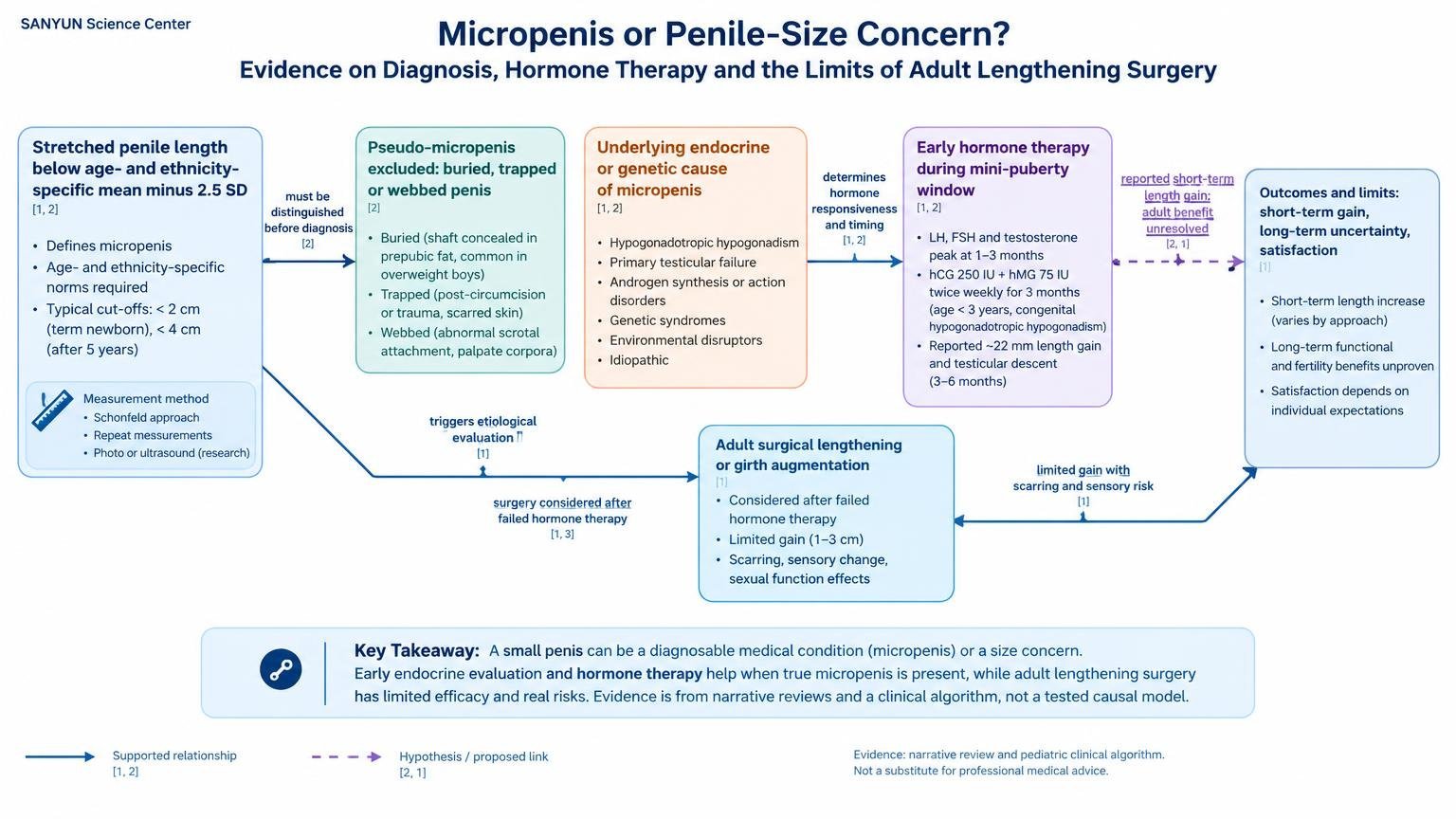
Conceptual framework: Conceptual framework. The figure maps the review's studied constructs: a statistical stretched-length threshold, exclusion of pseudo-micropenis, endocrine causes, early hormone therapy in the mini-puberty window, and adult surgical options. Solid arrows denote relationships supported as worded by the reviews; the dashed-style hypothesis arrow marks the unresolved link between early treatment and adult benefit. Evidence is narrative review and clinical algorithm, not a tested causal model.
Academic References & Evidence
- 姜浩; 李彦锋; JIANG Hao; LI Yanfeng. 小阴茎的规范化诊断和合理治疗选择. 临床泌尿外科杂志. 2026 41(1):71-75, 80 DOI: 10.13201/j.issn.1001-1420.2026.01.013.
- Pamali Mahasweta Nanda; Sharan Thangaraju; Jaivinder Yadav. Micropenis. J Pediatr Endocrinol Diabetes DOI: 10.25259/JPED_IC_127_2026.
- 姜浩; 李彦锋; JIANG Hao; LI Yanfeng. 小阴茎的规范化诊断和合理治疗选择. 临床泌尿外科杂志. 2026 41(1):71-75, 80 DOI: 10.13201/j.issn.1001-1420.2026.01.013.
- 姜浩; 李彦锋. 小阴茎的规范化诊断和合理治疗选择. 临床泌尿外科杂志 41(1)
SANYUN Science Center explains published research on men's reproductive and sexual health, connecting scientific evidence with everyday questions while making sources and limitations clear.
Disclaimer: This article is for scientific education and research communication only. It does not provide medical advice, diagnosis, or individualized treatment recommendations, and does not endorse any medication, supplement, device, penile enlargement procedure, or other intervention. Decisions about sexual and reproductive health should be made in consultation with a qualified healthcare professional. Do not delay seeking professional care because of information in this article.
Original Content & Copyright Notice
- This article is prepared for SANYUN Science Center, drawing on published research and publicly available academic literature on men’s sexual and reproductive health. Its editorial explanations and presentation are developed for this platform.
- Copyright in the original editorial content, selection, and arrangement is reserved by SANYUN Science Center to the extent protected by applicable law. Referenced research, quotations, and third-party materials remain subject to the rights of their respective owners. This notice does not claim ownership of scientific facts or third-party research.
- Except where permitted by applicable law or an applicable license, prior written permission is required to reproduce, republish, translate, adapt, redistribute, or commercially reuse protected content. Attribution alone does not grant permission for such reuse.
- For permitted quotation or authorized reuse, clearly identify the source and retain a link to the original article.
- Source: SANYUN Science Center
- Original URL: Retain the original article URL on science.san-yun.com.
- Copyright Holder: SANYUN Science Center, for its own protected editorial content.
- Quotation, excerpts, or authorized reuse must not distort the scientific meaning, omit material limitations or disclaimers, or imply unverified medical claims, product efficacy, or endorsement by SANYUN Science Center.



