




Category: Clinical Insights
Core Research Direction: Repeat semen analysis for low sperm motility: why single samples are unreliable, how many tests are needed, and how to standardize abstinence and collection conditions between tests
Search Intent: If one semen analysis shows low sperm motility, how many repeat tests are needed before the result should be considered meaningful, and what factors make repeat results more comparable?
Platform: SANYUN Science Center
Evidence reviewed through: 2026-11-26
Executive Summary
A semen analysis reporting low motility is one of the most anxiety-provoking results in male reproductive care, yet it is also one of the least stable. Consumer-facing clinical guidance in this packet converges on a simple point: semen quality is not fixed, and a single sample reflects the state at that moment rather than a durable fertility verdict; clinicians weigh the trend after standardized repeat testing instead.[1][2]
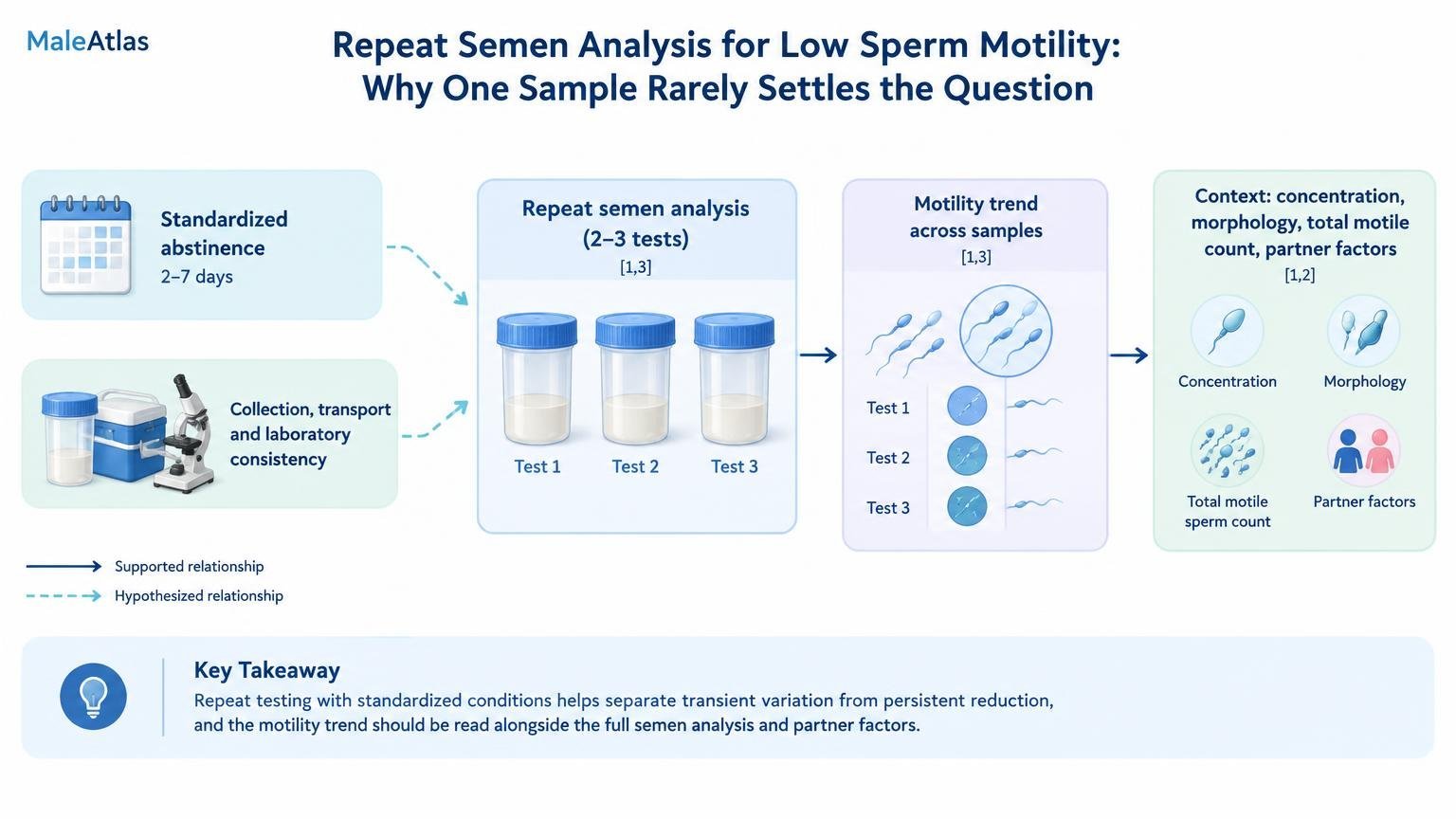
The practical recommendations are modest and largely consensus-style. When a first test is abnormal, the sources suggest repeating after an interval of roughly 2–4 weeks and completing at least two tests, with a third considered if the two diverge sharply or if one is normal and one abnormal. Elsewhere, the same clinical literature suggests that two to three tests usually provide a more reliable judgment. Note that these are recommendations, not measured diagnostic-accuracy thresholds.[3]
Comparability depends on holding conditions steady between tests. The sources recommend abstinence of 2–7 days, kept consistent each time; full collection; rapid transport with temperature protection; and, where possible, the same laboratory to limit differences in instruments and criteria. One clinic blog gives a narrower 2–5 day abstinence window, a reminder that operational ranges differ by center.[4]
Low motility is also not the same as infertility, and it is not the same as a low sperm count. The evidence packet stresses that motility must be read alongside concentration, total count, morphology, volume, total motile sperm count and the partner's factors. A single percentage figure, divorced from those variables, is easy to over-interpret.[5]
- The working conclusion of this review: repeat testing is justified to separate transient fluctuation from persistent reduction, but the exact number of tests should follow clinical context, not a universal rule.
Why This Matters
Male factors are commonly evaluated within couple infertility, and semen analysis remains the first-line laboratory test. Because motility is a proportion-based measure influenced by recent health, behavior and collection conditions, a single result carries a wide interpretive margin. Anchoring a diagnosis or a treatment decision to one sample risks labeling a transient dip as a persistent disorder and, conversely, missing a real problem hidden by a favorable day.
The anxiety dimension is not trivial. Patients often interpret a downward arrow as a verdict on fertility, while the sources consistently frame it as a prompt to repeat, review technique and look for causes. Standardizing the repeat test is what converts two numbers into a trend that can be interpreted.
Biological and Measurement Mechanisms
Sperm production and maturation take roughly two to three months, and one clinic source cites approximately 74 days for spermatogenesis to complete. That biology has two implications. First, an exposure or health event in the preceding weeks may not yet be reflected in the ejaculate. Second, an intervention aimed at improving sperm production cannot be fairly judged by a test taken days later; the relevant window is measured in months, not days.
Measurement adds its own variance. Abstinence duration changes the reservoir of sperm in the epididymis; abstinence beyond a week is described as potentially reducing motility because sperm remain in the epididymis too long, while too short an interval may underfill the sample. Collection completeness, transport time and temperature, and laboratory technique all sit on top of biological variation. A motility percentage is therefore a measurement of a sample under specific conditions, not a fixed property of the man.
Finally, motility is only one axis of semen quality. The same motility percentage can mean different things depending on how many sperm are present; a sample with reduced motility but relatively high concentration may contain more total moving sperm than a sample with the same motility percentage and much lower concentration. This is why total motile sperm count, derived from volume, concentration and motility, is often more informative than the motility percentage alone.
What the Evidence Shows
The packet contains no primary diagnostic-accuracy study of repeat semen analysis. Its evidence base is clinical educational material, a clinic blog with a reference list, and one company press release summarizing a published multi-clinic study of a different test. Claims about how many repeats are needed should therefore be read as expert-style guidance rather than as measured sensitivity or specificity.
On timing and number, the sources are broadly consistent. The first explainer recommends repeating an abnormal result after 2–4 weeks, completing at least two tests, and adding a third when results differ greatly or when one is normal and one abnormal. The second explainer suggests 1–2 weeks or longer depending on clinician advice and states that two to three tests usually give a more reliable judgment. These intervals are short relative to the spermatogenesis cycle, which makes them suitable for assessing short-term measurement variation but not for judging the effect of a lifestyle change.
On conditions, the sources recommend abstinence of 2–7 days with consistency between samples, complete collection, prompt and temperature-protected transport, and the same laboratory where feasible. The clinic blog lists abstinence outside a recommended 2–5 day interval, recent febrile illness, medications, alcohol, smoking, toxin exposure and stress as factors that can affect results. The ranges differ between sources; the shared principle is consistency rather than one universally correct number.
| Variable | Source-grounded definition or recommendation | Interpretation for repeat testing |
|---|---|---|
| Abstinence interval | Generally 2–7 days, kept consistent between tests; one blog cites 2–5 days as the recommended window | Hold constant across repeats; abstinence beyond a week may reduce motility |
| Interval between tests | Repeat after roughly 2–4 weeks and complete at least two tests; another source suggests 1–2 weeks or longer | Short intervals capture measurement and short-term variation, not spermatogenesis-cycle effects |
| Number of tests | At least two; a third if results differ greatly or one is normal and one abnormal; 2–3 tests usually give a more reliable judgment | Guidance-level recommendation, not a validated decision threshold |
| Collection and transport | Complete collection, rapid delivery, temperature protection, same laboratory where possible | Reduces pre-analytical variance between samples |
| Motility context | Read with concentration, morphology, volume and total motile sperm count | Same motility percentage can carry different implications depending on sperm number |
The packet also includes a press release about an epigenetic sperm test studied in 537 couples at 10 U.S. fertility clinics. In the captured dataset, no IUI pregnancies were recorded when men had an abnormal epigenetic result, while IVF with ICSI outcomes showed no meaningful difference by epigenetic result. This is a different test from routine semen analysis and does not inform how many repeat analyses are needed; it is included here only to illustrate that standard semen analysis does not capture every aspect of sperm function.[6]
Causes and Clinical Context After Repeat Testing
When motility remains low across standardized repeats, the question shifts from measurement to cause. The sources mention varicocele as relatively common and often asymptomatic, detected by physical examination and scrotal ultrasound, along with reproductive tract infection and endocrine problems. They also list modifiable lifestyle factors such as prolonged sitting, tight clothing, frequent hot baths or saunas, smoking, excess weight and chronic stress as possibly raising scrotal temperature and affecting sperm. These are plausible contributors, but the packet does not supply prevalence data or effect sizes.
A normal total count alongside low motility is described as relatively favorable because the 'raw material' is sufficient. That framing is useful but should not be read as a guarantee; it is an interpretive statement rather than a measured outcome.
In some cases no single cause is identified, and repeat testing helps determine whether the reduction is persistent. Persistence, not a single value, is what should trigger fuller evaluation.
Interpretation and Limitations
Several limitations deserve emphasis. First, the recommendations on test number and interval come from consumer health explainers and clinic pages, not from a prospective study comparing repeat-testing strategies against fertility outcomes. Second, the abstinence ranges conflict (2–7 days versus 2–5 days), and neither source explains which interval is superior or how much variation each day of abstinence introduces. Third, the spermatogenesis figures are approximate and cited without inline references in the source text.
Fourth, statements about lifestyle factors and varicocele use causal-sounding language without quantitative support. Fifth, the epigenetic-test press release describes an observational dataset with unclear denominators and no effect sizes; its findings should not be generalized to routine semen analysis or to individual treatment decisions. Finally, none of the sources establishes a threshold number of abnormal repeats that defines a diagnosis; the count of tests is a practical convention.
Research Outlook
- Prospective studies are needed to quantify how much of the variance in motility between samples is attributable to abstinence duration, transport time and laboratory technique, rather than to biology.
- Comparisons of repeat-testing strategies would help clarify whether two tests, three tests, or a trend-based rule best predicts clinical outcomes such as time to conception or response to intervention.
- Head-to-head work on abstinence windows and on total motile sperm count versus motility percentage would sharpen interpretation for clinicians and patients alike.
Key Takeaways
- One low motility result is a snapshot; clinical interpretation depends on the trend across standardized repeats.
- Common guidance is to repeat after about 2–4 weeks, complete at least two tests, and add a third if results are discordant; two to three tests are often described as sufficient for a more reliable judgment.
- Keep abstinence at 2–7 days and consistent between tests, collect the full sample, transport promptly with temperature protection, and use the same laboratory where possible.
- Motility is one component of a full semen analysis; total motile sperm count and other parameters, plus partner factors, shape the clinical picture.
- Low motility does not equal infertility, and persistent abnormality warrants clinical evaluation for causes such as varicocele, infection or endocrine factors.
Questions and Answers
Why is a single low sperm motility result not enough to confirm a fertility problem?
Semen quality is not fixed, and one sample reflects only the state at that time. Motility can be depressed by recent fever, poor sleep, alcohol, stress at collection, or abstinence outside the recommended range. Clinicians therefore interpret the trend across standardized repeat tests rather than a single downward arrow, and they read motility alongside concentration, morphology and partner factors.
How many repeat semen analyses are usually recommended after an abnormal motility result?
Guidance in this packet suggests completing at least two tests after an abnormal first result, with a third considered if the two results differ greatly or if one is normal and one abnormal. Another source states that two to three tests usually provide a more reliable judgment. These are recommendation-level figures, not validated diagnostic thresholds.
What abstinence period should be used before each repeat semen analysis?
The most commonly cited range is 2–7 days, kept consistent between tests, because too short or too long an abstinence can affect results and abstinence beyond a week may reduce motility. One clinic blog cites a narrower 2–5 day window. Because ranges differ by center, follow the laboratory's instruction and use the same interval each time.
How long does sperm production take, and how does that affect repeat testing timing?
Sperm production and maturation take roughly two to three months, with one source citing approximately 74 days for spermatogenesis. That means tests spaced days to a few weeks apart mainly capture short-term and measurement variation, not the effect of a lifestyle change. Judging an intervention on sperm production requires waiting on the order of months.
How strong is the evidence behind recommendations for repeat semen analysis?
The evidence in this packet is educational and consensus-style rather than diagnostic-accuracy research. Sources are consumer health explainers, a clinic blog and a patient education page. No prospective study here compares repeat-testing strategies against fertility outcomes, and abstinence ranges conflict between sources. The recommendations are reasonable clinical practice but not strongly quantified.
What other sperm measurements should be considered alongside motility?
Motility should be interpreted with sperm concentration, total count, morphology, semen volume and total motile sperm count, plus the partner's reproductive factors. The same motility percentage can carry different implications depending on how many sperm are present. Low motility also does not equal infertility, and persistent abnormality warrants evaluation for causes such as varicocele or infection.
Conceptual framework: Conceptual framework, not a tested causal model. Repeat semen analysis is proposed to support trend interpretation when abstinence and collection conditions are standardized; the motility trend is then read alongside concentration, morphology, total motile sperm count and partner factors. Relations are conceptual, and evidence in this review is educational rather than diagnostic-accuracy research.
Academic References & Evidence
- 精子活力低检查几遍才能定论?医生提醒关键细节别忽视. 39健康网. 2026
- Poor Sperm Motility: What Your Results Mean | Spring Fertility. Spring Fertility
- 精子活力低要检查几遍才准,多次排查有必要吗. 39健康网. 2026
- Quando repetir o espermograma? Entenda o momento ideal!. Huntington Blog
- 精子活力低但总数不低,这种情况其实不用太慌. 39健康网. 2026
- Jill Liss. For Couples in "Fertility Limbo," a Real-World Study Published by JARG Finds "Normal" Semen Analysis May Not Tell the Whole Story — Inherent Biosciences. 2026
SANYUN Science Center explains published research on men's reproductive and sexual health, connecting scientific evidence with everyday questions while making sources and limitations clear.
Disclaimer: This article is for scientific education and research communication only. It does not provide medical advice, diagnosis, or individualized treatment recommendations, and does not endorse any medication, supplement, device, penile enlargement procedure, or other intervention. Decisions about sexual and reproductive health should be made in consultation with a qualified healthcare professional. Do not delay seeking professional care because of information in this article.
Original Content & Copyright Notice
- This article is prepared for SANYUN Science Center, drawing on published research and publicly available academic literature on men’s sexual and reproductive health. Its editorial explanations and presentation are developed for this platform.
- Copyright in the original editorial content, selection, and arrangement is reserved by SANYUN Science Center to the extent protected by applicable law. Referenced research, quotations, and third-party materials remain subject to the rights of their respective owners. This notice does not claim ownership of scientific facts or third-party research.
- Except where permitted by applicable law or an applicable license, prior written permission is required to reproduce, republish, translate, adapt, redistribute, or commercially reuse protected content. Attribution alone does not grant permission for such reuse.
- For permitted quotation or authorized reuse, clearly identify the source and retain a link to the original article.
- Source: SANYUN Science Center
- Original URL: Retain the original article URL on science.san-yun.com.
- Copyright Holder: SANYUN Science Center, for its own protected editorial content.
- Quotation, excerpts, or authorized reuse must not distort the scientific meaning, omit material limitations or disclaimers, or imply unverified medical claims, product efficacy, or endorsement by SANYUN Science Center.



