




Category: Penile Size
Core Research Direction: How human penis size relates to sexual attractiveness, male rivalry perception, and population average measurements, and what the evidence does and does not establish
Search Intent: Does penis size actually influence how attractive women find a man and how threatening other men perceive him, and what is the measured average size?
Platform: SANYUN Science Center
Evidence reviewed through: 2026-11-27
Executive Summary
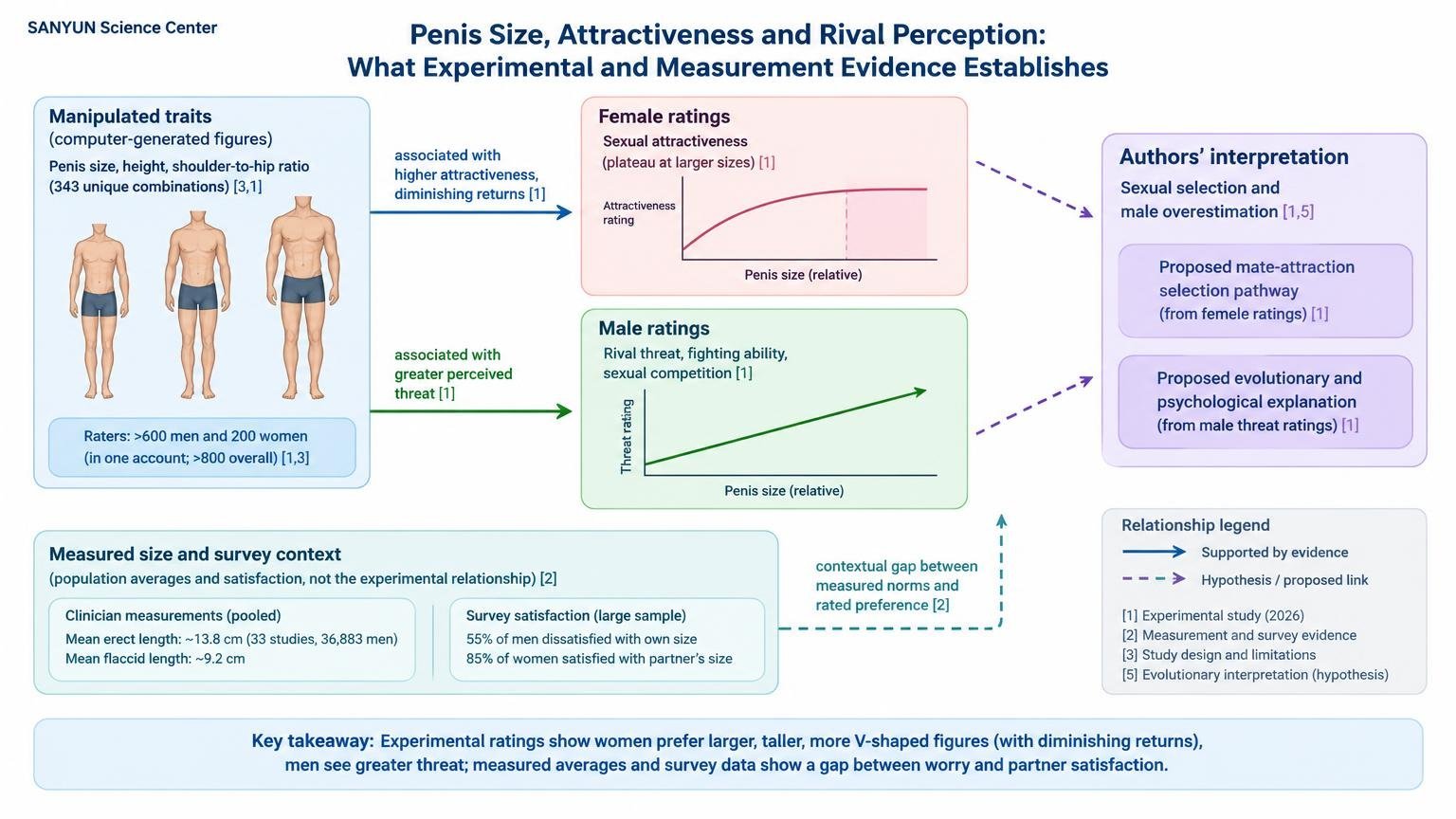
A 2026 experimental study published in PLOS Biology asked more than 600 men and more than 200 women to rate computer-generated male figures that varied in height, body shape and penis size. Women rated taller, more V-shaped figures with larger penises as more sexually attractive, but the benefit of further size increases diminished beyond a point. Men rated the same exaggerated features as more intimidating both as sexual rivals and as fighting opponents, and unlike women they treated ever-larger penises as steadily more of a sexual threat.[1]
The study is best read alongside measurement and survey evidence rather than as a statement about any individual. A pooled analysis of clinician measurements reported a mean erect length of about 13.8 cm across 33 studies and 36,883 men, with differences within regions often larger than differences between regions. A separate large survey found 55% of men dissatisfied with their own size while 85% of women were satisfied with their partner's size.[2]
Why This Matters
Penis size sits at an unusual intersection of evolutionary biology, body image and clinical practice. Men searching for reassurance encounter conflicting numbers, many derived from self-report rather than clinician measurement. The 2026 experiment is unusual because it manipulated visible traits directly instead of relying on correlations between real bodies, allowing the researchers to isolate how raters respond to size when height and shoulder-to-hip ratio are held constant by design.[3]
The clinical stakes are real but often misplaced. Men seeking penile lengthening surgery frequently measure within the normal range, and a systematic review concluded that many enhancement procedures in men of normal size carry high complication rates and uncertain satisfaction. Distinguishing a measured anatomical concern from appearance-related distress is therefore a more useful clinical question than debating whether size matters in general.[4]
How the Attractiveness Experiment Was Designed
The researchers generated 343 male figures, each combining a unique set of penis size, height and shoulder-to-hip ratio values. Presenting figures in person at life size or online as rotating animations allowed the team to test whether results depended on viewing conditions; the reported findings were consistent across both formats. Raters were assigned to judge sexual attractiveness, desirability or threat as a sexual rival, or perceived fighting ability.
Because the three traits were varied experimentally rather than observed in real men, the design addresses a limitation of earlier correlational work in which taller men might also differ in body shape or other characteristics. The authors describe the study as the first experimental evidence that men consider penis size when assessing a rival's fighting ability and attractiveness, a novelty claim that reflects their own framing and has not been independently replicated in the supplied sources.
What the Attractiveness Ratings Showed
Female participants rated figures as more sexually attractive when they were taller, more V-shaped and had a larger penis. Crucially, the effect was not linear: beyond a certain point, further increases in penis size, height and shoulder breadth produced diminishing benefits. The source material does not quantify the threshold at which returns flattened, so the practical meaning of "up to a point" remains undefined in the available evidence.
The male ratings diverged in an informative way. Men judged taller, more V-shaped, larger-penis figures as more intimidating as both sexual rivals and fighting opponents, and they consistently ranked figures with ever-larger penises as more of a sexual threat. The authors interpret this pattern as men overestimating the importance of penis size in attracting a mate — an inference about male psychology rather than a direct measurement of what women actually prefer.
| Dimension | Experimental finding | Interpretation limit |
|---|---|---|
| Female sexual attractiveness | Taller, more V-shaped figures with larger penises rated more attractive; gains diminished beyond a point | Threshold not quantified; figures were synthetic, not real partners |
| Male threat as sexual rival | Larger penis, greater height and more V-shaped body each increased perceived threat | Ratings of digitally generated figures |
| Male threat as fighting opponent | Same traits increased perceived fighting ability | Perception, not actual combat outcome |
| Male response to extreme size | Ever-larger penises ranked as steadily more of a sexual threat | Authors' inference that men overestimate size importance |
| Relative trait weight | Height and body shape influenced male rival perception more than penis size | Evolutionary explanation is a hypothesis |
Why Human Penis Size Interests Evolutionary Biologists
Relative to body size, the human penis is larger than that of other primates, a pattern that has puzzled evolutionary biologists. The 2026 authors propose that both female preference and competition between males favored increases in penis size, height and shoulder breadth, with penis size more strongly favored for mate attraction than for intimidating rivals. That interpretation is explicitly a hypothesis: the experiment measured contemporary ratings, not selection pressures operating over evolutionary time.
The researchers themselves cautioned that their results reflect average evolutionary trends rather than individual preferences and do not define norms for body diversity in modern societies. This distinction matters because group-level averages are routinely misread as expectations for individuals.[5]
Measured Averages Versus Popular Numbers
Measurement evidence tells a less dramatic story than internet comparisons. One widely summarized pooled analysis of clinician measurements from up to 15,521 men reported a mean erect length of about 13.1 cm and a mean flaccid length of about 9.2 cm, with a wide normal range at both values. A separate large review of 33 studies covering 36,883 men reported a mean erect length of about 13.8 cm and a mean flaccid length of about 9.2 cm.
The small difference between those two erect estimates illustrates a broader point: pooled averages shift with study composition and measurement method, and neither figure should be treated as a personal target. The review of 33 studies emphasized that differences within regions are often larger than differences between regions, and that measurement techniques were not identical across studies, so part of the geographic variation may be methodological rather than biological.
An older Indian conference report, circulated through media coverage rather than a peer-reviewed paper, measured 400 males over three years and reported an average of 13 cm, with a stated normal range of 8-18 cm and a threshold under 7 cm termed micropenis. Those cutoffs were the study's own criteria rather than an established standard, and the report lacks detail on measurement method — a reminder that not all size numbers carry equal evidentiary weight.[6]
The Gap Between Male Worry and Partner Satisfaction
Survey data point to a striking asymmetry. In a large survey of more than 52,000 adults, 55% of men reported dissatisfaction with their own penis size, while 85% of women reported satisfaction with their partner's size. A similarly worded summary of the same survey literature describes only about half of men as satisfied with their own size against 85% of women satisfied with their partner's. These are self-reported attitudes cited secondhand, not clinical diagnoses, but they consistently suggest that male concern is poorly calibrated to partner experience.
This mismatch is not evidence that size is irrelevant to sexual satisfaction. It indicates that distress about size is often driven by self-perception, comparison with selected media images, and viewing angle rather than by a partner's appraisal. Persistent preoccupation with a normal-sized penis is a recognized pattern that merits its own assessment rather than a cosmetic procedure.
Interpretation and Limitations
The 2026 experiment has clear strengths: controlled manipulation of three traits, a large rater sample, and consistency across in-person and online presentation formats. Its limitations are equally important. Participants rated computer-generated figures rather than real people, so the results describe how people judge abstracted bodily cues, not how they choose partners or behave in relationships. The effect sizes and the specific size threshold for diminishing returns are not reported in the available summaries.
Participant counts differ slightly across reports, described as more than 600 men and 200 women in one account and more than 800 men and women overall in another; these are compatible descriptions of the same sample but should not be treated as independent datasets. The novelty claim and the evolutionary interpretation both come from the research team, and no independent replication is present in the supplied material.
The measurement literature has its own constraints. Pooled averages cannot tell an individual whether he is typical, and the sources do not provide percentile distributions. The survey satisfaction figures rely on self-report and are cited secondhand rather than from the original dataset. The conference report on Indian men was not peer reviewed in the supplied material. None of these sources establishes a causal pathway from size to relationship outcomes.
Clinical and Practical Relevance
For clinicians, the useful question is not whether size influences attractiveness in the aggregate but whether a patient's concern reflects anatomy, perception, or both. Men who request lengthening surgery often measure within normal limits. Surgical ligamentolysis increases visible flaccid length by published averages of roughly 1-2 cm, but results vary greatly and some men see little or no change, while a systematic review found high complication rates and uncertain satisfaction for many procedures in men of normal size.
No pill, cream, or supplement has evidence for permanently increasing penis size, and the absence of proven efficacy is the central finding rather than a gap awaiting a product. The most defensible first step for size-related distress is an accurate clinician measurement and an honest conversation about expectations, which frequently reframes the problem as one of perception rather than anatomy.
Research Outlook
The 2026 study opens several directions: whether the attractiveness plateau and the male threat gradient hold across cultures, age groups and socioeconomic settings, and which psychological mechanisms underlie the observed ratings. Those questions are proposed research directions, not established findings. Replication with real rather than synthetic stimuli, and with reported effect sizes, would clarify how much of the laboratory effect survives outside controlled rating tasks.
Key Takeaways
- In a 2026 experiment, women rated taller, more V-shaped figures with larger penises as more sexually attractive, but further size increases produced diminishing returns beyond an unquantified point.
- Men rated the same exaggerated traits as more intimidating as sexual rivals and fighting opponents, and unlike women they treated ever-larger penises as steadily more threatening.
- Height and body shape influenced male rival perception more than penis size, and the evolutionary explanation for these patterns remains a hypothesis.
- Pooled clinician measurements place mean erect length at roughly 13-13.8 cm and flaccid length near 9.2 cm, with wide normal ranges and substantial within-region variation.
- Survey data show a large gap between male dissatisfaction and female satisfaction with partner size, suggesting that distress about size is often perceptual rather than anatomical.
- Enhancement products lack evidence of permanent benefit, and surgical options produce limited, variable gains with real risks and uncertain satisfaction.
Questions and Answers
What did the 2026 PLOS Biology experiment on penis size and attractiveness actually find?
More than 600 men and 200 women rated computer-generated figures varying in height, body shape and penis size. Women rated taller, more V-shaped, larger-penis figures as more sexually attractive, but gains diminished beyond a point. Men rated those figures as more intimidating as sexual rivals and fighting opponents, and unlike women treated ever-larger penises as steadily more threatening.
Is penis size the main trait driving how men judge rival threat?
No. The study found that height and body shape had a greater influence on how men perceived rival males than penis size did. The authors therefore suggested penis size was more strongly favored by evolution for attracting mates than for intimidating rivals — a hypothesis about evolutionary pressures, not a directly tested causal claim.
What is the measured average erect penile length in pooled studies?
A pooled analysis of clinician measurements from up to 15,521 men reported a mean erect length of about 13.1 cm and flaccid length near 9.2 cm. A separate review of 33 studies and 36,883 men reported a mean erect length of about 13.8 cm, again with flaccid length near 9.2 cm. Both have wide normal ranges.
Do women and men feel differently about penis size in surveys?
Survey data suggest a large gap. In a large survey of over 52,000 adults, 55% of men were dissatisfied with their own size while 85% of women were satisfied with their partner's size. These are self-reported attitudes cited secondhand, not clinical findings, but they consistently indicate that male worry is poorly calibrated to partner experience.
What are the main limitations of the penis size attractiveness experiment?
Participants rated digitally generated figures rather than real people, so results describe judgments of abstracted bodily cues, not relationship behavior. The specific size threshold where female attractiveness gains flattened is not quantified in available summaries. The evolutionary interpretation and first-experimental-evidence claim come from the research team, and no independent replication appears in the supplied sources.
Do pills, creams or surgery reliably increase penis size permanently?
No pill, cream or supplement has evidence of permanent size gain. Surgical ligamentolysis increases visible flaccid length by published averages of roughly 1-2 cm, but results vary greatly and some men see little change. A systematic review found many enhancement procedures in men of normal size carry high complication rates and uncertain satisfaction.
Conceptual framework: Conceptual framework. A 2026 experiment had over 600 men and 200 women rate computer-generated figures varying in penis size, height and shoulder-hip ratio. Supported links show female attractiveness ratings with diminishing returns and male threat ratings; the evolutionary interpretation is proposed, not tested.
Academic References & Evidence
- Upama Aich; Michael D Jennions. Women find well endowed men more attractive, while men find them more. PLOS Biology. 2026
- V.L.T.. Godinama smo vjerovali mitovima: nova velika studija otkriva pravu prosječnu veličinu penisa, iznenadit će vas. 2026
- Arnaldo Iodice. Le dimensioni contano? Lo studio che sfata il luogo comune | Sanità Informazione. PLOS Biology. 2026
- Veale D; Miles S; Bramley S; Muir G; Hodsoll J; Mondaini N; Marra G; Lever J. เพิ่มขนาดน้องชาย: ขนาดปกติ อะไรได้ผลจริง ความเสี่ยง. BJU International. 2015 115(6):978-986
- Minority Azerbaijan – Scientists studied the evolutionary reasons for penis size. PLOS Biology. 2026
- Dr Sharath Kumar; Dr Promodu; Dr Vasan S S. Study clears myth about penis size.
SANYUN Science Center explains published research on men's reproductive and sexual health, connecting scientific evidence with everyday questions while making sources and limitations clear.
Disclaimer: This article is for scientific education and research communication only. It does not provide medical advice, diagnosis, or individualized treatment recommendations, and does not endorse any medication, supplement, device, penile enlargement procedure, or other intervention. Decisions about sexual and reproductive health should be made in consultation with a qualified healthcare professional. Do not delay seeking professional care because of information in this article.
Original Content & Copyright Notice
- This article is prepared for SANYUN Science Center, drawing on published research and publicly available academic literature on men’s sexual and reproductive health. Its editorial explanations and presentation are developed for this platform.
- Copyright in the original editorial content, selection, and arrangement is reserved by SANYUN Science Center to the extent protected by applicable law. Referenced research, quotations, and third-party materials remain subject to the rights of their respective owners. This notice does not claim ownership of scientific facts or third-party research.
- Except where permitted by applicable law or an applicable license, prior written permission is required to reproduce, republish, translate, adapt, redistribute, or commercially reuse protected content. Attribution alone does not grant permission for such reuse.
- For permitted quotation or authorized reuse, clearly identify the source and retain a link to the original article.
- Source: SANYUN Science Center
- Original URL: Retain the original article URL on science.san-yun.com.
- Copyright Holder: SANYUN Science Center, for its own protected editorial content.
- Quotation, excerpts, or authorized reuse must not distort the scientific meaning, omit material limitations or disclaimers, or imply unverified medical claims, product efficacy, or endorsement by SANYUN Science Center.



