




Category: Reproductive Care
Core Research Direction: Male fertility preservation before cancer treatment: which exposures reduce later fatherhood, what sperm banking achieves, and how strong is the evidence for testicular tissue banking before puberty
Search Intent: For a boy or young man facing cancer treatment, how much does treatment actually reduce his chance of fathering a child later, and which fertility-preservation options are established versus still experimental?
Platform: SANYUN Science Center
Evidence reviewed through: 2026-11-27
Executive Summary
Cancer treatment during childhood or adolescence can reduce the chance of fathering a child later, but the evidence does not support a blanket warning. In the Childhood Cancer Survivor Study, 6,224 male survivors aged 15 to 44 who were not surgically sterile were compared with their siblings. The hazard ratio for ever siring a pregnancy was 0.56, meaning the survivor group as a whole was less likely than their brothers to have achieved a pregnancy. That average conceals the most important finding for families: risk was concentrated in identifiable exposures rather than spread evenly.[1]
Boys and young men with an alkylating agent dose score of zero and no hypothalamic, pituitary or testicular radiation showed no detectable reduction compared with siblings: hazard ratio 0.91, 95% confidence interval 0.73 to 1.14, P = .41. By contrast, testicular radiotherapy above 7.5 gray carried a hazard ratio of 0.12, and specific drug families carried their own risk. A later analysis of 10,938 survivors found a hazard ratio of 0.63 for pregnancy and 0.63 for livebirth in male survivors, with reduced likelihood at the highest tertiles of cyclophosphamide, ifosfamide, procarbazine and cisplatin.
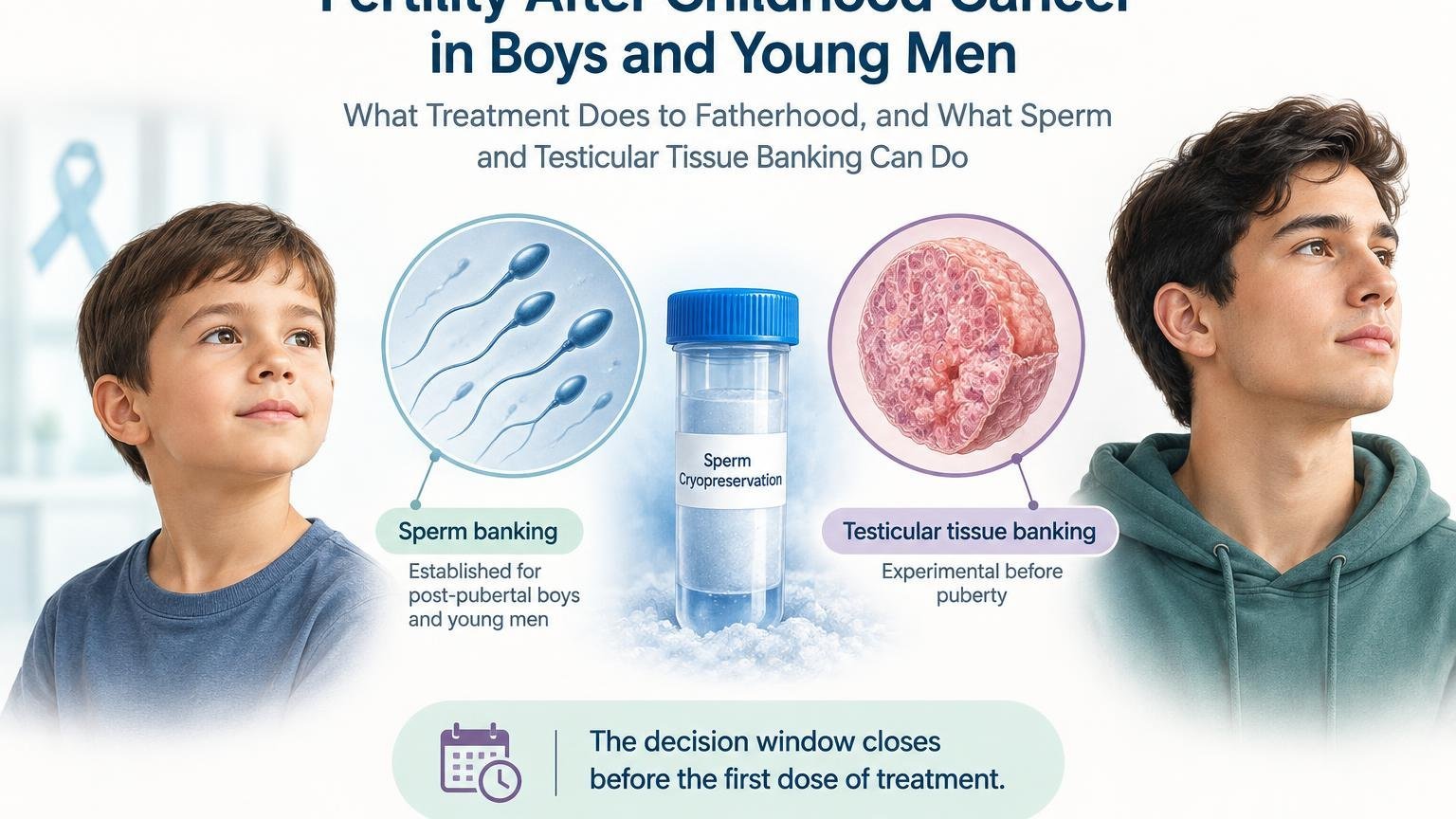
For a post-pubertal boy or young man, sperm banking is the established option: cheap, quick and effective when offered before the first dose. For a boy who cannot yet produce sperm, testicular tissue cryopreservation exists only as an experimental option. The largest coordinated banking series froze tissue from 189 patients between January 2011 and November 2018; germ cells were confirmed in 132 of the 137 patients analysed, but the function of those spermatogonia was not tested, and no child has yet been born from human testicular tissue frozen before puberty.[2]
Why This Matters
The decision window closes at the first dose of treatment. Sperm banking must happen before chemotherapy or radiotherapy begins, and a family conversation deferred until after treatment is a conversation that cannot be had. Uptake is far from universal. A systematic review of 25 United States studies of female adolescents and young adults found that reported rates of fertility-preservation discussions ranged from 9% to 75%, specialist referrals from 0.9% to 57%, and completion of preservation procedures from 0.56% to 70.3%. The review did not supply equivalent synthesised figures for men or for prepubertal children, and the source explicitly noted that no verified male referral-rate figure was given.[3]
The access review also found that facilitators included younger age, private insurance, higher socioeconomic status and more recent diagnosis year, while barriers included non-Hispanic Black or Hispanic race/ethnicity, lower income, public insurance and rural residence. Institutional interventions improved access but did not eliminate the underlying disparities. For any individual family, the practical question is less about averages than about whether the conversation happened and whether a referral was made in time.
The Biology: Why Some Treatments Spare Fertility
Spermatogonial stem cells divide continuously, which makes them highly sensitive to alkylating chemotherapy and ionising radiation. The key qualifier is whether enough stem cells survive. If they do, they can repopulate the seminiferous tubules and sperm production often returns over one to five years, sometimes longer. That recovery pattern explains why a semen analysis at one year is not the final answer and why contraception still matters after treatment ends. It also explains why fertility can return after moderate exposure and generally does not after an ablative one.
Testosterone production is a separate question from sperm production. Leydig cells, which make testosterone, are described as more radioresistant than the germ cells that produce sperm. A young man can therefore be infertile while having normal testosterone, or after higher doses may need testosterone replacement as well. In the St Jude Lifetime Cohort the estimated cumulative prevalence of Leydig cell failure at age 50 among men at risk was 31.1% (95% CI 27.3 to 34.9). This distinction matters because a normal hormone level does not prove that fertility has been preserved.
What the Evidence Shows: Which Exposures Matter
The Childhood Cancer Survivor Study provides the clearest exposure-specific picture. In the sibling comparison, testicular radiotherapy above 7.5 gray carried a hazard ratio of 0.12 for ever siring a pregnancy, an association with a substantial reduction. The later analysis of 10,938 survivors confirmed a group-level reduction, with hazard ratios of 0.63 for pregnancy and 0.63 for livebirth, and identified reduced likelihood at the upper tertile for cyclophosphamide (0.60), ifosfamide (0.42), procarbazine (0.30) and cisplatin (0.56). A dose-response estimate was also reported: a hazard ratio of 0.82 per 5,000 mg/m2 increment of cyclophosphamide equivalent dose.
| Exposure or group | Reported estimate | What it describes |
|---|---|---|
| All male survivors aged 15–44 versus siblings | Hazard ratio 0.56 for ever siring a pregnancy | Group-level reduction across the full survivor cohort |
| No alkylating dose score, no hypothalamic/pituitary radiation, no testicular radiation | Hazard ratio 0.91 (95% CI 0.73–1.14; P = .41) | No detectable reduction versus siblings in this subgroup |
| Testicular radiotherapy above 7.5 gray | Hazard ratio 0.12 | Exposure-subgroup estimate; confidence interval not quoted in the source text |
| Upper-tertile cyclophosphamide | Hazard ratio 0.60 | Drug-specific estimate in the later analysis of 10,938 survivors |
| Upper-tertile ifosfamide | Hazard ratio 0.42 | Drug-specific estimate in the later analysis of 10,938 survivors |
| Upper-tertile procarbazine | Hazard ratio 0.30 | Drug-specific estimate in the later analysis of 10,938 survivors |
| Upper-tertile cisplatin | Hazard ratio 0.56 | Drug-specific estimate in the later analysis of 10,938 survivors |
| Cyclophosphamide equivalent dose, per 5,000 mg/m2 | Hazard ratio 0.82 (95% CI 0.79–0.86) | Dose-response estimate |
The guideline picture is less definitive than the cohort numbers suggest. The International Guideline Harmonization Group's 2017 male gonadotoxicity recommendations, developed with PanCareSurFup by a panel of 25 experts, cover both sperm and testosterone outcomes and state that they reveal a paucity of high-quality evidence, highlighting the need for further targeted research. That is an important caution: the large cohort estimates are observational associations from a sibling comparison, not evidence from randomised trials, and the guideline authors themselves judged the evidence base thin.
Sperm Banking: The Established Option
Sperm banking is described as cheap, quick and effective, and as the standard for any post-pubertal boy or young man facing fertility-impairing treatment. The main obstacles are not technical: the appointment was not raised, or it was not made in time before treatment started. Guidance cited on the protocol page recommends offering sperm cryopreservation to men and boys, and to trans women and non-binary people with male reproductive organs, of reproductive age who are preparing for treatment likely to make them infertile.
Timing affects sample quality as well as availability. Guidance cited on the protocol page states that males should be advised of potentially higher genetic damage risks in sperm collected soon after cancer-directed therapy initiation and completion. The magnitude of that risk is not quantified in the quoted text, but the practical implication is consistent: collect before the first dose where the clinical situation allows, and discuss the uncertainty honestly where urgency makes that impossible.
Testicular Tissue Banking Before Puberty: Experimental
For a boy who cannot yet produce sperm, testicular tissue cryopreservation is the only option that aims to preserve fertility potential, and it remains experimental. According to the protocol page's reading of the 2025 ASCO guideline, testicular tissue freezing in prepubertal boys is experimental; the page notes that ASCO was read only as an abstract and that its grades were not seen. Families should be offered the procedure as research, not as an established treatment.
The largest coordinated experience banked tissue from 189 patients between January 2011 and November 2018 across a network of academic centres. The mean age was 7.9 years (standard deviation 5), with a range from 5 months to 34 years. The indication was a malignancy in 118 patients, a blood disorder in 45 and another condition in 26. Thirty-nine per cent, or 74 patients, had already started chemotherapy before the biopsy, which limits what the series can say about tissue collected before any exposure.
Of the 189 patients, 137 were analysed for the presence of germ cells, and germ cells were confirmed in 132. The authors state the limit plainly: the function of those spermatogonia was not tested. No child has yet been born from human testicular tissue frozen before puberty. Finding germ cells is a necessary step, not proof that the tissue can later produce sperm or a pregnancy. That gap between a biological marker and a live birth is the central limitation families need to understand.
Interpretation and Limitations
Several cautions apply to the numbers above. The Childhood Cancer Survivor Study estimates are observational and compare survivors with siblings; they describe associations between treatment exposures and later pregnancy, not proven causal effects in an individual. Hazard ratios for exposure subgroups may rest on smaller numbers, and the source text does not quote confidence intervals for every estimate. The 0.91 hazard ratio in the lowest-risk subgroup should not be read as a guarantee of unaffected fertility, only as no detectable reduction in that cohort comparison.
The access evidence has its own scope limits. The systematic review of discussion and referral rates covered female adolescents and young adults in the United States; it did not supply synthesised figures for men, prepubertal children, adults over 40 or non-United States settings. Applying those ranges to a boy's care pathway is therefore an extrapolation, and referral rates for men are widely described as low but were not verified with a figure in the supplied source. On the preservation side, the protocol page states that no source it read gives live birth rates per stored egg, embryo or tissue graft, and that ESHRE asks each centre to provide its own rates.
Research Outlook
The most important open question is whether testicular tissue frozen before puberty can ever produce a live birth. The banking series established that germ cells can be found in most analysed samples; it did not establish that those cells can mature, be transplanted or be used in vitro to produce sperm capable of fertilisation. Until that is demonstrated, the procedure remains a research option whose value depends on future techniques that do not yet exist as established care.
A second gap concerns the quality of the underlying evidence. The 2017 harmonised recommendations covering sperm and testosterone outcomes explicitly noted a paucity of high-quality evidence. The 2025 ASCO guideline was read only as an abstract on the protocol page, and the ESMO 2020 guideline could not be read. Families and clinicians should therefore treat strong-sounding averages with appropriate caution and ask what is known for the specific drugs and radiation fields in the planned regimen.
Key Takeaways
- Male survivors as a group were less likely to have sired a pregnancy than their brothers (hazard ratio 0.56), but survivors with no alkylating dose score and no hypothalamic, pituitary or testicular radiation showed no detectable reduction (hazard ratio 0.91, 95% CI 0.73 to 1.14).
- Risk is concentrated in specific exposures: testicular radiotherapy above 7.5 gray (hazard ratio 0.12) and upper-tertile cyclophosphamide, ifosfamide, procarbazine and cisplatin in the later survivor analysis.
- Sperm banking is the established option for any post-pubertal boy or young man and should be arranged before the first treatment dose; collecting soon after therapy starts may carry higher genetic damage risk in the sample.
- Testicular tissue banking before puberty is experimental: germ cells were confirmed in 132 of 137 analysed patients in the largest series, but their function was not tested and no child has been born from tissue frozen before puberty.
- Fertility and testosterone are separate outcomes; Leydig cell failure by age 50 among men at risk was estimated at 31.1% in the St Jude Lifetime Cohort, so normal testosterone does not rule out impaired fertility.
- Recovery of spermatogenesis can occur over one to five years and sometimes longer, so an early semen analysis is not the final answer and contraception still matters after treatment.
Questions and Answers
How much does childhood cancer treatment reduce a boy's chance of fathering a child later?
It depends heavily on the treatment. In the Childhood Cancer Survivor Study, male survivors aged 15 to 44 had a hazard ratio of 0.56 for ever siring a pregnancy compared with siblings, but those with no alkylating dose score and no hypothalamic, pituitary or testicular radiation showed no detectable reduction (hazard ratio 0.91, 95% CI 0.73 to 1.14). Testicular radiotherapy above 7.5 gray and high-dose alkylating agents carried the largest reductions.
Which chemotherapy drugs are linked to reduced fertility in male childhood cancer survivors?
In an analysis of 10,938 survivors, reduced likelihood of pregnancy was associated with upper-tertile cyclophosphamide (hazard ratio 0.60), ifosfamide (0.42), procarbazine (0.30) and cisplatin (0.56). A cyclophosphamide equivalent dose relationship of 0.82 per 5,000 mg/m2 was also reported. These are observational dose-response associations, not proof that a specific regimen will cause infertility in an individual.
Is sperm banking before cancer treatment effective and when should it be done?
Sperm banking is described as cheap, quick and effective, and as the standard option for any post-pubertal boy or young man facing fertility-impairing treatment. It should be arranged before the first dose of chemotherapy or radiotherapy, because the window closes once treatment starts. Guidance also notes potentially higher genetic damage risks in sperm collected soon after therapy initiation, so earlier collection is preferable where feasible.
Has testicular tissue banking before puberty produced any pregnancies or births?
No. No child has yet been born from human testicular tissue frozen before puberty. In the largest coordinated banking series of 189 patients, germ cells were confirmed in 132 of 137 analysed, but the authors stated that the function of those spermatogonia was not tested. The procedure remains experimental and should be offered to families as research rather than as established fertility treatment.
Can a male survivor have normal testosterone but still be infertile after cancer treatment?
Yes. Leydig cells, which produce testosterone, are described as more radioresistant than the germ cells that make sperm. That means sperm production can fail while testosterone remains normal, or higher doses can cause both problems. In the St Jude Lifetime Cohort the estimated cumulative prevalence of Leydig cell failure by age 50 among men at risk was 31.1% (95% CI 27.3 to 34.9), which is why both outcomes need separate follow-up.
What are the main limitations of the evidence on fertility after childhood cancer?
Most estimates come from observational sibling-comparison cohorts rather than randomised trials, so they describe associations, not proven causal effects for an individual. The 2017 harmonised male gonadotoxicity recommendations themselves noted a paucity of high-quality evidence. Access studies are largely United States-based and focused on female patients, and no source read gives live birth rates per stored sample or tissue graft.
Sources and References
- Fertility in boys and young men… · Technology · OnCo.
- Fertility discussion and preservation… · Protocol · OnCo.
- Who gets told about fertility before… · Technology · OnCo.
SANYUN Science Center explains published research on men's reproductive and sexual health, connecting scientific evidence with everyday questions while making sources and limitations clear.
Disclaimer: This article is for scientific education and research communication only. It does not provide medical advice, diagnosis, or individualized treatment recommendations, and does not endorse any medication, supplement, device, penile enlargement procedure, or other intervention. Decisions about sexual and reproductive health should be made in consultation with a qualified healthcare professional. Do not delay seeking professional care because of information in this article.
Original Content & Copyright Notice
- This article is prepared for SANYUN Science Center, drawing on published research and publicly available academic literature on men’s sexual and reproductive health. Its editorial explanations and presentation are developed for this platform.
- Copyright in the original editorial content, selection, and arrangement is reserved by SANYUN Science Center to the extent protected by applicable law. Referenced research, quotations, and third-party materials remain subject to the rights of their respective owners. This notice does not claim ownership of scientific facts or third-party research.
- Except where permitted by applicable law or an applicable license, prior written permission is required to reproduce, republish, translate, adapt, redistribute, or commercially reuse protected content. Attribution alone does not grant permission for such reuse.
- For permitted quotation or authorized reuse, clearly identify the source and retain a link to the original article.
- Source: SANYUN Science Center
- Original URL: Retain the original article URL on science.san-yun.com.
- Copyright Holder: SANYUN Science Center, for its own protected editorial content.
- Quotation, excerpts, or authorized reuse must not distort the scientific meaning, omit material limitations or disclaimers, or imply unverified medical claims, product efficacy, or endorsement by SANYUN Science Center.



