




Category: Reproductive Care
Core Research Direction: How male factor infertility is evaluated and managed in couples: the sequential role of history, physical exam, and semen analysis (with repeat testing for variability), when hormonal/genetic/imaging tests are indicated, and how azoospermia is differentiated and treated
Search Intent: When should a man be evaluated for infertility, which tests actually matter and in what order, and what do results like an abnormal semen analysis or azoospermia mean for diagnosis and treatment options?
Platform: SANYUN Science Center
Evidence reviewed through: 2026-11-26
Executive Summary
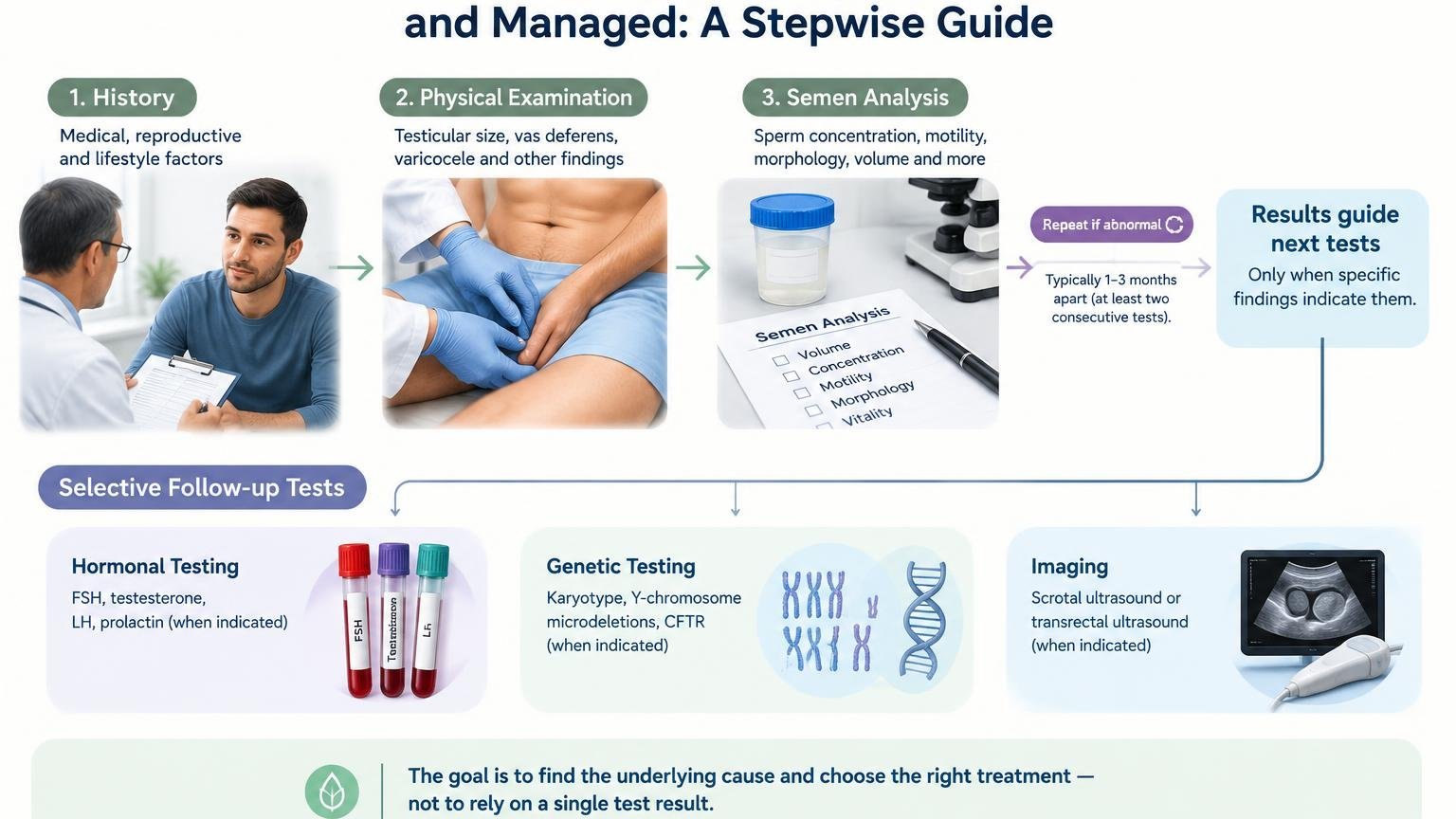
Male factor infertility is not a niche problem. It is the sole cause in approximately 20–30% of infertile couples and a contributing factor in another 20–30%, which is why guidelines recommend evaluating the man as part of the couple's initial assessment rather than after female testing is exhausted. The evaluation is sequential by design: a focused history and physical examination narrow the differential, semen analysis provides the core laboratory signal, and hormonal, genetic or imaging tests are added only when specific findings point toward them.[1][2]
Two practical points are frequently missed. First, an abnormal semen analysis should generally be repeated before a diagnosis is assigned, because sperm parameters vary between samples; the European Association of Urology recommends at least two consecutive analyses when the baseline result is abnormal, and educational summaries describe repeat testing 1–3 months apart. Second, a normal semen analysis does not prove fertility, and an abnormal one does not by itself establish infertility — results must be interpreted alongside history, examination and the couple's reproductive context.
When no sperm are found on repeated testing, the key branch point is whether sperm production is preserved but blocked (obstructive azoospermia) or impaired at the testicular level (non-obstructive azoospermia). Physical examination, semen volume, semen pH and FSH help make that distinction, and it matters because the diagnostic pathway and treatment options diverge. Idiopathic infertility remains the single most common diagnostic label, affecting 30–40% of men, so a clear result is not always available.
Why This Matters
Couples often arrive at a fertility clinic with the woman's testing already underway. That sequence is understandable but inefficient: male factor is common enough that the man's evaluation belongs in the initial work-up, and several causes of male infertility are correctable or carry broader health implications. Varicocele, for instance, is described as the most common surgically correctable cause of male infertility and is found in approximately 40% of men presenting with infertility in one educational summary — a prevalence figure that varies by setting and should not be read as a universal screening yield.
Beyond conception, the evaluation can surface hormonal disorders, genetic abnormalities or reproductive tract problems that warrant medical attention in their own right. That is one reason clinicians caution against relying on supplements or repeated semen tests without a structured assessment. The goal is not to label a sample as normal or abnormal but to identify an underlying cause and select treatment accordingly, rather than treating the semen analysis result in isolation.
When Should a Man Be Evaluated?
The conventional trigger is 12 months of regular, unprotected intercourse without pregnancy. Earlier evaluation is appropriate when a known risk factor or relevant history is present: previous testicular surgery or injury, undescended testicles, testicular infection, varicocele, prior chemotherapy or radiation, use of anabolic steroids or certain medications, erectile or ejaculation problems, previous fertility problems, or a history of reproductive or hormonal disorders.
This risk-factor list matters because it converts the evaluation from a calendar-based rule into a clinical one. A man with a history of undescended testis repair or prior gonadotoxic chemotherapy does not need to wait a year before semen analysis is informative. The same logic applies to couples in which the female partner has known reproductive factors, since treatment timing depends on both partners' status.
The Core Sequence: History, Examination, Semen Analysis
A complete evaluation does not depend on one test. It usually combines medical and reproductive history, physical examination, semen analysis and hormonal evaluation, with genetic tests or imaging added depending on findings rather than ordered routinely. The history covers previous pregnancies, duration of infertility, sexual function and ejaculation, prior illnesses and surgeries, medications, lifestyle exposures and family history, including conditions such as diabetes, obesity, prior genital infections, testicular cancer or trauma.
The physical examination is focused rather than exhaustive: testicular size and consistency, presence of both testes, the epididymis and vas deferens, varicocele, penile abnormalities, signs of hormonal disorders and secondary sexual characteristics. Testicular size gives useful information about sperm production, while abnormalities of the vas deferens or epididymis may suggest an obstruction affecting sperm transport. These are bedside inferences, not definitive tests, but they direct the next step.
Semen analysis is the cornerstone laboratory test. It reports concentration, total sperm number, motility, morphology, volume and vitality when indicated. The lower reference limits are not pass/fail diagnostic thresholds for an individual man; they describe a distribution. In the WHO 2021 limits cited in the educational source, with 2–7 days of abstinence, the lower references are volume ≥1.4 mL, concentration ≥16 million/mL, total sperm count ≥39 million/ejaculate, total motility ≥42%, progressive motility ≥30% and normal morphology ≥4%.
Because sperm parameters fluctuate, an abnormal first result should be repeated. The EAU recommends at least two consecutive semen analyses when the baseline result is abnormal, and exam-oriented summaries describe the repeat being performed 1–3 months apart. This is a diagnosis-stability step, not a delay tactic, and it prevents couples from acting on a single outlier sample.
When Hormonal, Genetic and Imaging Tests Are Indicated
Hormonal testing is selective. The AUA/ASRM guideline summarized in the source recommends hormonal evaluation, including FSH and testosterone, in infertile men with impaired libido, erectile dysfunction, oligozoospermia, azoospermia, testicular atrophy or signs of hormonal abnormality. Adding LH and prolactin when clinically indicated helps localize the problem to the hypothalamus, pituitary or testis. The pattern matters: primary testicular failure typically raises FSH, whereas hypogonadotropic states lower it.
Genetic testing is likewise not universal. It becomes important in men with severe sperm abnormalities or azoospermia, particularly when impaired sperm production is suspected. Depending on the scenario, testing may include karyotype analysis, Y-chromosome microdeletion testing, or CFTR mutation testing when the vas deferens is absent or obstructive azoospermia is suspected. Y-chromosome microdeletions, such as AZFc region deletions, are described as causing severe spermatogenic failure.
Imaging is not automatically required. When clinically indicated, scrotal ultrasound can assess testicular anatomy, volume or certain abnormalities, and transrectal ultrasound may be considered when the semen analysis suggests ejaculatory duct obstruction, particularly with low semen volume and supporting findings. In other words, imaging answers a specific question raised by the history or semen result; it is not a screening ritual.
Azoospermia: Differentiating Obstruction From Production Failure
Azoospermia means no sperm are found on repeated semen analyses. It does not automatically mean biological fatherhood is impossible; the next task is to determine why sperm are absent from the ejaculate. In obstructive azoospermia, sperm production may be preserved but an obstruction prevents sperm from reaching the ejaculate. In non-obstructive azoospermia, the primary problem is impaired sperm production within the testicles.
The distinction is clinically actionable. Guidelines recommend using physical examination, semen volume, semen pH and FSH to help differentiate obstruction from impaired production. Educational summaries describe a typical pattern — obstructive azoospermia with normal FSH and testicular size, versus non-obstructive azoospermia with elevated FSH and small testes — but this is a pattern, not a universal rule, and overlap occurs.
Klinefelter syndrome illustrates the non-obstructive end of the spectrum. It results from an extra X chromosome in a male, giving 47 chromosomes instead of the usual 46. It is a hypergonadotropic hypogonadism that often leads to azoospermia, with blood testing typically showing abnormally low testosterone and very high FSH. Even here, modern treatment can enable some men to achieve biological fatherhood, although the commercial source provides no success rates and should be read cautiously.[3]
What the Evidence Shows About Management
Management follows the diagnosis, not the semen analysis in isolation. Options described in the source material include lifestyle modification, medical treatment for hormonal disorders, treatment of infections when indicated, varicocele treatment in selected patients, surgical correction of reproductive tract obstruction, sperm retrieval procedures, and assisted reproductive techniques such as IVF or ICSI. ICSI is described as the cornerstone for severe male infertility, including azoospermia using surgically retrieved sperm by TESE or MESA.
For non-obstructive azoospermia, Micro-TESE uses an operating microscope to search testicular tissue for isolated pockets of sperm that may persist despite impaired production. For Klinefelter syndrome specifically, the commercial source describes Micro-TESE followed by ICSI as the pathway that changed the previous assumption of impossibility. These are procedure descriptions, not comparative outcome data; retrieval and pregnancy rates are not provided and should not be inferred from the promotional text.
One safety-relevant point deserves emphasis for men considering hormone treatment: exogenous testosterone can suppress any remaining endogenous sperm production. That is why testosterone therapy in a man trying to conceive requires specialist supervision and why hormonal evaluation precedes hormonal treatment in the fertility work-up.
| Evaluation step | What it addresses | When it is added | Key interpretation point |
|---|---|---|---|
| History and physical examination | Risk factors, exposures, testicular volume, vas deferens, varicocele | Initial visit | Testicular size informs about production; vas or epididymal abnormalities suggest obstruction |
| Semen analysis | Concentration, count, motility, morphology, volume | Initial visit; repeat if abnormal | Reference limits describe a distribution, not an individual diagnosis |
| Hormonal testing (FSH, testosterone, LH, prolactin when indicated) | Hypothalamic-pituitary-testicular axis | Impaired libido, ED, oligozoospermia, azoospermia, testicular atrophy, hormonal signs | High FSH suggests primary testicular failure; low FSH suggests central cause |
| Genetic testing | Karyotype, Y-chromosome microdeletions, CFTR | Severe sperm abnormality or azoospermia with suspected impaired production; absent vas deferens | Selective, not routine for every man |
| Imaging | Scrotal ultrasound; transrectal ultrasound | Clinically indicated anatomy questions or suspected ejaculatory duct obstruction | Answers a specific question; not a screening test |
| Azoospermia differentiation | Obstructive versus non-obstructive | After repeated confirmation of no sperm | Examination, volume, pH and FSH guide the distinction |
Interpretation and Limitations
The evidence base here is educational and guideline-derived, not a set of primary studies. The source material includes a guideline summary, a set of exam-preparation notes and two commercial clinic articles. The prevalence figures — 20–30% sole male factor, another 20–30% contributing, approximately 40% varicocele prevalence, 30–40% idiopathic — come from educational summaries without primary citations in the packet and should be treated as approximate, setting-dependent estimates rather than fixed constants.
Claims from the commercial clinic material require particular caution. The assertion that a man can have normal semen parameters and still be infertile is plausible and clinically recognized, but the source provides no data. The DNA fragmentation discussion proposes oxidative stress as the primary mechanism and describes a fragmentation index above 30% as generally highly abnormal, yet no guideline or study is cited, the assay dependence is not addressed, and the thresholds should not be treated as settled. Likewise, antioxidant therapy taking about three months to show results is an unsupported efficacy and timing claim, and microscopic varicocelectomy being the 'absolute gold standard' is a superlative without comparative data in the packet.[4]
Even the stronger guideline-based statements carry limits. The recommendation to repeat an abnormal semen analysis is well established, but the packet does not specify the threshold used to define abnormality in that recommendation. The obstructive versus non-obstructive pattern based on FSH and testicular size is typical but not universal. And the absence of reported retrieval or pregnancy rates for Micro-TESE and ICSI means the article cannot compare success probabilities; couples should seek center-specific outcome data during counseling.
Research Outlook
Several gaps stand out from this packet. The role of sperm DNA fragmentation testing remains contested in the material presented: the mechanism is biologically plausible, but the source gives a threshold without assay-specific validation and without outcome data linking testing to improved live birth rates. Whether antioxidant therapy changes clinically important outcomes, and which patients might benefit, is not answered here. Similarly, the comparative effectiveness of Micro-TESE versus other retrieval approaches, and predictors of successful retrieval in non-obstructive azoospermia, are not quantified in these sources.
A further gap concerns the diagnostic yield of the stepwise approach itself. The packet describes what tests are recommended and when, but not how often each test changes management or how often a cause is ultimately found. Those are questions for primary diagnostic-accuracy and outcome studies, not for an educational review. Until such data are synthesized, the sequence described here should be understood as a structured clinical pathway rather than a proven algorithm with quantified benefit.
Key Takeaways
- Evaluate the man early: after 12 months of regular unprotected intercourse, or sooner with risk factors such as testicular surgery, undescended testes, varicocele, gonadotoxic treatment, anabolic steroid use or ejaculatory problems.
- Start with history, physical examination and semen analysis; add hormonal, genetic or imaging tests only when specific findings indicate them.
- Repeat an abnormal semen analysis before diagnosing male factor infertility; at least two consecutive analyses are recommended when the baseline result is abnormal, and repeat testing is often spaced 1–3 months apart.
- When no sperm are found, distinguish obstructive from non-obstructive azoospermia using examination, semen volume, semen pH and FSH, because the diagnostic pathway and treatment options differ.
- Treatment follows the identified cause; ICSI with surgically retrieved sperm is described as the cornerstone for severe male infertility including azoospermia, but the packet provides no success rates.
Questions and Answers
When should a man be evaluated for male factor infertility?
The usual trigger is 12 months of regular, unprotected intercourse without pregnancy. Earlier evaluation is appropriate when risk factors are present, including previous testicular surgery or injury, undescended testicles, testicular infection, varicocele, chemotherapy or radiation, anabolic steroid use, erectile or ejaculation problems, or a history of reproductive or hormonal disorders. These are guideline-based triggers for clinical assessment, not an individualized recommendation.
Why is an abnormal semen analysis repeated before diagnosing male infertility?
Sperm parameters vary between samples, so a single abnormal result can be an outlier. The European Association of Urology recommends at least two consecutive semen analyses when the baseline result is abnormal, and educational summaries describe repeat testing 1–3 months apart. Repeat testing stabilizes the diagnosis before couples commit to further investigation or treatment; the packet does not specify the exact abnormality threshold used in that recommendation.
When are hormonal and genetic tests indicated in male infertility?
Hormonal testing with FSH and testosterone is recommended in men with impaired libido, erectile dysfunction, oligozoospermia, azoospermia, testicular atrophy or signs of hormonal abnormality. Genetic testing is selective, considered with severe sperm abnormalities or azoospermia when impaired production is suspected; options include karyotype, Y-chromosome microdeletion testing and CFTR testing when the vas deferens is absent. Neither is routine for every man.
How are obstructive and non-obstructive azoospermia distinguished?
After repeated semen analyses show no sperm, clinicians use physical examination, semen volume, semen pH and FSH to differentiate obstruction from impaired production. A typical pattern is obstructive azoospermia with normal FSH and testicular size versus non-obstructive azoospermia with elevated FSH and small testes, but this pattern is not universal. The distinction matters because diagnostic pathways and treatment options differ.
What are the limitations of sperm DNA fragmentation testing claims?
The packet's DNA fragmentation material comes from a commercial clinic article without cited studies. A fragmentation index above 30% is described as generally abnormal, but no guideline or assay-specific validation is provided. Oxidative stress is proposed as the primary mechanism, but that remains a hypothesis in this source. Antioxidant therapy timing claims are similarly unsupported. DNA fragmentation testing may be offered in selected cases, but the evidence here cannot establish thresholds or treatment benefit.
Can men with non-obstructive azoospermia still become biological fathers?
Some can, according to the source material. Micro-TESE uses an operating microscope to search testicular tissue for isolated pockets of sperm, and ICSI can use surgically retrieved sperm. In Klinefelter syndrome, which often causes non-obstructive azoospermia with low testosterone and high FSH, the commercial source states that modern treatment can enable biological fatherhood. However, the packet reports no retrieval or pregnancy rates, so success probability must come from center-specific counseling, not this article.
Sources and References
- Male Factor Infertility – NEET-PG Obstetrics and Gynecology Notes.
- Male Infertility: 6 Tests Used to Evaluate Male Fertility – Prof. Osama Shaeer.
- Klinefelter Syndrome & Infertility: Micro-TESE Treatment – Prof. Osama Shaeer.
- Sperm DNA Fragmentation: Hidden Infertility Causes & Cures – Prof. Osama Shaeer.
SANYUN Science Center explains published research on men's reproductive and sexual health, connecting scientific evidence with everyday questions while making sources and limitations clear.
Disclaimer: This article is for scientific education and research communication only. It does not provide medical advice, diagnosis, or individualized treatment recommendations, and does not endorse any medication, supplement, device, penile enlargement procedure, or other intervention. Decisions about sexual and reproductive health should be made in consultation with a qualified healthcare professional. Do not delay seeking professional care because of information in this article.
Original Content & Copyright Notice
- This article is prepared for SANYUN Science Center, drawing on published research and publicly available academic literature on men’s sexual and reproductive health. Its editorial explanations and presentation are developed for this platform.
- Copyright in the original editorial content, selection, and arrangement is reserved by SANYUN Science Center to the extent protected by applicable law. Referenced research, quotations, and third-party materials remain subject to the rights of their respective owners. This notice does not claim ownership of scientific facts or third-party research.
- Except where permitted by applicable law or an applicable license, prior written permission is required to reproduce, republish, translate, adapt, redistribute, or commercially reuse protected content. Attribution alone does not grant permission for such reuse.
- For permitted quotation or authorized reuse, clearly identify the source and retain a link to the original article.
- Source: SANYUN Science Center
- Original URL: Retain the original article URL on science.san-yun.com.
- Copyright Holder: SANYUN Science Center, for its own protected editorial content.
- Quotation, excerpts, or authorized reuse must not distort the scientific meaning, omit material limitations or disclaimers, or imply unverified medical claims, product efficacy, or endorsement by SANYUN Science Center.



