




Category: Clinical Insights
Core Research Direction: How semen analysis and the male infertility workup should be interpreted and sequenced — repeat testing, hormone, genetic, and sperm DNA fragmentation testing — and which causes are treatable versus not
Search Intent: In a man with an abnormal semen analysis, which follow-up tests and treatable causes actually change management, and what does the evidence say about repeat testing and the limits of each test?
Platform: SANYUN Science Center
Evidence reviewed through: 2026-11-27
Executive Summary
An abnormal semen analysis is the usual entry point into male fertility assessment, but it is a measurement rather than an explanation. Two men with identical results can have entirely different causes, prognoses and treatments, which is why the finding should trigger a diagnosis rather than an immediate referral to assisted reproduction.[1]
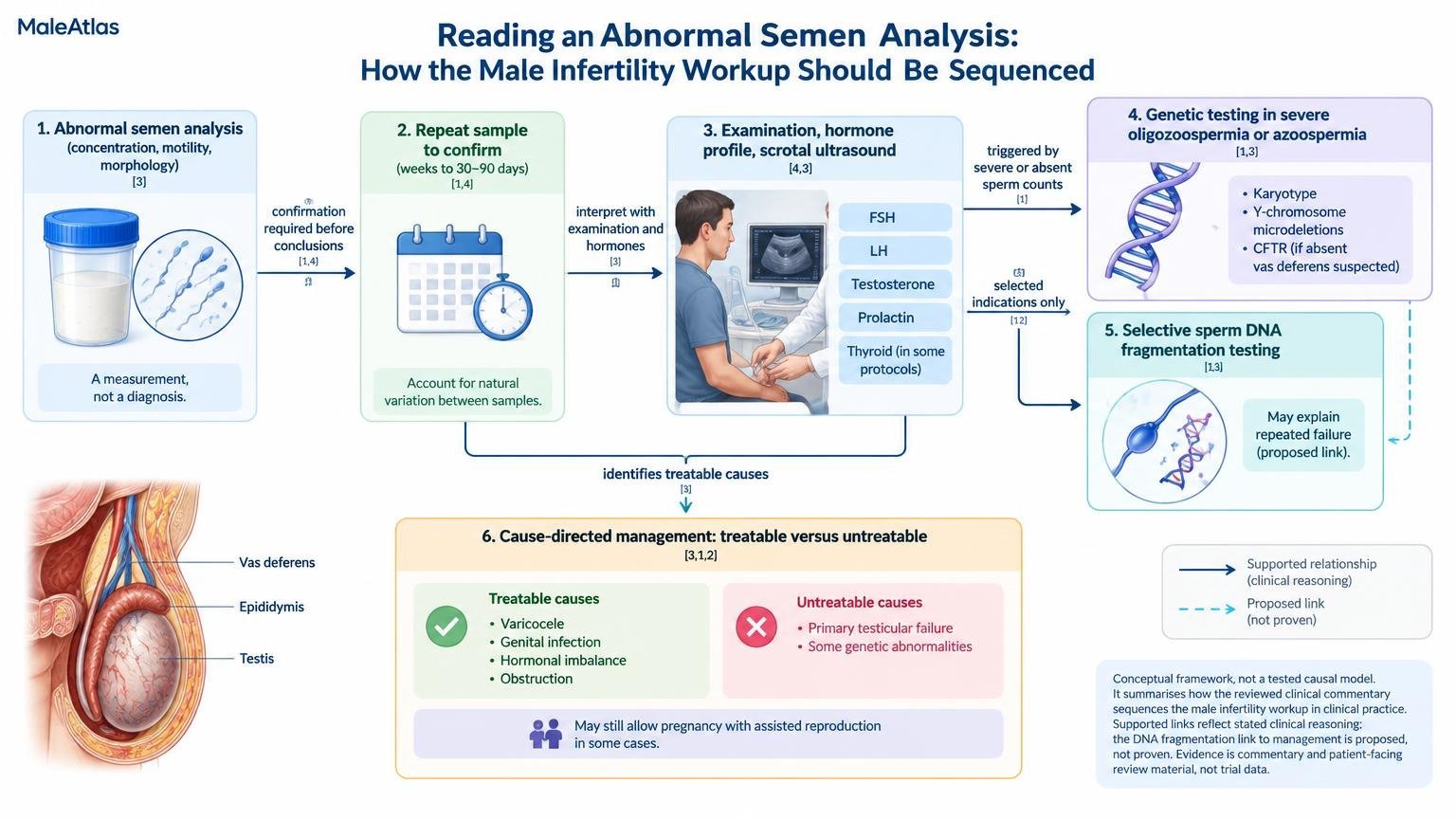
The literature summarised here is clinical commentary and patient-facing review material rather than primary trial data. Within that limit, the recurring message is consistent: confirm the abnormal sample, examine the patient, interpret hormones as a pituitary–testicular axis question, reserve genetic testing for severe oligozoospermia and azoospermia, and use sperm DNA fragmentation selectively rather than routinely.[2][3]
Male factors are estimated to contribute to roughly 30–50% of couple infertility in one review, while an institutional patient text places male involvement at approximately 40–50%; the ranges overlap but are not identical, and neither is presented with primary data here.
Why This Matters: The Number Is Not the Diagnosis
Infertility is conventionally defined as the absence of pregnancy after twelve months of regular unprotected intercourse, and the male partner should be investigated at the same time as the female partner rather than after her results return. Earlier assessment is reasonable when risk factors are already known, such as a history of undescended testis, genital infection, pelvic surgery, chemotherapy or radiotherapy.
The practical stakes are that some causes are correctable and some are not, and the two look similar on a semen report. A man with a low count may have a varicocele, an endocrine deficiency, an obstruction or primary testicular failure; only some of these respond to treatment, while others may still allow surgical sperm retrieval for assisted reproduction.
There is also a broader health argument. Men presenting with infertility appear to carry a higher incidence of testicular cancer and of undiagnosed endocrine and metabolic disorders than the general population, so the fertility consultation functions partly as a general health assessment.
The Biological Frame: One Long Cycle, Several Failure Points
Sperm production takes roughly 72 days and depends on a functioning testis, an intact hormonal axis, an unobstructed outflow pathway and the absence of damaging exposures. A problem at any of these points can reduce count, motility, morphology or DNA quality, which is why a single number cannot localise the fault.
The same timeline explains why repeat testing has a natural interval. Because one cycle of spermatogenesis runs about three months, repeating a semen analysis sooner than that tends to measure biological noise rather than progress, and no lifestyle or medical change should be judged before roughly that interval has passed.
Exogenous testosterone is a specific and avoidable mechanism. Testosterone replacement suppresses the hormonal signal that drives sperm production and can cause azoospermia, so it is the wrong treatment for a man trying to conceive — a point that matters because anabolic steroid use and testosterone therapy are common in men who present with low counts.
What the Semen Analysis Actually Reports
| Parameter | Reported reference framing | Interpretation note |
|---|---|---|
| Volume | Reference around 1.4 mL or more; low volume may point to seminal vesicle, prostate or ejaculatory problems | A low volume can be a collection or outflow issue before it is a production issue |
| Sperm concentration | Reference minimum 16 million per mL; below this is oligozoospermia | A threshold, not a fertility verdict |
| Total and progressive motility | Total motility 42% or more; progressive motility 30% or more; below these is asthenozoospermia | Motility grading separates progressive, non-progressive and immotile forms |
| Morphology[4] | Under strict criteria, 4% or more normal forms; below this is teratozoospermia | The 4% figure is assessed in a 200-sperm count and commonly alarms men despite being a lower reference limit |
| Other reported features | pH, liquefaction, vitality, leucocytes | Leucocytes may prompt consideration of infection |
The semen analysis is the first-line test because it reflects spermatogenesis, ductal patency and accessory gland function, assessing volume, concentration, motility and morphology against standardised reference values.[5]
Reference limits deserve careful framing. WHO values describe the lower limits found in men whose partners conceived within twelve months; they are not a pass mark, and men below them do conceive naturally. Conversely, a result within reference values does not by itself guarantee fertility.
Collection conditions vary between sources. One institutional text cites a WHO-recommended abstinence interval of two to seven days, while a urology clinic describes two to five days; the discrepancy is a reminder to follow the receiving laboratory's own instruction rather than a memorised number.
Sequencing Step One: Repeat Before You Conclude
Semen quality varies considerably between samples from the same man, so a single abnormal result should be repeated before any conclusion is drawn. One clinical commentary suggests an interval of 30 to 90 days; another advises repeating after a few weeks. Both converge on the principle that the second sample, not the first, should carry the diagnostic weight.
An abnormal semen analysis does not by itself confirm infertility. It guides diagnosis and next steps, and it should be interpreted alongside history and physical examination rather than read in isolation.
The examination is not optional sequencing decoration. It identifies a varicocele, assesses testicular volume and detects an absent vas deferens, and it is described as the step most often skipped when a man is referred straight into a fertility pathway.
Sequencing Step Two: Hormones as an Axis Question
Hormone testing is used to distinguish a testis that is failing from a testis that is not being stimulated, which is the distinction that determines whether medical treatment can help. FSH, LH, testosterone and prolactin are the usual panel, with thyroid function added in some protocols.
The interpretation logic is directional. A very elevated FSH may indicate testicular damage with poor response to hormonal stimulation, whereas a low FSH may point to a pituitary problem upstream. Low testosterone can affect both sperm production and sexual function, and elevated prolactin can inhibit testosterone and sperm production.
The therapeutic consequence is clearest in hypogonadotropic hypogonadism, where hormonal treatment can restore sperm production. The same treatment is far less predictable in idiopathic cases and should be described that way rather than offered as a general fertility tonic.
Sequencing Step Three: Genetics for Severe Phenotypes Only
Karyotype and Y-chromosome microdeletion testing are indicated in severe oligozoospermia and azoospermia. The result affects not only the treatment plan but also the counselling given to the couple about their future children, because some abnormalities can be transmitted if assisted reproduction is used.
Karyotype analysis detects chromosomal anomalies such as Klinefelter syndrome, which is associated with severe male infertility. Y-chromosome microdeletions remove regions containing genes essential for sperm production and can cause azoospermia or severe oligozoospermia. CFTR testing is relevant where congenital absence of the vas deferens is suspected.
Genetic results also inform prognosis for surgical retrieval, which is why they belong before, not after, a decision about sperm retrieval in non-obstructive azoospermia.
Sequencing Step Four: DNA Fragmentation and Other Selective Tests
Sperm DNA fragmentation measures damage to the genetic material inside sperm and can be elevated even when standard semen parameters look normal. A high fragmentation index may explain repeated fertilisation or implantation failure, but that explanatory link is phrased as a possibility rather than a demonstrated causal pathway.
The indications are narrow and consistent across sources: recurrent pregnancy loss, repeated assisted-reproduction failure, or unexplained infertility with a normal semen analysis. It should be requested for a reason and not added routinely to the initial panel.
Other tests are similarly conditional. Scrotal ultrasound confirms a varicocele, measures testicular volume and rules out testicular tumours. Semen culture may detect bacterial infection. Testicular biopsy or sperm retrieval procedures are reserved for azoospermia, and retrieval is not guaranteed.
Treatable Versus Untreatable: What Actually Changes Management
Treatable causes include varicocele, genital infection, hormonal imbalance and obstruction. Where one of these is identified, treating it may significantly improve semen quality and increase the chance of natural pregnancy, although the sources give no effect sizes for that claim.
Varicocele is the most common surgically correctable cause, present in around 15% of men and considerably more often in men with abnormal semen parameters. Microsurgical varicocelectomy improves semen parameters in appropriately selected men — those with a clinically palpable varicocele and abnormal semen analysis — and is not indicated for an incidental ultrasound finding in a man with normal parameters.
Untreatable causes include primary testicular failure and some genetic abnormalities, where the testis itself cannot be restored. In these situations assisted reproduction, including surgical sperm retrieval and ICSI, may still allow pregnancy, but the counselling is different and the prognosis is set by the diagnosis rather than by the count.
Lifestyle and exposure factors sit in a middle category: frequently modifiable, often underestimated, and never a guarantee. Stopping anabolic steroids, treating an endocrine disorder, weight reduction and smoking cessation are recommended for general and reproductive health, but they do not assure normalisation of semen parameters or a pregnancy.
Antioxidant supplements are widely sold, but the evidence for benefit on pregnancy and live birth is weak, inconsistent and still uncertain, and they are not a substitute for identifying a cause.
Interpretation and Limitations
The evidence base summarised here is not a body of primary trials. It consists of clinical commentary, patient-facing review articles and institutional explainers, several without named authors or in-text citations for their numeric thresholds. Statements such as the superiority of varicocelectomy in selected men or the predictability of hormonal therapy are qualitative summaries rather than pooled estimates.
Several concrete details conflict across sources and should be treated as variation in practice rather than resolved fact: the abstinence interval is given as two to seven days in one text and two to five in another, and the estimated male contribution to couple infertility ranges from 30–50% to 40–50%. The DNA fragmentation literature is described in terms of association with poor outcomes, not proven causation.
A further limitation is that no source here reports the diagnostic yield of each test in a defined population, so the sequence proposed reflects clinical reasoning about mechanism and treatability rather than comparative effectiveness data.
Research Outlook
The open questions are practical ones: how repeat samples should be combined to reduce misclassification, which men with normal standard parameters nonetheless warrant DNA fragmentation testing, and whether earlier diagnosis and treatment of reversible causes measurably reduces the need for assisted reproduction. The sources frame these as uncertainties rather than settled practice.
A second gap concerns outcomes after sperm retrieval in non-obstructive azoospermia, where retrieval is possible but not guaranteed and success depends on the underlying cause. Better genetic and clinical prediction of retrievability would change counselling more than another semen parameter would.
Key Takeaways
- An abnormal semen analysis should be repeated before conclusions are drawn; suggested intervals range from a few weeks to 30–90 days.
- The physical examination — varicocele, testicular volume, absent vas deferens — changes management and should precede advanced testing.
- Hormone testing separates testicular failure from inadequate stimulation, and hormonal therapy is most reliable in hypogonadotropic hypogonadism.
- Karyotype and Y-chromosome microdeletion testing belong to severe oligozoospermia and azoospermia, and inform both treatment and genetic counselling.
- Sperm DNA fragmentation testing is reserved for recurrent loss, repeated assisted-reproduction failure or unexplained infertility, not routine use.
- Varicocele, infection, hormonal deficiency and obstruction are potentially correctable; primary testicular failure and some genetic causes are not, though retrieval may still be possible.
- Exogenous testosterone suppresses sperm production and is the wrong treatment for a man trying to conceive.
Questions and Answers
What does a semen analysis measure, and why is one sample not enough?
It reports volume, pH, liquefaction, sperm concentration, motility and morphology, reflecting sperm production, duct patency and gland function. Results vary considerably between samples from the same man, so a single abnormal result should be repeated — one source suggests 30 to 90 days, another a few weeks — and interpreted with history and examination.
Which hormone tests are used in a male infertility workup and what do they show?
FSH, LH, testosterone and prolactin are the usual panel, with thyroid testing in some protocols. They distinguish a failing testis from one that is not being stimulated: very high FSH may suggest testicular damage, low FSH may point to a pituitary problem, and elevated prolactin can suppress testosterone and sperm production.
When should karyotype and Y-chromosome microdeletion testing be ordered in male infertility?
They are indicated in severe oligozoospermia and azoospermia, not in mild abnormalities. Karyotype can detect Klinefelter syndrome, and Y microdeletions remove genes essential for sperm production. Results affect the treatment plan, the likelihood of surgical sperm retrieval and genetic counselling about future children.
Is sperm DNA fragmentation testing routine in male infertility assessment?
No. It is reserved for recurrent pregnancy loss, repeated assisted-reproduction failure, or unexplained infertility with normal semen parameters. A high fragmentation index may help explain repeated fertilisation or implantation failure, but the sources describe this as an explanatory association rather than proven causation, and it should not be added routinely.
Which causes of male infertility are treatable and which are not?
Varicocele, genital infection, hormonal deficiency and obstruction are potentially correctable, and treating them may improve semen quality. Primary testicular failure and some genetic abnormalities cannot be reversed, although sperm retrieval for assisted reproduction may still be possible. This is why the diagnosis, not the sperm count, should drive treatment.
Does testosterone therapy help a man with a low sperm count who wants to conceive?
No. Exogenous testosterone suppresses the hormonal signal that drives sperm production and can cause azoospermia, so it is the wrong treatment for a man trying to conceive. Any man on testosterone who wishes to father a child needs a specific discussion before continuing, and the underlying cause of his low count still requires investigation.
Conceptual framework: Conceptual framework, not a tested causal model. It summarises how the reviewed clinical commentary sequences the male infertility workup in clinical practice. Supported links reflect stated clinical reasoning; the DNA fragmentation link to management is proposed, not proven. Evidence is commentary and patient-facing review material, not trial data.
Academic References & Evidence
- Prof Fabio Castiglione. Male Infertility: 7 Causes, Tests and the Best Next Step. 2026
- Infertilidade masculina: causas, diagnóstico e tratamentos | Fleury Fertilidade.
- Dr. Luís Malca. Infertilidad masculina: qué pruebas se realizan en la consulta | UROCAT. 2026
- Dra. Maria do Carmo. Quais exames diagnosticam infertilidade no homem?.
- Nguyễn Ngọc Nhất. Tiếp cận toàn diện yếu tố nam trong hỗ trợ sinh sản Từ đánh giá tinh trùng đến các xét nghiệm chuyên sâu và tối ưu hóa điều trị – HOSREM – Hội NTSS & VS TPHCM.
SANYUN Science Center explains published research on men's reproductive and sexual health, connecting scientific evidence with everyday questions while making sources and limitations clear.
Disclaimer: This article is for scientific education and research communication only. It does not provide medical advice, diagnosis, or individualized treatment recommendations, and does not endorse any medication, supplement, device, penile enlargement procedure, or other intervention. Decisions about sexual and reproductive health should be made in consultation with a qualified healthcare professional. Do not delay seeking professional care because of information in this article.
Original Content & Copyright Notice
- This article is prepared for SANYUN Science Center, drawing on published research and publicly available academic literature on men’s sexual and reproductive health. Its editorial explanations and presentation are developed for this platform.
- Copyright in the original editorial content, selection, and arrangement is reserved by SANYUN Science Center to the extent protected by applicable law. Referenced research, quotations, and third-party materials remain subject to the rights of their respective owners. This notice does not claim ownership of scientific facts or third-party research.
- Except where permitted by applicable law or an applicable license, prior written permission is required to reproduce, republish, translate, adapt, redistribute, or commercially reuse protected content. Attribution alone does not grant permission for such reuse.
- For permitted quotation or authorized reuse, clearly identify the source and retain a link to the original article.
- Source: SANYUN Science Center
- Original URL: Retain the original article URL on science.san-yun.com.
- Copyright Holder: SANYUN Science Center, for its own protected editorial content.
- Quotation, excerpts, or authorized reuse must not distort the scientific meaning, omit material limitations or disclaimers, or imply unverified medical claims, product efficacy, or endorsement by SANYUN Science Center.



