




Category: Premature Ejaculation
Core Research Direction: Comparative effectiveness and evidence quality for premature ejaculation interventions: how pharmacological (dapoxetine, clomipramine), physiotherapeutic, and non-pharmacological options compare on IELT, tolerability, and recommendation strength, and what patient-reported outcome tools can and cannot capture
Search Intent: For men with premature ejaculation, how strong is the current evidence comparing drug treatments with physiotherapy and other non-pharmacological approaches, and what do patient-reported outcome measures add beyond timing?
Platform: SANYUN Science Center
Evidence reviewed through: 2026-11-27
A 2026 systematic review and meta-analysis pooled six clinical trials and 416 men to ask a question patients often raise directly: is a drug for premature ejaculation actually better than physiotherapy? The pooled answer favoured dapoxetine 30 mg over physiotherapy, but by a mean intravaginal ejaculatory latency time (IELT) difference of less than one second, with high heterogeneity between studies. Meanwhile, guideline bodies have begun to acknowledge that some non-pharmacological therapies may work, and have added caveated statements on clomipramine and glans hyaluronic acid injection. This review examines what the evidence supports for each option, how strong the recommendations really are, and what validated patient-reported instruments add beyond a stopwatch.[1][2]
Executive Summary
The most directly comparative quantitative evidence is a systematic review and meta-analysis of six trials with 416 participants that pooled IELT for dapoxetine 30 mg against physiotherapy in men with premature ejaculation (PE). The pooled effect was statistically significant and favoured dapoxetine, but the mean difference was only about 0.8 seconds in the direction of the comparison, and heterogeneity was high. That small pooled magnitude sits alongside far larger within-trial IELT gains reported for dapoxetine and for some activity-based interventions, a discrepancy that should shape how the comparison is read.
- Dapoxetine 30 mg outperformed physiotherapy on pooled IELT, but the pooled difference was under one second with high between-study heterogeneity.
- Guideline updates now acknowledge that some non-pharmacological PE therapies may be effective, and add statements on clomipramine and glans hyaluronic acid injection with explicit consent caveats.
- Validated patient-reported instruments measure control, distress and interpersonal difficulty, but most were not built on the DSM-5 definition and several lack diagnostic cutoffs.[3]
Why This Matters
PE is often discussed as a timing problem, yet modern classification also emphasises reduced control and subjective distress alongside short latency. That distinction matters for treatment comparison: an intervention could lengthen IELT modestly while still changing perceived control or relationship strain, and the reverse is possible. The review literature notes that PE commonly appears between ages 25 and 55 but is not confined to that range.[4]
Cumulative lifetime figures should be read cautiously. One cited estimate suggests that roughly three in four men experience PE at some point, but this likely reflects any occurrence rather than formal clinical diagnosis, so it is not a prevalence estimate for the disorder as defined in guidelines.
Tolerability is the other reason comparison matters. SSRI-based treatment for PE is frequently limited by adverse effects such as nausea and dizziness and by first-year discontinuation rates reported between about 71% and 90%. Those figures are drawn from cited literature within the review rather than its own pooled analysis, but they explain why safer alternatives and combined approaches attract interest.
Proposed Mechanisms and Rationale
The pharmacological rationale rests on serotonergic modulation of the ejaculatory reflex. Dapoxetine is a short-acting selective serotonin reuptake inhibitor developed specifically for PE and approved in Europe but not the United States; the review describes it as acting through serotonin reuptake inhibition with additional effects on norepinephrine and dopamine transporters. Clomipramine, a tricyclic with serotonergic activity, has been used both daily and on demand. The guideline amendment accepted evidence supporting new statements on daily or on-demand clomipramine and on glans hyaluronic acid injection, while specifying informed consent and use by a trained clinician. That wording signals residual uncertainty about positioning rather than unrestricted endorsement.
Physiotherapeutic approaches target a different layer: pelvic floor muscle strength and tone, voluntary control and arousal regulation. Modalities pooled in the review include pelvic floor muscle strengthening, biofeedback with pelvic floor electromyography, electrostimulation, acupuncture, yoga integrating breathing and postural exercise, and general physical activity at moderate versus minimal intensity. The premise is that pelvic floor weakness or hypertonicity may contribute to ejaculatory disorder, and that training could raise latency without drug side effects. This remains a plausible rationale rather than a demonstrated pathway, and the trials do not isolate which component drives any benefit.
What the Evidence Shows
The comparative meta-analysis followed PRISMA reporting and was registered on PROSPERO. It searched for clinical trials published over a ten-year window comparing physiotherapy with pharmacological treatment in men with PE, using IELT as the primary outcome. Six trials with 416 participants met criteria, with sample sizes ranging from 18 to 120 participants and a mean participant age of about 43 years. Methodological quality on the PEDro scale was high in three studies, medium in one and low in two; blinding items scored lowest, which is expected when comparing exercise or acupuncture with a drug.
Measurement was mostly stopwatch-based IELT, with one trial using self-report, and three trials also administered the Premature Ejaculation Diagnostic Tool. Dapoxetine 30 mg was the comparator in five trials, with 30 mg and 60 mg in two, and fluoxetine in one. The pooled analysis was restricted to dapoxetine 30 mg because 60 mg appeared in only two studies and fluoxetine in one; one trial was excluded from pooling for missing standard deviations and non-stopwatch IELT. The authors describe the pooled effect as statistically significant and, by conventional effect-size conventions, large, while cautioning that scarcity and heterogeneity of trials prevent definitive conclusions.
| Comparison | Reported result | Population and timing | Direction of effect |
|---|---|---|---|
| Dapoxetine 30 mg vs physiotherapy (pooled) | Mean IELT difference reported as −0.80 s (95% CI −1.53 to −0.06); I2 = 83% | Six trials, 416 men with PE | Negative value denotes the comparison direction favouring dapoxetine |
| Dapoxetine dose response (Pastore et al.) | Average IELT 37.2 s at baseline; 168.2 ± 36.6 s at 30 mg and 193.2 ± 43.8 s at 60 mg at 6 weeks | Men with PE in a single trial | Larger IELT is better; single small trial, not pooled |
| Moderate vs minimal physical activity (Kilinc et al.) | Moderate: 39.3 s (SD ±8.8) to 188.6 s (SD ±82.9); minimal: 33.8 s (SD ±14.7) to 50.3 s (SD ±19.1) | Men with PE in a single trial | Larger IELT is better; activity intensity may matter, single trial only |
| Acupuncture vs dapoxetine (Sahin et al.) | Significant IELT increase in all groups except sham acupuncture; largest increase with dapoxetine 60 mg | Four-arm single trial | Suggests a non-specific or expectancy component; not pooled |
| Combined therapy (qualitative synthesis) | Described as producing the most significant IELT improvements | Narrative review of included trials | Hypothesis-generating only; not a pooled finding |
| SSRI tolerability | Discontinuation 70.6% to 89.6% in the first year; nausea and dizziness common | Men treated with SSRIs for PE (cited literature) | Lower discontinuation is better; adherence limits drug strategies |
Individual trials illustrate how wide the range of reported effects is. In one trial, dapoxetine 30 mg and 60 mg raised average IELT from a baseline of 37.2 seconds to 168.2 and 193.2 seconds respectively at six weeks. In another, moderate physical activity raised IELT from 39.3 to 188.6 seconds while minimal activity moved it only from 33.8 to 50.3 seconds. A four-arm trial found significant increases in all groups except sham acupuncture, with the largest rise in the dapoxetine 60 mg arm.
These within-trial changes are far larger than the pooled sub-second difference. That gap is a signal that the pooled estimate is dominated by between-trial differences rather than by a consistent head-to-head margin, and it argues against reading the meta-analytic number as a description of what an individual patient should expect.
Guideline-level synthesis tells a related but distinct story. A guideline amendment searched MEDLINE and Embase for studies published between January 1, 2020 and December 19, 2024, identifying 727 abstracts of which 89 met inclusion criteria and 25 informed updated statements. It revised its non-pharmacological statement to reflect new evidence that some such therapies may be effective, and added an Expert Opinion statement on PDE5 inhibitors for PE, a designation that typically implies lower certainty than evidence-based statements. The panel's overarching recommendation is shared decision-making whatever treatment is chosen.
What Patient-Reported Instruments Add and Cannot Capture
Timing alone is a narrow outcome. Three instruments recur in the PE literature: the Premature Ejaculation Profile, the Index of Premature Ejaculation and the Premature Ejaculation Diagnostic Tool. They differ in length, domain structure and whether they provide diagnostic cutoffs, which matters when comparing trial results or structuring a clinical conversation.
| Instrument | Domains and length | Validated cutoffs | Main limitation |
|---|---|---|---|
| Premature Ejaculation Profile (PEP) | Perceived control, intercourse satisfaction, personal distress, interpersonal difficulty; 4 questions | None validated | One question per domain; not based on DSM-5 PE definition |
| Index of Premature Ejaculation (IPE) | Control, sexual satisfaction, distress; 10 questions | None; lacks norms | Not based on DSM-5 PE definition |
| Premature Ejaculation Diagnostic Tool (PEDT)[5] | Screening questionnaire; 5 items | Yes; scores ≤8 no PE, 9–10 probable, ≥11 established | Not based on DSM-5 PE definition |
The Premature Ejaculation Profile has four questions covering perceived control, intercourse satisfaction, personal distress and interpersonal difficulty; it has reliability and validity studies but no validated cutoff scores, only one question per domain and no DSM-5 basis. The Index of Premature Ejaculation has ten questions across control, sexual satisfaction and distress, is relatively brief, but lacks norms and diagnostic cutoffs and is likewise not DSM-5 based. The Premature Ejaculation Diagnostic Tool is a five-item screening instrument with cutoffs, described as brief and easy to administer, but also not built on the DSM-5 definition.
An educational overview of the PEDT reports score bands of 8 or below for no PE, 9 to 10 for probable PE and 11 or above for established PE, with sensitivity around 89% and specificity near 78% in ROC analysis. It also reports Cronbach's alpha of 0.82 in general populations and 0.76 in clinical subgroups in the original 2007 validation study, and moderate-to-strong negative correlations between total PEDT score and stopwatch IELT, generally between about −0.45 and −0.68. These figures are secondhand summaries rather than primary datasets, but they indicate that questionnaire severity and measured latency move in the expected direction without being interchangeable.
The practical implication is that patient-reported outcomes and IELT answer different questions. A tool can register improved control or reduced distress while latency shifts little, and a latency gain can occur without meaningful change in relationship strain. Because the instruments above were not constructed against DSM-5 criteria, they are best used as structured descriptors of the domains that matter to patients, not as substitutes for clinical assessment.
Interpretation and Limitations
Several caveats constrain how far the comparison can be pushed. The meta-analysis rests on six trials with heterogeneous designs, physiotherapy modalities and comparator doses; most trials were small, and the pooled confidence interval, while excluding zero, is narrow in absolute terms. Blinding was weak by design. The authors themselves state that scarcity and heterogeneity make definitive conclusions difficult, and the claim that combined therapy yields the greatest IELT improvements comes from qualitative review rather than pooled analysis.
The guideline evidence carries its own boundaries. The amendment's search covered literature published up to December 19, 2024, so newer trials are not reflected. The clomipramine and glans hyaluronic acid statements come with explicit consent and clinician-training caveats rather than effect sizes in the supplied summary, and the PDE5 inhibitor statement is Expert Opinion rather than a graded efficacy recommendation. None of these sources provides a clean, adequately powered head-to-head trial of drug, physiotherapy and combined care with patient-reported endpoints.
Discontinuation figures cited for SSRIs illustrate a further interpretive point: efficacy in a trial and persistence in practice are different outcomes. High first-year discontinuation reported between 70.6% and 89.6% suggests that tolerability, cost and perceived benefit shape real-world value as much as latency change does. That figure is drawn from cited literature within the review rather than the review's own data, so it should be treated as context rather than a pooled estimate.
Research Outlook
The most useful next step would be adequately powered trials that randomise men to dapoxetine, a defined physiotherapy protocol and combined care, with stopwatch IELT and a validated patient-reported instrument as co-primary endpoints. Standardising which physiotherapy modality is tested, whether pelvic floor training, biofeedback, acupuncture or activity prescription, would reduce the heterogeneity that currently dominates pooling. The 5th International Consultation on Sexual Medicine review aims to present evidence-based recommendations on definition, classification and treatment of PE and delayed ejaculation, and consensus work of that kind may help align outcome selection across future trials.
Until such trials exist, the reasonable reading is that dapoxetine has the more consistent short-term latency signal, physiotherapy has a more favourable tolerability profile and plausible benefit, and combined approaches are promising but not yet proven superior in pooled data. Clinicians and patients are left weighing latency against side effects, adherence and the domains captured only by patient report.
Key Takeaways
- In pooled analysis of six trials with 416 men, dapoxetine 30 mg produced a statistically significant but very small IELT advantage over physiotherapy, with high heterogeneity.
- Individual trials report much larger within-group IELT gains for dapoxetine and for moderate physical activity, so pooled and single-trial results should not be conflated.
- Guideline updates now recognise that some non-pharmacological therapies may be effective and add caveated statements on clomipramine, glans hyaluronic acid injection and PDE5 inhibitors.
- Validated patient-reported instruments capture control, distress and relationship impact but mostly lack DSM-5 alignment and, for the profile and index tools, validated cutoffs.
- SSRI discontinuation in the first year has been reported between 70.6% and 89.6%, making tolerability central to any treatment comparison.
Questions and Answers
What is intravaginal ejaculatory latency time and why is it used in premature ejaculation research?
IELT is the time from vaginal penetration to intravaginal ejaculation, measured by stopwatch in most trials and by self-report in a minority. It is used because it is objective and comparable across trials, but it does not capture perceived control, distress or relationship impact, which are core features of how PE is defined and experienced.
Is dapoxetine more effective than physiotherapy for premature ejaculation on IELT?
A 2026 meta-analysis of six trials with 416 men found a statistically significant pooled IELT difference favouring dapoxetine 30 mg over physiotherapy, reported as a mean difference of −0.80 seconds because of the comparison direction. The magnitude is very small and heterogeneity was high (I2 = 83%), while individual trials reported much larger within-group gains. The authors cautioned that limited, heterogeneous trials prevent definitive conclusions.
In men with premature ejaculation, how strong is the evidence that physiotherapy improves IELT compared with dapoxetine?
The comparative evidence comes from six small trials of mixed quality: three rated high, one medium and two low on the PEDro scale. Physiotherapy was described as safe and beneficial and a promising option for men intolerant of drugs, but blinding is inherently difficult and the pooled comparison against dapoxetine rested on a small, heterogeneous set of studies.
What do patient-reported outcome measures add beyond stopwatch timing in premature ejaculation?
Instruments such as the Premature Ejaculation Profile, Index of Premature Ejaculation and Premature Ejaculation Diagnostic Tool capture perceived control, satisfaction, personal distress and interpersonal difficulty. These domains are central to the clinical definition of PE but invisible to a stopwatch. Their limits are real, however: several lack validated cutoffs and most were not built on the DSM-5 definition.
How do weak blinding and mixed IELT measurement methods affect the dapoxetine-versus-physiotherapy comparison?
Blinding items scored lowest on the PEDro assessment, which is expected when comparing exercise or acupuncture with a drug. IELT was stopwatch-measured in most included trials but self-reported in one, and that trial was excluded from pooling for missing standard deviations. Together these factors increase heterogeneity (I2 = 83%) and limit how precisely the pooled difference can be interpreted.
What does the updated AUA/SMSNA guideline say about clomipramine and non-drug treatments for premature ejaculation?
The amendment revised its non-pharmacological statement to reflect evidence that some such therapies may be effective, and added statements on daily or on-demand clomipramine and glans hyaluronic acid injection. The panel specified these should be used with informed consent and by a trained clinician, and it recommends shared decision-making as the foundation of management regardless of treatment chosen.
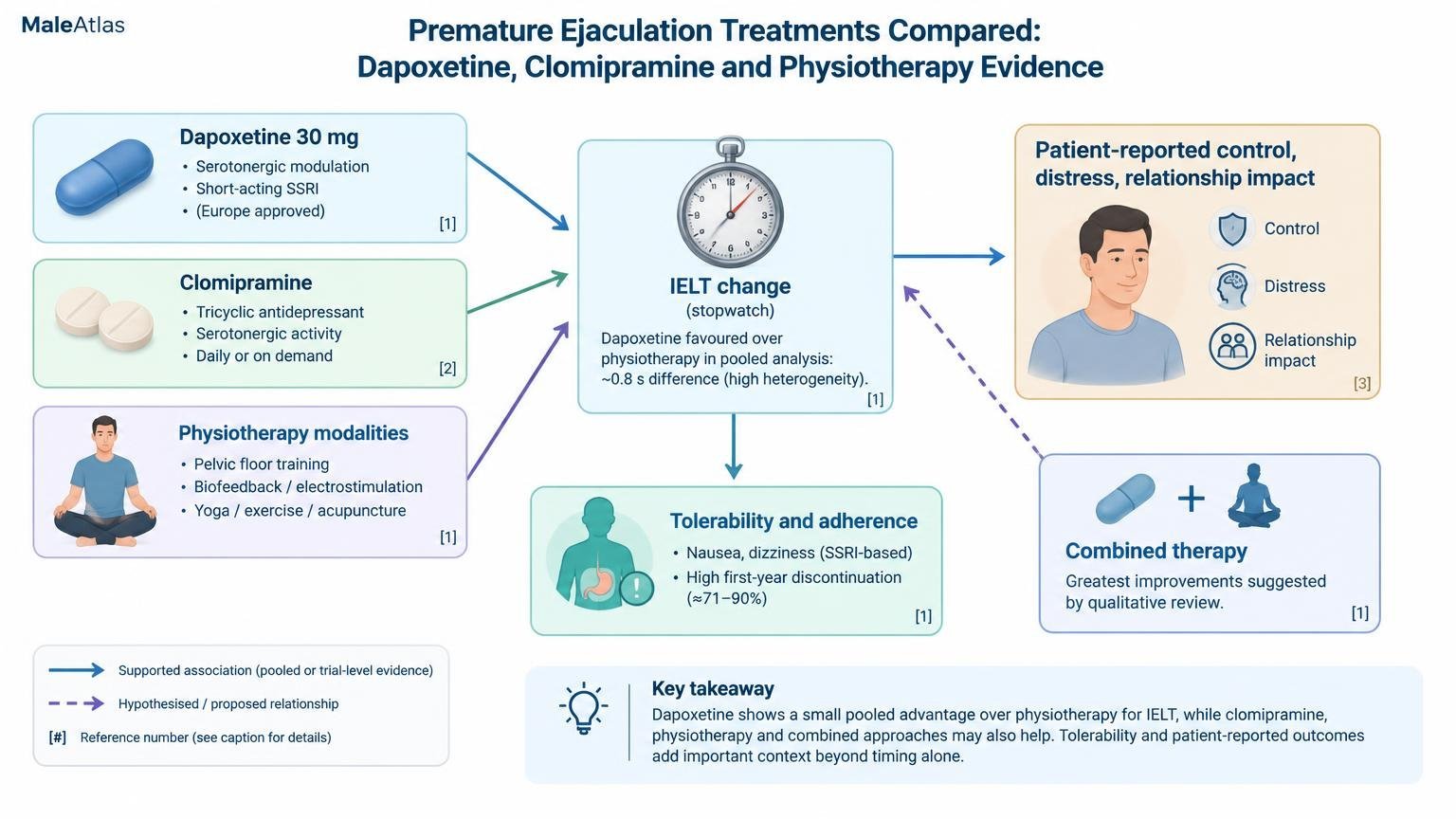
Conceptual framework: Conceptual framework for a review of premature ejaculation treatment comparisons, showing dapoxetine and physiotherapy linked to IELT change, tolerability and patient-reported domains. Supported edges reflect pooled or trial-level associations; the combined-therapy edge is hypothesis-generating only. Not a tested causal model.
Academic References & Evidence
- Esther M Medrano-Sánchez; Ana López-del-Castillo; Maud Boisseau; Juan C Fernández-Domínguez; Esther Díaz-Mohedo. Effectiveness of physiotherapy in male premature… : The Journal of Sexual Medicine. The Journal of Sexual Medicine. 2026 23(5) DOI: 10.1093/jsxmed/qdag096.
- Disorders of Ejaculation: AUA/SMSNA Guideline (2027) | Journal of Urology. Journal of Urology DOI: 10.1097/JU.0000000000005378.
- Table 1. Characteristics of recommended patient reported outcomes for premature ejaculation..
- Contemporary consensus and emerging directions in premature and delayed ejaculation: recommendations from the 5th International Consultation on Sexual Medicine.. Sexual medicine reviews PMID: 42855438.
- Tara Symonds; Michael A. Perelman; Stanley E. Althof; Raymond C. Rosen; Ian Eardley. Outil de diagnostic de l’éjaculation précoce (PEDT). 2007
SANYUN Science Center explains published research on men's reproductive and sexual health, connecting scientific evidence with everyday questions while making sources and limitations clear.
Disclaimer: This article is for scientific education and research communication only. It does not provide medical advice, diagnosis, or individualized treatment recommendations, and does not endorse any medication, supplement, device, penile enlargement procedure, or other intervention. Decisions about sexual and reproductive health should be made in consultation with a qualified healthcare professional. Do not delay seeking professional care because of information in this article.
Original Content & Copyright Notice
- This article is prepared for SANYUN Science Center, drawing on published research and publicly available academic literature on men’s sexual and reproductive health. Its editorial explanations and presentation are developed for this platform.
- Copyright in the original editorial content, selection, and arrangement is reserved by SANYUN Science Center to the extent protected by applicable law. Referenced research, quotations, and third-party materials remain subject to the rights of their respective owners. This notice does not claim ownership of scientific facts or third-party research.
- Except where permitted by applicable law or an applicable license, prior written permission is required to reproduce, republish, translate, adapt, redistribute, or commercially reuse protected content. Attribution alone does not grant permission for such reuse.
- For permitted quotation or authorized reuse, clearly identify the source and retain a link to the original article.
- Source: SANYUN Science Center
- Original URL: Retain the original article URL on science.san-yun.com.
- Copyright Holder: SANYUN Science Center, for its own protected editorial content.
- Quotation, excerpts, or authorized reuse must not distort the scientific meaning, omit material limitations or disclaimers, or imply unverified medical claims, product efficacy, or endorsement by SANYUN Science Center.



