




Category: Health Academy
Core Research Direction: How low testosterone (male hypogonadism) is actually diagnosed: which symptoms track with measured testosterone, why morning and repeat blood tests are required, and how symptom overlap, daily variability, and body weight complicate the symptom-versus-number question.
Search Intent: Which symptoms actually track with low testosterone, and why do doctors need two morning blood tests rather than one number or a symptom checklist to diagnose it?
Platform: SANYUN Science Center
Evidence reviewed through: 2026-11-27
Executive Summary
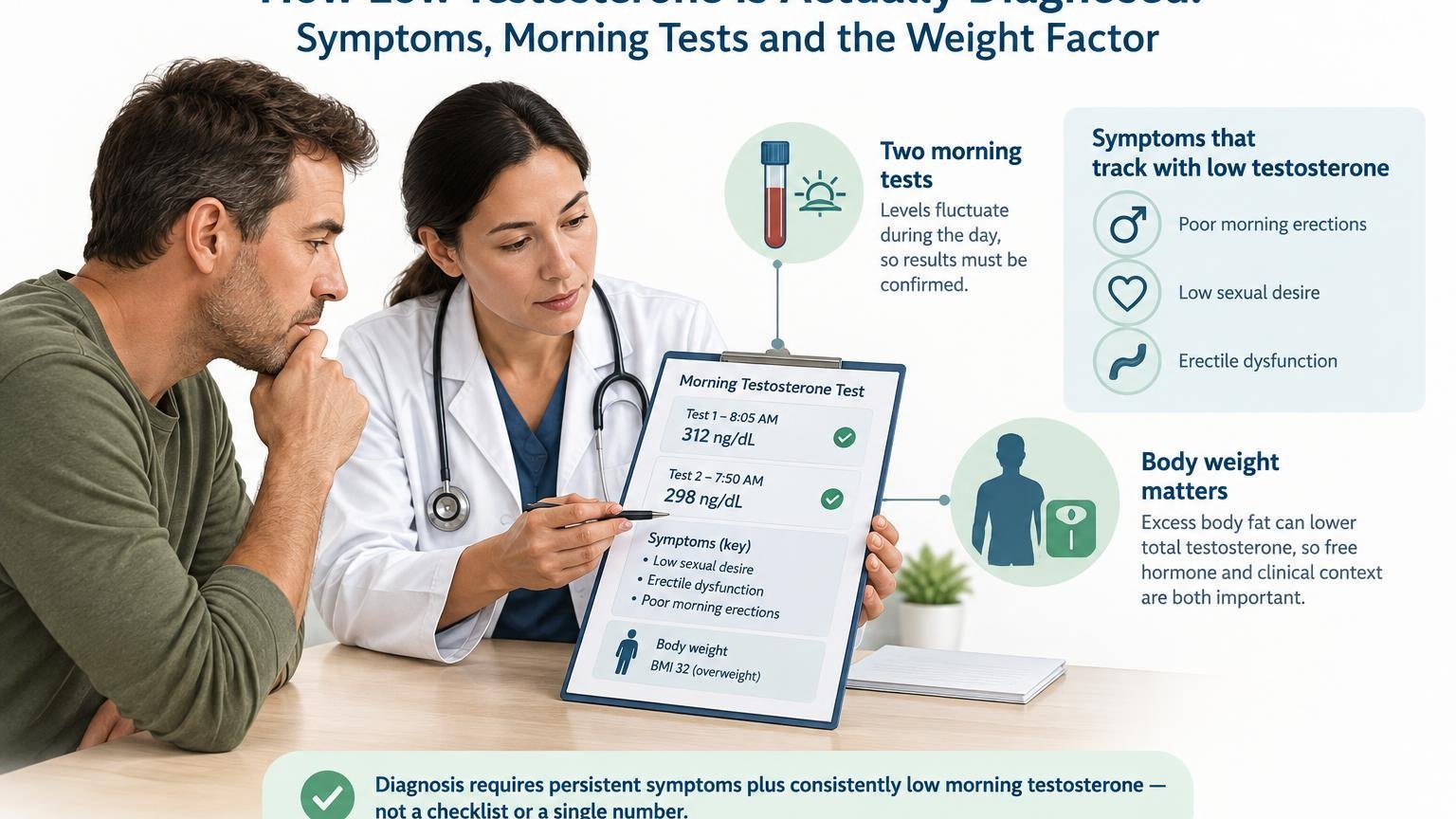
How low testosterone is diagnosed comes down to two gates that must both open: persistent symptoms that fit the condition, and consistently low morning testosterone on more than one measurement. The most influential population analysis, the European Male Aging Study diagnostic analysis of 3,369 men aged 40 to 79, found that only three sexual symptoms showed a syndromic association with low testosterone: poor morning erections, low sexual desire and erectile dysfunction.[1]
That distinction matters because the complaints most often marketed as signs of low testosterone, including fatigue, low mood and reduced physical vigor, correlate with many conditions and do not by themselves identify androgen deficiency. The hormone itself fluctuates through the day and from day to day, which is why clinicians draw blood in the morning and repeat the test before believing either a low or a normal result.[2][3][4]
Why This Matters
Testosterone is the primary male sex hormone, acting on androgen receptors throughout the body and contributing to libido, sperm production, muscle and bone maintenance, and mood stability. Because its effects are broad, the list of complaints attributed to low testosterone is also broad, and that breadth is exactly what makes diagnosis difficult. Many of those complaints are common, nonspecific and explainable by sleep debt, stress, depression, medication, illness or simply being human at fifty.
The commercial stakes are substantial. Over-the-counter testosterone boosters are widely sold with promises of energy and libido, yet the quoted clinician in one source states that most such products lack strong scientific proof of working, often do not meaningfully change testosterone levels, and may contain harmful or unknown ingredients. A review described a 2020 study of 50 products that found supporting data for only about a quarter of their listed ingredients. Accurate diagnosis therefore protects men not only from missed treatable causes but also from unnecessary spending and potential harm.
Biological and Clinical Mechanism
Testosterone production depends on a signal chain from the brain to the testes. In primary hypogonadism, the testes themselves fail to produce enough hormone. In secondary hypogonadism, the problem lies in the brain's signaling, and factors including obesity, untreated sleep apnea, depression, opioid medications and high blood sugar can suppress natural hormone production. This distinction matters clinically because secondary causes may respond to addressing the underlying condition, whereas primary testicular failure generally will not.
The hormone is released in pulses and follows a daily rhythm, typically highest in the early hours and drifting lower through the day. This rhythm is the biological reason behind morning testing. A single afternoon draw can read low for reasons unrelated to disease, and a single morning draw can still catch a transient dip caused by poor sleep, illness, heavy training, undereating or medication. The two-measurement requirement is a defense against treating a laboratory artifact rather than a persistent condition.
Which Symptoms Actually Track With Testosterone
The European Male Aging Study remains the landmark on this question. Investigators correlated a long list of candidate symptoms against measured testosterone in 3,369 men aged 40 to 79 and split the sample into training and validation sets so findings could be independently confirmed. Six symptoms showed some statistical relationship with testosterone, but only three, poor morning erections, low sexual desire and erectile dysfunction, had a syndromic association that held out of sample. The working definition of late-onset hypogonadism that emerged required at least three sexual symptoms together with total testosterone below 11 nmol/L, roughly 320 ng/dL, and free testosterone below 220 pmol/L.
| Symptom or sign | Type | Relationship to low testosterone | Important caveat |
|---|---|---|---|
| Poor morning erections | Self-reported symptom | Syndromic association in population data | Also sensitive to sleep quality and vascular health |
| Low sexual desire | Self-reported symptom | Syndromic association in population data | Depression, relationship strain, SSRIs and stress are common alternative causes |
| Erectile dysfunction | Self-reported symptom | Syndromic association in population data | Vascular disease is a dominant cause at older ages |
| Fatigue | Self-reported symptom | Does not by itself identify androgen deficiency | Sleep debt, low iron and other conditions deserve attention first |
| Low mood | Self-reported symptom | Does not by itself identify androgen deficiency | Depression has its own treatments and should not be reframed as a hormone problem |
| Reduced physical vigor | Self-reported symptom | Associated in the European Male Aging Study but not syndromic | Detraining and poor sleep mimic it closely |
| Gynecomastia, reduced body hair, testicular atrophy | Clinician-observed sign | Physical findings that warrant medical examination | These are clinician-observed signs rather than self-checkable symptoms |
The practical implication is that fatigue or low mood alone should not send a man straight to a testosterone prescription. Those complaints are real and deserve evaluation, but the differential diagnosis is long, and attributing them to testosterone before measurement risks missing treatable alternatives. When the sexual triad is present and persistent, the question becomes genuinely clinical.
What the Evidence Says About Testing
Testing guidance is consistent across the sourced material. Blood should be drawn early in the morning, ideally as close to 8 a.m. as possible, because levels fluctuate through the day. One clinician quoted in the sources specifies a window of 7 to 10 a.m. and advises fasting where the ordering clinician requests it. A low result should then be repeated on a different day to confirm that it is real rather than a one-time fluctuation.
Reference thresholds are broadly similar but not identical. One quoted clinician describes a typical healthy adult male range of 300 to 900 ng/dL, with some variation between clinics. The American Urological Association position cited in the same source holds that levels below 300 ng/dL may indicate a problem only when accompanied by other signs. Another source states that adult males below 300 ng/dL would generally be considered low, while noting that every person is different.
These numbers are thresholds, not verdicts. A result just below a laboratory cutoff in a man with no sexual symptoms is a different clinical situation from the same result in a man with persistent erectile dysfunction and low desire. The Endocrine Society guideline summarized in the sources requires both consistent symptoms and consistently low morning total testosterone on at least two separate measurements. Both gates must open.
Day-to-Day Variability and Spontaneous Remission
The Massachusetts Male Aging Study natural-history follow-up made the instability concrete. Among men who met criteria for symptomatic androgen deficiency at one wave, 55% had remitted by the next wave, and remission was more likely in younger, leaner men. The condition, as measured in the community, is frequently transient rather than fixed. That cuts both ways: a single low value should not launch a prescription, and a single normal value should not end the conversation when the sexual triad persists.
Part of this variability reflects the hormone's reactivity to the previous weeks of life. Sleep restriction, illness, caloric deficit and heavy training bouts can each depress testosterone reversibly. Part reflects pulsatile release. And part reflects measurement itself, since reference ranges differ between laboratories and assays. The two-gate design absorbs all three sources of noise, which is why it is the profession's standard rather than an optional extra.
How Body Weight Complicates the Symptom-Versus-Number Question
Obesity produces the subtlest trap in the field. Excess body fat lowers sex hormone-binding globulin (SHBG), which drags total testosterone down, so an overweight man's lab slip can read borderline-low while the free fraction his tissues actually see is entirely normal. Because routine reporting often emphasizes total testosterone, this pattern can generate a diagnosis that the free hormone does not support.
The magnitude is measurable. In European Male Aging Study data, overweight men averaged about 2.3 nmol/L lower total testosterone than lean men, and men with a body mass index of 30 or more averaged about 5.1 nmol/L lower. These are population averages, not individual predictions, but they explain why a competent workup computes free testosterone when body weight muddies the total. They also explain part of the association between obesity, metabolic syndrome, type 2 diabetes and lower testosterone noted in clinical guidance.
The mirror-image trap exists too. Low SHBG from obesity can mask a genuine problem in other men, which is precisely why symptoms remain half the diagnosis. When the number and the symptoms disagree, the resolution is clinical judgment with repeat morning testing and free hormone calculation where indicated, not whichever answer the marketing prefers.
Interpretation and Limitations
The evidence summarized here has real limits. Much of the practical guidance comes from clinical explainers and health-system articles rather than primary trials, and the key European Male Aging Study findings, the 55% remission figure and the obesity-related testosterone averages are reported through a single secondary evidence summary rather than the original journal articles. The quoted clinicians' statements are expert opinion, not experimental results. The 10% to 15% prevalence estimate for hypogonadism in men over 60, and the description of testosterone declining by about 1% per year beginning somewhere between ages 30 and 40, are attributed to research without a specific study being named in the source.
Some clinical questions remain genuinely open. Whether testosterone treatment helps men whose only symptoms are non-sexual is uncertain because trial evidence for that population is thin. How much of any individual's fatigue or low mood is attributable to testosterone when the level sits inside the normal range cannot be answered from these sources. And the boundary between low and low-normal is blurrier than reference ranges imply, particularly given day-to-day variability and the 55% remission figure.
A further limitation is scope. The sources describe Australian and United States clinical contexts, and testing logistics, reference ranges and specialist referral pathways differ between health systems. International readers should treat the numeric thresholds as broadly representative rather than locally authoritative. Age-related decline, in particular, is generally not a medical concern on its own, and a lower level in a healthy older man should not be equated with disease.
Key Takeaways
- Only poor morning erections, low sexual desire and erectile dysfunction showed a syndromic association with low testosterone in population data.
- Fatigue, low mood and reduced vigor do not by themselves identify androgen deficiency and have many competing explanations.
- Guidelines require consistent symptoms plus consistently low morning total testosterone on at least two separate measurements.
- Morning timing and repeat testing exist because testosterone follows a daily rhythm and varies from day to day.
- Obesity lowers SHBG and can make total testosterone read low while the free fraction is normal, so free testosterone calculation matters.
- In community follow-up, 55% of men meeting criteria for symptomatic androgen deficiency at one wave had remitted by the next wave.
Questions and Answers
Which symptoms actually track with low testosterone in men?
Population data tie only three sexual symptoms to low testosterone as a syndromic pattern: poor morning erections, low sexual desire and erectile dysfunction. Fatigue, low mood and reduced physical vigor appear in symptom lists but correlate with many conditions and do not by themselves identify androgen deficiency. Physical signs such as gynecomastia, reduced body hair and testicular atrophy warrant examination but are clinician-observed rather than self-checkable.
Why do doctors require two morning blood tests to diagnose low testosterone?
Testosterone follows a daily rhythm, highest in the early hours, and fluctuates from day to day in response to sleep, illness, training, undereating and medication. A single draw can read low for reasons unrelated to disease, or miss a real problem. Guidance therefore requires consistently low morning total testosterone on at least two separate measurements alongside consistent symptoms, and both gates must open before a diagnosis is made.
What testosterone level is considered low in adult men?
Broadly, adult men below 300 ng/dL are generally considered to have low testosterone, though reference ranges vary between clinics. One quoted clinician cites a typical healthy range of 300 to 900 ng/dL. The American Urological Association position cited holds that levels below 300 ng/dL may indicate a problem only when accompanied by other signs. A threshold alone is not a diagnosis.
How does body weight affect testosterone test results?
Excess body fat lowers SHBG, the binding protein that carries testosterone, which drags total testosterone down. An overweight man can therefore show borderline-low total testosterone while his free fraction is normal. In European Male Aging Study data, overweight men averaged about 2.3 nmol/L lower total testosterone than lean men, and men with a BMI of 30 or more about 5.1 nmol/L lower. These are population averages, not individual predictions, and free testosterone calculation is often needed when body weight complicates the total.
Can a single low testosterone reading resolve on its own?
Yes. In the Massachusetts Male Aging Study natural-history follow-up, 55% of men who met criteria for symptomatic androgen deficiency at one wave had remitted by the next wave, with remission more likely in younger, leaner men. This is one reason repeat morning testing is required before treating. It also means a single normal value should not necessarily end the conversation when sexual symptoms persist.
Is there good evidence that testosterone boosters treat low testosterone?
No. The quoted clinician states that most over-the-counter testosterone boosters lack strong scientific proof, often do not meaningfully change testosterone levels, and may contain harmful or unknown ingredients. A review described a 2020 study of 50 products that found supporting data for only about a quarter of their listed ingredients. Supplements cannot diagnose or treat confirmed hypogonadism, and diagnosis requires morning blood tests and clinical evaluation.
Sources and References
- The Symptom vs Number Question — Longevity Ladder.
- Signs of Low Testosterone and When to See a GP | Supps247.
- Brad Ivey; Joshua Cummings. Testosterone and Why You Shouldn’t Trust those ‘Low T’ Supplements. 2025
- Low Testosterone in Men.
SANYUN Science Center explains published research on men's reproductive and sexual health, connecting scientific evidence with everyday questions while making sources and limitations clear.
Disclaimer: This article is for scientific education and research communication only. It does not provide medical advice, diagnosis, or individualized treatment recommendations, and does not endorse any medication, supplement, device, penile enlargement procedure, or other intervention. Decisions about sexual and reproductive health should be made in consultation with a qualified healthcare professional. Do not delay seeking professional care because of information in this article.
Original Content & Copyright Notice
- This article is prepared for SANYUN Science Center, drawing on published research and publicly available academic literature on men’s sexual and reproductive health. Its editorial explanations and presentation are developed for this platform.
- Copyright in the original editorial content, selection, and arrangement is reserved by SANYUN Science Center to the extent protected by applicable law. Referenced research, quotations, and third-party materials remain subject to the rights of their respective owners. This notice does not claim ownership of scientific facts or third-party research.
- Except where permitted by applicable law or an applicable license, prior written permission is required to reproduce, republish, translate, adapt, redistribute, or commercially reuse protected content. Attribution alone does not grant permission for such reuse.
- For permitted quotation or authorized reuse, clearly identify the source and retain a link to the original article.
- Source: SANYUN Science Center
- Original URL: Retain the original article URL on science.san-yun.com.
- Copyright Holder: SANYUN Science Center, for its own protected editorial content.
- Quotation, excerpts, or authorized reuse must not distort the scientific meaning, omit material limitations or disclaimers, or imply unverified medical claims, product efficacy, or endorsement by SANYUN Science Center.



