




Category: Health Academy
Core Research Direction: Explaining the links between erectile dysfunction and chronic health conditions—especially diabetes and chronic kidney disease—including mechanisms, prevalence data and study limitations, and what treatment context readers should be aware of.
Search Intent: How do chronic conditions like diabetes and kidney disease contribute to erectile dysfunction, how common is ED in these groups, and what should men understand about the evidence and its limits?
Platform: SANYUN Science Center
Evidence reviewed through: 2026-11-27
Executive Summary
Erectile dysfunction is common and treatable, yet it is not simply a routine consequence of getting older. The National Institute of Diabetes and Digestive and Kidney Diseases defines it as a condition that prevents a man from getting or keeping an erection firm enough for sex, and it states plainly that ED is not a routine part of aging. That framing matters because it invites a search for underlying causes, many of which are chronic conditions already on a man's problem list.[1]
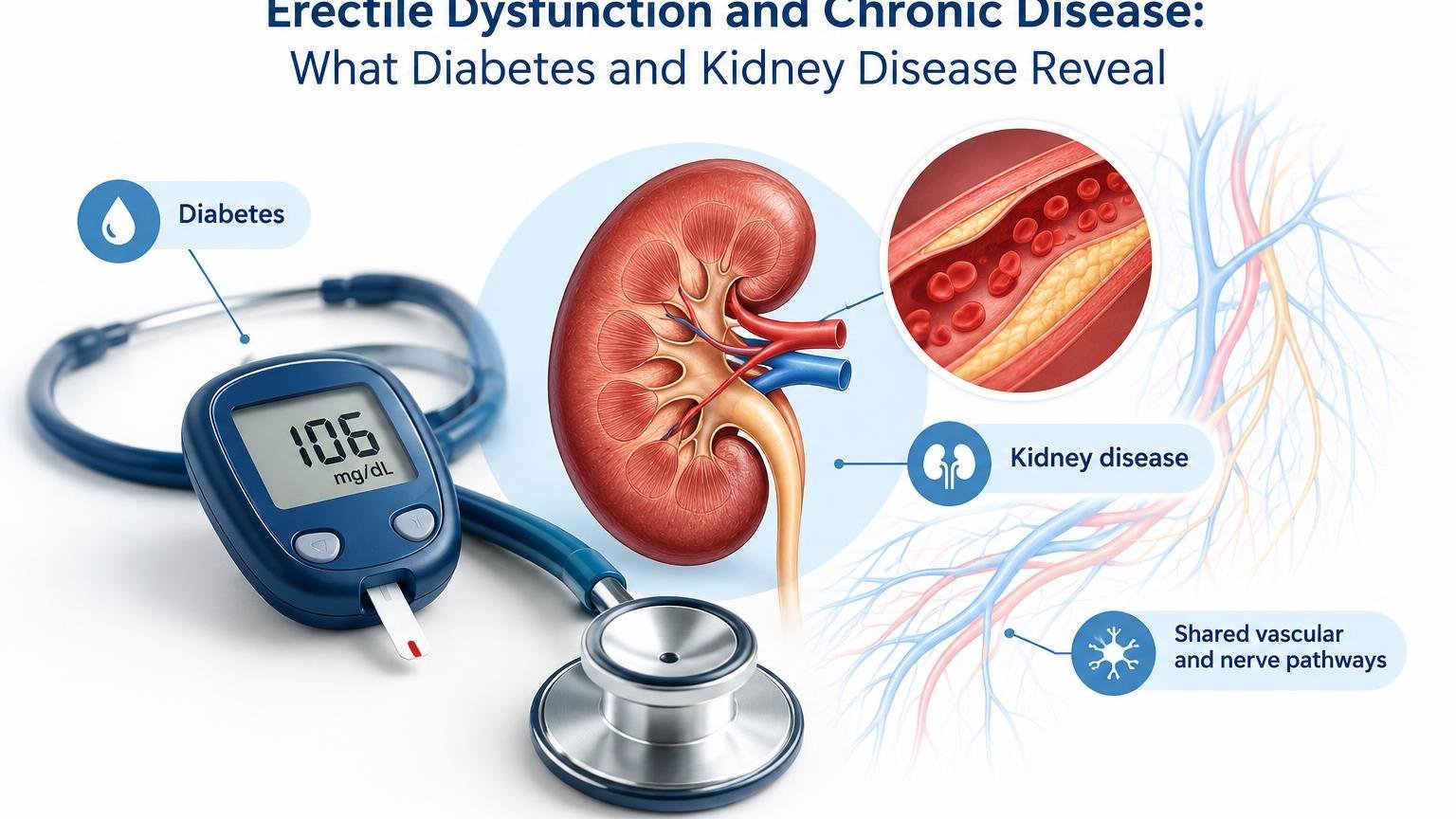
The shared biology is not mysterious. NIDDK notes that ED can have several causes at once and that diseases affecting blood vessels, nerves or hormones, along with medicines, mental and emotional issues and lifestyle behaviors, can all contribute. Diabetes and chronic kidney disease sit squarely inside that network. High blood glucose can damage blood vessels and nerves, and kidney disease rarely appears in isolation: it is frequently accompanied by diabetes, high blood pressure and other vascular problems that compound the same mechanisms.[2][3]
The numbers are striking but need careful reading. NIDDK reports that more than half of men with diabetes will develop ED and that men with diabetes are more than three times more likely to develop it than men without diabetes, often 10 to 15 years earlier. A 2026 systematic review and meta-analysis in BMC Nephrology estimated that sexual dysfunction affects 71.2% of people with chronic kidney disease. Those figures describe populations, not individuals, and they carry real limits.
This explainer walks through the mechanisms, the epidemiological evidence, the limitations that often get lost in headlines, and the treatment context that follows. It draws on NIDDK's patient-education material, a 2026 meta-analysis on sexual dysfunction in chronic kidney disease, a 2025 meta-analysis of male kidney transplant recipients, and a NIDDK-informed diabetes summary. It does not offer a diagnosis or a personalized treatment plan.
Why This Matters Beyond the Bedroom
Erectile dysfunction is sometimes the first sign of something more serious. NIDDK observes that ED may be a symptom of another health problem. In men with diabetes, sexual problems can be an early signal that blood sugar is not well controlled; in those with kidney disease, sexual dysfunction often overlaps with cardiovascular risk factors, medicines and mood changes that matter to overall health. Treating ED as a purely sexual concern risks missing the bigger picture.
The broader context is also useful. NIDDK cites research estimating that between 30 million and 50 million men in the United States have ED, that about 40% of men are affected at age 40, and that 70% report ED by age 70. The Massachusetts Male Aging Study, quoted in a treatment review, found that 52% of men aged 40 to 70 reported some degree of ED. These are not narrow, exotic populations; chronic-disease-associated ED is a mainstream clinical concern, which is precisely why distinguishing correlation from cause and statistically striking figures from practical ones matters.[4]
The Mechanisms: Vessels, Nerves and Hormones
An erection is a vascular and neurological event. It requires healthy blood flow and intact nerve signaling, and it depends on hormones that help sustain sexual desire and function. NIDDK explains that high blood glucose can damage blood vessels and nerves, and this damage can lead to sexual problems. Chronic hyperglycemia is therefore a plausible pathway to ED, and NIDDK states that good diabetes management may help prevent and treat ED caused by nerve damage and circulation problems. That language is deliberately hedged: it describes a possibility, not a guarantee for any individual.
Chronic kidney disease adds layers to the same story. NIDDK lists chronic kidney disease among chronic health conditions that can lead to ED, alongside obesity and overweight and chronic obstructive pulmonary disease. Kidney disease also intersects with diabetes, high blood pressure and atherosclerosis, all of which NIDDK identifies among the diseases and conditions that can lead to ED. The 2026 meta-analysis went further, noting that sexual dysfunction in kidney disease was linked with poorer mental and physical quality of life and greater depression severity, though that link does not establish which came first.
Medicines and hormones deserve explicit mention. NIDDK says ED can be a side effect of many prescription and over-the-counter medicines, including blood pressure medicines and diuretics, antidepressants, some pain relievers and sedatives. It also notes that men with diabetes, especially older overweight men, are more likely to have low testosterone and that testosterone therapy may carry serious risks and may not be safe for all men, so the choice belongs with a licensed provider. These factors matter because in chronic-disease populations they rarely appear one at a time.
What the Evidence Shows: Diabetes
The diabetes evidence is consistent enough to be clinically useful. NIDDK reports that more than half of men with diabetes will get ED and that men with diabetes are more than three times more likely to develop it than men without diabetes. Men with diabetes may develop ED 10 to 15 years earlier than men without diabetes. These are striking, but they come with an important statistical warning: they describe groups, and many men with diabetes never develop ED.
The source material points to a cluster of aggravating factors: high blood glucose that is not well controlled, nerve damage, untreated high blood pressure, untreated high cholesterol, overweight or obesity, low physical activity, certain medicines, excess alcohol and smoking. Several of these are modifiable, which is one reason the conversation belongs in routine diabetes care rather than in a specialist's office alone. That said, the evidence here is largely educational rather than trial-based; the specific NIDDK page on diabetes was last reviewed in 2018, a limitation the source itself acknowledges.
One nuance worth flagging: diabetes is linked with other sexual-health issues beyond ED, including retrograde ejaculation, Peyronie's disease and low testosterone. Unexplained sexual changes can therefore be an early clue that glucose metabolism is not where it should be, and NIDDK advises talking with a health care professional if symptoms of diabetes are present.
What the Evidence Shows: Chronic Kidney Disease
The kidney-disease evidence is larger and more recent, but also more heterogeneous. A 2026 systematic review and meta-analysis in BMC Nephrology pooled 44 studies covering 10,672 participants from 18 countries. The authors estimated that sexual dysfunction affected 71.2% of people with chronic kidney disease, with a 95% confidence interval of 65.9% to 76.3%. Two things matter for interpretation: the outcome was sexual dysfunction broadly rather than ED specifically, and the heterogeneity was very high, with an I-squared of 96.8%, meaning the exact percentage is less precise than a single number suggests.
| Group or variable | Reported estimate | What it reflects |
|---|---|---|
| All people with chronic kidney disease | 71.2% sexual dysfunction (95% CI 65.9% to 76.3%) | Pooled prevalence from 44 studies of 10,672 participants |
| Male kidney transplant recipients | 53.0% ED prevalence (95% CI 48.0% to 57.9%) | Pooled estimate from 28 studies of 3,520 recipients |
| Diabetes as a covariate in transplant recipients | Odds ratio 3.80 | Observational association, not causal proof |
| Between-study heterogeneity | I-squared 96.8% | Higher values mean pooled estimates should be interpreted cautiously |
A separate 2025 meta-analysis looked specifically at male kidney transplant recipients. Pooling 28 studies and 3,520 men, it found a pooled ED prevalence of 53.0%, with a 95% confidence interval of 48.0% to 57.9%. Diabetes was significantly associated with ED in that group, with an odds ratio of 3.80, and age was also associated. These are observational data: the odds ratio quantifies association, not causation, and it cannot tell a clinician whether treating diabetes will eliminate ED.
The transplant data also complicate a tempting narrative. In the 2026 review, the pooled rate of sexual dysfunction was lower after transplant than during hemodialysis or in the predialysis stage, and the difference across patient groups was statistically significant. Yet the 2025 transplant-specific review still found ED in about half of male recipients. The reasonable conclusion is that transplant may improve but does not eliminate sexual dysfunction, and that the drivers are multiple.
Interpreting the Evidence: Correlation, Heterogeneity and Clinical Meaning
A 71.2% pooled prevalence is arresting, and it is also easy to overread. The 2026 meta-analysis combined different measurement tools and populations, and its I-squared of 96.8% signals that substantial variation exists between studies. A pooled estimate is not a prediction for any one man; it is a central estimate across many contexts. Similarly, the 53.0% figure in transplant recipients is a group average from observational studies, and the diabetes odds ratio of 3.80 describes associations in that population rather than the effect of a treatment program.
The diabetes figures carry similar caveats. NIDDK's more-than-half and more-than-three-times statements are population-level statistics, and many men with diabetes will never develop ED. The claim that good diabetes management may help prevent and treat ED is a plausible and clinically reasonable statement, but NIDDK's own language uses 'may', signaling that it is not a guaranteed individual outcome. Reading the evidence honestly means holding two ideas at once: the overlap is real and actionable, and the precision of any individual prognosis is limited.
There is also a distinction between statistical and clinical significance. A 2025 Cochrane review of low-intensity shockwave therapy pooled 21 randomized trials with 1,357 men and found a small short-term effect that men may not notice and possible long-term improvement, but all of the evidence was rated low certainty. This kind of result illustrates why 'statistically detectable' and 'clinically meaningful for a given patient' are different questions, a distinction that applies across ED research.
Treatment Context: What Men Should Know
Treatment starts with finding the cause. NIDDK states that ED is diagnosed with a medical, sexual and mental health history, a physical exam, and lab and other tests. That process matters because in men with diabetes or kidney disease the relevant contributors may include blood sugar control, blood pressure, cholesterol, testosterone, medicines and mood. A doctor who finds those factors can address them alongside the sexual complaint rather than treating the complaint in isolation.
PDE5 inhibitors remain a common treatment for many men, but safety rules are non-negotiable. Never combine a PDE5 inhibitor with any nitrate, because the combination can cause a dangerous drop in blood pressure. People with kidney disease often take several blood pressure medicines, which can further lower blood pressure when combined with these drugs. Standard labels also include kidney-related dosing limits, and dialysis does not meaningfully speed clearance of some of these medicines. Only a licensed provider who knows a man's kidney function, full medicine list and heart health can decide whether a particular treatment is appropriate.
Beyond medication, NIDDK emphasizes healthy lifestyle changes: a healthy diet, regular physical activity, maintaining a healthy weight, limiting alcohol, quitting smoking and getting help for emotional or psychological problems. Research cited by NIDDK shows that a healthy diet can lower the risk of developing ED or improve symptoms, and that foods lowering the risk of diabetes, heart disease and obesity also help ED. These are supportive measures, not replacements for medical evaluation.
Limitations and Open Questions
The evidence base has real gaps. Much of the kidney-disease literature pools heterogeneous studies with different definitions and instruments, and the 2026 review's high heterogeneity limits how precisely its point estimate should be applied. NIDDK's patient-education pages are summaries rather than primary research, and the diabetes page was last reviewed in 2018. The transplant meta-analysis is observational, so its diabetes odds ratio cannot establish that treating diabetes prevents ED. None of these sources provides personalized prediction.
A further limitation concerns outcomes. Many studies measure sexual dysfunction broadly rather than ED specifically, and some rely on questionnaires that may not capture what men consider meaningful. The direction of some associations is also unresolved, as with the link between sexual dysfunction and depression. These uncertainties do not undermine the practical message; they refine it. The overlap between chronic disease and ED is well supported, while the precise numbers and causal pathways require continued research.
Research Outlook
Future work is likely to focus on three areas. First, better standardization of sexual-function measurement would make pooled prevalence estimates more comparable. Second, longitudinal studies could clarify whether improving glucose control or kidney function changes ED trajectories over time, rather than merely correlating with them. Third, treatment research in chronic-disease populations needs to account for the many overlapping causes, including medications and mood, that distinguish these groups from otherwise healthy men with ED.
Key Takeaways
- ED is not a routine part of aging, and it often signals an underlying health problem that deserves evaluation.
- Diabetes and chronic kidney disease are both linked to ED through vascular, neurological and hormonal pathways, and they frequently coexist with other risk factors.
- NIDDK reports that more than half of men with diabetes will develop ED and that they are more than three times more likely to do so than men without diabetes, often 10 to 15 years earlier.
- A 2026 meta-analysis estimated sexual dysfunction in 71.2% of people with chronic kidney disease, but high heterogeneity and broad outcome definitions mean the figure should not be read as an individual prognosis.
- PDE5 inhibitors must never be combined with nitrates, and kidney-related dosing limits exist; treatment decisions belong with a licensed provider who knows the full clinical picture.
Questions and Answers
How does diabetes cause erectile dysfunction?
NIDDK explains that high blood glucose can damage blood vessels and nerves, and this damage can lead to sexual problems. An erection depends on healthy nerve signals and blood flow, so injury to either system can interfere. Hormones, medicines, mood and lifestyle also contribute, and ED often has several causes at once rather than a single pathway.
How common is erectile dysfunction in men with diabetes?
NIDDK reports that more than half of men with diabetes will get ED and that they are more than three times more likely to develop it than men without diabetes, sometimes 10 to 15 years earlier. These are population-level figures; many men with diabetes never develop ED, and individual risk depends on blood sugar control, blood pressure, cholesterol, weight, activity, medicines, smoking and alcohol.
What percentage of people with chronic kidney disease have sexual dysfunction?
A 2026 meta-analysis pooling 44 studies and 10,672 participants estimated that sexual dysfunction affected 71.2% of people with chronic kidney disease, with a 95% confidence interval of 65.9% to 76.3%. The outcome was broad sexual dysfunction rather than ED alone, and between-study heterogeneity was high, so the figure describes groups rather than predicting any individual's experience.
Does sexual function improve after a kidney transplant?
The 2026 meta-analysis found a lower pooled rate of sexual dysfunction after transplant than during hemodialysis or in the predialysis stage. However, a separate 2025 review of 28 studies and 3,520 male transplant recipients still found a 53.0% pooled prevalence of ED. Transplant may improve sexual function but does not eliminate the problem, and individual outcomes vary.
Can men with kidney disease take erectile dysfunction medication?
Possibly, but only with a licensed provider's guidance. Labels include kidney-related dosing limits; for example, sildenafil exposure is about doubled in severe impairment, and tadalafil has specific limits for reduced creatinine clearance and dialysis. PDE5 inhibitors must never be combined with nitrates, and people with kidney disease often take multiple blood pressure medicines, so individual review is essential.
Is erectile dysfunction a normal part of aging or a sign of disease?
NIDDK states that ED is not a routine part of aging. While it becomes more common with age, it often reflects underlying conditions such as diabetes, kidney disease, vascular disease or medicine effects. NIDDK advises that ED may be a symptom of another health problem, which is why evaluation with a medical, sexual and mental health history, a physical exam and appropriate tests is worthwhile.
Sources and References
- Arthur L. Burnett. Erectile Dysfunction (ED) – NIDDK. 2024
- Chronic Kidney Disease and ED: Causes, Rates and Label Limits. BMC Nephrology
- Diabetes and Erectile Dysfunction: How the Two Are Linked. NIDDK
- Jen Adams; Josh Allen. Erectile Dysfunction Treatments: What the Evidence Shows. 2026
SANYUN Science Center explains published research on men's reproductive and sexual health, connecting scientific evidence with everyday questions while making sources and limitations clear.
Disclaimer: This article is for scientific education and research communication only. It does not provide medical advice, diagnosis, or individualized treatment recommendations, and does not endorse any medication, supplement, device, penile enlargement procedure, or other intervention. Decisions about sexual and reproductive health should be made in consultation with a qualified healthcare professional. Do not delay seeking professional care because of information in this article.
Original Content & Copyright Notice
- This article is prepared for SANYUN Science Center, drawing on published research and publicly available academic literature on men’s sexual and reproductive health. Its editorial explanations and presentation are developed for this platform.
- Copyright in the original editorial content, selection, and arrangement is reserved by SANYUN Science Center to the extent protected by applicable law. Referenced research, quotations, and third-party materials remain subject to the rights of their respective owners. This notice does not claim ownership of scientific facts or third-party research.
- Except where permitted by applicable law or an applicable license, prior written permission is required to reproduce, republish, translate, adapt, redistribute, or commercially reuse protected content. Attribution alone does not grant permission for such reuse.
- For permitted quotation or authorized reuse, clearly identify the source and retain a link to the original article.
- Source: SANYUN Science Center
- Original URL: Retain the original article URL on science.san-yun.com.
- Copyright Holder: SANYUN Science Center, for its own protected editorial content.
- Quotation, excerpts, or authorized reuse must not distort the scientific meaning, omit material limitations or disclaimers, or imply unverified medical claims, product efficacy, or endorsement by SANYUN Science Center.



