




Category: Penis Enlargement
Core Research Direction: Commercial and clinical claims about penile enlargement/augmentation techniques (hyaluronic acid filler, autologous fat graft, dermal grafting, suspensory-ligament lengthening) and what these commercial sources can and cannot establish
Search Intent: What do commercial clinic sources actually claim about penile enlargement procedures, durations, and outcomes, and what evidence limitations do those claims carry?
Platform: SANYUN Science Center
Evidence reviewed through: 2026-11-22
Executive Summary
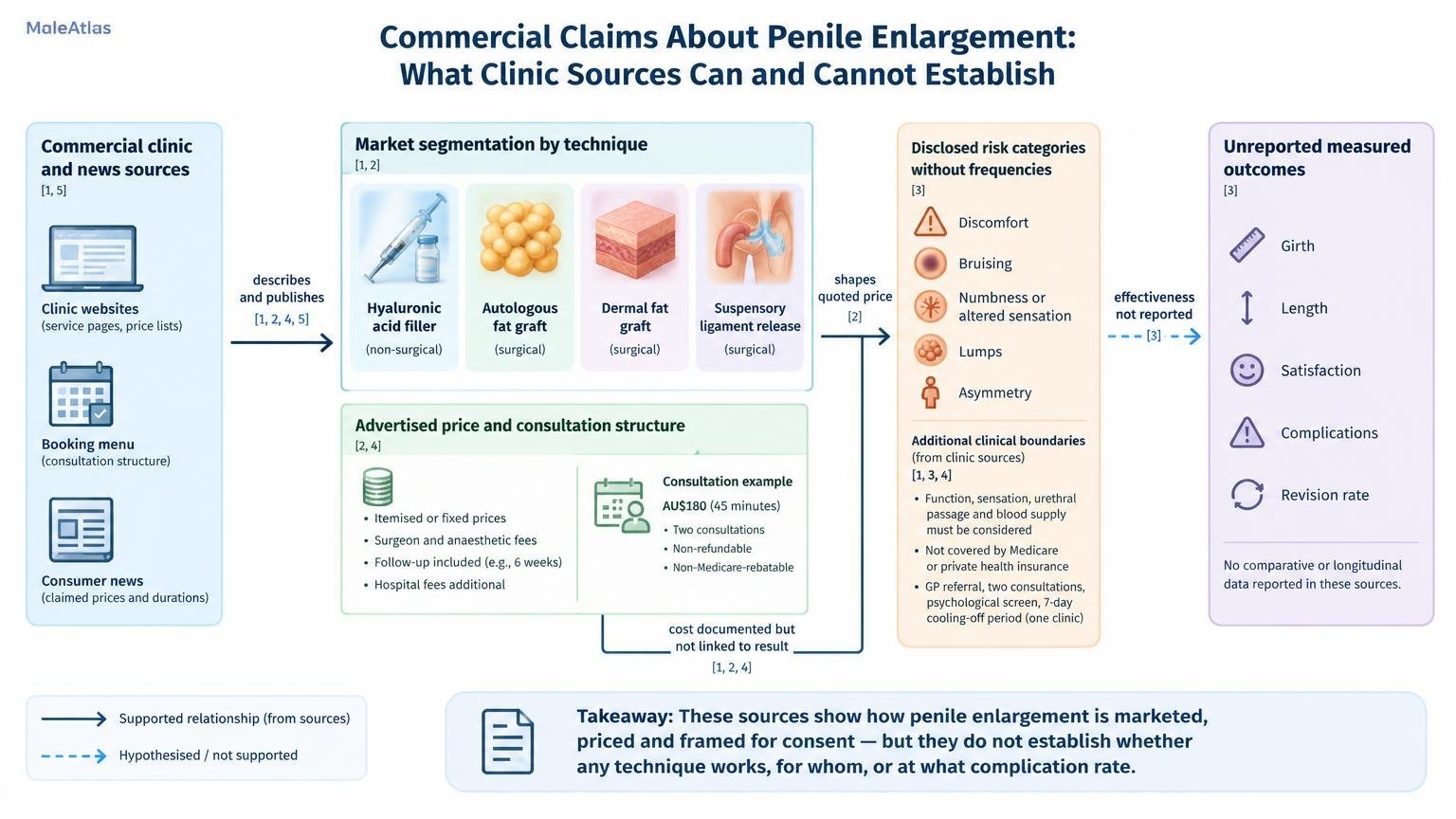
Commercial Australian sources describe penile augmentation not as one operation but as a family of distinct techniques, each with its own clinical context and its own plan built at consultation. The techniques named across the sources reviewed here are hyaluronic acid filler, autologous fat graft, dermal fat grafting, and surgical lengthening by releasing the suspensory ligament.[1][2]
What these sources mostly contain is commercial information: itemised or fixed price lists, consultation structures, eligibility rules and lists of stated risks. One clinic explicitly limits its non-surgical service to girth or shape and states that it does not increase penile length or treat erectile dysfunction — a scope boundary that is materially narrower than popular expectations of "enlargement".[3][4]
The central finding of this review is therefore about evidence type rather than about outcomes. These sources can show how procedures are marketed, priced and framed for consent; they cannot show whether the procedures work, for whom, or at what complication rate, because no comparative or longitudinal outcome data are reported. Consumer news adds claimed prices and durations but remains anecdotal secondary reporting.[5]
Readers should treat clinic pages as documentation of commercial practice and regulatory self-description. They are not clinical trials, guidelines, or independent assessments, and nothing in this article should be read as a claim that any listed technique is proven effective.
Why This Matters
Penile size concerns are common enough that a commercial market has formed around them, and the money involved is not trivial. Consumer reporting describes clinics pushing for a sale on a procedure claimed to cost up to US$30,000, while one listed surgical package for combined lengthening and thickening with dermal fat grafting is advertised at AU$17,990, excluding hospital fees.
That gap between a marketing claim and a verifiable price line is the practical problem. A man weighing a procedure needs to know whether the intervention changes a measured outcome, how often complications occur, and what happens when the effect fades. Commercial pages typically address cost and process far more thoroughly than they address measured benefit.
Consumer reporting also captures the psychosocial context that clinic pages rarely mention. One patient described feeling pressured toward cosmetic procedures by advertising and social media, and one surgeon declined to operate on a patient, telling him there was nothing wrong with his penis — a reminder that demand can be manufactured and that not every request should be met with an operation.
How the Techniques Are Described
The clearest conceptual point across these sources is terminological. One clinic describes penile augmentation as a family of techniques — hyaluronic acid filler, autologous fat graft, and surgical lengthening — selected according to anatomy and goals, and separately states that augmentation and lengthening are distinct procedures with distinct risk profiles.
A Sydney surgical clinic gives the mechanism-level description: thickening is achieved with the body's own tissue via fat grafting or dermal grafts, while lengthening involves releasing the suspensory ligament. These are descriptions of surgical intent, not demonstrations of durable measured gain.
The non-surgical branch is narrower than the category label suggests. One clinic states plainly that its non-surgical penile augmentation service concerns girth or shape and does not increase penile length or treat erectile dysfunction. A consumer news report describes the injectable version in similar mechanical terms: a gel-like substance injected while the man is fully erect after an injection, similar to material used in lips and cheeks.
Duration is where the consumer and clinic sources diverge most conspicuously. Consumer reporting states that a penile injection costing US$3,000 lasts only 18 months, after which the procedure must be repeated. No clinic page in this evidence set states a comparable measured durability figure, and the consumer figure carries no methodology, currency confirmation or location detail.
What the Price Lists Reveal
Prices are the most concrete data in these sources, which is itself diagnostic of their purpose. A Sydney clinic lists penile thickening with fat injection and one area of liposuction at AU$9,990, dermal fat grafting thickening at AU$15,990, a full lengthening-plus-thickening package with dermal fat grafting at AU$17,990, and a lengthening-plus-thickening package with fat injection and liposuction at AU$14,990. Each includes surgeon and anaesthetic fees and six weeks of follow-up, with hospital fees additional.
A different clinic takes the opposite commercial approach and refuses to publish a headline figure at all, arguing that a number quoted without context creates a false impression of equivalence between techniques and patients. Its written quotes itemise doctor, facility, anaesthesia or sedation, consumables, and after-care.
The same clinic's booking menu lists a tailored penile augmentation consultation for non-surgical techniques at AU$180 for 45 minutes, covering two consultations, non-refundable and non-Medicare-rebatable but redeemable against the procedure cost. Note that these price points are not a head-to-head comparison: they describe different services, different inclusions and different currencies of claim, and none is linked to an outcome.
| Procedure as listed | Advertised price | Stated inclusions | Stated exclusions |
|---|---|---|---|
| Penile thickening with fat injection and one area of liposuction | AU$9,990 | Surgeon fee, anaesthetic fee, 6 weeks follow-up | Hospital fees |
| Penile thickening with dermal fat grafting | AU$15,990 | Surgeon fee, anaesthetic fee, 6 weeks follow-up | Hospital fees |
| Full package penile lengthening and thickening with dermal fat grafting | AU$17,990 | Surgeon fee, anaesthetic fee, 6 weeks follow-up | Hospital fees |
| Full package penile lengthening and thickening with fat injection plus one area of liposuction | AU$14,990 | Surgeon fee, anaesthetic fee, 6 weeks follow-up | Hospital fees |
| Non-surgical penile augmentation consultation (45 minutes) | AU$180 | Two consultations, personalised quote; fee redeemable against procedure | Non-refundable, non-Medicare-rebatable |
Read as a group, the four surgical listings cluster in a relatively narrow band, but the differences track technique and tissue source rather than any documented difference in result. Nothing in the price list states expected gain, revision rate or complication frequency.
Clinical Boundaries and Stated Risks
The most clinically useful material in these sources is not the pricing but the boundary-setting. One clinic states that function, sensation, the urethral passage and blood supply to the soft tissues must all be considered in assessment — the anatomical structures genuinely at stake in any penile procedure.
Stated risks include discomfort, bruising, numbness or altered sensation, lumps and asymmetry. Separately, a surgical clinic states that some temporary changes in sensation may occur during healing, that most patients do not report long-term changes, and that this varies between individuals — a hedged formulation without a denominator.
The regulatory framework described by one clinic is unusually specific for a commercial page: a GP referral, two separate consultations with the treating doctor, a psychological screen for body dysmorphic disorder, and a seven-day cooling-off period before a procedure can be booked. The same clinic states that cosmetic penile augmentation is not covered by Medicare or private health insurance in Australia, and frames doing nothing as a legitimate option for some patients after discussion of anatomy, goals and realistic outcomes.
These are self-descriptions by an interested party, not an independent audit of compliance. The underlying regulatory documents were not included in the evidence reviewed here, so the requirements should be checked against the relevant authority rather than accepted from a clinic page.
What These Sources Cannot Establish
The central limitation is structural. A price list, a booking menu, a service page and a consumer news item share one property: none reports a defined patient cohort followed for a defined period with a measured outcome. There is no reported girth or length measurement, no satisfaction instrument, no comparator group, no complication rate and no revision rate in this evidence set.
The consumer news material is weaker still. Claims of a US$3,000 injection lasting 18 months and procedures costing up to US$30,000 are journalistic assertions without stated methodology, and the currency and location of pricing are not specified in the source. A single anecdotal case of a surgeon declining to operate cannot support any inference about how often surgery is appropriately refused.
Statement of the risk profile is another limit worth naming precisely. A clinic listing numbness, lumps and asymmetry has disclosed categories of harm but not their frequency, severity or reversibility. Without denominators, a reader cannot distinguish a rare event from a common one, and a hedged phrase such as most patients do not report long-term sensation changes cannot be quantified from the page alone.
Finally, duration claims deserve separate scrutiny. A stated 18-month effect implies repeat treatment and cumulative cost, but no clinic source in this set confirms, contradicts or quantifies that figure. Repeat-treatment burden is therefore an open question rather than an established property of injectable augmentation.
Interpreting the Commercial Signal
Commercial framing is informative in its own right. The contrast between a clinic that publishes itemised surgical prices and a clinic that refuses any headline figure shows that "transparency" in this market is contested even at the level of how a quote is structured. Both approaches can be defended; neither substitutes for outcome reporting.
The price architecture also hints at where clinical complexity is thought to lie. Dermal grafting is priced above fat injection in the same clinic's list, and combined lengthening-plus-thickening packages sit above single-modality thickening. These are commercial valuations of technique, not evidence that the more expensive option produces a better or safer result.
One clinic's emphasis that not everyone who enquires is a suitable candidate, and that doing nothing may be appropriate, is a useful counterweight to the demand-side pressure described in consumer reporting. But it remains a statement of intent made by the provider, and the evidence reviewed here offers no way to verify how often that intent translates into a declined procedure.
Research Outlook
Progress in this field depends on study designs these sources do not contain. Prospective cohorts with standardised measurement, defined follow-up intervals, validated satisfaction and function instruments, and complete complication and revision reporting would begin to answer the questions that price lists cannot. Comparison against no treatment, or against a sham or alternative technique, would be needed before any technique could be described as effective rather than merely offered.
Until such data exist, the appropriate posture for readers and clinicians is to separate three questions that commercial pages tend to merge: is the procedure available and at what price, what are the disclosed categories of risk, and does it produce a measured benefit. The first two can be answered from these sources; the third cannot.
Key Takeaways
- Commercial Australian sources describe penile augmentation as a family of distinct techniques, including hyaluronic acid filler, autologous fat graft, dermal fat grafting and suspensory-ligament release for lengthening.
- At least one clinic explicitly limits its non-surgical service to girth or shape and states it does not increase length or treat erectile dysfunction.
- Listed surgical prices range from AU$9,990 for fat-injection thickening to AU$17,990 for a combined lengthening and dermal-graft thickening package, with hospital fees additional in each case.
- Consumer reporting claims a US$3,000 injection with an 18-month effect and procedures costing up to US$30,000, but provides no methodology, currency confirmation or outcome data.
- Stated risks include discomfort, bruising, numbness or altered sensation, lumps and asymmetry, without reported frequencies or denominators.
- None of these sources reports measured outcomes, comparators, complication rates or revision rates, so they cannot establish that any technique works.
Questions and Answers
What techniques are marketed as penile enlargement in Australia?
Australian clinic sources list several distinct approaches: hyaluronic acid filler injection, autologous fat grafting, dermal fat grafting, and surgical lengthening by releasing the suspensory ligament. One clinic stresses that these are different procedures with different risk profiles rather than a single operation, and that its non-surgical service addresses girth or shape only, not length or erectile function.
Do commercial penile enlargement clinic pages prove the procedures work?
No. The sources reviewed here are price lists, service pages, booking menus and consumer news. They report no defined patient cohort, no measured girth or length change, no satisfaction scores, no comparator group and no complication or revision rates. They can document commercial practice and stated risks, but they cannot establish effectiveness or safety at a measurable level.
How much do penile thickening and lengthening procedures cost in Australia?
One Sydney clinic lists AU$9,990 for fat-injection thickening with one area of liposuction, AU$15,990 for dermal fat grafting thickening, AU$14,990 for combined lengthening and thickening with fat injection, and AU$17,990 for combined lengthening and thickening with dermal fat grafting. Each includes surgeon and anaesthetic fees and six weeks of follow-up, with hospital fees additional. A separate clinic lists a 45-minute non-surgical consultation at AU$180.
How long does injectable penile filler last, according to these sources?
Only consumer news in this evidence set states a duration: it reports that a penile injection costing US$3,000 lasts only 18 months, after which the procedure must be repeated. That claim carries no methodology, and the currency and location are not specified. No clinic source reviewed here confirms, contradicts or quantifies the durability of injectable augmentation.
What risks do penile augmentation clinics disclose?
Clinic sources list discomfort, bruising, numbness or altered sensation, lumps and asymmetry, and state that function, sensation, the urethral passage and soft-tissue blood supply must be considered. One page adds that temporary sensation changes may occur during healing, with most patients not reporting long-term changes. None of these sources reports how often any complication occurs or how severe it tends to be.
What regulatory steps does an Australian cosmetic penile procedure involve?
One clinic states that Australian Medical Board guidelines require a GP referral, two separate consultations with the treating doctor, a psychological screen for body dysmorphic disorder, and a seven-day cooling-off period before booking. The same clinic says cosmetic penile augmentation is not covered by Medicare or private insurance. These are clinic self-descriptions; the primary regulatory documents were not part of the evidence reviewed.
Conceptual framework: Conceptual framework, not a tested causal model. It maps the variables described in commercial clinic pages and consumer news: technique segmentation, quoted prices and consultation structure, disclosed risk categories, and the measured outcomes those sources do not report. Relationships reflect what the sources state, not demonstrated effectiveness or safety.
Academic References & Evidence
- Penile augmentation cost in Australia | RevAesthetic.
- Genital & Intimate Surgery Sydney | Specialist Plastic Surgery.
- Penile Augmentation in Melbourne — Chadstone | RevAesthetic.
- RevAesthetic | Chadstone | VIC.
- La moda de inyectarse relleno de pene.
SANYUN Science Center explains published research on men's reproductive and sexual health, connecting scientific evidence with everyday questions while making sources and limitations clear.
Disclaimer: This article is for scientific education and research communication only. It does not provide medical advice, diagnosis, or individualized treatment recommendations, and does not endorse any medication, supplement, device, penile enlargement procedure, or other intervention. Decisions about sexual and reproductive health should be made in consultation with a qualified healthcare professional. Do not delay seeking professional care because of information in this article.
Original Content & Copyright Notice
- This article is prepared for SANYUN Science Center, drawing on published research and publicly available academic literature on men’s sexual and reproductive health. Its editorial explanations and presentation are developed for this platform.
- Copyright in the original editorial content, selection, and arrangement is reserved by SANYUN Science Center to the extent protected by applicable law. Referenced research, quotations, and third-party materials remain subject to the rights of their respective owners. This notice does not claim ownership of scientific facts or third-party research.
- Except where permitted by applicable law or an applicable license, prior written permission is required to reproduce, republish, translate, adapt, redistribute, or commercially reuse protected content. Attribution alone does not grant permission for such reuse.
- For permitted quotation or authorized reuse, clearly identify the source and retain a link to the original article.
- Source: SANYUN Science Center
- Original URL: Retain the original article URL on science.san-yun.com.
- Copyright Holder: SANYUN Science Center, for its own protected editorial content.
- Quotation, excerpts, or authorized reuse must not distort the scientific meaning, omit material limitations or disclaimers, or imply unverified medical claims, product efficacy, or endorsement by SANYUN Science Center.



