




Category: Latest Research
Core Research Direction: Recent clinical research on male sexual and reproductive health reported in the June 2026 issue of The Journal of Sexual Medicine, with emphasis on erectile dysfunction, ejaculatory function, pelvic floor training, and sexual function after benign prostatic hyperplasia or gender-affirming surgery
Search Intent: What does the latest research in a leading sexual medicine journal find about treating male erectile and ejaculatory dysfunction, and how strong is that evidence?
Platform: SANYUN Science Center
Evidence reviewed through: 2026-11-25
Executive Summary
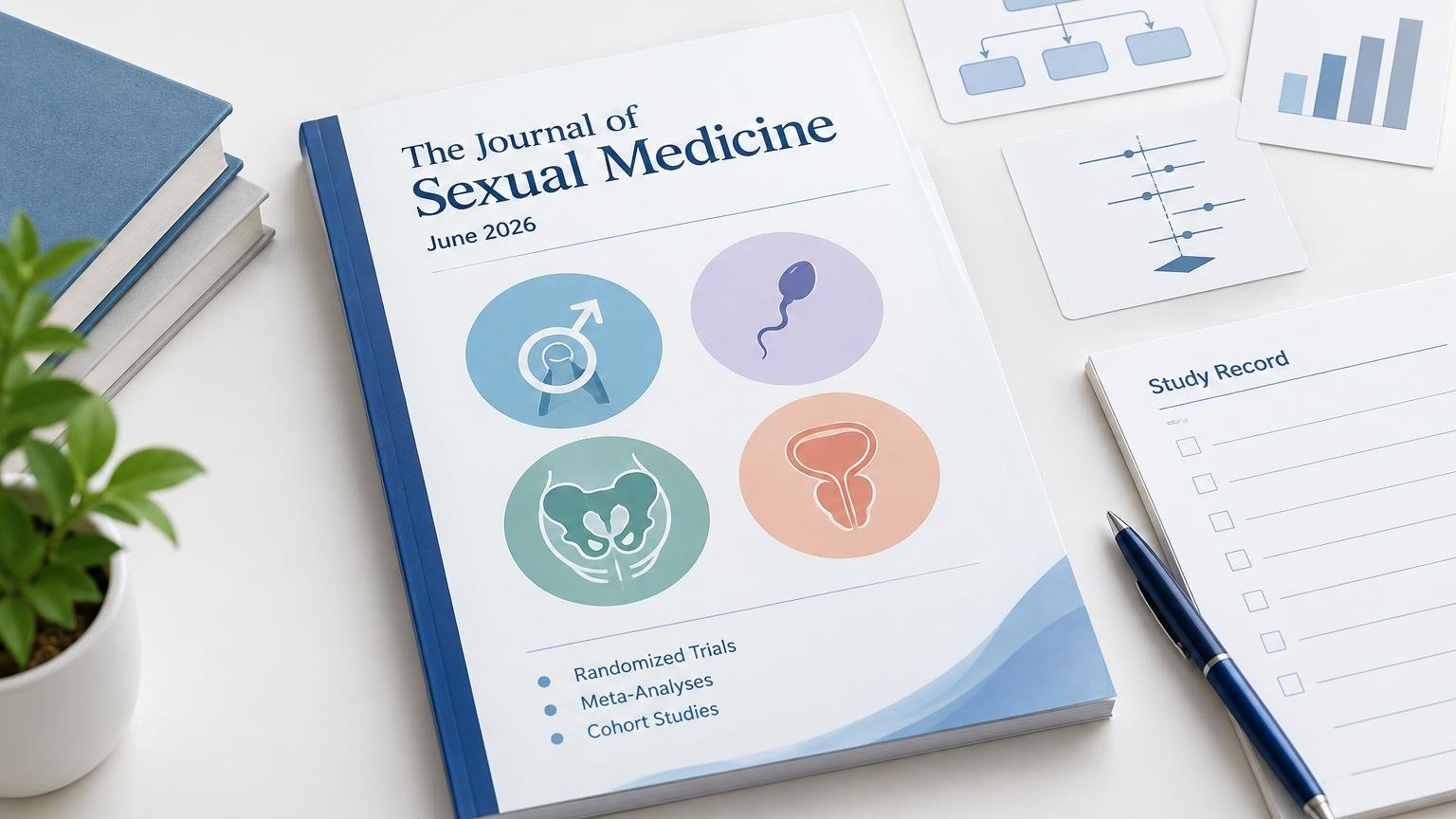
The June 2026 issue of The Journal of Sexual Medicine is indexed with a cluster of studies directly relevant to male sexual and reproductive health: a phase 2 trial of simenafil in men with erectile dysfunction; a systematic review and meta-analysis of pelvic floor muscle training for premature ejaculation; a randomized three-way crossover study of benzocaine paste-containing latex condoms; a meta-analysis of lifestyle interventions for erectile dysfunction; a cohort comparison of five-year sexual function outcomes after Rezum versus drugs for benign prostatic hyperplasia; and several studies of inflatable penile prosthesis surgery and associated risks. A separate review addresses sexual function and orgasm before and after gender-affirming hysterectomies.[1][2]
This article is an updated evidence review of the retrieved publication record, not a report of new findings. The available text supplies titles, study designs and publication metadata but no sample sizes, effect estimates, confidence intervals, adverse-event counts or follow-up values. The central message is therefore methodological: the issue signals where randomized and pooled evidence is being generated, while the strength of any clinical claim cannot be judged until the full reports are read. Nothing here should be interpreted as showing that any intervention works.
For clinicians and readers, the useful questions are not only what each study found but what its design can and cannot establish. A phase 2 trial is typically intended to test dose and early signal, not to license broad claims. A meta-analysis of randomized trials can provide stronger pooled evidence but is only as trustworthy as its included trials, its risk-of-bias handling and its prespecified outcomes. Associational studies and pilot surgical series cannot establish causation or comparative superiority.
Why This Matters
Erectile dysfunction and ejaculatory disorders are common reasons for clinical consultation, and men often encounter a fragmented market of drugs, devices, behavioral advice and online claims. A leading specialty journal's issue is a useful checkpoint because it lists what investigators themselves consider testable questions. The presence of randomized trials and systematic reviews matters: these designs are intended to reduce bias and to separate a real treatment effect from placebo response, natural fluctuation or selective reporting.
The issue also illustrates how broad the term sexual function is. It spans erectile function, ejaculatory latency, sexual function after prostate treatments, sexual function after gender-affirming surgery, psychological care access and device surgery. Each outcome requires a different measurement approach, and improvements in one domain do not automatically translate into improvements in another. That distinction is central to reading headlines that collapse several endpoints into a single claim of improved sexual health.
Mechanisms and Study Designs: What Each Article Can Test
Simenafil is listed as the subject of a multicenter, randomized, double-blind, placebo-controlled, fixed-dose, parallel-group phase 2 trial in men with erectile dysfunction. This design can test whether a fixed dose separates from placebo on a prespecified efficacy measure while monitoring safety in a controlled population. It does not by itself establish long-term effectiveness, comparative advantage over existing treatments, or performance in men with complex comorbidities. The retrieved record provides no dose, sample size or outcome values, so the trial's results remain unknown here.
Pelvic floor muscle training is the subject of a systematic review and meta-analysis of randomized controlled trials for premature ejaculation. Pelvic floor training is a behavioral approach, and pooling randomized trials can estimate average effects on ejaculatory latency and related outcomes if the trials are comparable and adequately reported. The record gives no pooled effect estimates, number of trials or participant totals. It therefore supports the statement that the question has been systematically reviewed—not that training is effective, ineffective, safe or superior to other approaches.
A randomized three-way crossover study examined benzocaine paste-containing natural rubber latex condoms for prolonging ejaculatory latency. Crossover designs can be efficient because each participant contributes to more than one condition, reducing between-person variability. They also require careful handling of carryover effects and sequence, and condom-based interventions raise practical questions about acceptability, sensation and correct use. The available text supplies no latency values, no sample size and no adverse-event data, so no claim about magnitude or safety can be made.
Lifestyle interventions for erectile dysfunction are covered by a systematic review and meta-analysis of randomized controlled trials. This is an important question because lifestyle change is often presented as a foundational intervention, but its evidence base depends on the intensity, duration and adherence achieved in trials, and on whether outcomes are measured with validated instruments. The record contains no effect sizes or trial counts. Readers should treat lifestyle advice as a legitimate area of randomized study while withholding judgment on the size of benefit until the pooled analysis is examined.
A cohort analysis from the Medical Therapy of Prostatic Symptoms Trial compared sexual function outcomes after five years of treatment with Rezum, doxazosin, finasteride or combination drug therapy in men with benign prostatic hyperplasia. Cohort data from a trial population can describe long-term associations, but treatment groups are not necessarily equivalent to randomized comparisons for every sexual outcome, and the record provides no group sizes or outcome values. The article is best understood as a long-horizon comparison question, not as evidence that one strategy preserves sexual function better than another.
What the Evidence Shows—and What the Record Does Not Show
The retrieved record establishes the existence and stated design of several studies but does not report their results. For the phase 2 simenafil trial, no efficacy or safety outcome is available. For the pelvic floor training meta-analysis, no pooled effect estimate is available. For the benzocaine condom crossover study, no ejaculatory latency measurement is available. For the lifestyle meta-analysis, no effect size is available. For the five-year benign prostatic hyperplasia cohort comparison, no sexual function outcome values are available. These are evidence gaps in the available text, not findings of no effect.
| Article focus | Design stated in the record | Population or setting | What the record cannot establish |
|---|---|---|---|
| Simenafil for erectile dysfunction | Multicenter randomized, double-blind, placebo-controlled, fixed-dose, parallel-group phase 2 trial | Men with erectile dysfunction | Efficacy, safety, dose response, sample size and durability |
| Pelvic floor muscle training for premature ejaculation | Systematic review and meta-analysis of randomized controlled trials | Men with premature ejaculation | Pooled effect size, trial count, heterogeneity and certainty |
| Benzocaine paste-containing latex condoms | Randomized three-way crossover study | Men using the condoms | Latency change, sample size, carryover and adverse events |
| Lifestyle interventions for erectile dysfunction | Systematic review and meta-analysis of randomized controlled trials | Men with erectile dysfunction | Effect size, trial quality and clinical importance |
| Sexual function after benign prostatic hyperplasia therapy | Cohort data from the Medical Therapy of Prostatic Symptoms Trial, five-year treatment | Men with benign prostatic hyperplasia | Comparative outcome values, group sizes and causal treatment effects |
| Sexual function and orgasm before and after gender-affirming hysterectomy | Review article | People undergoing gender-affirming hysterectomy | Outcome estimates, sample data and certainty of synthesized evidence |
The surgical studies in the issue address device-related questions: whether a 24-hour closed-suction drain reduces infection and hematoma after inflatable penile prosthesis surgery, and a prospective pilot study of a TYRX antibacterial envelope in the same setting. These are clinically important because device infection and hematoma are serious complications, but a comparative study title and a pilot title do not provide rates or comparative statistics. Pilot studies are generally exploratory and underpowered for definitive safety conclusions, so they should be read as hypothesis-generating.
Two studies in the issue illustrate adjacent areas where association and risk prediction dominate. One examined prevalence and predictors of bone density loss in men with low testosterone; another examined the association between phosphodiesterase type 5 inhibitor use and fracture risk in older men. Neither record supplies estimates. An association study cannot establish that a drug causes or prevents fractures; confounding by indication, health status and lifestyle are plausible. Similarly, prevalence and predictor studies describe patterns and generate hypotheses about monitoring rather than proving a causal pathway.
Interpretation and Limitations
The most important limitation is that this review was written from a publication listing and bibliographic records, not from complete trial reports. Titles can tell us the design and the question, but not the answer. Even a well-described randomized trial can produce a null result, a modest result or an implausible result; a meta-analysis can be limited by small trials, publication bias or inconsistent outcome definitions. Readers should look for sample size, prespecified primary outcomes, effect estimates with confidence intervals, adverse events and the handling of missing data before drawing clinical conclusions.
A second limitation concerns populations and applicability. Men with erectile dysfunction in a phase 2 trial are not identical to men seen in general practice with diabetes, cardiovascular disease or multiple medications. Premature ejaculation trials may use different definitions and outcome measures, making pooled estimates difficult to translate. The benign prostatic hyperplasia cohort is drawn from a specific trial population, and the gender-affirming hysterectomy review addresses a different anatomy and outcome set. Generalization requires matching the study population and outcome to the person and question at hand.
A third limitation is the separation of statistical from clinical significance. A meta-analysis can report a statistically significant pooled change that is too small for an individual to notice or value. Conversely, a trial can miss statistical significance because it is underpowered while still suggesting a useful signal. Without the actual estimates, neither possibility can be judged. The correct interpretation of the June 2026 listing is that these questions have reached a level of methodological sophistication that warrants careful reading of the full papers, not that the questions are settled.
The gender-affirming hysterectomy review is identified in a bibliographic record with a text publication date of 2026-02-05; that date should not be confused with later record updates. The review record also cites earlier work noting that evaluation of sexual functioning in transmasculine adults has been limited by a lack of brief screening measures, and a psychometric evaluation aiming to develop such a measure. Those cited statements are context about measurement, not results of the review itself.
Research Outlook
Several near-term questions follow from the issue. For simenafil, the field will need the phase 2 efficacy and safety results, including dose selection and adverse events, before any phase 3 program can be interpreted. For pelvic floor training and lifestyle interventions, the meta-analyses should be judged by their search strategies, risk-of-bias assessments, heterogeneity and whether outcomes were patient-important. For condom-delivered benzocaine, replication and comparison with established topical strategies will matter, alongside acceptability and safety data. For surgical infection prevention, adequately powered comparative studies are needed before practice claims are made.
The broader outlook is that male sexual medicine is accumulating randomized and pooled evidence across pharmacological, behavioral, device and lifestyle domains, but the clinical value of each advance depends on transparent reporting. A listing of studies is a starting point for critical appraisal. It is not a substitute for reading the full reports, checking whether outcomes were prespecified, and asking whether the observed effect would matter to a patient. That discipline is especially important in a field where hope, stigma and commercial interest can all distort interpretation.
Key Takeaways
- The June 2026 issue lists a phase 2 randomized trial of simenafil for erectile dysfunction, but the retrieved record contains no efficacy, safety, sample size or follow-up data.
- A systematic review and meta-analysis of pelvic floor muscle training for premature ejaculation is listed, but no pooled effect estimates or trial counts are available in the record.
- A randomized three-way crossover study of benzocaine paste-containing latex condoms and a meta-analysis of lifestyle interventions for erectile dysfunction are listed, but neither record provides outcome values.
- A five-year cohort comparison of sexual function after Rezum versus drug therapy for benign prostatic hyperplasia is listed, but no comparative outcome values are supplied.
- Surgical studies of drains and antibacterial envelopes in inflatable penile prosthesis surgery, and a review of sexual function after gender-affirming hysterectomy, are identified without result data; design alone does not establish benefit or safety.
Questions and Answers
What is simenafil and what did the June 2026 sexual medicine trial test?
The retrieved record lists simenafil as the subject of a multicenter, randomized, double-blind, placebo-controlled, fixed-dose, parallel-group phase 2 trial in men with erectile dysfunction. That design can test early efficacy and safety against placebo, but the available text provides no dose, sample size, outcome values or adverse-event data. It therefore does not establish that simenafil works or is safe.
Does pelvic floor muscle training improve premature ejaculation according to the June 2026 meta-analysis?
The issue lists a systematic review and meta-analysis of randomized controlled trials on pelvic floor muscle training for premature ejaculation, so the question has been formally pooled. However, the retrieved record supplies no pooled effect estimate, trial count, heterogeneity result or certainty rating. The correct answer from this record is that the evidence has been synthesized but its direction and size cannot be judged here.
How strong is the evidence for lifestyle interventions in erectile dysfunction?
The record identifies a systematic review and meta-analysis of randomized controlled trials on lifestyle interventions for erectile dysfunction. That design is generally stronger than single-arm or observational evidence, but strength also depends on trial quality, outcome measurement and consistency. No effect sizes or trial numbers are given in the available text, so the magnitude and clinical importance of any benefit remain unknown.
Can benzocaine condoms prolong ejaculatory latency in premature ejaculation?
A randomized three-way crossover study examined benzocaine paste-containing natural rubber latex condoms for prolonging ejaculatory latency. Crossover designs can be efficient, but the retrieved record reports no latency values, sample size, carryover analysis or adverse events. The study design supports the plausibility of the question, not a conclusion that these condoms are effective or safe for any individual.
What does the five-year benign prostatic hyperplasia cohort show about sexual function after Rezum versus drug therapy?
The record lists a cohort analysis from the Medical Therapy of Prostatic Symptoms Trial comparing sexual function outcomes after five years of Rezum, doxazosin, finasteride or combination therapy in men with benign prostatic hyperplasia. It provides no group sizes, outcome values or statistical comparisons. Cohort data can describe associations, but the available text does not show that one strategy preserves sexual function better than another.
What are the limitations of reading June 2026 sexual medicine research from publication listings?
A listing gives titles and stated designs but not results, sample sizes, effect estimates, confidence intervals, adverse events or follow-up. It cannot distinguish a positive trial from a null one, a well-conducted meta-analysis from a fragile one, or an association from causation. Full reports and critical appraisal are required before any clinical claim is made, and this review deliberately avoids treating study titles as evidence of benefit.
Sources and References
- Yuzhuo Yang; Tao Jiang; Lianming Zhao; Xiansheng Zhang; Junhong Deng; Yutian Dai; Huiliang Zhou; Jiaxiang Juan; Huaqing Duan; Hui Jiang. June 2026 – Volume 23 – Issue 6 : The Journal of Sexual Medicine. The Journal of Sexual Medicine. 2026 23(6)
- Katarina Q Watson; Allison J De Moya; Maria Wangamez; Tami S Rowen. Matilda – Sexual function and orgasm experience pre- and post-gender-affirming hysterectomies.. The Journal of Sexual Medicine. 2026 23(2) DOI: 10.1093/jsxmed/qdag012. PMID: 41640050.
SANYUN Science Center explains published research on men's reproductive and sexual health, connecting scientific evidence with everyday questions while making sources and limitations clear.
Disclaimer: This article is for scientific education and research communication only. It does not provide medical advice, diagnosis, or individualized treatment recommendations, and does not endorse any medication, supplement, device, penile enlargement procedure, or other intervention. Decisions about sexual and reproductive health should be made in consultation with a qualified healthcare professional. Do not delay seeking professional care because of information in this article.
Original Content & Copyright Notice
- This article is prepared for SANYUN Science Center, drawing on published research and publicly available academic literature on men’s sexual and reproductive health. Its editorial explanations and presentation are developed for this platform.
- Copyright in the original editorial content, selection, and arrangement is reserved by SANYUN Science Center to the extent protected by applicable law. Referenced research, quotations, and third-party materials remain subject to the rights of their respective owners. This notice does not claim ownership of scientific facts or third-party research.
- Except where permitted by applicable law or an applicable license, prior written permission is required to reproduce, republish, translate, adapt, redistribute, or commercially reuse protected content. Attribution alone does not grant permission for such reuse.
- For permitted quotation or authorized reuse, clearly identify the source and retain a link to the original article.
- Source: SANYUN Science Center
- Original URL: Retain the original article URL on science.san-yun.com.
- Copyright Holder: SANYUN Science Center, for its own protected editorial content.
- Quotation, excerpts, or authorized reuse must not distort the scientific meaning, omit material limitations or disclaimers, or imply unverified medical claims, product efficacy, or endorsement by SANYUN Science Center.



