




Category: Penis Enlargement
Core Research Direction: Evidence quality, measured outcomes, and risks of penile lengthening and girth-enhancement procedures (surgical, injectable, and implant-based) in men, including those with normal penile dimensions and small penis syndrome
Search Intent: What do clinical studies actually show about how much penile augmentation procedures add in length or girth, for whom, and with what complications and evidence limitations?
Platform: SANYUN Science Center
Evidence reviewed through: 2026-11-22
Executive Summary
Published evidence on penile lengthening and girth enhancement is thin, methodologically uneven and marked by a gap between the surgeons who perform these operations and those who report their results. A 2025 narrative review in the Journal of Urological Surgery, compiled by the Andrology Working Group of the Society of Urological Surgery in Turkiye, concluded that the literature remains limited, frequently centres on complications from unlicensed or illegitimate interventions, and has yet to establish scientific consensus. The authors argue for caution and meticulous patient selection rather than wider adoption.[1][2]
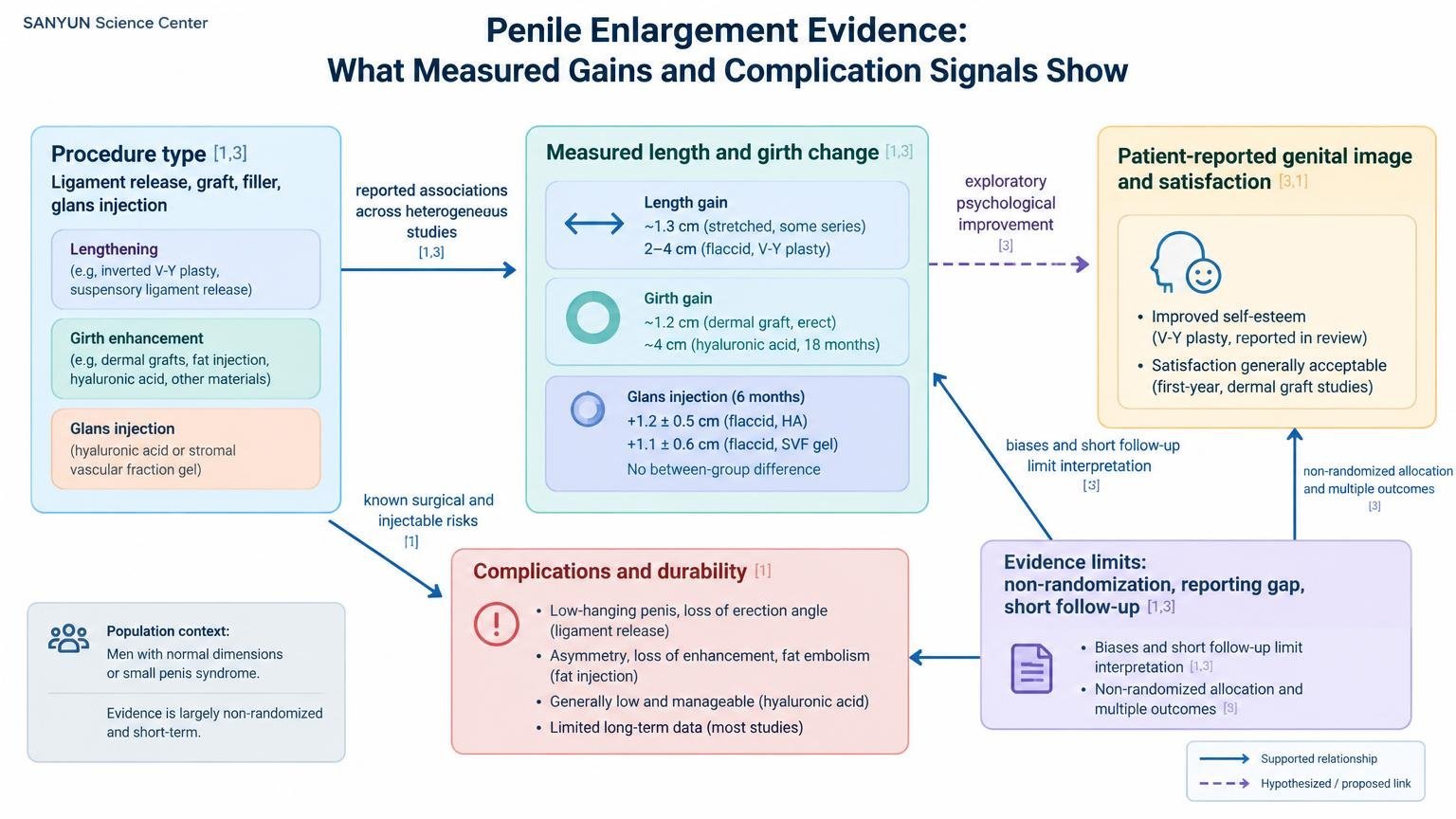
Where numbers exist, they are modest and inconsistent. Cited lengthening series report a mean 1.3 cm gain in stretched penile length with a risk of 1 cm shortening in some patients, and 2 to 4 cm of flaccid lengthening after V-Y plasty with suspensory ligament release. For girth, cited figures include a mean 1.2 cm increase in erect girth with dermal grafts and a mean 4 cm increase sustained over 18 months with hyaluronic acid filler in a feasibility study that evaluated 41 of 50 enrolled patients.
A separate small pilot study of glans penis augmentation in men with small penis syndrome reported 6-month flaccid glans circumference gains of 1.2 ± 0.5 cm with hyaluronic acid and 1.1 ± 0.6 cm with a mechanically processed stromal vascular fraction gel, with no between-group difference. The design was non-randomized, unblinded and single-centre, and the authors label their psychological finding exploratory.[3]
Why This Matters
The central population in this literature is not men with a diagnosed congenital anomaly but men whose measured dimensions fall within the normal range and who remain dissatisfied. The review specifically notes that the cited lengthening studies reported results in men with normal penile length, which it identifies as the main reason penile enlargement is sought for aesthetic purposes. For that group, the relevant question is whether a modest measured change justifies surgical risk, cost and the possibility that benefit reverses.
Small penis syndrome is defined in the pilot study as persistent anxiety about inadequate penile size despite normal measured dimensions, producing distress and avoidance of intimacy. Its authors state that psychological counseling remains the first-line approach while many patients continue to pursue physical enlargement. That framing places expectation management and psychological assessment at the centre of ethical care rather than at its margins, and it explains why validated patient-reported measures appear alongside tape measurements in newer studies.
Biological and Surgical Mechanisms
Lengthening procedures aim to increase visible or measurable shaft length. Suspensory ligament release divides the main component of the penile suspensory ligament complex, sometimes with dorsal skin advancement or inverted V-Y plasty, so that the penis sits more caudally. The review notes there is no consensus on predicting how much length division of the ligament will yield, and describes magnetic resonance imaging only as a promising predictive modality rather than an established selection tool. Technical variations, such as cross-closing the incision or filling the dead space with flaps or biocompatible material, are intended to prevent scar tethering and re-attachment that can cause de novo shortening.
Girth enhancement uses four broad material strategies. Autologous dermal and dermal-fat grafts are fixed to the tunica albuginea after degloving. Autologous fat injection places processed lipoaspirate beneath the penile skin. Hyaluronic acid fillers add temporary volume; their durability depends partly on cross-linking with 1,4-butanediol diglycidyl ether, and fillers with higher cross-linker concentrations are reported to persist for up to 18 to 24 months. Acellular matrix scaffolds and vascularised flaps are used in reconstructive and salvage settings, with flaps described as technically demanding.
Glans augmentation targets a different anatomical unit. The pilot study injected either cross-linked hyaluronic acid or a mechanically emulsified, non-enzymatic adipose product into the glans lamina propria using a fanning technique, with entry points chosen to avoid the dorsal neurovascular bundle. The authors are explicit that their product retains stromal vascular cells and extracellular matrix fragments but, without enzymatic digestion or cellular characterisation, does not meet the compositional definition of stromal vascular fraction set by international adipose therapy societies.
What the Evidence Shows
For lengthening, the review cites Li et al. reporting a mean 1.3 cm increase in stretched penile length after inverted V-Y plasty, with a risk of 1 cm shortening in some patients. Deskoulidi and Caminer reported improved self-esteem in all subjects and 2 to 4 cm of flaccid lengthening after V-Y plasty with suspensory ligament release. Both are secondhand citations inside a narrative review that does not supply sample sizes or follow-up durations, so durability and generalisability cannot be judged from the review text alone.
For shaft girth, Zhang et al. reported a mean 1.2 cm increase in erect girth after dermal grafting in a young cohort, and Xu et al. reportedly found a similar mean benefit across two cohorts that included men with possible penile dysmorphophobia and men with prior hypospadias surgery. The review states that most dermal graft studies lack long-term data while first-year satisfaction appears acceptable in most papers. For hyaluronic acid, Kwak et al. reported a mean 4 cm girth increase sustained over 18 months in 41 evaluated patients from a 50-patient feasibility study, which the review characterises as having an excellent safety profile.
Those figures should not be read as a ranking. They come from different populations, materials, injected or grafted volumes, measurement states and follow-up windows. The review also cites comparisons among fillers: hyaluronic acid and polylactic acid produced similar satisfaction, while polymethyl methacrylate reportedly produced greater augmentation than either; those are secondhand summaries without effect sizes, and the long-term behaviour of permanent fillers is not quantified in the reviewed text.
In the glans pilot study, 25 men with small penis syndrome were allocated by preference to stromal vascular fraction gel (13) or hyaluronic acid (12), with comparable injection volumes of 4.4 ± 0.4 mL and 4.1 ± 0.5 mL. At 6 months, flaccid glans circumference rose significantly in both groups with no between-group difference. Erect glans circumference rose 0.6 ± 0.6 cm with hyaluronic acid and 0.2 ± 0.2 cm with stromal vascular fraction gel, again without a significant difference. Glans length changes were small and inconsistent, with flaccid length increasing 0.14 ± 0.17 cm and 0.08 ± 0.16 cm respectively.
| Procedure and material | Reported measured change | Population and timing | Main limitation |
|---|---|---|---|
| Inverted V-Y plasty lengthening | Mean 1.3 cm increase in stretched penile length; risk of 1 cm shortening in some patients | Men with normal penile length; follow-up not stated in review | Secondhand citation without sample size or follow-up detail |
| V-Y plasty with suspensory ligament release | 2 to 4 cm flaccid lengthening; self-esteem improved in all subjects | Men with normal penile length; follow-up not stated | Secondhand citation; durability uncertain |
| Dermal graft girth enhancement | Mean 1.2 cm increase in erect girth | Young cohort; first-year satisfaction reported as acceptable in most papers | Most studies lack long-term data |
| Hyaluronic acid filler for shaft girth | Mean 4 cm girth increase sustained over 18 months | 50 patients with subjective small penis size; 41 evaluated | Feasibility study; 9 of 50 not evaluated; temporary effect |
| Glans injection, hyaluronic acid versus stromal vascular fraction gel | Flaccid glans circumference +1.2 ± 0.5 cm versus +1.1 ± 0.6 cm at 6 months; no between-group difference | 25 men with small penis syndrome; non-randomized | Small, unblinded, single-centre; multiple outcomes tested |
| Glans injection, erect circumference at 6 months | +0.6 ± 0.6 cm with hyaluronic acid; +0.2 ± 0.2 cm with stromal vascular fraction gel | 25 men with small penis syndrome | Erect size measured after visual stimulation only; unblinded examiner |
Complications and Safety Signals
Suspensory ligament release sacrifices an anatomical leverage point, which the review describes as producing a low-hanging penis and loss of the acute erection angle. One cited series, by Ralph et al., reported no cases requiring ligament repair, but the review also states that suspensory ligament release is known for high complication rates that have required admission to tertiary centres and complex reconstruction. No numerical complication rates accompany these statements, which limits any counselling about absolute risk.
Autologous fat injection has well-described drawbacks, including asymmetrical fat distribution and loss of enhancement over time, both of which can leave an unsatisfactory cosmetic result. The review also notes that mortality has been reported from systemic fat embolism. These are qualitative descriptions rather than event rates, and the reviewed text does not supply numerators or denominators, so the frequency of serious harm remains unclear from this source.
For hyaluronic acid, the review describes complications as relatively low and manageable while noting that poor results are possible though rare. In the glans pilot study, early adverse events occurred within the first month and resolved spontaneously within 2 to 4 weeks without intervention; at the 12-month in-person examination, with 24 of 25 patients completing and one followed to 10 months, no nodularity, induration, fibrosis or fat necrosis was detected in either group. That reassurance is bounded by a small, unblinded sample and by exclusion of men with moderate to severe erectile dysfunction, psychiatric disorders, diabetes or coagulopathy.
Interpretation and Limitations
The most consequential limitation is structural. The review's authors observed that many surgeons worldwide known for high-volume work in male genital aesthetics have not reported their outcomes, and that some tend to abandon these interventions during their careers, unlike practitioners in paediatric urology, endourology or uro-oncology. In most surgical fields the evidence comes from the highest-volume centres; here the reporters and the operators may be different people, so published series can over-represent enthusiastic providers, selected patients or early favourable results.
Measurement heterogeneity compounds the problem. Penile dimensions can be recorded flaccid, stretched or erect, and the cited studies differ in method and timing. In the glans study, erect dimensions were measured after visual sexual stimulation alone, without pharmacological assistance, and the coordinator taking measurements was aware of treatment allocation. These choices do not invalidate the findings, but they reduce confidence in small differences and in any cross-study comparison of centimetres.
Statistical significance is not clinical importance. The glans study set significance at p < 0.05 without adjustment across four dimensional and three psychometric outcomes, and its authors explicitly ask that p-values be read descriptively. A 0.08 to 0.14 cm change in glans length may be statistically detectable while being imperceptible to a patient, and the absence of a between-group difference in a 25-man sample is not evidence of equivalence.
Psychological outcomes add a further layer. Both groups in the glans study improved on the Index of Male Genital Image, with stromal vascular fraction gel showing a larger gain of 18.4 ± 7.4 points versus 10.6 ± 7.3 points, a between-group difference of 7.8 points with a 95% confidence interval of 1.7 to 13.9. Because allocation followed patient preference including cost considerations and many outcomes were tested, the authors label this exploratory. Neither group showed significant change in erectile function as measured by the International Index of Erectile Function-5.
Guideline positions are themselves contested. The review reports that European Association of Urology guidance classifies acellular matrix scaffold-based penile augmentation as experimental, and that its own authors consider that label too strict given the material's established use in Peyronie's disease and wound care, while still concluding that its role in girth enhancement is undetermined. A cited study combining an acellular matrix material with suspensory ligament division produced disappointing results. Where expert bodies disagree, patients are best served by hearing the disagreement stated plainly.
Research Outlook
The glans pilot authors call for larger randomized trials with longer follow-up, and a 2026 conference abstract on genital aesthetics reaches a similar conclusion for emerging therapies, arguing that standardized training, evidence-based guidelines and ethical clarity remain essential. That abstract also proposes that radiofrequency may remodel tissue through neocollagenesis and angiogenesis in erectile dysfunction; this is presented as a hypothesis from a narrative literature review without trial data or effect sizes and should not be read as established efficacy.[4]
Several concrete improvements would raise the quality of evidence quickly. Prospective designs with pre-registered primary endpoints, blinded measurement, standardized erect assessment and follow-up beyond one year would address the most obvious weaknesses. Transparent reporting from high-volume operators, including revision and removal rates, would narrow the provider–reporter gap. Because many candidates have normal dimensions, trials should also incorporate validated psychological instruments and predefine what counts as a meaningful benefit rather than relying on centimetres alone.
Key Takeaways
- The reviewed evidence is limited, often dominated by complications from unlicensed interventions, and lacks scientific consensus; the reviewing authors urge caution and meticulous patient selection.
- Reported lengthening gains range from a mean 1.3 cm in stretched length to 2 to 4 cm flaccid, with a 1 cm shortening risk in some patients and no long-term follow-up in the reviewed summaries.
- Reported girth gains differ by material: a mean 1.2 cm erect increase with dermal grafts and a mean 4 cm increase sustained over 18 months with hyaluronic acid in one feasibility study of 50 patients, 41 evaluated.
- A non-randomized 25-man glans study found similar 6-month flaccid circumference gains with hyaluronic acid and stromal vascular fraction gel, while its psychological advantage for stromal vascular fraction remains exploratory.
- Suspensory ligament release can cause a low-hanging penis and loss of erection angle, and high complication rates requiring tertiary care have been described; fat injection has been linked to systemic fat embolism with reported mortality.
- Many high-volume surgeons have not published outcomes, and most studies lack long-term data, so reported gains may not reflect typical results.
Questions and Answers
What is penile enlargement surgery and which procedures does the evidence review cover?
The reviewed literature covers lengthening by suspensory ligament release with or without V-Y plasty or skin advancement, girth enhancement using dermal grafts, autologous fat, hyaluronic acid and other fillers, acellular matrix scaffolds, vascularised flaps and silicone sleeve implants, plus glans augmentation by injection. The review describes evidence as limited, often focused on complications from unlicensed interventions, and without established consensus.
How much length can suspensory ligament release or V-Y plasty add in published series?
Cited figures are modest and variable. One series reported a mean 1.3 cm increase in stretched penile length after inverted V-Y plasty, with a risk of 1 cm shortening in some patients. Another reported 2 to 4 cm of flaccid lengthening after V-Y plasty with suspensory ligament release. Both are secondhand citations in a narrative review without sample sizes or follow-up durations.
How much girth increase do hyaluronic acid fillers and dermal grafts produce?
A cited dermal graft series reported a mean 1.2 cm increase in erect girth, while a hyaluronic acid feasibility study of 50 patients, 41 evaluated, reported a mean 4 cm girth increase sustained over 18 months. These come from different populations, materials and measurement methods and should not be compared head-to-head. Hyaluronic acid enhancement is temporary, with reported residence times up to 18 to 24 months.
How strong is the evidence for stromal vascular fraction gel glans augmentation?
It is preliminary. One small, non-randomized, unblinded, single-centre pilot study of 25 men found significant 6-month flaccid glans circumference gains with both stromal vascular fraction gel and hyaluronic acid, with no between-group difference. The greater psychological score improvement with stromal vascular fraction was exploratory given allocation by preference and multiple outcomes tested. The product also does not meet international compositional definitions of enzymatically isolated stromal vascular fraction.
What complications are reported after penile lengthening and fat injection enhancement?
Suspensory ligament release can cause a low-hanging penis and loss of the acute erection angle, and the review notes high complication rates requiring tertiary-centre admission and complex reconstruction, without giving rates. Autologous fat injection can cause asymmetrical fat distribution, loss of enhancement over time and, rarely, systemic fat embolism with reported mortality. Frequency data are not supplied in the reviewed text.
Why is the published evidence on penile augmentation difficult to interpret?
The review reports that many high-volume surgeons have not published outcomes and that some abandon these procedures over time, creating a gap between providers and reporters. Most studies lack long-term data, designs are often non-randomized with unblinded measurement, and multiple outcomes are tested without adjustment. Consequently, reported centimetre gains may not represent typical results and cannot be treated as durable.
Conceptual framework: Conceptual framework, not a tested causal model. It organizes variables discussed in this evidence review: procedure type, measured length and girth change, patient-reported genital image, complications and durability, and evidence limitations. Supported edges reflect reported associations or known risks; the link from measured change to psychological improvement is proposed and exploratory. Population context is mainly men with normal dimensions or small penis syndrome; evidence is largely non-randomized and short-term.
Academic References & Evidence
- Genital Cosmetic Procedures in Urology. J Urol Surg. 2025 12(3):120-131 DOI: 10.4274/jus.galenos.2025.2025-4-2.
- Genital Cosmetic Procedures in Urology – Journal of Urological Surgery. J Urol Surg. 2025 12(3):120-131 DOI: jus.galenos.2025.2025-4-2.
- Efficacy and Safety of Autologous Stromal Vascular Fraction Gel Injection for Glans Penis Augmentation: A Pilot Comparative Study.
- Lanna CHEUCK. Genital aesthetics in 2026: advances, controversies, and future directions. 2026
SANYUN Science Center explains published research on men's reproductive and sexual health, connecting scientific evidence with everyday questions while making sources and limitations clear.
Disclaimer: This article is for scientific education and research communication only. It does not provide medical advice, diagnosis, or individualized treatment recommendations, and does not endorse any medication, supplement, device, penile enlargement procedure, or other intervention. Decisions about sexual and reproductive health should be made in consultation with a qualified healthcare professional. Do not delay seeking professional care because of information in this article.
Original Content & Copyright Notice
- This article is prepared for SANYUN Science Center, drawing on published research and publicly available academic literature on men’s sexual and reproductive health. Its editorial explanations and presentation are developed for this platform.
- Copyright in the original editorial content, selection, and arrangement is reserved by SANYUN Science Center to the extent protected by applicable law. Referenced research, quotations, and third-party materials remain subject to the rights of their respective owners. This notice does not claim ownership of scientific facts or third-party research.
- Except where permitted by applicable law or an applicable license, prior written permission is required to reproduce, republish, translate, adapt, redistribute, or commercially reuse protected content. Attribution alone does not grant permission for such reuse.
- For permitted quotation or authorized reuse, clearly identify the source and retain a link to the original article.
- Source: SANYUN Science Center
- Original URL: Retain the original article URL on science.san-yun.com.
- Copyright Holder: SANYUN Science Center, for its own protected editorial content.
- Quotation, excerpts, or authorized reuse must not distort the scientific meaning, omit material limitations or disclaimers, or imply unverified medical claims, product efficacy, or endorsement by SANYUN Science Center.



