




Category: Latest Research
Core Research Direction: Interim single-center outcomes of a 3-piece inflatable penile prosthesis (Rigicon Infla10) in 250 men implanted January 2021–December 2023: reoperation/mechanical failure, satisfaction assessment, and design limitations
Search Intent: What did the largest single-center series in Türkiye report about the durability, revision/reoperation rates, and patient satisfaction of a newer 3-piece inflatable penile prosthesis, and what can a retrospective review of manufacturer-reported patient information forms establish?
Platform: SANYUN Science Center
Evidence reviewed through: 2026-11-25
Executive Summary
A retrospective single-center series from Türkiye reviewed manufacturer patient information forms for 250 men implanted with the Rigicon Infla10, a newer three-piece inflatable penile prosthesis, between January 2021 and December 2023. The authors describe it as the largest such series in Türkiye. Mean follow-up was 21.2 months (SD 8.7; range 6–36 months), mean age was 56.2 years (SD 9.1), and average surgical time was 47 minutes.[1]
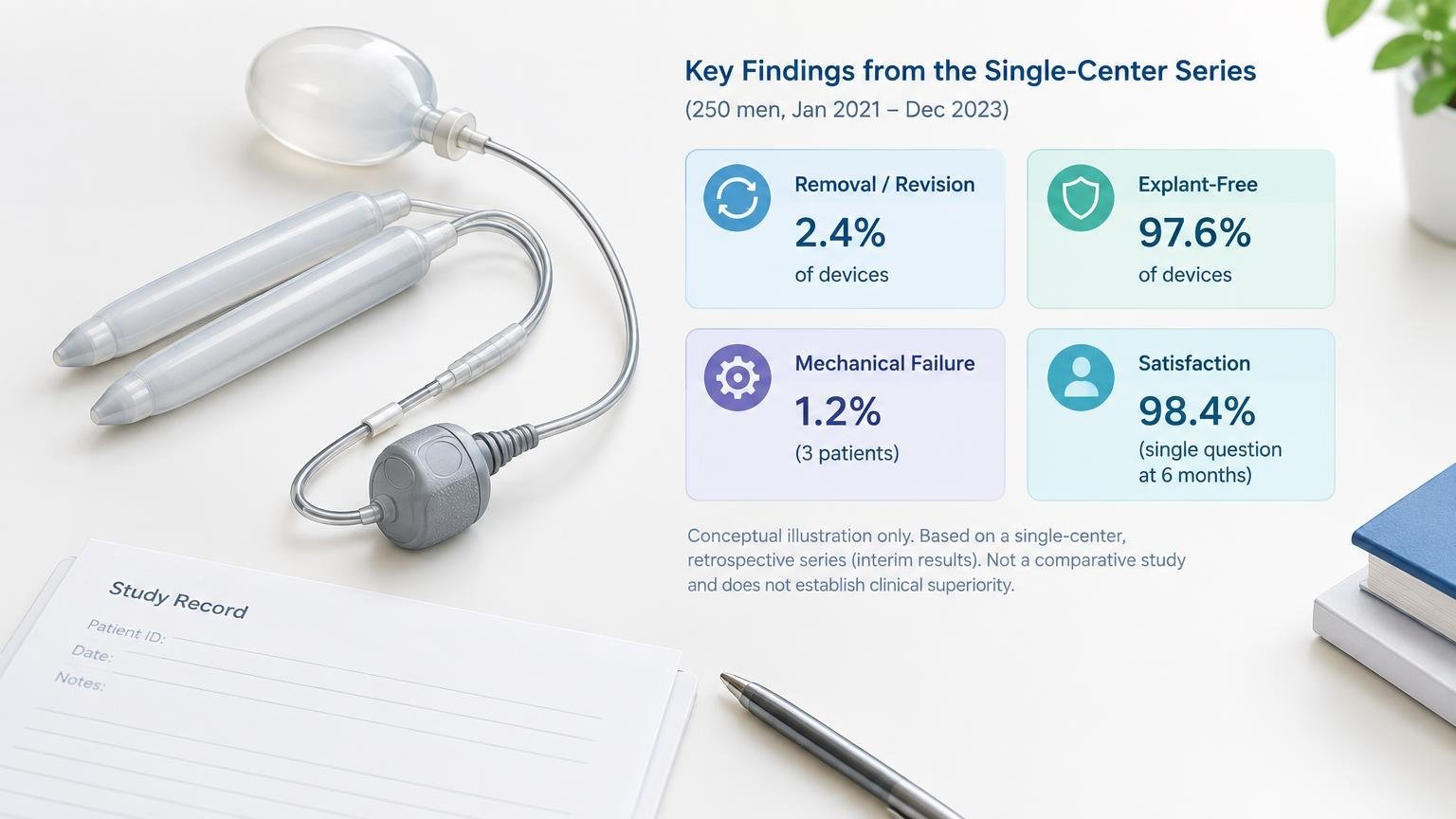
Overall, 2.4% of devices required removal or revision, and 97.6% were free from explant or revision over the observed follow-up. Mechanical failure was reported in 3 patients (1.2%), one patient (0.4%) required revision for noise during pumping, and two patients (0.8%) asked for removal because of dissatisfaction. No infections were observed. Satisfaction was reported as 98.4% using a single question asked by the surgeon at six months.
Three features limit how far these figures can be generalized: the retrospective reliance on voluntarily submitted manufacturer forms, the interim follow-up with some men observed for only six months, and a satisfaction measure that was neither validated nor blinded. The abstract also states 92.4% satisfaction in its conclusion while reporting 98.4% in its results, an internal inconsistency that should be resolved by reading the full text.
Why This Matters
For men with erectile dysfunction that has not responded to other treatments, an inflatable penile prosthesis is a surgical option intended to restore the ability to achieve an erection. Device durability and the need for reoperation are central concerns because revision surgery carries additional risk and cost. Newer devices therefore need independent outcome data, not only regulatory clearance or manufacturer reporting.[2]
This series is relevant because it reports on a relatively new three-piece device outside the manufacturers' own trials, in a single high-volume center. It also illustrates a recurring methodological problem in device research: when outcomes are reconstructed from forms completed for the manufacturer, the completeness and independence of the data determine how much weight the results can bear.
How the Device Works and How the Study Was Designed
A three-piece inflatable penile prosthesis consists of two cylinders implanted in the corpora cavernosa, a pump placed in the scrotum, and a fluid reservoir in the pelvis. Pumping moves fluid from the reservoir into the cylinders to create rigidity; a release valve returns fluid and deflates the device. The Rigicon Infla10 is one such system, and this paper reports interim outcomes from its use at a single center.
The study was a retrospective review of patient information forms from 250 patients implanted between January 2021 and December 2023. The authors state that all Rigicon Infla10 implants placed at the center before January 2024 were included, based on voluntarily submitted forms. The analysis covered patient characteristics, surgical data, device durability, satisfaction, and reoperation for any reason.
What the Evidence Shows
The cohort was middle-aged on average, with a mean age of 56.2 years. Mean follow-up was 21.2 months, but the range of 6 to 36 months means that some men contributed only half a year of observation. Average surgical time of 47 minutes reflects the experience of one center and should not be read as a benchmark for all surgeons.
| Outcome | Reported result | What it means |
|---|---|---|
| Removal or revision for any reason | 2.4% of devices | Six devices among 250 required removal or revision over the observed follow-up. |
| Free from explant or revision | 97.6% of devices | The complement of the removal/revision figure over the same interim period. |
| Mechanical failure | 3 patients (1.2%) | Device malfunction was uncommon but not absent in this series. |
| Revision for noise during pumping | 1 patient (0.4%) | A non-mechanical complaint that nonetheless led to surgery. |
| Removal requested for dissatisfaction | 2 patients (0.8%) | Dissatisfaction severe enough to prompt removal occurred in a small minority. |
| Device infection | 0 observed | No infections were recorded, but a series of this size cannot establish a zero population rate. |
| Satisfaction (single surgeon question at 6 months) | 98.4% | The result section figure; the conclusion states 92.4%, an unresolved discrepancy. |
The authors conclude that initial durability from reoperation was superior to other contemporary devices. That statement is a hypothesis-level claim from a single-arm series without a contemporaneous comparison group. A low revision rate in one center can reflect patient selection, surgical technique, follow-up duration, or how revision was defined, as well as device performance. The paper does not report a head-to-head comparison, so superiority over named alternatives is not established by these data.
Satisfaction: A Number That Needs Careful Reading
Satisfaction was assessed with a single question asked by the surgeon six months after surgery, and the reported rate was 98.4%. This design has known weaknesses: a single item does not capture the different dimensions of satisfaction such as rigidity, ease of use, cosmetic result, and partner experience, and questioning by the operating surgeon can encourage a courteous response. Validated questionnaires administered independently would provide stronger evidence.
There is also a numerical inconsistency within the abstract itself. The results section reports 98.4% satisfaction, while the conclusion states that high satisfaction was reported by 92.4% of patients. The reason for the difference is not explained in the available text. Readers should treat both figures cautiously until the full article clarifies how satisfaction was defined, how many men responded, and which denominator was used.
Statistical Versus Clinical Meaning
With 250 devices and a 2.4% removal or revision rate, the absolute number of events is small. A series of this size provides a useful early signal but has wide uncertainty around the true long-term revision rate. A rate of roughly one in forty devices over about two years is clinically meaningful for counseling, yet it cannot tell a patient what will happen over ten years, which is the horizon over which device durability matters most.
The absence of observed infections is a favorable finding but should not be interpreted as proof that infection risk is zero. Infection rates in penile prosthesis surgery are generally low, and a single-center series without an independent adjudication process may undercount events that were managed elsewhere. Patients who moved, changed insurers, or sought care at another hospital may not appear in the manufacturer forms.
Interpretation and Limitations
The principal limitation is the data source. Patient information forms are completed for the manufacturer, and voluntary submission may be incomplete or selective. The authors state that all implants placed before January 2024 were included, but the analysis still depends on the quality of the forms and on the center's ability to capture follow-up. Retrospective designs are also vulnerable to inconsistent definitions of revision and satisfaction across patients and clinicians.
Follow-up is interim. The mean of 21.2 months and minimum of 6 months mean that mechanical failures occurring later would not yet be captured. This matters for a device intended to last many years, and it means the reported revision-free rate is a short-term estimate rather than a durability claim. The authors themselves frame the results as interim.
Single-center experience is another constraint. Surgical volume, technique, patient selection, and postoperative care at one center may differ from elsewhere, so the 47-minute average surgical time and the low complication counts should be interpreted as center-specific observations. Publication in a peer-reviewed journal does not remove these design limitations, and the paper should be read as hypothesis-generating rather than definitive.
Research Outlook
What would strengthen the evidence is a prospective, independently collected registry with predefined outcome definitions, validated satisfaction instruments, and follow-up extending well beyond two years. A comparison group using another contemporary device, or a pooled analysis across centers, would allow the superiority claim to be tested rather than asserted. Until such data exist, clinicians should present the Rigicon Infla10 results as encouraging early single-center experience, not as proven comparative advantage.
Key Takeaways
- In a single Turkish center, 250 Rigicon Infla10 inflatable penile prostheses were implanted between January 2021 and December 2023, with a mean follow-up of 21.2 months and a mean patient age of 56.2 years.
- Overall, 2.4% of devices required removal or revision, and 97.6% remained free from explant or revision; mechanical failure occurred in 3 patients (1.2%), and no infections were observed.
- Satisfaction was reported as 98.4% using a single surgeon-administered question at six months, but the abstract's conclusion states 92.4%, and the measure was not validated or blinded.
- The authors' claim of superior durability compared with other contemporary devices is a hypothesis-level conclusion from a single-arm retrospective series without a comparison group.
- These interim results are useful for early counseling but cannot establish long-term revision rates, infection risk, or comparative performance; prospective registry data with validated measures are needed.
Questions and Answers
What is a three-piece inflatable penile prosthesis and how does it work?
A three-piece inflatable penile prosthesis has two cylinders implanted in the erectile tissue, a scrotal pump, and a fluid reservoir. Pumping moves fluid into the cylinders to create rigidity, and a release valve deflates the device. The Rigicon Infla10 studied here is one such system, assessed in a retrospective single-center series of 250 men in Türkiye.
What did the 250-man Rigicon Infla10 penile prosthesis series report about revision and mechanical failure?
Overall, 2.4% of devices required removal or revision, and 97.6% were free from explant or revision over a mean follow-up of 21.2 months. Mechanical failure occurred in 3 patients (1.2%), one patient (0.4%) needed revision for pump noise, and two patients (0.8%) requested removal for dissatisfaction. No infections were observed. These are interim single-center figures.
How strong is the evidence that the Rigicon Infla10 is more durable than other inflatable penile prostheses?
The evidence is limited. The study was a retrospective single-arm review of manufacturer patient information forms without a contemporaneous comparison group, and follow-up was interim, with some men observed for only six months. The authors' statement that durability was superior to other contemporary devices is therefore a hypothesis-level conclusion rather than a demonstrated finding.
How was patient satisfaction measured in this penile prosthesis study, and why does it matter?
Satisfaction was measured by a single question asked by the surgeon six months after surgery and reported as 98.4%. A single item does not capture rigidity, ease of use, or partner experience, and questioning by the operating surgeon can bias responses. The abstract's conclusion also states 92.4%, so the figure should be treated cautiously until the full text clarifies the discrepancy.
Who were the men in the Turkish penile prosthesis series, and how long were they followed?
The series included 250 men implanted at a single Turkish center between January 2021 and December 2023, described by the authors as the largest such series in Türkiye. Mean age was 56.2 years and mean follow-up was 21.2 months, ranging from 6 to 36 months. Average surgical time was 47 minutes, reflecting one center's experience.
What are the main limitations of relying on manufacturer patient information forms for penile prosthesis outcomes?
Patient information forms are completed for the manufacturer and submitted voluntarily, so reporting may be incomplete or selective. Patients who moved or sought care elsewhere may not be captured, and definitions of revision and satisfaction are not standardized across retrospective records. These factors mean a single-center retrospective review cannot establish long-term revision rates, infection risk, or comparative device performance.
Sources and References
- Muhammet İhsan Karaman; Rasim Güzel; Duygu Kirkik; Orhan Koca. Interim Results of Rigicon Penile Prosthesis Implantation in a Single Center: The Largest Series in Türkiye. Urology Research and Practice. 2025 50(4):234-239 DOI: 10.5152/tud.2025.24122.
- Muhammet İhsan Karaman; Rasim Güzel; Duygu Kirkik; Orhan Koca. Interim Results of Rigicon Penile Prosthesis Implantation in a Single Center: The Largest Series in Türkiye – DOAJ. Urology Research and Practice. 2025 50(4):234-239 DOI: 10.5152/tud.2025.24122.
SANYUN Science Center explains published research on men's reproductive and sexual health, connecting scientific evidence with everyday questions while making sources and limitations clear.
Disclaimer: This article is for scientific education and research communication only. It does not provide medical advice, diagnosis, or individualized treatment recommendations, and does not endorse any medication, supplement, device, penile enlargement procedure, or other intervention. Decisions about sexual and reproductive health should be made in consultation with a qualified healthcare professional. Do not delay seeking professional care because of information in this article.
Original Content & Copyright Notice
- This article is prepared for SANYUN Science Center, drawing on published research and publicly available academic literature on men’s sexual and reproductive health. Its editorial explanations and presentation are developed for this platform.
- Copyright in the original editorial content, selection, and arrangement is reserved by SANYUN Science Center to the extent protected by applicable law. Referenced research, quotations, and third-party materials remain subject to the rights of their respective owners. This notice does not claim ownership of scientific facts or third-party research.
- Except where permitted by applicable law or an applicable license, prior written permission is required to reproduce, republish, translate, adapt, redistribute, or commercially reuse protected content. Attribution alone does not grant permission for such reuse.
- For permitted quotation or authorized reuse, clearly identify the source and retain a link to the original article.
- Source: SANYUN Science Center
- Original URL: Retain the original article URL on science.san-yun.com.
- Copyright Holder: SANYUN Science Center, for its own protected editorial content.
- Quotation, excerpts, or authorized reuse must not distort the scientific meaning, omit material limitations or disclaimers, or imply unverified medical claims, product efficacy, or endorsement by SANYUN Science Center.



