




Category: Premature Ejaculation
Core Research Direction: Evidence base for premature ejaculation: ISSM definition and IELT-based classification, physiological/behavioral explanatory mechanisms, and comparative effectiveness and limitations of pharmacological versus behavioral/physiotherapeutic management
Search Intent: What does current evidence support about how premature ejaculation is defined, why it occurs, and how well dapoxetine, pelvic-floor physiotherapy, and behavioral techniques actually work?
Platform: SANYUN Science Center
Evidence reviewed through: 2026-11-27
Executive Summary
Premature ejaculation (PE) is one of the most common ejaculatory complaints in men, and a 2026 systematic review and meta-analysis gives a useful snapshot of where comparative treatment evidence currently stands. Pooling six clinical trials with 416 participants, the authors found a statistically significant pooled difference in intravaginal ejaculation latency time (IELT) favouring dapoxetine 30 mg over physiotherapy, with a mean difference of −0.80 seconds (95% CI −1.53 to −0.06; P = .03) and high heterogeneity (I2 = 83%). That statistically significant result is small in absolute seconds, and the authors themselves cautioned that scarce, heterogeneous trials prevent a definitive conclusion.[1]
The same review describes physiotherapy — pelvic-floor muscle strengthening, biofeedback, electrostimulation, acupuncture and yoga — as a safe and beneficial option, particularly for men who cannot tolerate medication, and its qualitative synthesis suggests that combined pharmacological and physiotherapeutic approaches produced the largest IELT improvements. Behavioral techniques such as stop-start and squeeze have a long clinical tradition but thinner comparative trial evidence in this packet, and some widely repeated efficacy figures come from professional-society statements rather than controlled studies.[2][3]
Why This Matters
A consensus review prepared under the Fifth International Consultation on Sexual Medicine describes ejaculatory disorders, including PE, as common conditions with a substantial impact on men's quality of life and relationships, and set out to provide evidence-based recommendations on definition, classification and treatment. That framing matters because PE is often discussed either as a purely mechanical timing problem or as a purely psychological one; the better-supported position is that definition, mechanism and management each involve several layers.[4]
For readers trying to interpret treatment claims, the central question is not simply whether a therapy "works" but what it was compared against, in which PE subtype, for how long, and with what tolerability and dropout. The 2026 review is helpful precisely because it addresses these comparative questions, while also exposing how small and variable the underlying trials are.
How Premature Ejaculation Is Defined
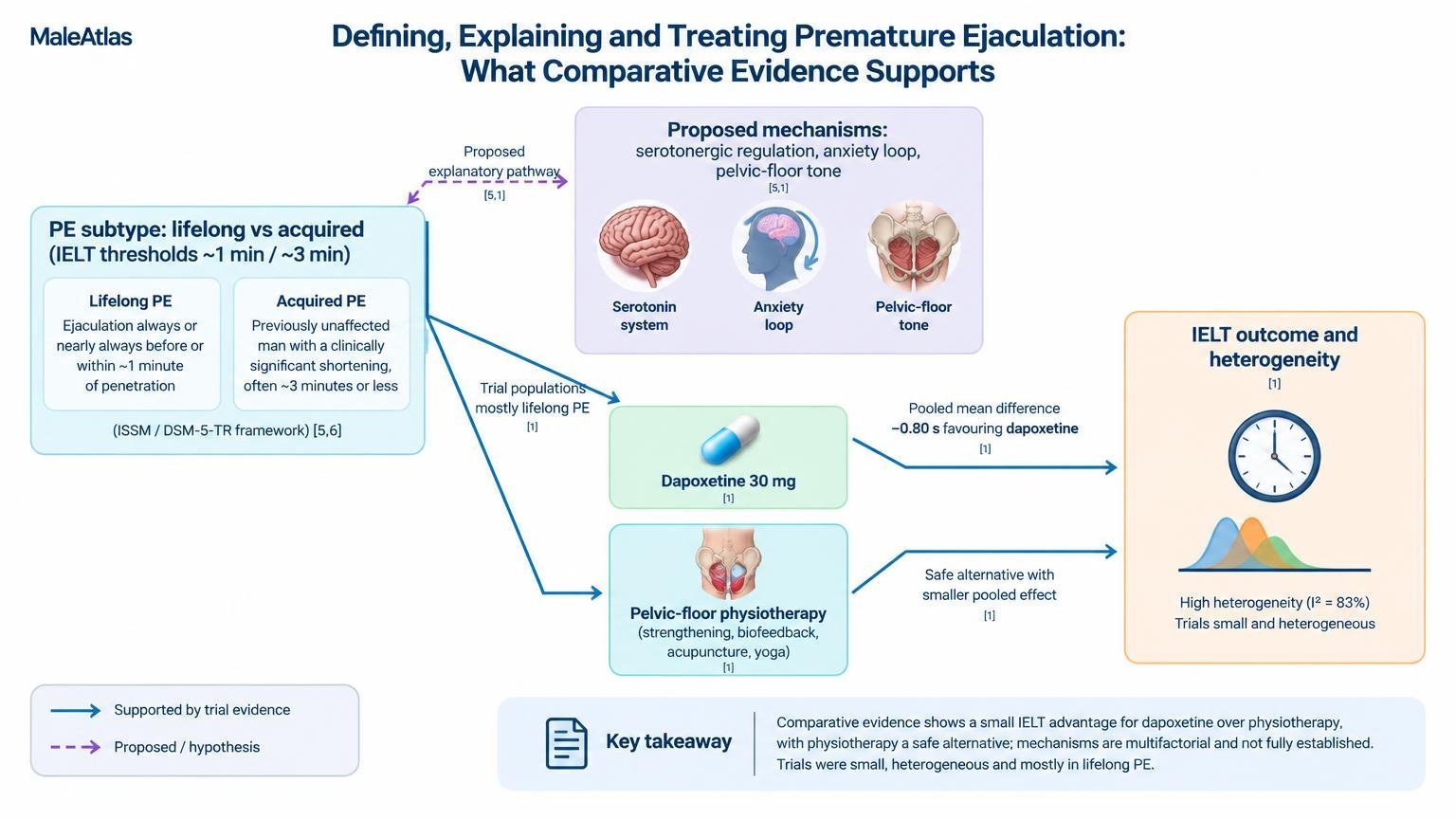
Modern definitions combine timing, control and distress rather than relying on a single stopwatch value. The International Society for Sexual Medicine (ISSM) evidence-based definition distinguishes lifelong PE — ejaculation always or nearly always before or within about 1 minute of vaginal penetration from the first sexual experiences — from acquired PE, in which a previously unaffected man experiences a clinically significant and distressing shortening, often about 3 minutes or less. The DSM-5-TR framework is similar: ejaculation within about 1 minute of vaginal penetration, present for at least 6 months in all or nearly all (about 75–100%) encounters, and causing marked distress.[5]
The 2026 meta-analysis uses a compressed version of this framework, describing PE as an IELT of 1 minute or less for lifelong PE and about 3 minutes for acquired PE, while noting that reduced IELT, lack of control and subjective perception of timing are shared features. A commercial clinic page in the packet similarly summarises the 2014 ISSM thresholds of about 1 minute for lifelong and ≤3 minutes for acquired PE.[6]
What counts as "normal" is much broader than many men assume. In a five-country study in which couples timed intercourse with a stopwatch, median IELT was about 5.4 minutes, but values ranged from a few seconds to over 40 minutes. That distribution is important context: a man whose latency sits near the population median may still present with distress, and a man below a threshold may not. Definitions are aids to clinical communication, not self-diagnosis tools.
Proposed Mechanisms: Reflex, Brain and Pelvic Floor
No single mechanism explains all PE. The serotonin system is thought to play a role in regulating the ejaculatory reflex, and genetic and neurobiological predisposition is among the proposed explanations for lifelong PE. A professional-society statement emphasises that the neurophysiology of ejaculation is not yet fully known, that sexual stimuli are interpreted and modulated in the brain, and that in PE the key feature is argued to be lack of voluntary brain control over the reflex rather than reflex speed alone.
Psychological models add a maintaining loop rather than a sole cause. Performance anxiety — "will it happen again?", "will my partner be disappointed?" — is proposed to accelerate arousal, which promotes premature ejaculation, which in turn increases anxiety for the next encounter. This is a clinical conceptual model rather than a directly tested pathway, and it does not exclude biological predisposition; the two are usually described as interacting.
Physiotherapy researchers propose a pelvic-floor contribution: weakness and/or hypertonicity of pelvic-floor muscles involved in sexual function may contribute to ejaculatory disorder, and strengthening or retraining those muscles might increase IELT without drug side effects. This mechanistic claim is framed as a hypothesis ("may") and has not been directly tested in the comparative trials summarised.
What Comparative Evidence Shows
The 2026 systematic review screened nearly 10,000 records and included six clinical trials with 416 participants in the meta-analysis. Trial durations averaged about 2.5 months, participants averaged about 43 years of age, and designs varied: two two-arm trials, three three-arm trials and one four-arm trial. Physiotherapy interventions were heterogeneous and included biofeedback, pelvic-floor muscle strengthening, general physical exercise and acupuncture; pharmacological comparators were dapoxetine 30 mg in five trials, dapoxetine 30 and 60 mg in two, and fluoxetine in one.
| Trial (as summarised) | Intervention compared | Key reported IELT result | Interpretive note |
|---|---|---|---|
| Pastore et al. | Dapoxetine 30 mg or 60 mg | Mean IELT from 37.2 s at baseline to 168.2 ± 36.6 s (30 mg) and 193.2 ± 43.8 s (60 mg) at 6 weeks | Single trial; sample sizes not given in the review excerpt |
| Sahin et al. | Dapoxetine 30 mg, dapoxetine 60 mg, acupuncture, placebo | Baseline ~44–45 s; at 4 weeks 127.52 s (60 mg), 103.21 s (30 mg), 87.21 s (acupuncture), placebo ≤63.43 s | Four-arm design; single small trial |
| Kilinc et al. | Moderate physical activity, minimal activity, dapoxetine | 39.3→188.6 s (moderate activity); 33.8→50.3 s (minimal activity); 36.8→181.7 s (dapoxetine) | High within-group variability (SDs up to 88.8 s) |
| Mantovani et al. | Dapoxetine, pelvic-floor training, combined | Proportion improved: 75%/25% (dapoxetine, 3/6 months); 25%/25% (pelvic floor); 75%/50% (combined) | Excluded from meta-analysis; lacked SDs and stopwatch IELT |
| Yilmaz et al. | Dapoxetine, biofeedback, combined | IELT increased in all groups; combined group significantly greater (P < .001) | Exact IELT values not given in review excerpt |
| Pooled meta-analysis | Dapoxetine 30 mg vs physiotherapy | Mean difference −0.80 s (95% CI −1.53 to −0.06; P = .03), I2 = 83% | Statistically significant but small in absolute seconds; high heterogeneity |
Three points are worth separating. First, the pooled meta-analytic difference — a mean difference of −0.80 seconds favouring dapoxetine — is statistically significant but tiny in absolute terms; its clinical meaning depends on baseline IELT, which was very low in these trials. Second, individual trial mean IELTs often moved into the 100–190 second range, but those are within-trial observations from small samples, not pooled estimates. Third, the review's qualitative synthesis suggested that combined approaches (for example, biofeedback plus dapoxetine) produced the largest improvements, although this was not the pooled comparison.
Tolerability shapes the comparison. The review reports that SSRI use is often limited by adverse effects such as nausea and dizziness and by discontinuation rates of 70.6% to 89.6% after the first year of treatment. These figures are drawn from the cited literature rather than a single trial, and comparability across sources is unclear, but they help explain why a safer, if slower, option remains attractive.
Behavioral and Psychosexual Approaches
Behavioral techniques are usually described in clinical rather than trial terms. Stop-start training teaches a man to monitor arousal on a 0–10 scale, pause before the point of inevitability (for example at 7–8), and resume as arousal declines, progressing from solo to partner practice. Squeeze techniques apply brief pressure at the same threshold. These are not one-off tricks: they require weeks of repeated home practice, and a common pitfall is that the technique itself becomes a performance test.
A professional-society statement reports that in 90–95% of people applying stop-start, ejaculation could be extended to 10–15 minutes. That figure is not accompanied in the supplied text by the underlying study design, sample or citation, so it should be treated as an unaudited association claim rather than trial-grade evidence. The same source's assertion that PE can be 100% treated with sex therapy is an unsupported absolute and should not be read as an evidence estimate.
Durability is a further question. One educational article reports that a review of sex-therapy outcomes was not encouraging: about 3 years after treatment, nearly all treated men had returned to their pre-treatment ejaculation times. No study design, sample size or citation is given there, so this is a caution rather than a quantified relapse rate. A commercial clinic page lists a treatment target for PE of IELT ≥3–5 minutes together with patient-couple satisfaction; that is a planned goal, not an observed outcome.
Interpretation and Limitations
The comparative evidence base is thin. The 2026 review included only six trials with small samples and marked methodological differences, and the authors explicitly cautioned that scarcity and heterogeneity prevent a definitive conclusion. Of the six studies, three had high PEDro methodological quality, one medium and two low; blinding of participants, therapists and assessors scored lowest, which is difficult to avoid in physiotherapy trials but still limits certainty.
Population and outcome heterogeneity matter. Most trials focused on lifelong PE, so findings may not transfer to acquired PE, where an underlying cause such as erectile difficulty, prostatitis or thyroid dysfunction is more often relevant and where medical evaluation is particularly important. IELT measurement varied — stopwatch in most trials, self-report in one — and "improvement" in the Mantovani trial was not defined in the review excerpt. The high I2 of 83% means the pooled estimate should be read as a direction of effect, not a precise constant.
Finally, several widely circulated claims in the packet are not evidence-grade. The statement that masturbation performed with guilt or fear may "program" a man for PE is framed with "may" and lacks a supporting study. The prevalence estimates that one third of men under 25 and about 10% of men over 40 have PE are explicitly presented as beliefs ("sanılmaktadır") without a cited design. And no food has been shown to treat PE; healthy lifestyle habits support sexual health but do not substitute for treatment.[7]
Research Outlook
The Fifth International Consultation on Sexual Medicine review set out to deliver evidence-based recommendations on definition, classification and treatment of PE and delayed ejaculation; its scope keywords include IELT, dapoxetine, SSRIs, psychotherapy and penile hypersensitivity, signalling where the field is concentrating. What the current packet cannot answer is the size of combined-treatment benefit in a pooled estimate, the durability of physiotherapy gains, or which PE subtype responds best to which modality. Larger, better-blinded trials with standardised IELT measurement and couple-reported outcomes are the obvious next step.
Key Takeaways
- PE is defined by timing, control and distress, not by a single stopwatch value; ISSM distinguishes lifelong PE (about 1 minute or less) from acquired PE (often about 3 minutes or less).
- In a 2026 meta-analysis of six trials and 416 participants, dapoxetine 30 mg outperformed physiotherapy on IELT with a statistically significant but small pooled mean difference of −0.80 seconds and high heterogeneity.
- Physiotherapy and behavioral approaches appear safe and potentially useful, especially where medication is poorly tolerated, but their comparative evidence is limited by small, heterogeneous trials.
- Mechanistic explanations — serotonergic regulation, performance-anxiety loops and pelvic-floor function — are plausible and partly supported, but none is established as a complete causal pathway.
- Widely repeated claims such as 90–95% success with stop-start or 100% response to sex therapy come from professional-society statements without supplied study detail and should not be treated as trial-grade evidence.
Questions and Answers
How is premature ejaculation defined using IELT?
The ISSM definition separates lifelong PE — ejaculation always or nearly always before or within about 1 minute of vaginal penetration from the first sexual experiences — from acquired PE, where a previously unaffected man develops a clinically significant shortening, often about 3 minutes or less. Control and personal distress are part of the definition, and DSM-5-TR adds a duration and proportion requirement.
Does dapoxetine work better than pelvic-floor physiotherapy for premature ejaculation?
A 2026 meta-analysis of six trials with 416 participants found a statistically significant pooled difference in IELT favouring dapoxetine 30 mg over physiotherapy, with a mean difference of −0.80 seconds and high heterogeneity. The absolute difference is small, trials were few and variable, and the authors cautioned against a definitive conclusion; several individual trials and the qualitative synthesis suggested combined approaches may produce larger gains.
How strong is the evidence for physiotherapy in premature ejaculation?
The evidence is promising but limited. Six trials compared physiotherapy with medication, and physiotherapy was described as safe and beneficial, particularly for men intolerant to drugs. However, only six small studies with heterogeneous designs were available, blinding was difficult, and the authors explicitly stated that scarcity and heterogeneity prevent a definitive conclusion.
Why does premature ejaculation happen according to current models?
No single mechanism is established. Proposed contributors include serotonergic regulation of the ejaculatory reflex and genetic or neurobiological predisposition in lifelong PE, a performance-anxiety loop that accelerates arousal and reinforces itself, and altered pelvic-floor muscle tone or strength. These are hypotheses and clinical models rather than fully mapped pathways.
What are the limitations of comparative premature ejaculation trials?
Key limitations include very small samples, only six trials in the pooled analysis, marked design differences, high statistical heterogeneity (I2 = 83%), inconsistent IELT measurement (stopwatch versus self-report), and poor blinding of participants and assessors. Most data concern lifelong PE, so findings may not transfer to acquired PE, where medical causes deserve particular attention.
Are stop-start techniques and sex therapy really 90–100% effective for premature ejaculation?
Those figures should be treated cautiously. A professional-society statement reports 90–95% extension of ejaculation to 10–15 minutes with stop-start and claims 100% treatment with sex therapy, but the supplied text gives no study design, sample or citation for either. Behavioral techniques require weeks of practice, can become a performance test, and long-term durability is uncertain.
Conceptual framework: Conceptual framework, not a tested causal model. It maps the review's variables: PE subtype, proposed mechanisms, dapoxetine and pelvic-floor physiotherapy as comparators, and IELT as the pooled outcome. Supported edges reflect trial-level associations; the mechanism edge is proposed. Trials were small, heterogeneous and mostly in lifelong PE.
Academic References & Evidence
- Esther M Medrano-Sánchez; Ana López-del-Castillo; Maud Boisseau; Juan C Fernández-Domínguez; Esther Díaz-Mohedo. Effectiveness of physiotherapy in male premature… : The Journal of Sexual Medicine. The Journal of Sexual Medicine. 2026 23(5) DOI: 10.1093/jsxmed/qdag096.
- Cem Keçe. Erken Boşalma – CİSEF Cinsellik.
- Erken Boşalmanın Tedavisi – CİSEF Cinsellik.
- Contemporary consensus and emerging directions in premature and delayed ejaculation: recommendations from the 5th International Consultation on Sexual Medicine.. Sexual medicine reviews PMID: 42855438.
- Berre Demirci. Erken Boşalma Psikolojik mi? Nedenleri ve Tedavisi | Berre Demirci.
- Elif Yılmaz. Cinsel Terapi — Vajinismus, Erken Boşalma, Ereksiyon ve Cinsel İstek Bozukluklarında Kanıta Dayalı Psikoseksüel Tedavi.
- Cem Keçe; Serap Güngör. Cinsel Hurafelerde Top 10 – CİSEF Basın Açıklamaları.
SANYUN Science Center explains published research on men's reproductive and sexual health, connecting scientific evidence with everyday questions while making sources and limitations clear.
Disclaimer: This article is for scientific education and research communication only. It does not provide medical advice, diagnosis, or individualized treatment recommendations, and does not endorse any medication, supplement, device, penile enlargement procedure, or other intervention. Decisions about sexual and reproductive health should be made in consultation with a qualified healthcare professional. Do not delay seeking professional care because of information in this article.
Original Content & Copyright Notice
- This article is prepared for SANYUN Science Center, drawing on published research and publicly available academic literature on men’s sexual and reproductive health. Its editorial explanations and presentation are developed for this platform.
- Copyright in the original editorial content, selection, and arrangement is reserved by SANYUN Science Center to the extent protected by applicable law. Referenced research, quotations, and third-party materials remain subject to the rights of their respective owners. This notice does not claim ownership of scientific facts or third-party research.
- Except where permitted by applicable law or an applicable license, prior written permission is required to reproduce, republish, translate, adapt, redistribute, or commercially reuse protected content. Attribution alone does not grant permission for such reuse.
- For permitted quotation or authorized reuse, clearly identify the source and retain a link to the original article.
- Source: SANYUN Science Center
- Original URL: Retain the original article URL on science.san-yun.com.
- Copyright Holder: SANYUN Science Center, for its own protected editorial content.
- Quotation, excerpts, or authorized reuse must not distort the scientific meaning, omit material limitations or disclaimers, or imply unverified medical claims, product efficacy, or endorsement by SANYUN Science Center.



