




Category: Clinical Insights
Core Research Direction: What the 2025/2026 EAU sexual and reproductive health guidelines recommend for diagnosing and treating late-onset hypogonadism and erectile dysfunction in adult men, and how strong the underlying evidence is
Search Intent: According to the latest EAU guidelines, how should clinicians evaluate low testosterone in ageing men and choose among erectile dysfunction treatments, and where is the evidence weakest?
Platform: SANYUN Science Center
Evidence reviewed through: 2026-11-27
Executive Summary
The European Association of Urology (EAU) sexual and reproductive health guideline is one of the most widely used reference documents for adult male sexual medicine. Its 2025 publication summarised an updated systematic review of research published between 2021 and 2024, searched in Medline, EMBASE and the Cochrane Libraries, and issued practical recommendations on diagnosis, treatment and follow-up. The 2026 document is described by the panel as a limited update of the 2025 publication rather than a wholesale rewrite. For late-onset hypogonadism, the guideline combines a biochemical definition with a symptom requirement and stresses appropriate indications and follow-up for testosterone therapy. For erectile dysfunction, it provides a decision-making algorithm intended to support personalised treatment according to invasiveness, tolerability, effectiveness and patient expectations.[1][2]
The strength of each recommendation was graded using three inputs: the balance of benefits and drawbacks, the quality and reliability of the evidence, and patient preferences and values. That framework matters because many recommendations are strong on clinical logic but rest on evidence that is less certain than the wording suggests. The 2026 update added 116 updated studies across the hypogonadism, ejaculation disorder, penile curvature and priapism sections, and highlighted limited high-quality evidence in areas such as testosterone therapy in prostate cancer survivors and treatment of ejaculation disorders.[3]
Why This Matters
Late-onset hypogonadism and erectile dysfunction are common reasons for consultation in adult men, and both sit at the intersection of endocrinology, urology and cardiovascular risk. The clinical risk is rarely a missed exotic diagnosis; it is more often a diagnosis made too quickly, a treatment started without a clear indication, or a reversible cause left unexplored. The EAU documents are explicit that guidelines cannot replace clinical expertise when decisions are made for individual patients, and that personal values, preferences and circumstances must be taken into account. That statement is a framing position rather than an empirical finding, but it is the correct lens for reading the recommendations.
For readers trying to interpret the guideline rather than apply it, the useful question is not only what is recommended but how strongly. A strong recommendation with a narrow evidence base and a weak recommendation with genuine uncertainty are different clinical objects, and the EAU grading system is designed to make that distinction visible.
How the Guideline Defines and Diagnoses Late-Onset Hypogonadism
The guideline defines late-onset hypogonadism as a clinical condition in the ageing male that combines low levels of circulating testosterone with specific symptoms attributable to impaired hormone production and/or action. The definition is deliberately two-part. A low laboratory value alone is not the condition, and symptoms alone are not the condition. The recommendation emphasises appropriate indications and subsequent follow-up for testosterone therapy, which reflects the practical difficulty of separating genuine androgen deficiency from nonspecific symptoms in older men.
The most concrete diagnostic recommendation in the available guideline text concerns measurement conditions. The panel strongly recommends measuring total testosterone in the morning, between 07.00 and 10.00 hours, in the fasting state, using a reliable laboratory assay. This is a pre-analytical recommendation rather than a threshold recommendation: it addresses the circadian and postprandial variability that can make a single random testosterone result misleading. The guideline summary available here does not report diagnostic accuracy figures for this approach, so the recommendation should be read as expert consensus on measurement quality rather than as a validated diagnostic algorithm with published sensitivity and specificity.
The 2026 update podcast summary adds a related emphasis: diagnosing hypogonadism requires proper testosterone measurement and a distinction between functional and organic causes. That distinction is clinically important because functional causes may be reversible, whereas organic causes imply a more durable deficit. The underlying evidence for how reliably clinicians make that distinction is not quantified in the materials reviewed here.
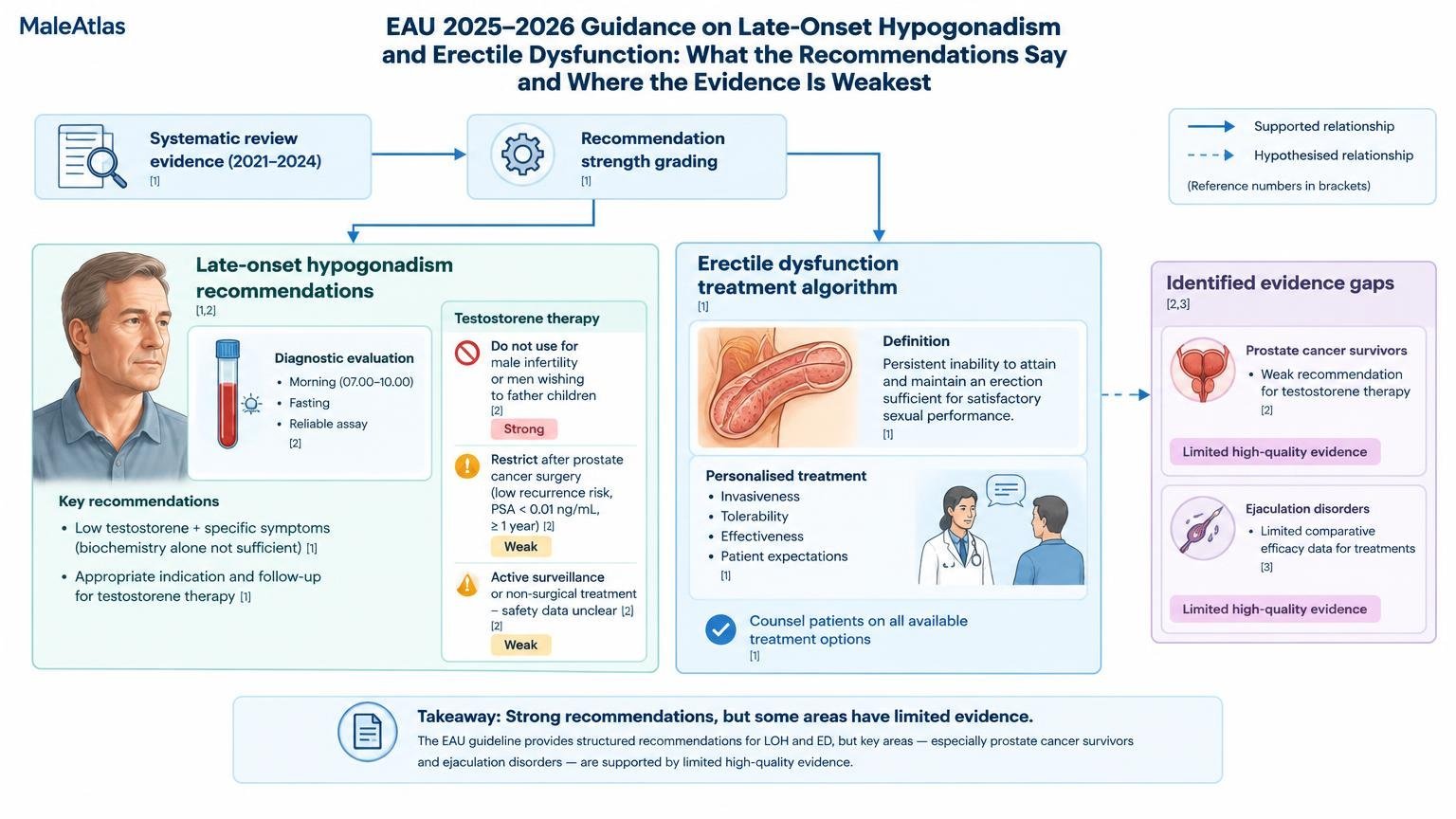
- Morning (07.00–10.00) fasting total testosterone with a reliable assay is a strong recommendation for diagnostic evaluation.
- Late-onset hypogonadism requires both low circulating testosterone and specific symptoms; biochemistry alone is not sufficient.
- Appropriate indication and follow-up are central to the guideline's testosterone therapy recommendations.
Testosterone Therapy: Indications, Contraindications and Monitoring
The guideline's testosterone recommendations are uneven in strength, and that unevenness is informative. A strong recommendation states that testosterone therapy should not be used to treat male infertility or in men who wish to father children. This is a clear boundary: testosterone suppresses spermatogenesis, so using it as a fertility treatment is conceptually and clinically inappropriate. The recommendation is strong, although the underlying fertility outcome data are not summarised in the abstract-level text reviewed here.
In men with a history of prostate cancer treated by surgery, the guidance is noticeably more cautious. The panel weakly recommends restricting testosterone therapy to patients at low risk of recurrent prostate cancer, starting only after at least one year of follow-up with a prostate-specific antigen level below 0.01 ng/mL and no evidence of recurrence. The weak rating is consistent with limited safety data. For men on active surveillance or treated with non-surgical curative intent, the recommendation is also weak and advises telling patients that safety data are unclear. The difference between the strong fertility recommendation and the weak prostate cancer recommendations is a useful illustration of how the panel separates established harm from uncertain long-term safety.
The 2026 update is reported to have significantly revised the prostate cancer section of the hypogonadism chapter and relocated two recommendations into it because their conceptual framework and clinical implications aligned more directly with prostate cancer management. The podcast summary accompanying the 2026 update specifically names testosterone therapy in prostate cancer survivors as an area where high-quality evidence is limited. Readers should therefore treat this part of the guideline as a carefully reasoned risk-management framework rather than a well-powered comparative safety statement.
| Decision point | Guideline position | Recommendation strength | Evidence context |
|---|---|---|---|
| Testosterone measurement for suspected late-onset hypogonadism | Morning 07.00–10.00, fasting, reliable assay | Strong | Pre-analytical standard; diagnostic accuracy figures not given in the summary text |
| Testosterone therapy for male infertility or men wishing to father children | Do not use | Strong | Clear clinical boundary; detailed fertility outcome data not summarised here |
| Testosterone therapy after surgery for prostate cancer | Restrict to low recurrence risk; start after at least one year with PSA < 0.01 ng/mL and no recurrence | Weak | Limited safety data |
| Testosterone therapy on active surveillance or after non-surgical curative treatment | Advise that safety data are unclear | Weak | Explicitly acknowledged uncertainty |
Erectile Dysfunction: Definition and the Logic of Personalised Treatment
The guideline defines erectile dysfunction as the persistent inability to attain and maintain an erection sufficient to permit satisfactory sexual performance. The definition is functional rather than purely organic, and the treatment algorithm that follows is explicitly built to support personalised care. Selection among options is guided by invasiveness, tolerability and effectiveness, alongside the patient's expectations. That is a shared-decision framework, not a simple stepwise ladder in which the least invasive option is always tried first regardless of preference.
The recommendation that patients be fully counselled about all available treatment modalities is stated in the guideline summary, although the summary text available here does not provide comparative efficacy estimates for individual therapies. The 2026 update reorganised the recommendations in the erectile dysfunction treatment section so that they flow more logically, but a reorganisation of presentation is not evidence of changed effectiveness. A secondary commentary on the 2025 guideline notes that the recommendations target key clinical decisions expected to have the greatest impact on patient care, which is consistent with the guideline's decision-focused structure.[4]
Two clinical implications follow. First, the presence of erectile dysfunction should prompt assessment of reversible contributors and cardiovascular risk rather than an immediate prescription-only pathway. Second, because the algorithm is preference-sensitive, the quality of the consultation matters as much as the choice of drug or device. Neither implication is quantified in the guideline summary, but both are consistent with the stated rationale for the algorithm.
Related Conditions and the Limits of the Evidence
The same 2025 guideline covers premature ejaculation and Peyronie's disease, and these sections illustrate how the panel handles sparse evidence. For premature ejaculation, the guideline adopted the International Society for Sexual Medicine definition and recommends pharmacotherapy as first-line for lifelong premature ejaculation, while for acquired premature ejaculation the initial goal is treating the underlying cause. The recommendation presupposes accurate subtyping, which is a clinical skill rather than a laboratory test. The 2026 update fully revised the supporting text and references for the ejaculation disorders section, and the podcast summary identifies treatment options for ejaculation disorders as an area of limited high-quality evidence.[5]
For Peyronie's disease, surgery is recommended for men whose penile deformity negatively affects sexual function, and men with concomitant erectile dysfunction should be offered penile prosthesis implantation. The 2026 update adds a strong recommendation that surgery be performed only when the disease is stable and intercourse is compromised by the deformity. It also strongly recommends counselling patients that data on intralesional platelet-rich plasma, alone or with oral treatment, remain limited. The podcast summary of the 2026 update mentions the introduction of new options such as hyaluronic acid for Peyronie's disease, but the materials reviewed here do not report efficacy data for that option, so it should not be read as an established treatment effect.
Priapism is outside the main focus of this analysis but illustrates the guideline's evidence grading. The panel strongly recommends blood gas analysis of aspirated corporal blood in the emergency setting to distinguish ischaemic from non-ischaemic priapism, while the alternative use of peno-scrotal decompression as a first-line option instead of distal shunting carries only a weak recommendation. The 2026 update significantly revised the ischaemic priapism section. The contrast between a strong diagnostic recommendation and a weak procedural one is consistent with the grading philosophy described in the 2025 methods.
How Strong Is the Underlying Evidence?
The 2025 guideline was built on a systematic review of literature published over a defined period, and the panel graded recommendations through a structured three-factor process. That process yields a hierarchy of certainty rather than a single verdict on the whole document. Several recommendations that are central to everyday practice are rated weak, and the reasons are specific rather than general. Testosterone therapy in prostate cancer survivors is weak because long-term safety data are limited. Testosterone therapy in men on active surveillance or after non-surgical curative treatment is weak because the safety data are explicitly described as unclear. Peno-scrotal decompression as an alternative first-line approach to ischaemic priapism is weak because comparative outcome data are not summarised.
Conversely, some recommendations are strong despite an absence of detailed effect estimates in the summary text. Morning fasting testosterone measurement, avoiding testosterone therapy for fertility, performing Peyronie's surgery only in the stable phase, and using corporal blood gas analysis in priapism are all rated strong. The strength here reflects a combination of clinical logic, consistency of the evidence base and the consequences of getting the decision wrong, not necessarily large randomised trials summarised in the abstract. This is an important distinction for readers who equate strong recommendation with high-certainty comparative evidence.
The 2026 update does not resolve these gaps. It is a limited update, and its added 116 studies are counted across several sections rather than distributed evenly. The podcast summary explicitly names limited high-quality evidence in testosterone therapy for prostate cancer survivors and in ejaculation disorder treatments. The 2026 changes also removed ineffective treatments, which is a useful reminder that guideline updates can reduce as well as expand the therapeutic repertoire.
Interpretation and Limitations
Several limitations apply to any interpretation of this evidence. The primary sources reviewed here are a guideline summary article, a guideline introduction and summary-of-changes page, a secondary commentary and podcast summaries. The full guideline text, including the evidence tables and the detailed rationale for each grading decision, is not reproduced in these materials. Statements about what the guideline recommends should therefore be read as faithful summaries of the published summaries, not as a substitute for the full document. In particular, the absence of a reported effect size in this article does not mean the guideline lacks one; it means the available summary text did not provide it.
A second limitation is that guideline recommendations are not predictions about individual outcomes. The EAU document itself states that following recommendations will not necessarily produce the best outcome and that guidelines are not mandates or a legal standard of care. This is particularly relevant in late-onset hypogonadism, where symptom attribution is subjective, and in erectile dysfunction, where patient preferences are explicitly part of the treatment algorithm. A recommendation can be appropriate for a population while being the wrong choice for a particular man.
A third limitation concerns the interpretation of the 2026 update. The count of 116 updated studies is a measure of literature inclusion, not of evidence quality or patient benefit. It should not be read as 116 new trials proving clinical effectiveness. Similarly, the described reorganisation of the erectile dysfunction recommendations and the revision of supporting text are document-level changes that do not by themselves establish new treatment effects.
Research Outlook
The clearest research priorities implied by the guideline are long-term safety of testosterone therapy in men with a history of prostate cancer, better evidence for treatment of ejaculation disorders, and higher-quality comparative data for conservative and minimally invasive options in Peyronie's disease and priapism. The panel's use of weak recommendations in these areas is a signal that the evidence base is not yet sufficient for stronger guidance. The distinction between functional and organic causes of hypogonadism also warrants better diagnostic research, since the current recommendation emphasises measurement conditions more than diagnostic thresholds.
A secondary commentary notes that the recommendations are focused on key clinical decisions expected to have the greatest impact on patient care. That focus is helpful for clinicians but also concentrates the evidence gaps where they matter most. Future updates would be more informative if they reported the certainty of evidence alongside the strength of each recommendation in the summary documents, so that readers can distinguish a strong recommendation based on consistent trial data from a strong recommendation based on clinical necessity.
Key Takeaways
- Late-onset hypogonadism in the EAU framework requires both low circulating testosterone and specific symptoms; measurement conditions are a strong recommendation, not an optional detail.
- Testosterone therapy should not be used for male infertility or in men who wish to father children, and its use after prostate cancer treatment is restricted and weakly recommended because safety data are limited.
- Erectile dysfunction treatment is explicitly personalised according to invasiveness, tolerability, effectiveness and patient expectations, with full counselling about available options.
- The 2026 update is a limited update of the 2025 guideline that added 116 updated studies across several sections and removed some ineffective treatments, but it did not resolve the main evidence gaps.
- Guidelines support but do not replace clinical judgement for individual patients, and recommendation strength reflects benefit-harm balance, evidence quality and patient values rather than a single measure of certainty.
Questions and Answers
How does the EAU guideline define late-onset hypogonadism in ageing men?
The EAU guideline defines late-onset hypogonadism as a clinical condition in ageing men that combines low circulating testosterone levels with specific symptoms attributable to impaired hormone production and/or action. Both elements are required, so a low laboratory value alone or symptoms alone are not sufficient. The guideline stresses appropriate indications and follow-up for testosterone therapy rather than treating biochemistry in isolation.
When and how should total testosterone be measured for suspected late-onset hypogonadism according to the EAU?
The EAU strongly recommends measuring total testosterone in the morning, between 07.00 and 10.00 hours, in the fasting state, using a reliable laboratory assay. The recommendation targets pre-analytical variability that can make random results misleading. The summary text reviewed here does not report diagnostic accuracy figures, so this should be read as a strong consensus standard for measurement rather than a validated diagnostic threshold algorithm.
What does the EAU guideline say about testosterone therapy for men with a history of prostate cancer?
For men treated surgically for prostate cancer, the guideline weakly recommends restricting testosterone therapy to those at low risk of recurrence, starting only after at least one year of follow-up with PSA below 0.01 ng/mL and no evidence of recurrence. For men on active surveillance or after non-surgical curative treatment, it weakly recommends advising that safety data are unclear. The weak ratings reflect limited long-term safety evidence, which the 2026 update summary still identifies as a gap.
How does the EAU guideline approach erectile dysfunction treatment selection?
The guideline defines erectile dysfunction as the persistent inability to attain and maintain an erection sufficient for satisfactory sexual performance and uses a decision-making algorithm to support personalised treatment. Selection is guided by invasiveness, tolerability, effectiveness and the patient's expectations, with full counselling about all available modalities. The summary text reviewed here does not provide comparative efficacy estimates for individual therapies, so the algorithm should be understood as a shared-decision framework.
How strong is the evidence behind the EAU recommendations for late-onset hypogonadism and erectile dysfunction?
Recommendation strength was graded using benefit-harm trade-offs, evidence quality and patient values, which produces a mix of strong and weak recommendations. Several central recommendations are strong despite sparse effect estimates in the summary text, while testosterone therapy in prostate cancer survivors and treatment of ejaculation disorders are explicitly identified as areas of limited high-quality evidence. The 2026 update added 116 studies but is described as a limited update and does not resolve these gaps.
What should readers keep in mind when interpreting the 2026 EAU sexual and reproductive health guideline update?
The 2026 document is a limited update of the 2025 publication, not a new systematic review of the whole field. Its 116 updated studies are spread across the hypogonadism, ejaculation disorder, penile curvature and priapism sections, and document changes such as reorganisation of recommendations do not by themselves establish new treatment effects. The guideline also states that it cannot replace clinical expertise or serve as a legal standard of care for individual patients.
Conceptual framework: Conceptual framework, not a biological pathway. The diagram shows the relationships discussed in this article: systematic review evidence informs recommendation strength grading, which shapes late-onset hypogonadism and erectile dysfunction recommendations. Weak recommendation links to prostate cancer survivors and limited ejaculation disorder data are shown as evidence gaps. Based on guideline summaries and secondary commentary; not a tested causal model.
Academic References & Evidence
- Salonia, A; Capogrosso, P; Boeri, L; Cocci, A; Corona, G; Dinkelman-Smit, M; Falcone, M; Jensen, CF; Gül, M; Kalkanli, A; Kadioğlu, A; Martinez-Salamanca, JI; Afonso Morgado, L; Russo, GI; Serefoğlu, EC; Verze, P; Minhas, S. European Association of Urology Guidelines on Male Sexual and Reproductive Health: 2025 Update on Male Hypogonadism, Erectile Dysfunction, Premature Ejaculation, and Peyronie's Disease.. European urology. 2025 88(1):76-102 DOI: 10.1016/j.eururo.2025.04.010. PMID: 40340108.
- Introduction – EAU Guidelines on Sexual and Reproductive Health – Uroweb.
- 2026 update on EAU Guidelines for Sexual & Reproductive Health.
- Graziottin A.. Disturbi sessuali e riproduttivi maschili: le linee guida dell'Associazione Europea di Urologia – Disturbi sessuali maschili – Alessandra Graziottin. 2026
- EAU Guidelines on Sexual and Reproductive Health – Uroweb.
SANYUN Science Center explains published research on men's reproductive and sexual health, connecting scientific evidence with everyday questions while making sources and limitations clear.
Disclaimer: This article is for scientific education and research communication only. It does not provide medical advice, diagnosis, or individualized treatment recommendations, and does not endorse any medication, supplement, device, penile enlargement procedure, or other intervention. Decisions about sexual and reproductive health should be made in consultation with a qualified healthcare professional. Do not delay seeking professional care because of information in this article.
Original Content & Copyright Notice
- This article is prepared for SANYUN Science Center, drawing on published research and publicly available academic literature on men’s sexual and reproductive health. Its editorial explanations and presentation are developed for this platform.
- Copyright in the original editorial content, selection, and arrangement is reserved by SANYUN Science Center to the extent protected by applicable law. Referenced research, quotations, and third-party materials remain subject to the rights of their respective owners. This notice does not claim ownership of scientific facts or third-party research.
- Except where permitted by applicable law or an applicable license, prior written permission is required to reproduce, republish, translate, adapt, redistribute, or commercially reuse protected content. Attribution alone does not grant permission for such reuse.
- For permitted quotation or authorized reuse, clearly identify the source and retain a link to the original article.
- Source: SANYUN Science Center
- Original URL: Retain the original article URL on science.san-yun.com.
- Copyright Holder: SANYUN Science Center, for its own protected editorial content.
- Quotation, excerpts, or authorized reuse must not distort the scientific meaning, omit material limitations or disclaimers, or imply unverified medical claims, product efficacy, or endorsement by SANYUN Science Center.



