




Category: Clinical Insights
Core Research Direction: Clinical interpretation and repeat-timing of semen analysis in adult men: when a single abnormal semen sample can and cannot establish infertility, how spermatogenesis timing and biological variability justify repeat testing, and how this differs from post-vasectomy semen analysis success criteria.
Search Intent: When should a man repeat an abnormal semen analysis — and how should the result be interpreted before a diagnosis is made?
Platform: SANYUN Science Center
Evidence reviewed through: 2026-11-27
Executive Summary
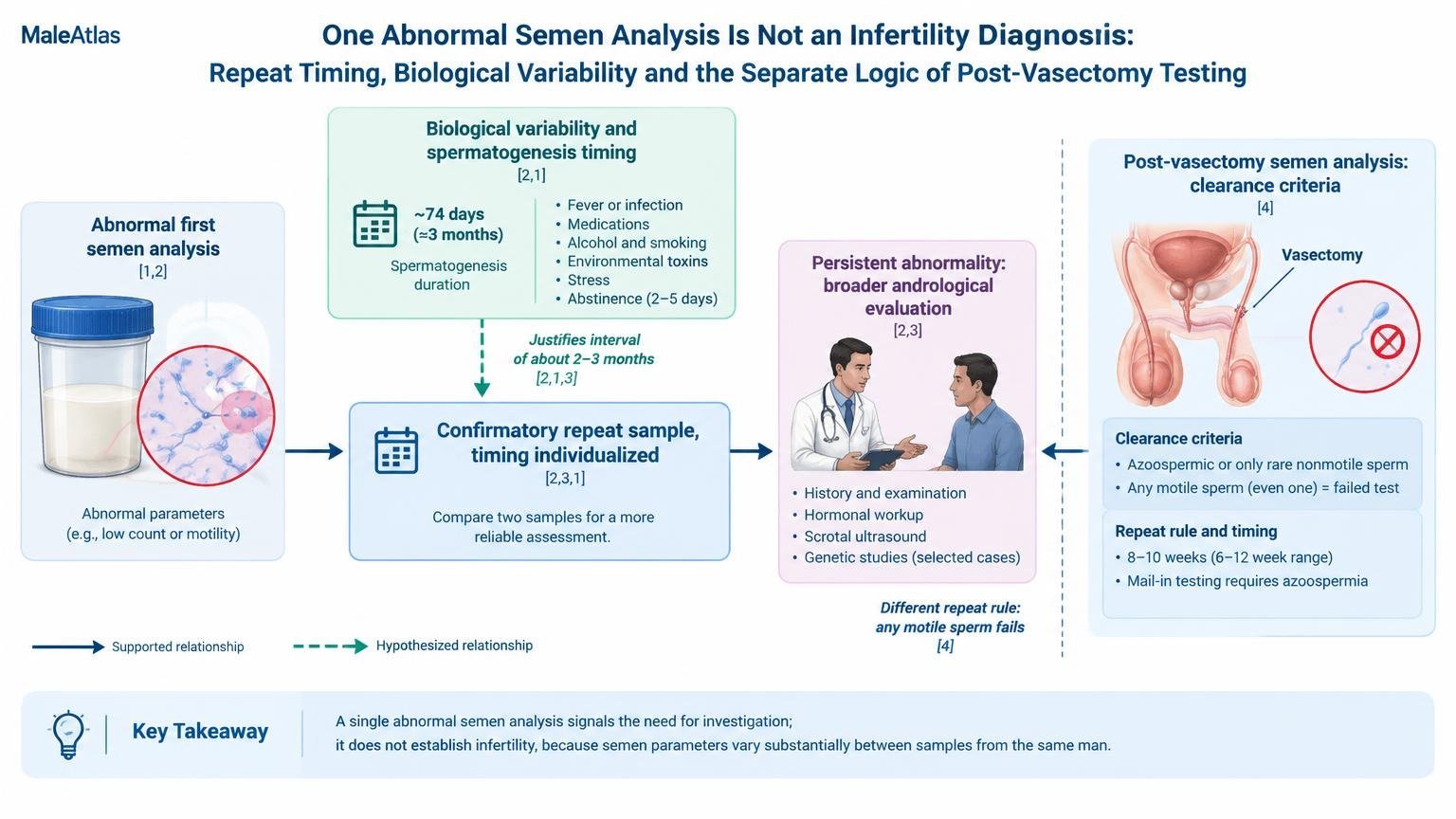
A semen analysis is a snapshot of one ejaculate, not a verdict on a man's fertility. Clinician-authored patient explainers describe substantial biological variability between samples from the same man and recommend confirming an abnormal first result with a second sample, with timing adapted to the type and severity of the abnormality and the clinical context.[1][2]
Two timing rationales recur in the source material. Spermatogenesis is described as taking approximately 74 days, or roughly three months, which is why an interval of about two to three months, or about 90 days, is often suggested when the goal is to reflect a new production cycle. These are practical conventions drawn from narrative clinical commentary, not results of a comparative trial.[3]
World Health Organization reference values are guides rather than a sharp line between fertile and infertile: some men with parameters below reference still conceive spontaneously, and a normal semen analysis alone does not guarantee fertility.
Post-vasectomy semen analysis follows a different logic. In expert commentary on the 2026 American Urological Association vasectomy guideline, standard laboratory testing considers a man cleared if he is azoospermic or has only rare nonmotile sperm, with a single analysis then sufficient; any motile sperm, even one, is a failed test requiring repeat analysis. Practical timing is described as 8 to 10 weeks after vasectomy within a broader 6- to 12-week range, and mail-in testing requires azoospermia.[4]
Why This Matters
Semen analysis is the usual first laboratory test when a couple struggles to conceive, and its results shape referrals, lifestyle counseling and decisions about assisted reproduction. Because an abnormal report often arrives before any clinical conversation, the difference between "this sample was abnormal" and "this man is infertile" carries real emotional and financial weight.[5]
Context figures quoted in patient explainers place the stakes in perspective: male factors are estimated to contribute to up to about 50% of a couple's conception difficulties, and about 15% of couples are described as having difficulty conceiving, with the male factor contributing in approximately half of those cases. These are background estimates without a primary study, design or setting given in the body text, so they should inform counseling rather than be treated as precise epidemiological measurements.
There is also a diagnostic-context distinction that patients frequently miss. For fertility assessment, an abnormal sample triggers confirmation and broader evaluation. For post-vasectomy testing, the question is not fertility potential but whether sperm have cleared the ejaculate after the duct was interrupted. Those two questions use different thresholds, different repeat rules and different timelines, and conflating them is a common source of confusion.
Biological Mechanism: Why One Sample Rarely Settles the Question
Spermatogenesis is described as a continuous process that takes approximately 74 days to complete, or roughly three months. Because the sperm in an ejaculate reflect a production cycle that has been underway for weeks, any event affecting the body during that window can plausibly appear in the sample.
The source material lists plausible modifiers: recent high fever or infection in the previous three months, certain medications including antibiotics and hormonal supplements, heavy alcohol use, smoking, environmental toxin exposure, high physical or emotional stress, and sexual abstinence outside the recommended two- to five-day interval. These are presented as mechanisms that can shift results, not as quantified effect estimates.
Layered on these external factors is intrinsic sample-to-sample variability. Clinician-authored explainers state that semen parameters show considerable biological variability between different samples from the same patient, and that fluctuations can occur even in men with proven fertility. That is the core reason a single abnormal result is described as a signal for investigation rather than a permanent diagnosis.
What the Evidence Shows
The strongest consistent message across the sources is procedural rather than numerical: confirm an abnormal first sample. Clinician-authored explainers recommend a second sample when the first shows abnormalities, with timing individualized to the type and severity of the abnormality and the clinical context, and they argue that comparing two samples taken at different times is more reliable than judging a single result.
On timing, the sources offer converging but loosely specified conventions rather than a validated schedule. One explainer states that specialists generally request repeat testing after about 90 days, framed as the time needed for a new cycle of sperm production. Another notes that an interval of roughly two to three months may be considered when the goal is to assess changes tied to spermatogenesis, while explicitly stating that the decision must be individualized.
Interpretation of borderline results is deliberately cautious. One explainer states that concentrations below 16 million sperm per milliliter or motility below 30% indicate important abnormalities warranting medical evaluation, and advises that values only slightly above 16 million per milliliter may still merit specialist input because current criteria may not capture every case of reproductive difficulty. That caution is framed as a hypothesis about threshold limitations, not a demonstrated finding.
The sources also emphasize two-directional uncertainty. Some men with one or more parameters below reference values achieve spontaneous pregnancy, and a normal semen analysis does not by itself guarantee fertility. Patient-facing text adds that many men with subnormal parameters can still conceive naturally, particularly when the partner has healthy ovarian reserve — a qualitative statement without cited quantification.
A comparison table helps separate the two testing contexts, which use different success definitions and repeat rules.
| Testing context | Question being asked | Reported success or abnormality criterion | Repeat rule described |
|---|---|---|---|
| Fertility assessment after an abnormal first sample | Does this man's semen profile suggest impaired reproductive potential requiring further evaluation? | Below 16 million sperm per mL or motility below 30% described as important abnormalities; WHO reference values described as guides, not a sharp boundary | Confirm with a second sample; timing individualized to abnormality type and severity, with about 90 days or roughly two to three months often suggested |
| Standard laboratory post-vasectomy semen analysis | Have sperm cleared the ejaculate after vasectomy? | Cleared if azoospermic or only rare nonmotile sperm | One analysis suffices when cleared; any motile sperm, even a single one, is a failed test requiring repeat analysis |
| Mail-in post-vasectomy semen analysis | Have sperm cleared the ejaculate, using a remote collection pathway? | Azoospermia required | Any sperm detected, motile or nonmotile, considered a failed test |
| Post-vasectomy timing | When should the clearance check be done? | Not a criterion; timing balances early confirmation against prolonged alternative contraception | 8 to 10 weeks described as a practical sweet spot within a broader 6- to 12-week range; no precise window mandated per the commentary |
Interpretation and Limitations
The evidence base here is thin by design. Most of the fertility-side statements come from clinic-authored patient explainers, several of which exist in multiple language versions of the same content, so they should be read as convergent clinical commentary rather than independent corroboration. Variability is described qualitatively; no coefficient of variation, repeatability estimate or longitudinal dataset is reported in these texts.[6]
The spermatogenesis figures deserve the same caution. Approximately 74 days and roughly three months are approximate narrative values without a cited primary measurement or study design in the body text. The derived suggestions of about 90 days or two to three months are therefore practical conventions rather than intervention effects established by comparison.
The post-vasectomy material is stronger in provenance but still indirect. It reflects an expert's video commentary summarizing the 2026 AUA vasectomy guideline, not the guideline text itself and not patient-level outcome data. Statements about mail-in testing being held to a stricter azoospermia standard come from that commentary, and no performance data on mail-in test accuracy are provided.
One claim in the patient-facing material goes beyond what the sources can support: that altered semen parameters may signal higher risks of heart disease, diabetes and, in some cases, predisposition to certain cancers. No design, magnitude or citation accompanies this in the body text. It is best treated as an association hypothesis requiring dedicated study, not as an established clinical link, and it should not drive screening decisions on the basis of these sources alone.
Statistical versus clinical meaning also matters here. A single value below a reference threshold is a statistical position relative to a reference population, not a clinical diagnosis. Because reference values derive from men who achieved spontaneous pregnancy within a defined time window, they are calibrated to describe populations, and their application to one individual is inherently probabilistic.
Research Outlook and Clinical Relevance
The sources point toward a stepwise evaluation when abnormalities persist or conception remains difficult: targeted history, andrological physical examination, hormonal workup, scrotal ultrasound, and in selected cases genetic studies. This is a conditional pathway, not a universal protocol, and the sources do not specify which findings should trigger each step or in what order.
Clinically useful anchors include referral timing: specialist evaluation is advised when a couple has tried to conceive for more than a year without success, or for six months if the female partner is older than 35 years, and prompt urological review is advised for azoospermia or severe abnormalities across two consecutive samples. These thresholds are presented without guideline citation in the body and should be confirmed against local guidance.
The overarching clinical implication is to treat the repeat sample as an information-gathering step rather than a formality. Because abstinence interval and collection completeness can alter results, preparation guidance matters: respect the instructed abstinence window, disclose recent illness or medication, follow hygiene instructions, and ensure the entire ejaculate is collected.
Key Takeaways
- A single abnormal semen analysis signals the need for investigation; it does not establish infertility, because semen parameters vary substantially between samples from the same man.
- Confirming an abnormal result with a second sample is consistently recommended, with timing individualized to the abnormality and clinical context rather than fixed by a single rule.
- Spermatogenesis is described as taking approximately 74 days, or roughly three months, which underpins suggestions of about 90 days or two to three months before re-testing when production change is the goal.
- WHO reference values are guides rather than a fertility boundary; some men below reference conceive spontaneously, and normal results do not guarantee fertility.
- Post-vasectomy semen analysis uses separate criteria: standard laboratory testing clears men who are azoospermic or have only rare nonmotile sperm, any motile sperm fails, and mail-in testing requires azoospermia.
- Practical post-vasectomy timing is described as 8 to 10 weeks within a broader 6- to 12-week range, balancing earlier confirmation against prolonged alternative contraception.
Questions and Answers
Why can a single semen analysis not confirm infertility in a man?
Semen parameters show considerable biological variability between samples from the same man, and sperm production unfolds over roughly three months, so recent fever, infection, medication, lifestyle factors or an out-of-range abstinence interval can shift a result. A single abnormal report is therefore described as a snapshot and a signal for investigation rather than a permanent diagnosis, though these statements come from clinical commentary rather than quantified longitudinal data.
When should a man repeat an abnormal semen analysis?
Patient explainers consistently recommend confirming an abnormal first sample with a second one, with timing individualized to the type and severity of the abnormality and the clinical context. When the goal is to reflect a new production cycle, intervals of about 90 days or roughly two to three months are often suggested, based on a spermatogenesis duration of approximately 74 days. No comparative trial in these sources establishes an optimal interval.
Do WHO semen analysis reference values separate fertile from infertile men?
No. The sources describe WHO reference values as guides rather than a sharp fertility boundary because they derive from populations of men who achieved spontaneous pregnancy within a defined time window. Some men with one or more parameters below reference still conceive naturally, and a normal semen analysis alone does not guarantee fertility, so interpretation requires all parameters plus clinical context.
How are post-vasectomy semen analysis success criteria different from fertility testing?
Post-vasectomy testing asks whether sperm have cleared the ejaculate, not whether fertility potential is intact. In expert commentary on the 2026 AUA vasectomy guideline, standard laboratory testing clears men who are azoospermic or have only rare nonmotile sperm, with one analysis sufficient; any motile sperm, even a single one, is a failed test requiring repeat testing. Mail-in testing requires azoospermia.
How strong is the evidence behind these repeat-testing recommendations?
Moderate at best for the procedural advice and weak for the numbers. Fertility-side statements come mainly from clinic-authored patient explainers, some duplicated across language versions, and variability is described qualitatively without coefficients. Post-vasectomy criteria come from an expert video commentary summarizing a guideline rather than the guideline text or patient-level data, and no source quantifies the optimal repeat interval.
When should a man with persistent semen abnormalities see a specialist?
Sources advise specialist evaluation after more than one year of unsuccessful conception attempts, or six months if the female partner is older than 35 years, and prompt urological review for azoospermia or severe abnormalities on two consecutive samples. Persistent abnormalities may prompt targeted history, andrological examination, hormonal workup, scrotal ultrasound and in selected cases genetic testing, though these thresholds lack in-body guideline citation.
Conceptual framework: Conceptual framework, not a causal model: an abnormal fertility-oriented semen analysis prompts a confirmatory sample with individualized timing, informed by variability and spermatogenesis duration, while post-vasectomy testing uses its own clearance criteria and repeat rules.
Academic References & Evidence
- Quando repetir o espermograma? Entenda o momento ideal!.
- Esther García Rojo. Qu'est-ce qu'une analyse de sperme et à quoi sert-elle ? | Clinique Roc – Clinique ROC. 2026
- Espermograma Alterado: O Que Significa e Quando se Preocupar.
- Akanksha Mehta. When should post-vasectomy semen analysis be performed? | Urology Times. 2026
- Esther García Rojo. Was ist eine Spermienanalyse und wozu dient sie? | Roc Clinic – ROC-Klinik. 2026
- Qu'est-ce qu'une analyse de sperme et à quoi sert-elle ? | Clinique Roc – Clinique ROC.
SANYUN Science Center explains published research on men's reproductive and sexual health, connecting scientific evidence with everyday questions while making sources and limitations clear.
Disclaimer: This article is for scientific education and research communication only. It does not provide medical advice, diagnosis, or individualized treatment recommendations, and does not endorse any medication, supplement, device, penile enlargement procedure, or other intervention. Decisions about sexual and reproductive health should be made in consultation with a qualified healthcare professional. Do not delay seeking professional care because of information in this article.
Original Content & Copyright Notice
- This article is prepared for SANYUN Science Center, drawing on published research and publicly available academic literature on men’s sexual and reproductive health. Its editorial explanations and presentation are developed for this platform.
- Copyright in the original editorial content, selection, and arrangement is reserved by SANYUN Science Center to the extent protected by applicable law. Referenced research, quotations, and third-party materials remain subject to the rights of their respective owners. This notice does not claim ownership of scientific facts or third-party research.
- Except where permitted by applicable law or an applicable license, prior written permission is required to reproduce, republish, translate, adapt, redistribute, or commercially reuse protected content. Attribution alone does not grant permission for such reuse.
- For permitted quotation or authorized reuse, clearly identify the source and retain a link to the original article.
- Source: SANYUN Science Center
- Original URL: Retain the original article URL on science.san-yun.com.
- Copyright Holder: SANYUN Science Center, for its own protected editorial content.
- Quotation, excerpts, or authorized reuse must not distort the scientific meaning, omit material limitations or disclaimers, or imply unverified medical claims, product efficacy, or endorsement by SANYUN Science Center.



