




Category: Premature Ejaculation
Core Research Direction: What current evidence shows about treating premature ejaculation: how behavioural/psychological self-help compares with pharmacological options, and what study designs and limitations can and cannot establish
Search Intent: How do behavioural and psychological approaches (including digital self-help) compare with drug treatments for premature ejaculation, and how strong is the evidence behind each?
Platform: SANYUN Science Center
Evidence reviewed through: 2026-11-27
Executive Summary
Premature ejaculation (PE) is common but inconsistently defined. Under a strict definition, roughly 4% of men are estimated to meet criteria, while broader criteria can push the figure toward a third, and a press explainer reports that 30% of men in France perceive themselves as too quick during sex. A commonly cited clinical anchor is always or nearly always ejaculating before or within about one minute of vaginal penetration, but the subjective sense of poor control and distress matters as much as the stopwatch.[1][2]
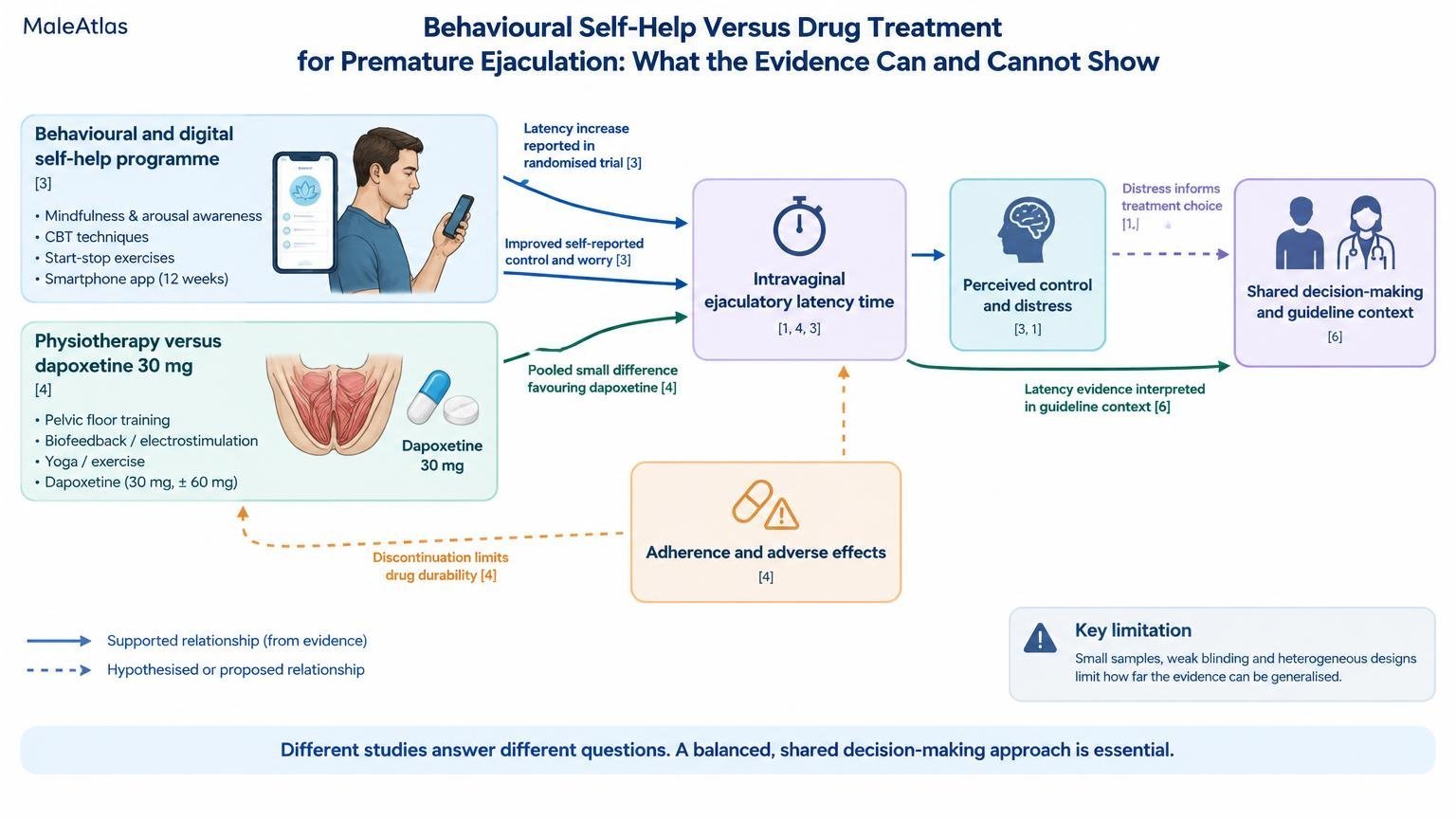
The evidence base now points in two directions at once. A 2026 randomised trial of a smartphone app reported that stopwatch-measured time from penetration to ejaculation roughly doubled over 12 weeks, from 61 to 125 seconds, against a mean 0.5-second change in a wait-list control group; 22% of app users no longer met PE criteria by self-report. In parallel, a 2026 systematic review and meta-analysis found that dapoxetine 30 mg outperformed physiotherapy for one latency measure, though the pooled difference was very small and heterogeneity was high. The apparent conflict is less about which treatment 'works' than about which outcomes, comparisons and designs each body of evidence can actually support.[3][4]
Why This Matters
PE carries a substantial psychological and relational burden, and most affected men do not seek help. Background figures in the CLIMACS release state that PE affects up to 30% of men, is highly stigmatised and that only 9% of men seek medical help. That gap matters clinically because the two dominant treatment families differ in character: drug options act on symptoms with adverse-effect and adherence costs, while behavioural and psychological approaches aim at arousal regulation and performance anxiety but demand time, practice and often partner involvement.
The practical question for clinicians and patients is not simply which arm produces a longer stopwatch time. It is whether a scalable, low-risk self-management route can produce meaningful change for enough men, and where pharmacotherapy remains the more reliable option. The randomised app trial and the physiotherapy meta-analysis address different slices of this question, and their designs constrain how far each can be generalised.
Definitions, Mechanisms and Why Measurement Is Contested
Definitions shape everything downstream. The ISSM describes PE as ejaculation that always or nearly always occurs before or within about one minute of vaginal penetration, a definition tied to vaginal intercourse and to lifelong patterns. The same ISSM framework, as summarised in the physiotherapy review, also recognises acquired PE with a latency often around three minutes or less. These categories are not interchangeable, and trials that enrol lifelong PE may not speak to men whose problem began later in life.[5]
Contextual expectations are equally relevant. A news report cites research indicating an average penetration-to-ejaculation time of five to six minutes in heterosexual intercourse, far from pornographic portrayals of hours-long endurance. That figure is useful for reassurance but weakly documented in the supplied material, with the underlying study, sample and measurement method unspecified. It also illustrates a broader point: distress and the sense of inadequate control can occur well above the one-minute threshold, which is why latency alone is an incomplete outcome.
The proposed mechanisms behind behavioural approaches are plausible rather than proven in these trials. Stop-start and squeeze techniques aim to interrupt rising arousal near the point of inevitability; the stop-start method is described as sometimes difficult to apply, with repeated interruptions capable of reducing pleasure. Digital programmes add mindfulness, arousal-awareness exercises and cognitive behavioural content, targeting the anxiety and avoidance cycle that can maintain the problem. Relationship strain, stress and performance anxiety are described as contributors, but the causal direction between anxiety and PE is not settled by the available designs.
What the Evidence Shows
The digital self-help randomised trial
The CLIMACS study, presented at the European Association of Urology 2026 congress and not yet peer reviewed, enrolled 80 men without other underlying health conditions into a 12-week programme. Participants used a smartphone app teaching mindfulness, arousal awareness, cognitive behavioural techniques and physical exercises such as start-stop, and measured latency with a stopwatch. Controls received no other study support during the first 12 weeks before being offered app access and followed for a further 12 weeks; 66 patients submitted complete questionnaires.
After 12 weeks, app users' time from penetration to ejaculation rose from 61 to 125 seconds, a mean increase of 64 seconds, while controls changed by 0.5 seconds on average. Reported control, ejaculation-related worry, relationship impact and sexuality-related quality of life improved in the app group. Based on self-reported measures, 22% of app users were no longer experiencing PE. The release states final results were expected to be published later in the year and that the app is available in six European countries.
Several design features limit inference. The control condition was a wait-list rather than an active comparator, so non-specific effects such as attention, expectation and structured self-monitoring cannot be separated from the therapeutic content. Blinding is not described, outcomes include self-report, and 14 of 80 enrolled participants did not contribute complete questionnaires. A doubling of a short baseline latency remains a modest absolute change, and a stopwatch reading in seconds does not by itself capture sexual satisfaction or partner experience.
Physiotherapy, drugs and the meta-analytic comparison
The 2026 systematic review and meta-analysis pooled six clinical trials with 416 participants, published between 2014 and 2024, comparing physiotherapy with pharmacological treatment in men with lifelong PE. Physiotherapy covered pelvic floor muscle strengthening, biofeedback, electrostimulation, acupuncture, yoga and general exercise; pharmacotherapy was predominantly dapoxetine 30 mg, with some 60 mg and fluoxetine arms. The pooled analysis found a statistically significant mean difference in intravaginal ejaculatory latency time of −0.80 seconds favouring dapoxetine, with high heterogeneity.
That result needs careful reading. A difference of less than one second is statistically detectable but clinically trivial on its own, and the review text elsewhere describes the same value as a standardised mean difference, a discrepancy that complicates interpretation of magnitude. Individual trials showed larger raw gains for dapoxetine, with some reporting latency increases into the range of roughly two to three minutes over weeks of treatment, but these are single small studies rather than pooled estimates. The authors conclude that dapoxetine 30 mg is significantly more effective than physiotherapy for prolonging latency, while describing physiotherapy as a safe and promising alternative for men intolerant to medication.
The review's qualitative synthesis suggests that combining physiotherapy and pharmacotherapy yields the largest latency improvements, but this is a narrative observation rather than a pooled interaction estimate and should be treated as a hypothesis. The authors themselves caution that the six studies had small samples and differing designs, that head-to-head evidence is scarce and heterogeneous, and that no consensus exists on which strategy is more effective and safer. Blinding of participants, therapists and assessors scored poorly, which is expected in exercise trials but still inflates risk of bias.
| Evidence source | Design and population | Main reported outcome | Key limitation |
|---|---|---|---|
| CLIMACS digital app trial (2026) | Randomised trial; 80 men without other health conditions; 66 complete questionnaires; 12 weeks | Latency 61 to 125 seconds with app versus mean +0.5 seconds in controls; 22% no longer meeting PE criteria by self-report | Conference presentation, not peer reviewed; wait-list control; unblinded; self-report components |
| Physiotherapy versus pharmacotherapy meta-analysis (2026) | Systematic review of 6 trials; 416 men with lifelong PE; studies 2014-2024 | Pooled mean difference in latency −0.80 seconds favouring dapoxetine 30 mg; high heterogeneity | Very small pooled effect; high heterogeneity; poor blinding; magnitude reporting inconsistent |
| Fifth International Consultation on Sexual Medicine review | Consensus review of etiology, epidemiology, evaluation and management | Evidence-based recommendations for definition, classification and treatment of PE and delayed ejaculation | Consensus synthesis; only abstract available in supplied material |
| AUA/SMSNA guideline amendment (2027)[6] | Guideline update; MEDLINE and Embase search 2020-2024; 727 abstracts, 89 included, 25 studies assessed | Non-pharmacological therapy statement revised to note some therapies may be effective; new PDE5 inhibitor expert opinion; caveated statements on clomipramine and glans hyaluronic acid injection | Search window ends December 2024; specific effect sizes not detailed |
Guideline Positioning and the Pharmacological Landscape
Current guidance has moved toward a more balanced view. The AUA/SMSNA guideline amendment searched MEDLINE and Embase for studies published between January 2020 and December 2024, identifying 727 abstracts, 89 meeting inclusion criteria, and assessing 25 studies in 2025 to update statements. Its statement on non-pharmacological therapies was revised to reflect new evidence that some of these therapies may be effective, a modest but meaningful shift from symptom-only framing.
The same amendment added an expert opinion on PDE5 inhibitors for PE and two new evidence-supported statements on daily or on-demand clomipramine and glans hyaluronic acid injection, with the explicit caveat that these be used with informed consent and by a trained clinician. The panel recommends shared decision-making as the fundamental principle regardless of treatment chosen. That framing acknowledges that drug options differ in onset, adverse effects and durability, and that no single agent dominates across all men.
Adherence is a central but under-measured issue. The physiotherapy review notes that although SSRIs can increase latency and improve perceived control and satisfaction, long-term adherence is limited by adverse effects such as nausea and dizziness and by discontinuation rates ranging from 70.6% to 89.6% after the first year. A treatment that works only while taken, and is often stopped, has a different real-world profile from a skills-based programme whose benefits may persist if practised. That contrast is plausible but not directly tested in the supplied evidence.
Interpretation and Limitations
The central interpretive trap is comparing effect sizes across designs that answer different questions. The app trial compares an active programme with a wait-list over 12 weeks in men without other health conditions; the meta-analysis compares physiotherapy with dapoxetine in men with lifelong PE, often in small arms with heterogeneous interventions. Neither can establish that one treatment family is superior overall, and neither isolates a mechanism. The meta-analysis cannot show that pelvic floor training changes ejaculatory physiology, and the app trial cannot show that its benefits exceed those of structured attention or partner-inclusive therapy.
Generalisability is another constraint. The app cohort excluded men with other underlying health conditions and was drawn from a German-based programme available in six European countries, so results may not transfer to men with comorbid erectile dysfunction, prostatitis or relationship crisis. The meta-analysis excluded chronic prostatitis, neurological and pulmonary disease. Neither body of evidence adequately captures partner satisfaction, which the trial investigators themselves flagged as an important next question.
Statistical significance and clinical significance diverge sharply here. A pooled difference of less than one second and a doubling from about one minute to about two minutes are both real findings, but they mean different things to a man deciding whether to persist with exercises or try medication. Distress, control and relational impact are the outcomes most likely to drive that decision, and they are measured with self-report instruments whose responsiveness and minimal important difference are not established in the supplied material.
Research Outlook
The next step is better comparators rather than more wait-lists. A trial comparing a digital behavioural programme with dapoxetine, and with combined treatment, using blinded outcome assessment where feasible and validated patient-reported measures alongside stopwatch latency, would directly address the question the current literature only gestures at. The meta-analysis authors' suggestion that combined therapy produces the largest gains is a hypothesis that such a trial could test rather than assume.
Peer-reviewed publication of the CLIMACS final results will matter, as will longer follow-up to see whether gains persist after the programme ends and whether partners report benefit. Guideline panels will need to weigh non-pharmacological evidence that is heterogeneous and hard to blind, and to define minimum clinically important differences for latency and distress so that statistically significant but trivial effects are not over-read. Shared decision-making remains the appropriate frame while that evidence matures.
Key Takeaways
- PE definitions range from a strict roughly 4% prevalence to broader estimates near a third, and the one-minute vaginal penetration anchor does not capture subjective distress or control.
- A 2026 randomised app trial reported latency rising from 61 to 125 seconds over 12 weeks versus a mean 0.5-second change in wait-list controls, with 22% no longer meeting PE criteria by self-report; results were not peer reviewed at presentation.
- A 2026 meta-analysis of six trials and 416 men found dapoxetine 30 mg outperformed physiotherapy for latency by a pooled −0.80 seconds, a statistically significant but clinically small difference with high heterogeneity.
- Guideline updates now acknowledge that some non-pharmacological therapies may be effective, add caveated statements on newer options and emphasise shared decision-making.
- Combined behavioural and drug approaches are plausibly superior but remain a hypothesis rather than a demonstrated pooled effect.
Questions and Answers
What is premature ejaculation and how is it defined in research?
Research commonly uses the ISSM definition: ejaculation always or nearly always occurring before or within about one minute of vaginal penetration, with acquired forms often set around three minutes or less. Strict criteria yield prevalence estimates near 4%, broader criteria up to a third. Distress and perceived lack of control matter alongside latency, and definitions are tied mainly to vaginal intercourse.
Did the smartphone app for premature ejaculation actually improve ejaculation time?
In the CLIMACS randomised trial, stopwatch-measured time from penetration to ejaculation rose from 61 to 125 seconds after 12 weeks among app users, a mean increase of 64 seconds, versus a mean 0.5-second change in wait-list controls. Self-reported control, worry and relationship impact also improved, and 22% no longer met PE criteria by self-report. The results were presented at a congress and not yet peer reviewed.
Is dapoxetine more effective than physiotherapy for premature ejaculation?
A 2026 meta-analysis of six trials and 416 men with lifelong PE found a statistically significant pooled latency difference of −0.80 seconds favouring dapoxetine 30 mg over physiotherapy, with high heterogeneity. That difference is very small clinically, the included studies were small and poorly blinded, and the authors describe physiotherapy as a safe alternative for men who cannot tolerate medication rather than a proven equal.
How strong is the evidence for behavioural and psychological self-help for PE?
It is promising but limited. The main randomised evidence is a single 80-man, non-peer-reviewed trial with a wait-list control and self-report components. Physiotherapy trials pooled in the 2026 meta-analysis were small and heterogeneous. Guideline panels have revised statements to note that some non-pharmacological therapies may be effective, but effect sizes and durability remain uncertain and blinding is difficult.
What are the limitations and risks of drug treatment for premature ejaculation?
SSRIs such as dapoxetine can increase latency and improve perceived control, but adverse effects include nausea and dizziness, and reported discontinuation rates range from 70.6% to 89.6% after the first year, meaning benefits may not persist. Newer statements on clomipramine and glans hyaluronic acid injection carry informed-consent and trained-clinician caveats. Guideline panels recommend shared decision-making rather than a single default drug.
Should combined behavioural and drug treatment be used for premature ejaculation?
Combination is plausible but not established. The 2026 meta-analysis' qualitative synthesis suggested combined physiotherapy and pharmacotherapy produced the largest latency improvements, but this was a narrative observation rather than a pooled interaction estimate. Individual small trials showed larger gains in combined arms, yet heterogeneity and poor blinding limit confidence. Combination should be discussed as a reasonable option within shared decision-making, not presented as proven superior.
Conceptual framework: Conceptual framework for interpreting premature ejaculation treatment evidence. The framework is not a tested causal model. It separates a digital self-help trial in 80 men (not peer reviewed) from a meta-analysis of six physiotherapy-versus-dapoxetine trials in 416 men with lifelong PE. Supported links reflect reported associations; the adherence-durability link and the distress-to-decision link are proposed. Key limitation: small samples, weak blinding and heterogeneous designs.
Academic References & Evidence
- When a man comes too fast.
- Trop rapide au lit ? La durée moyenne d’un rapport risque de vous surprendre – La santé au quotidien.
- Press release: Smartphone app can help men last longer in bed, finds research. (preprint)
- Esther M Medrano-Sánchez; Ana López-del-Castillo; Maud Boisseau; Juan C Fernández-Domínguez; Esther Díaz-Mohedo. Effectiveness of physiotherapy in male premature… : The Journal of Sexual Medicine. The Journal of Sexual Medicine. 2026 23(5) DOI: 10.1093/jsxmed/qdag096.
- Contemporary consensus and emerging directions in premature and delayed ejaculation: recommendations from the 5th International Consultation on Sexual Medicine.. Sexual medicine reviews PMID: 42855438.
- Disorders of Ejaculation: AUA/SMSNA Guideline (2027) | Journal of Urology. Journal of Urology DOI: 10.1097/JU.0000000000005378.
SANYUN Science Center explains published research on men's reproductive and sexual health, connecting scientific evidence with everyday questions while making sources and limitations clear.
Disclaimer: This article is for scientific education and research communication only. It does not provide medical advice, diagnosis, or individualized treatment recommendations, and does not endorse any medication, supplement, device, penile enlargement procedure, or other intervention. Decisions about sexual and reproductive health should be made in consultation with a qualified healthcare professional. Do not delay seeking professional care because of information in this article.
Original Content & Copyright Notice
- This article is prepared for SANYUN Science Center, drawing on published research and publicly available academic literature on men’s sexual and reproductive health. Its editorial explanations and presentation are developed for this platform.
- Copyright in the original editorial content, selection, and arrangement is reserved by SANYUN Science Center to the extent protected by applicable law. Referenced research, quotations, and third-party materials remain subject to the rights of their respective owners. This notice does not claim ownership of scientific facts or third-party research.
- Except where permitted by applicable law or an applicable license, prior written permission is required to reproduce, republish, translate, adapt, redistribute, or commercially reuse protected content. Attribution alone does not grant permission for such reuse.
- For permitted quotation or authorized reuse, clearly identify the source and retain a link to the original article.
- Source: SANYUN Science Center
- Original URL: Retain the original article URL on science.san-yun.com.
- Copyright Holder: SANYUN Science Center, for its own protected editorial content.
- Quotation, excerpts, or authorized reuse must not distort the scientific meaning, omit material limitations or disclaimers, or imply unverified medical claims, product efficacy, or endorsement by SANYUN Science Center.



