




Category: Health Academy
Core Research Direction: Discussing sexual health concerns such as erectile dysfunction and low libido during routine medical checkups
Search Intent: How can men start a conversation about sexual health problems with their doctor at a routine checkup?
Platform: SANYUN Science Center
Evidence reviewed through: 2026-11-26
Executive Summary
Sexual health concerns such as erectile dysfunction and low libido are often left unaddressed, and embarrassment or shyness is commonly cited as a reason people avoid raising them. A clinician-authored commentary argues that sexual health deserves routine attention alongside blood pressure or weight and offers practical steps for starting the conversation at a checkup. The commentary, however, is advice and opinion rather than a study of outcomes: it provides no data showing that its suggested conversation techniques improve diagnosis, treatment or satisfaction.[1]
One cited observation is that fewer than half of OB-GYNs routinely ask about sexual problems, and even fewer inquire about sexual satisfaction or orientation. That figure comes from an unidentified study and concerns OB-GYNs rather than clinicians who primarily see men, so it should not be generalized to all routine checkups. Still, it illustrates a plausible gap between the importance assigned to sexual health and how often it is proactively discussed.
Why This Matters
The commentary frames sexual health as a vital part of overall well-being, comparable in routine importance to blood pressure or weight checks. That is an editorial position rather than a measured finding, but it reflects a broader clinical reality: sexual function can be influenced by vascular, hormonal, psychological and relationship factors, and patients often carry concerns for years without mentioning them. The practical consequence is that a checkup may conclude without the topic ever being raised by either party.
The commentary also notes that sexual problems are more common than people assume yet frequently go unaddressed. Because no prevalence data are supplied, readers should treat this as a general assertion rather than a specific estimate. The takeaway is not a number but a pattern: silence around sexual concerns is common enough that clinicians and patients may both need a deliberate prompt.
What the Commentary Recommends
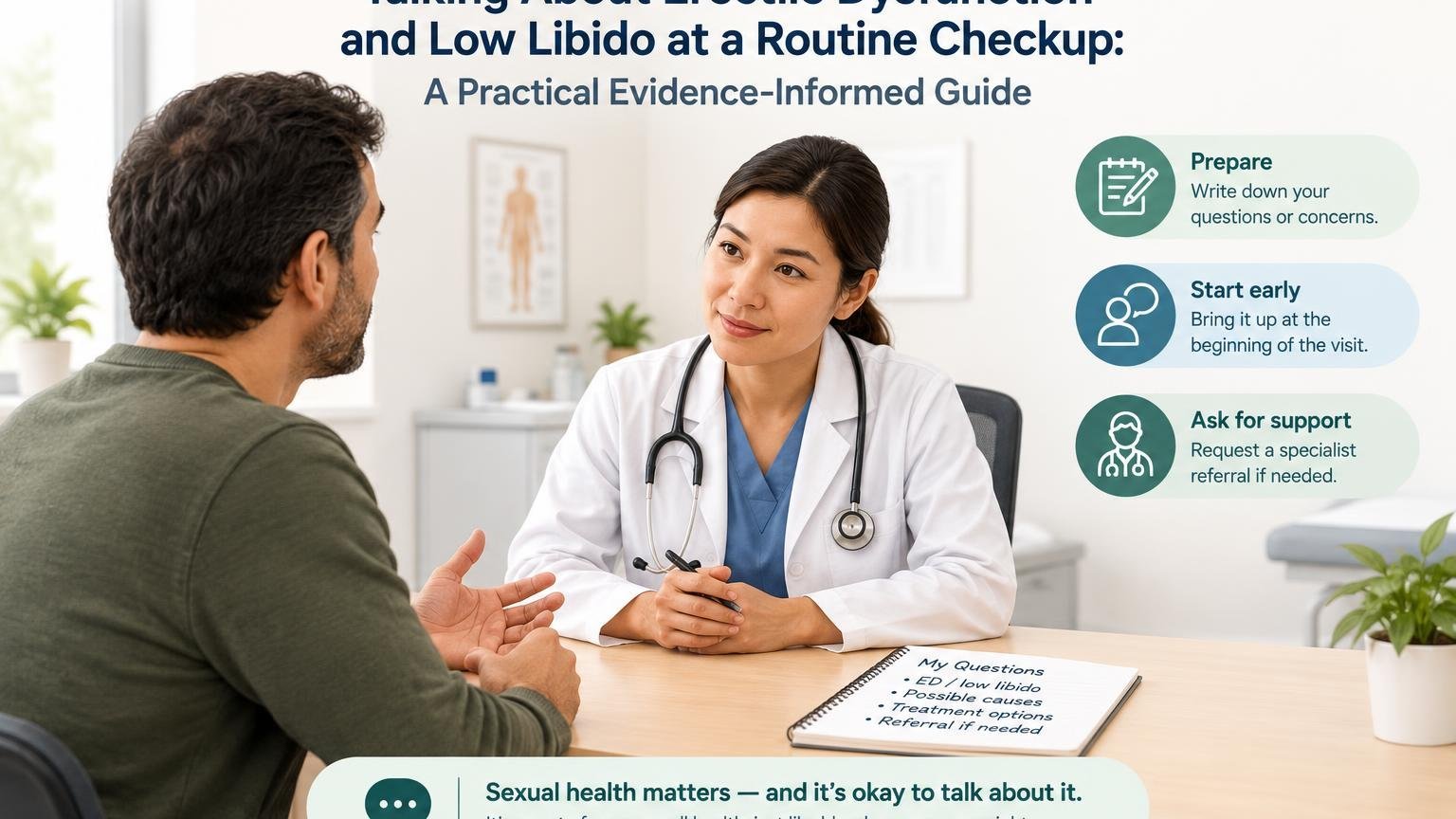
- Prepare before the visit: jot down questions or concerns about sexual health so they are covered during the appointment.
- Rehearse the opening if anxiety is high; the commentary suggests rehearsal can ease nervousness about starting the conversation.
- Raise the issue early rather than at the end of the visit, using a brief opening such as saying you have a personal issue to discuss.
- Ask for a specialist referral if your clinician does not have the answers you need.
The commentary also advises giving a heads-up to nursing staff when the conversation may need more time, and it frames disclosure as something most doctors will welcome. These are reasonable communication suggestions, but they are not derived from comparative studies of patient outcomes. They are best understood as a practical script rather than an evidence-based protocol.
How to Put the Advice Into Practice
| Conversation step | What it involves | Evidence status in the commentary |
|---|---|---|
| Prepare written notes | List sexual health questions or concerns before the appointment so they are covered during the visit. | Practical advice; no study data on whether preparation improves discussion or outcomes. |
| Rehearse the opening | Practice what you want to say to reduce anxiety about starting the conversation. | Suggested technique; no measurement of anxiety reduction provided. |
| Raise it early | Use a brief opening statement early in the visit rather than waiting until the clinician is about to leave. | Practical advice; no supporting study data. |
| Ask for a referral | Request a specialist referral when the clinician does not have the needed answers. | Advice only; no evidence on referral outcomes. |
| Expect a welcome response | The commentary states most doctors will be glad the issue was raised and can offer advice or treatments. | Opinion; no cited evidence on outcomes of patient-initiated discussion. |
What the Evidence Shows — and What It Does Not
The source material is a general commentary, not a clinical trial or systematic review. Its central claims about the importance of sexual health and the value of speaking up are reasoned positions. The one numerical observation — that fewer than half of OB-GYNs routinely ask about sexual problems — is attributed to an unidentified study without sample size, date or journal details. That makes it difficult to assess its quality, generalizability or currency.
There is also a population mismatch worth naming. The cited survey concerns OB-GYNs, while the article's practical advice is aimed at people seeing a clinician for a routine checkup, including men with erectile dysfunction or low libido. No data in the source describe how often primary care clinicians, urologists or other professionals ask about sexual health, nor how patients respond when they do. The commentary's recommendations therefore rest on plausibility and clinical common sense rather than measured effectiveness.
It is also important to separate association from causation. The commentary links unaddressed sexual problems to embarrassment, but it does not test whether reducing embarrassment improves health outcomes. Similarly, it suggests that doctors can offer valuable advice or treatments, but it does not report which treatments, for whom, or with what success. Readers should not interpret the commentary as proof that a particular conversation style changes clinical results.
Interpretation and Limitations
The commentary's strength is its practical framing: it treats sexual health as ordinary preventive care and gives concrete language for an awkward moment. Its limitations are equally clear. It is single-authored, opinion-based and does not cite specific studies for most of its advice. The one study it mentions is unnamed, and the statistics are incomplete. The recommendations about preparation, rehearsal, timing and referral are untested suggestions, not established best practice.
Another limitation is scope. Erectile dysfunction and low libido can have multiple contributors, and a routine checkup may or may not be the right setting for a full evaluation. The commentary does not discuss what a clinician should ask, what tests might be appropriate, or how concerns should be triaged. It also does not address cultural, relationship or privacy barriers beyond general embarrassment. These omissions mean the advice is a starting point for communication, not a clinical pathway.
Finally, the commentary includes a typographical error in its referral advice, which is a minor signal of editorial rather than peer-reviewed rigor. None of this makes the advice wrong; it simply means the suggestions should be held with appropriate uncertainty. A reader looking for proven conversation protocols will not find them here.
Research Outlook
What would strengthen this area is research that measures whether patient-initiated discussion at routine checkups changes diagnosis rates, treatment uptake or satisfaction, and whether clinician prompts or patient preparation tools improve those outcomes. Studies in primary care and urology settings, not only OB-GYN practice, would be more directly relevant to men with erectile dysfunction or low libido. Until such evidence exists, the commentary's advice remains a reasonable communication aid rather than a validated intervention.
Key Takeaways
- Sexual health concerns such as erectile dysfunction and low libido are often left unaddressed, with embarrassment cited as a common reason.
- A clinician commentary recommends preparing notes, rehearsing, raising the issue early and asking for a specialist referral if needed.
- The only cited statistic — fewer than half of OB-GYNs routinely ask about sexual problems — comes from an unidentified study and does not describe all clinicians.
- The advice is plausible but not proven to improve outcomes; it should be treated as a communication aid, not a clinical protocol.
Questions and Answers
Why do men avoid talking about erectile dysfunction or low libido at a medical checkup?
A clinician commentary attributes avoidance to embarrassment or shyness, noting that sexual problems are common but often left unaddressed. No prevalence data are provided to quantify how many men delay disclosure. The commentary presents this as a general pattern rather than a measured finding, so the exact scale of the problem remains unclear.
What practical steps does the commentary recommend for raising sexual health concerns with a doctor?
It suggests writing down questions beforehand, rehearsing the opening, raising the issue early in the visit with a brief statement, and asking for a specialist referral if the clinician lacks answers. It also advises giving nursing staff a heads-up if more time is needed. These are practical suggestions without supporting outcome data.
How strong is the evidence that preparing for a sexual health conversation improves care?
The evidence is weak. The source is an opinion-based commentary with no comparative studies or outcome data. Its suggestions about preparation, rehearsal and timing are plausible but untested. The one cited statistic comes from an unidentified study of OB-GYNs, making it difficult to assess quality or relevance to men's routine checkups.
Does the commentary's advice apply to primary care visits for men, not just OB-GYN appointments?
The practical advice is framed for general checkups, but the only cited study concerns OB-GYNs, not primary care clinicians or urologists. No data in the source describe how often other clinicians ask about sexual health or how they respond. Applicability to men's routine care is therefore plausible but not directly supported by the cited evidence.
What are the limitations of using this commentary as medical guidance?
It is single-authored opinion without peer review, most advice lacks cited evidence, and the one study mentioned is unnamed and incomplete. It does not discuss what a clinician should ask, which tests are appropriate, or how concerns should be triaged. It also gives only general attention to cultural or relationship barriers. It is a communication aid, not a clinical pathway.
What should a man expect if he brings up erectile dysfunction at a routine checkup?
The commentary states most doctors will be glad the issue was raised and can offer advice or treatments, but this is an opinion without cited outcome data. It does not specify what advice or treatments might be offered. Readers should treat the expectation as encouraging but unproven, and ask for a specialist referral if their clinician cannot help.
Sources and References
SANYUN Science Center explains published research on men's reproductive and sexual health, connecting scientific evidence with everyday questions while making sources and limitations clear.
Disclaimer: This article is for scientific education and research communication only. It does not provide medical advice, diagnosis, or individualized treatment recommendations, and does not endorse any medication, supplement, device, penile enlargement procedure, or other intervention. Decisions about sexual and reproductive health should be made in consultation with a qualified healthcare professional. Do not delay seeking professional care because of information in this article.
Original Content & Copyright Notice
- This article is prepared for SANYUN Science Center, drawing on published research and publicly available academic literature on men’s sexual and reproductive health. Its editorial explanations and presentation are developed for this platform.
- Copyright in the original editorial content, selection, and arrangement is reserved by SANYUN Science Center to the extent protected by applicable law. Referenced research, quotations, and third-party materials remain subject to the rights of their respective owners. This notice does not claim ownership of scientific facts or third-party research.
- Except where permitted by applicable law or an applicable license, prior written permission is required to reproduce, republish, translate, adapt, redistribute, or commercially reuse protected content. Attribution alone does not grant permission for such reuse.
- For permitted quotation or authorized reuse, clearly identify the source and retain a link to the original article.
- Source: SANYUN Science Center
- Original URL: Retain the original article URL on science.san-yun.com.
- Copyright Holder: SANYUN Science Center, for its own protected editorial content.
- Quotation, excerpts, or authorized reuse must not distort the scientific meaning, omit material limitations or disclaimers, or imply unverified medical claims, product efficacy, or endorsement by SANYUN Science Center.



