




Category: Penis Enlargement
Core Research Direction: Complications and evidence quality of penile augmentation procedures (injectables, implants, and surgical grafts) for adult men, and the gap between claimed benefits and documented risks
Search Intent: What does the current research evidence show about the safety, complications, and real size outcomes of penile augmentation procedures in adult men?
Platform: SANYUN Science Center
Evidence reviewed through: 2026-11-24
Executive Summary
Penile augmentation remains a controversial area of male genital surgery. A 2026 narrative review in the International Journal of Impotence Research examined the complications reported for foreign-body implantations and injections in the penis. The authors state that the controversy arises mainly because most men seeking these interventions have penile dimensions within the normal range and because the procedures carry risks of severe complications.[1]
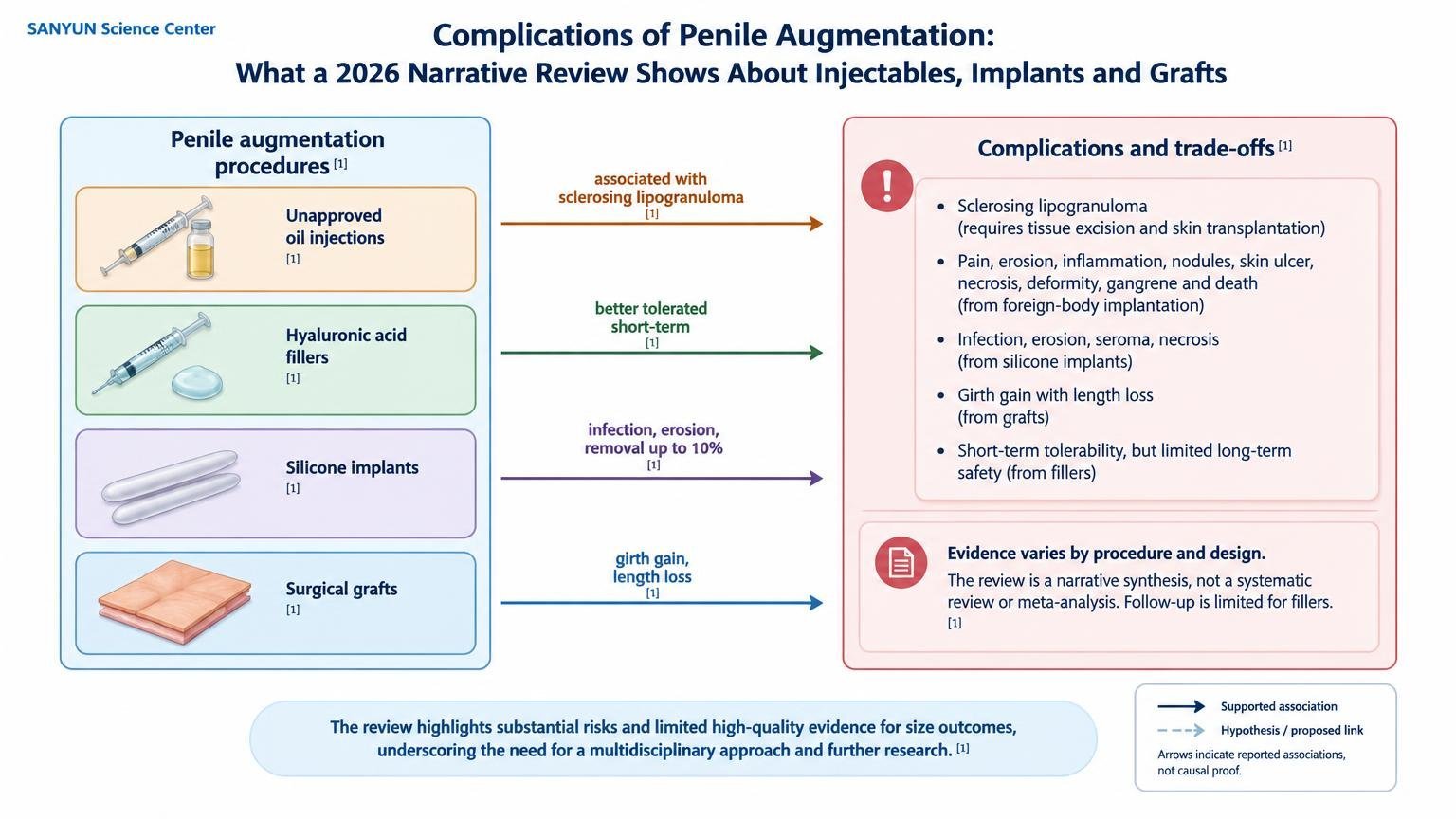
The review draws on retrospective case series and reports, prospective studies of hyaluronic acid fillers and silicone implants, and retrospective series of graft implantation. The evidence is uneven. Some reports describe catastrophic outcomes after unapproved oil injections under non-sterile conditions, including sclerosing lipogranuloma requiring tissue excision and skin transplantation. Others show that hyaluronic acid fillers are better tolerated but with short follow-up. Grafts have been reported to improve girth and patient satisfaction while having a negative impact on penile length. Silicone implants carry risks of infection, erosion, seroma and necrosis, with removal in up to 10% of cases.
The review concludes that a multidisciplinary approach is essential for men requesting penile augmentation and that further research is needed to manage these patients successfully. The narrative design means the findings describe patterns rather than provide pooled risk estimates or comparative effectiveness data.
Why This Matters
Men considering penile augmentation often encounter marketing that emphasizes size outcomes while minimizing risks. The review's central observation is that most men who seek these procedures already have penile dimensions within the normal range. This means that a substantial proportion of the population exposed to these procedures may not have a medical indication, making the risk-benefit balance especially unfavorable when complications are severe.
The complications described are not trivial. They include pain, erosion, inflammation, nodules, skin ulcer, necrosis, penile deformity, gangrene and even death. Some complications require complex reconstructive treatments such as tissue excision and skin transplantation. These outcomes matter because they can be permanent, may require further surgery, and can affect urinary, sexual and psychological function.
Biological and Clinical Mechanisms Behind the Complications
The mechanisms of harm differ by procedure type. Unapproved oil-based substances injected under non-sterile conditions can trigger a severe foreign-body reaction that progresses to sclerosing lipogranuloma, a chronic inflammatory and fibrotic process. The body cannot easily clear these substances, and the resulting tissue changes may require surgical excision and skin grafting. The review notes that the prevalence of this practice is unknown, which limits any estimate of population-level risk.
Foreign-body implantation for sexual pleasure has been associated with a spectrum of local complications. These include pain, erosion through the skin, inflammation, nodules, skin ulcer, necrosis, penile deformity and gangrene. The reported occurrence of death underscores that these are not only local genital problems but can become systemic or life-threatening events, although retrospective reports do not provide denominators to calculate incidence.
Silicone implants, studied in prospective cohorts, are associated with infection, erosion, seroma and necrosis. These processes can lead to severe penile deformities and, in some cases, removal of the implant. The removal rate of up to 10% reported in the review is a clinically meaningful signal, but it represents an upper bound from the available cohorts rather than a precise estimate.
Graft implantation has been reported in retrospective series to improve penile girth and patient satisfaction. However, the same series report a negative impact on penile length. This trade-off is important because penile length is often the primary concern motivating men to seek augmentation. A procedure that increases girth while reducing length may not satisfy the original goal and may compound dissatisfaction.
Hyaluronic acid filler injections have been studied prospectively and appear better tolerated than other injectable materials. However, the follow-up period in these studies is short. Short-term tolerability does not establish long-term safety, durability, or freedom from delayed complications such as migration, granuloma formation, or late infection. These limitations are particularly relevant because fillers are often marketed as non-surgical and low-risk alternatives.
What the Evidence Shows: Procedure-by-Procedure Findings
The review organizes evidence by material and procedure type, but the strength of evidence varies. Retrospective case series and reports dominate for unapproved injectables and foreign-body implants. These designs are useful for identifying severe outcomes but cannot estimate incidence or distinguish procedure-related risk from patient or setting factors. Prospective cohort data exist for hyaluronic acid fillers and silicone implants, but follow-up is limited or focused on specific products. Retrospective series of graft implantation provide some outcome data but lack standardized measurement and comparison groups.
| Procedure or material | Evidence design | Reported outcomes | Key limitation |
|---|---|---|---|
| Unapproved oil-based injections | Retrospective case series | Sclerosing lipogranuloma requiring tissue excision and skin transplantation; prevalence unknown | Retrospective design; prevalence of practice unknown |
| Foreign-body implantation for sexual pleasure | Retrospective reports | Pain, erosion, inflammation, nodules, skin ulcer, necrosis, penile deformity, gangrene, death | No denominators reported; retrospective |
| Hyaluronic acid filler | Prospective studies | Better tolerated than other methods; short follow-up | Short follow-up; long-term safety not established |
| Surgical graft implantation | Retrospective series | Improvement in girth and patient satisfaction; negative impact on penile length | Retrospective series; no quantified effect sizes |
| Silicone implant | Prospective cohorts | Infection, erosion, seroma, necrosis; severe deformity; removal rate up to 10% | Upper-bound removal rate; cohort sizes not given in abstract |
Interpretation and Limitations
The review is a narrative synthesis, not a systematic review or meta-analysis. It does not provide pooled complication rates, standardized outcome definitions, or formal risk-of-bias assessment. The included studies are heterogeneous in design, materials, populations and follow-up duration. This limits the ability to compare procedures directly or to estimate the probability of a given complication for an individual patient.
The evidence about unapproved injectables and foreign-body implants is largely retrospective and often obtained from case series that may over-represent severe outcomes. Conversely, prospective studies of hyaluronic acid fillers may under-represent rare but serious delayed complications because follow-up is short. The removal rate of up to 10% for silicone implants is a useful signal but should not be interpreted as a precise incidence estimate. None of these data establish that any procedure reliably achieves a meaningful, durable size gain.
The review emphasizes that most men seeking augmentation have normal penile dimensions. This context is central to interpretation: the risks described are borne by a population that may not have a medical condition requiring intervention. The review's recommendation for a multidisciplinary approach reflects the complexity of assessing these patients, including psychological, sexual and surgical dimensions. This recommendation is the authors' proposal rather than an outcome finding.
Research Outlook
The review calls for further research to manage patients seeking penile augmentation successfully. Priorities would include prospective studies with longer follow-up for fillers, standardized definitions of complications, and better data on the incidence of harms associated with unapproved injectables. Comparative studies that measure both size outcomes and patient-reported satisfaction and function would help clarify whether any procedure offers a favorable balance. However, the current evidence base does not support claims of safety or efficacy for most augmentation methods.
The narrative review also highlights a gap between the prevalence of these procedures and the quality of evidence about them. The prevalence of unapproved oil injection is unknown, and retrospective reports of foreign-body implantation lack denominators. These gaps make it difficult to quantify population-level risk or to counsel patients with precise probabilities. Until better data are available, clinicians and patients must rely on the patterns of harm described in the available literature.
Key Takeaways
- A 2026 narrative review found that penile augmentation is controversial because most men seeking it have normal penile dimensions and because severe complications are associated with the procedures.
- Unapproved oil-based injections under non-sterile conditions have caused sclerosing lipogranuloma requiring tissue excision and skin transplantation; the prevalence of this practice is unknown.
- Foreign-body implantation for sexual pleasure has been linked to pain, erosion, inflammation, nodules, skin ulcer, necrosis, deformity, gangrene and death in retrospective reports.
- Hyaluronic acid fillers appear better tolerated in prospective studies, but follow-up is short and long-term safety is not established.
- Graft implantation has been reported to improve girth and satisfaction but negatively affect penile length in retrospective series.
- Silicone implants carry risks of infection, erosion, seroma and necrosis, with a removal rate of up to 10% in prospective cohorts.
- The review authors recommend a multidisciplinary approach and further research, but these are proposals rather than demonstrated outcomes.
Questions and Answers
What is penile augmentation and what procedures does the 2026 review cover?
Penile augmentation refers to procedures intended to increase penile size or appearance. The 2026 narrative review examined foreign-body implantations and injections, including unapproved oil-based substances, hyaluronic acid fillers, silicone implants and surgical grafts. It focused on complications rather than efficacy. The review notes that most men seeking these interventions have penile dimensions within the normal range, which shapes the risk-benefit discussion.
What complications are linked to unapproved penile injections and foreign-body implants?
Retrospective case series describe unapproved oil-based injections under non-sterile conditions causing sclerosing lipogranuloma that required tissue excision and skin transplantation. Foreign-body implantation for sexual pleasure has been associated with pain, erosion, inflammation, nodules, skin ulcer, necrosis, penile deformity, gangrene and even death. These reports lack denominators, so the frequency of these complications cannot be calculated from the review.
How strong is the evidence on penile filler and implant safety?
The evidence varies by material. Hyaluronic acid fillers have been studied prospectively and appear better tolerated, but follow-up is short, so long-term safety is uncertain. Silicone implants have prospective cohort data showing risks of infection, erosion, seroma and necrosis, with a removal rate of up to 10%. Graft outcomes come mainly from retrospective series. Overall, the review is narrative and does not provide pooled risk estimates or standardized comparisons.
Do penile grafts increase size without trade-offs?
Retrospective series of graft implantation reported improvement in penile girth and patient satisfaction. However, the same series reported a negative impact on penile length. This means that a procedure intended to enhance size may reduce length, which is often a primary concern for men seeking augmentation. The review does not provide quantified effect sizes, so the magnitude of these trade-offs is unclear.
What are the limitations of the 2026 penile augmentation review?
The review is a narrative synthesis, not a systematic review or meta-analysis. It does not provide pooled complication rates, standardized outcome definitions, or formal risk-of-bias assessment. The included studies are heterogeneous, and many are retrospective with limited follow-up. The prevalence of unapproved injection practices is unknown. These limitations mean the findings describe patterns of harm rather than precise probabilities for individual patients.
What should men with concerns about penile size know before considering augmentation?
Most men who seek penile augmentation have penile dimensions within the normal range, according to the review. The procedures carry risks of severe complications, including infection, deformity, loss of length and, in some cases, life-threatening events. The review authors recommend a multidisciplinary approach and further research. Men with concerns about size should discuss them with a qualified clinician who can assess whether a medical condition exists and explain the limited evidence.
Conceptual framework: Conceptual framework of penile augmentation complications by procedure type, based on a 2026 narrative review. Arrows indicate reported associations, not causal proof; evidence strength varies by procedure and follow-up is limited for fillers.
Academic References & Evidence
- Mahmood Ramazan; Louise Faurholt Øbro; Majken Højrup Wiborg; Mikkel Fode; Christian Fuglesang S. Jensen; Palle Jörn Sloth Osther; Grzegorz Fojecki. Complications of penile augmentation: A narrative review of injectables, implants, and surgical grafts. International Journal of Impotence Research. 2026 38(3):238-246 DOI: 10.1038/s41443-025-01190-8.
SANYUN Science Center explains published research on men's reproductive and sexual health, connecting scientific evidence with everyday questions while making sources and limitations clear.
Disclaimer: This article is for scientific education and research communication only. It does not provide medical advice, diagnosis, or individualized treatment recommendations, and does not endorse any medication, supplement, device, penile enlargement procedure, or other intervention. Decisions about sexual and reproductive health should be made in consultation with a qualified healthcare professional. Do not delay seeking professional care because of information in this article.
Original Content & Copyright Notice
- This article is prepared for SANYUN Science Center, drawing on published research and publicly available academic literature on men’s sexual and reproductive health. Its editorial explanations and presentation are developed for this platform.
- Copyright in the original editorial content, selection, and arrangement is reserved by SANYUN Science Center to the extent protected by applicable law. Referenced research, quotations, and third-party materials remain subject to the rights of their respective owners. This notice does not claim ownership of scientific facts or third-party research.
- Except where permitted by applicable law or an applicable license, prior written permission is required to reproduce, republish, translate, adapt, redistribute, or commercially reuse protected content. Attribution alone does not grant permission for such reuse.
- For permitted quotation or authorized reuse, clearly identify the source and retain a link to the original article.
- Source: SANYUN Science Center
- Original URL: Retain the original article URL on science.san-yun.com.
- Copyright Holder: SANYUN Science Center, for its own protected editorial content.
- Quotation, excerpts, or authorized reuse must not distort the scientific meaning, omit material limitations or disclaimers, or imply unverified medical claims, product efficacy, or endorsement by SANYUN Science Center.



