


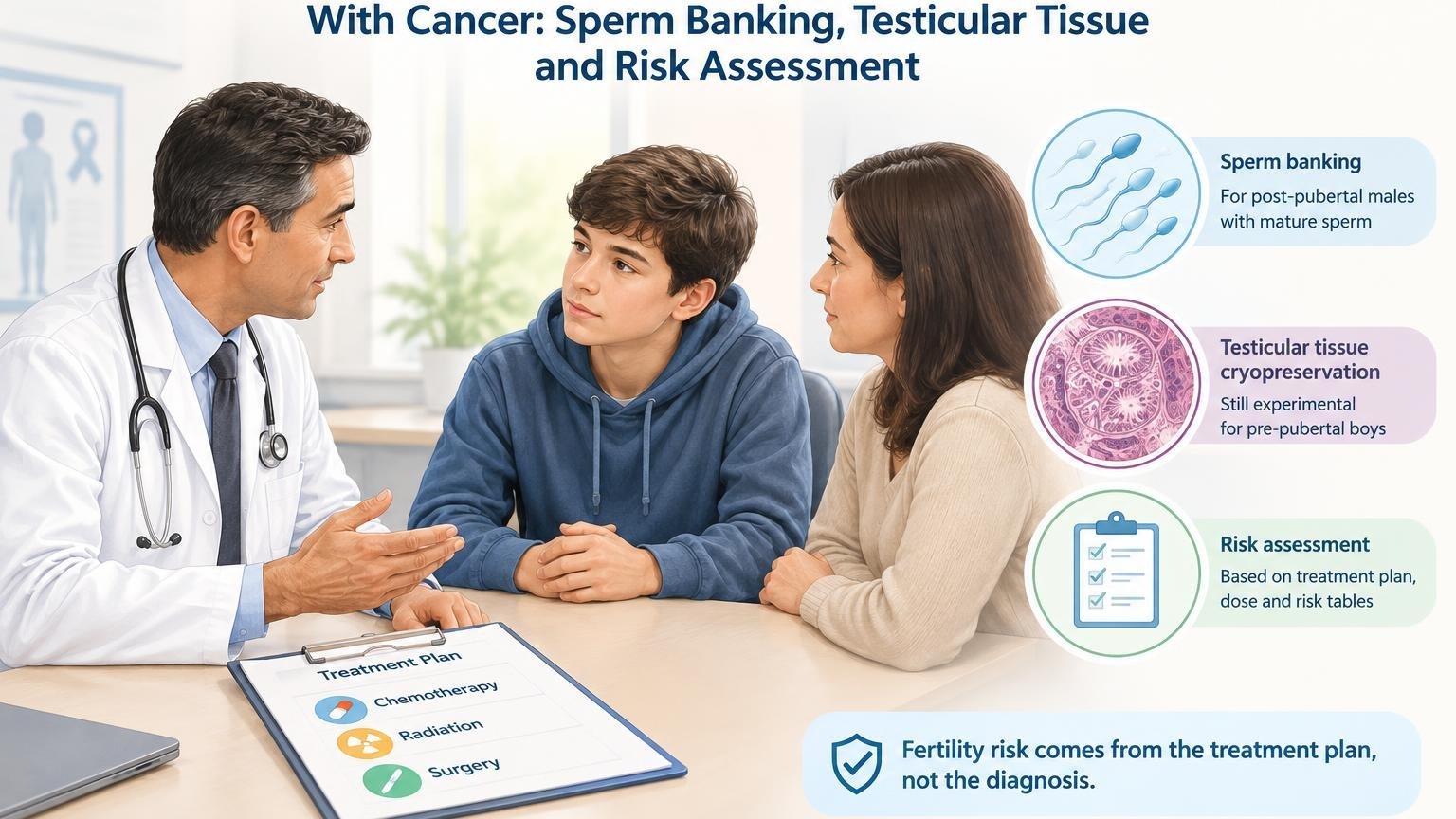


Category: Reproductive Care
Core Research Direction: Male fertility preservation in childhood, adolescent and young adult cancer: sperm banking eligibility and limits, the still-experimental status of prepubertal testicular tissue cryopreservation, and how fertility risk is assessed in boys
Search Intent: If a boy or young man is facing cancer treatment, what fertility preservation options exist, when is sperm banking possible, how is his risk of infertility assessed, and what is still experimental?
Platform: SANYUN Science Center
Evidence reviewed through: 2026-11-26
Executive Summary
A cancer diagnosis in childhood, adolescence or young adulthood forces a family to absorb a great deal of information quickly, and fertility is one of the topics most easily lost in that rush. The clearest message from the available clinical accounts is that fertility risk is not created by the cancer diagnosis itself but by the specific treatment planned. Clinicians look at the type and dose of chemotherapy, whether radiation is used and where it is directed, and whether surgery will touch reproductive organs.[1]
For males, the practical menu is narrow and age-dependent. Sperm banking is the established option, but it requires mature sperm, which the source places at puberty, and a specimen produced by masturbation. Every post-pubertal male in that program is offered it, and stored specimens have reportedly produced children after 20 years in storage. For pre-pubertal boys, testicular tissue cryopreservation is described as still experimental and tied to a multisite trial of safety and efficacy rather than to established benefit.
Why This Matters
Survival is the reason this conversation exists. Trial background material states that overall survival for children, adolescents and young adults with cancer now exceeds 80%, and a separate expert discussion puts US pediatric survival at about 85%, attributing the rise to earlier diagnosis and improved chemotherapy, biologics and radiation. More survivors means more young adults who want to know whether they can have biological children.[2][3]
The gap between wanting that information and receiving it is still measurable. One trial background reports that unmet fertility information needs remain high, at around 40% among cancer survivors, and notes that research on decision aids in survivorship is lacking. Pediatric survivors are also reported to be significantly more likely to be infertile than their siblings, though the source gives no effect size or adjustment for confounding.
How Fertility Risk Is Assessed in Boys
Risk assessment is described as a stepwise process rather than a single test. The treating oncologist first sets out the planned chemotherapy, radiation and surgery. The high-risk elements are then extracted and their doses calculated. Those doses are matched against risk-assessment tables that synthesise the best available evidence, much of it drawn from population-based studies of long-term survivors and their fertility outcomes.
Two features of this process deserve emphasis. First, the tables are explicitly described as changing as new information arrives, which means a risk estimate is a moving summary of population evidence, not a personal prophecy. Second, a pre-pubertal boy is not protected: the account states plainly that not having reached puberty does not mean a treatment plan with gonadotoxic elements will leave fertility untouched.
| Assessment element | What is examined | Why it matters |
|---|---|---|
| Chemotherapy | Type and calculated dose of agents with known long-term fertility impact | Dose is the input used with risk tables, not the drug name alone |
| Radiation | Whether radiation is planned, its target site and its dose | Targeting reproductive organs changes the risk profile |
| Surgery | Any procedure that could directly affect reproductive organs | Surgical risk is assessed alongside drug and radiation risk |
| Risk tables | Evidence synthesis, largely from long-term survivor populations | Produces a population-based estimate that is updated over time |
| Pubertal status | Whether mature sperm are likely to be present | Determines whether sperm banking is even feasible |
The Biology: Why Age Changes the Options
In males, treatment damage is described as falling on the cells that support sperm production, and that damage can occur before puberty. The resulting outcome is a spectrum: complete inability to produce sperm at one end, a normal sperm count at the other, and lower-than-normal counts in between. This is a description of a range of possible outcomes, not a prediction of where any individual boy will land.
That biology explains the awkward timing of the options. Sperm banking needs mature sperm, so it cannot serve a pre-pubertal boy at all. The experimental alternative, testicular tissue cryopreservation, is aimed precisely at that window, before sperm production has begun. The source does not describe the laboratory pathway by which stored tissue might later be used, and readers should not assume that a mature, routine route currently exists.
What the Evidence Shows
- Sperm banking is the established male option. It is offered to any post-pubertal male in the described program, requires a masturbation-produced specimen, and depends on an assessment of psychological, emotional and physical readiness to produce one.
- Storage duration is not the stated limiting factor. The account cites children born from specimens stored for 20 years and describes storage as possible for an indefinite period, although no counts of births or storage outcomes are given.
- Testicular tissue cryopreservation for pre-pubertal boys is experimental. The program frames it as an offer to families of boys at very high infertility risk, with a possible chance of preserving fertility and a clear contribution to research, alongside participation in a multisite trial of safety and efficacy.
- Individual prediction remains weak. An expert discussion states that it is still difficult to predict, person by person, who will recover gonadal function after gonadotoxic treatment and who will be permanently sterile.
Practical Barriers Beyond Biology
Time is the first constraint. The interval from diagnosis to aggressive treatment in pediatric oncology is described as very short for the most part, which compresses decisions that must be executed before chemotherapy or treatment begins. Programs try to start the conversation early so families have room to ask questions, but the window is genuinely narrow.
Embarrassment is the second. Discussing masturbation with a 14- or 15-year-old boy can be intensely uncomfortable, especially when parents are in the room, and the source notes that for some patients this is the reason they decline sperm banking. That is a reported clinical impression from one program, not a measured refusal rate, but it is a reminder that uptake depends on how the conversation is handled. For families weighing this, a structured decision aid approach is one area under study.
Cost is the third. Sperm banking avoids surgery and is less expensive upfront than egg freezing, but long-term storage is still a financial burden. The source quantifies egg-freezing costs but gives no specific figure for sperm banking, so no reliable per-patient cost estimate can be drawn from it.
Consent and ethics surround all of it. This program's consent language states that reproductive tissue from a patient who dies before age 18 must be destroyed and not used by others. That is one institution's stated policy position, not a survey of law or practice elsewhere.
Interpretation and Limitations
The evidence base here is thin in a specific way. The most detailed source is a podcast transcript from a single children's hospital program, and the second is a recorded expert discussion. Neither reports a trial of fertility-preservation outcomes in boys, and neither provides denominators, effect sizes or dose thresholds. Statements such as every post-pubertal male being offered sperm banking describe one program's practice, not a universal standard.
The planned research should be read as planned, not as findings. A double-blind randomised trial listed on a trials registry is designed to allocate parents and survivors by chance to high-quality information alone or to a fertility-preservation decision aid plus high-quality information. Its survivor eligibility requires age 16 or over and completed curative gonadotoxic treatment, so it does not test decision support during active treatment in young boys. No results are reported in the registry listing.
One further caution concerns the female data that sometimes gets borrowed to explain male care. Figures such as 86 documented live births worldwide from ovarian tissue autotransplantation apply to female patients, and the source itself notes that the denominator and cancer-recurrence rates are unknown. They illustrate the state of tissue-based preservation in females; they do not establish anything about testicular tissue in boys.
Research Outlook
The direction of travel is toward better decision support and better prediction. The planned decision-aid trial responds to a documented gap in survivorship information, and the stated difficulty of predicting individual recovery points to a need for better biomarkers or models than dose-and-table estimation alone. Neither is a treatment advance yet.
For male tissue preservation, the honest summary is that the technique is being studied under trial conditions for the highest-risk boys. Families considering it should understand that they are being offered a research pathway with a possible future benefit, not a proven fertility guarantee, and that the alternative of discussing other ways to build a family later remains part of good counselling when banking is declined.
Key Takeaways
- Fertility risk comes from the treatment plan, not the diagnosis. Chemotherapy type and dose, radiation site and dose, and reproductive-organ surgery are the inputs.
- Pre-pubertal status is not protective. Gonadotoxic treatment can affect the cells supporting sperm production before puberty begins.
- Sperm banking is the established option and requires mature sperm and a masturbation-produced sample, so it applies after puberty.
- Testicular tissue cryopreservation for pre-pubertal boys remains experimental and is being studied in a multisite trial of safety and efficacy.
- Individual outcome prediction is imperfect, and risk tables are population-based summaries that change as evidence accumulates.
Questions and Answers
How is fertility risk assessed in a boy who has just been diagnosed with cancer?
The oncologist sets out the planned chemotherapy, radiation and surgery. High-risk drugs and radiation fields are identified and their doses calculated, then matched against risk-assessment tables built largely from long-term survivor studies. The result is a population-based estimate, updated as evidence changes, not a personal prediction. Pre-pubertal status does not remove the risk.
When can a boy with cancer bank sperm, and what does it involve?
Sperm banking is offered once mature sperm are present, which the source places at puberty. It requires a specimen produced by masturbation, so clinicians assess whether the patient is psychologically, emotionally and physically ready. Every post-pubertal male in the described program is offered it. Embarrassment and privacy concerns are reported barriers, and some adolescents decline for that reason.
Is testicular tissue cryopreservation for pre-pubertal boys proven to preserve fertility?
No. It is described as still experimental, with the program participating in a multisite clinical trial of safety and efficacy. It is offered to families of boys at very high infertility risk as a possible chance of preserving fertility and as a contribution to research. The available sources report no efficacy results, so it should not be presented as an established fertility guarantee.
Can doctors predict which boys will become infertile after cancer treatment?
Not reliably at the individual level. An expert discussion states that predicting who will recover gonadal function after gonadotoxic treatment and who will be permanently sterile remains difficult. Male outcomes are described as a spectrum from no sperm production to normal counts, and risk tables give population-based estimates rather than individual probabilities.
What are the main limitations of the evidence on male fertility preservation in childhood cancer?
The detailed sources are a single-program podcast transcript and a recorded expert discussion, with no trial outcomes, denominators or dose thresholds. Practice statements describe one institution. The decision-aid trial is registry-listed as planned, with no results, and applies to survivors aged 16 or over who have completed treatment, not to boys during active treatment.
What happens to stored reproductive tissue if a child with cancer dies?
In the program described, consent language states that tissue from a patient who dies before age 18 must be destroyed and not made available for use by others. The rationale given is that the purpose is to preserve the patient's own ability to parent. This is one institution's stated policy, not a survey of law or practice elsewhere.
Sources and References
- Karen Albritton; Olivia Prebus. Doc Talk Podcast | Fertility Preservation. A Promising Future for Young Cancer Survivors. | Cook Children's.
- FOCUS. (protocol)
- Teresa Woodruff; Leslie Breech. Existing and Emerging Options for Pediatric Oncofertility Patients: Pediatric… with Dr. Teresa Woodruff and Dr. Leslie Breech.
SANYUN Science Center explains published research on men's reproductive and sexual health, connecting scientific evidence with everyday questions while making sources and limitations clear.
Disclaimer: This article is for scientific education and research communication only. It does not provide medical advice, diagnosis, or individualized treatment recommendations, and does not endorse any medication, supplement, device, penile enlargement procedure, or other intervention. Decisions about sexual and reproductive health should be made in consultation with a qualified healthcare professional. Do not delay seeking professional care because of information in this article.
Original Content & Copyright Notice
- This article is prepared for SANYUN Science Center, drawing on published research and publicly available academic literature on men’s sexual and reproductive health. Its editorial explanations and presentation are developed for this platform.
- Copyright in the original editorial content, selection, and arrangement is reserved by SANYUN Science Center to the extent protected by applicable law. Referenced research, quotations, and third-party materials remain subject to the rights of their respective owners. This notice does not claim ownership of scientific facts or third-party research.
- Except where permitted by applicable law or an applicable license, prior written permission is required to reproduce, republish, translate, adapt, redistribute, or commercially reuse protected content. Attribution alone does not grant permission for such reuse.
- For permitted quotation or authorized reuse, clearly identify the source and retain a link to the original article.
- Source: SANYUN Science Center
- Original URL: Retain the original article URL on science.san-yun.com.
- Copyright Holder: SANYUN Science Center, for its own protected editorial content.
- Quotation, excerpts, or authorized reuse must not distort the scientific meaning, omit material limitations or disclaimers, or imply unverified medical claims, product efficacy, or endorsement by SANYUN Science Center.



