




Category: Penis Enlargement
Core Research Direction: Randomized active-controlled evidence on penile girth enhancement with hyaluronic acid (HA) versus polylactic acid (PLA) fillers at 24 weeks: magnitude and durability of girth gain, patient satisfaction, effects on ejaculation measures, adverse events, and the methodological and evidence-quality limits (active rather than placebo control, short follow-up, no outcome registries, professional-society caution).
Search Intent: In adult men seeking cosmetic penile girth enhancement, how much girth increase do injectable HA and PLA fillers produce at 24 weeks, how do they compare, what happens to satisfaction and ejaculation measures, and what can this evidence not establish about long-term safety and real-world practice?
Platform: SANYUN Science Center
Evidence reviewed through: 2026-11-23
Executive Summary
Cosmetic penile girth enhancement with injectable fillers occupies an uneasy space: demand is rising, products are marketed with confident numbers, and the clinical evidence base remains small. The most directly informative study is a prospective, patient- and evaluator-blinded, randomized, active-controlled, multicenter trial that compared a hyaluronic acid (HA) filler with a polylactic acid (PLA) filler, the latter serving as the active comparator rather than a placebo.[1]
Of 78 screened applicants, 74 were randomized and 64 completed 24 weeks, with 32 men per group. Mean girth increase at 24 weeks was 22.74±12.60 mm with HA and 20.23±8.73 mm with PLA, and between-group differences were not statistically significant at any assessed time point. Satisfaction with appearance and sexual life rose in both arms, and no serious adverse events were reported.
The trial also reported improvements in ejaculation measures, including self-estimated intravaginal ejaculation latency time. The trial reported this improvement, but the analysis has important limits as a clinical claim: it involved a subset, the instruments have acknowledged constraints, fewer than half of assessed men had clinical premature ejaculation, and the study was not designed to test a treatment effect on ejaculatory dysfunction. Professional-society commentary has taken a more cautious position than the trial's own conclusions.[2]
Why This Matters
Penile augmentation, including girth enhancement, has historically been framed around men with anatomical or sexual dysfunction such as Peyronie's disease, while purely cosmetic use raises separate questions about standardized methods, patient selection and psychological screening. Demand for genital circumference enlargement has grown steadily, and multiple approaches exist, including dermal grafts, autologous fat injection and other scaffolds.
Those alternatives carry documented problems: palpable nodules, asymmetry, curvature from fibrosis, penile shortening or deformity, seroma, infection and necrosis have been described, and older unregulated injections of mineral oils and paraffin have caused severe complications. HA fillers entered widespread aesthetic use after regulatory clearance for facial indications, and their low complication rate relative to temporary fillers such as fat and collagen, together with slower degradation through cross-linking, made genital application an area of active commercial and clinical interest.[3]
The practical stakes are asymmetric. A man considering the procedure is usually deciding on the basis of appearance concerns and self-confidence, not a life-threatening condition, so the tolerance for poorly characterized long-term risk is low. Yet the evidence consists largely of small, short, active-controlled trials conducted at experienced centers. Professional-society analyses describe that evidence as poor quality, heterogeneous and methodologically limited, and note the absence of an outcome registry that would track procedure volumes, complication rates and practitioner qualifications.
Biological and Clinical Mechanism
The two fillers enlarge the shaft by different routes. HA is a naturally occurring, biodegradable molecule that retains water and creates volume; cross-linking slows its breakdown and extends persistence. The HA product used in the trial was a biphasic formulation containing 23 mg of cross-linked HA in 2 mL of saline with a particle size of approximately 700 μm, chosen partly because its concentration and cross-linking degree differed from earlier products.
PLA works less as a space-occupying gel and more as a scaffold. After injection, PLA microparticles absorb water and provoke a fibrous tissue reaction with collagen deposition, so part of the resulting bulk is host connective tissue rather than the injected material itself. The mechanisms therefore differ, but the trial found no significant difference in effect or stability between the two.
For ejaculation, the trial authors offer a speculative explanation rather than a demonstrated one. They note that one branch of the dorsal nerve runs along the dorsal midline to the glans while other fibers radiate over the lateral and ventral shaft, and they suggest that filler placed between Buck's fascia and the dartos fascia could act as a barrier between tactile stimulation and nerve-ending receptors in the shaft, lowering the sensory threshold. They explicitly state that the reason for the observed ejaculatory changes has not been clearly demonstrated.
This distinction matters for interpretation. A plausible anatomical rationale is not a validated mechanism, and the trial did not measure nerve conduction, sensory thresholds or tissue-level effects. The ejaculation findings should be read as hypothesis-generating observations from a study whose primary purpose was girth and safety.
What the Evidence Shows
The trial enrolled healthy men aged 20 to 65 seeking cosmetic penile girth enhancement who were in stable heterosexual relationships. Men with congenital or acquired penile malformation, previous penile surgery, psychiatric or psychological disorder including body dysmorphic disorder, or major systemic disease such as coagulopathy or anticoagulant use were excluded. Baseline mean girth was 81.75±9.86 mm in the HA group and 80.37±6.79 mm in the control group, without a significant difference.
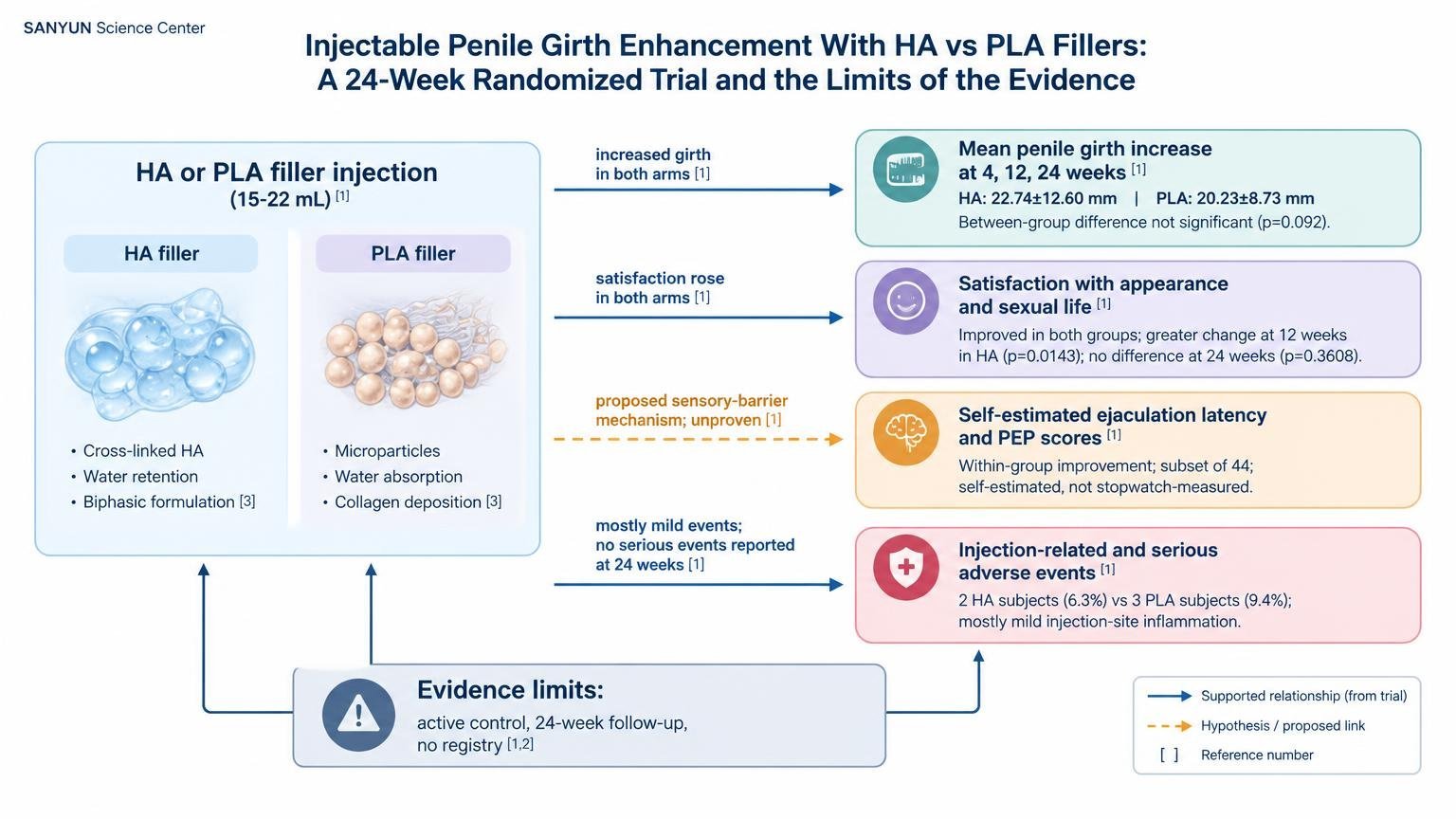
Depending on penile size, 15 to 22 mL of filler was injected, with mean injected volume 19.69±0.74 mL for HA and 20.00±0.00 mL for PLA. Girth increased significantly compared with baseline in both groups at 4, 12 and 24 weeks, with p<0.001 at each time point. At 24 weeks the mean increase was 22.74±12.60 mm for HA and 20.23±8.73 mm for PLA; between-group p-values were 0.073 at 4 weeks, 0.089 at 12 weeks and 0.092 at 24 weeks, none statistically significant.
Satisfaction with penile appearance and with sexual life increased significantly from baseline in both groups at 12 and 24 weeks. Appearance satisfaction did not differ significantly between groups at either time point. Satisfaction with sexual life improved more in the HA group at 12 weeks (p=0.0143), but that difference was no longer present at 24 weeks (p=0.3608), a pattern consistent with a transient rather than durable product-specific advantage.
The ejaculation analysis drew on 44 subjects, 22 per group, of whom 20 had a baseline Premature Ejaculation Diagnostic Tool score of 9 or higher. Both groups improved on the Premature Ejaculation Profile index. Self-estimated intravaginal ejaculation latency time rose from 5.36±3.51 to 7.86±4.73 minutes in the HA group (p=0.001) and from 5.23±3.55 to 6.43±4.22 minutes in the control group (p=0.021).
| Measure | HA filler group | PLA filler group | Interpretation |
|---|---|---|---|
| Mean girth increase at 24 weeks | 22.74±12.60 mm | 20.23±8.73 mm | Both substantial; between-group difference not statistically significant (p=0.092) |
| Satisfaction with sexual life | Improved; greater change at 12 weeks | Improved; smaller change at 12 weeks | Direction of change only; group difference at 12 weeks (p=0.0143) did not persist at 24 weeks (p=0.3608) |
| Self-estimated IELT | 5.36±3.51 to 7.86±4.73 minutes | 5.23±3.55 to 6.43±4.22 minutes | Within-group improvement; subset of 44; self-estimated, not stopwatch-measured |
| Injection-related adverse events | 2 subjects (6.3%) | 3 subjects (9.4%) | Mostly mild injection-site inflammation resolving conservatively |
| Serious adverse events | 0 reported | 0 reported | Cannot establish long-term or rare-event safety at 24 weeks |
Safety findings were reassuring within the trial's limits. Injection-related adverse events occurred in 2 HA subjects (6.3%) and 3 control subjects (9.4%), mostly mild injection-site inflammation that resolved with conservative treatment, plus one transient self-limited injection-site pain in the control group. No serious adverse events were reported over the 24-week period. Clinical commentary lists irregularities, nodules, infection, skin necrosis, pain and psychological regret as complications described in the wider literature.
Interpretation and Limitations
Several features limit what this trial can support. Its duration was too short to establish long-term efficacy, and the authors say so directly. The active-control design has been criticized because a placebo comparison would better isolate the specific effect of the intervention, although the investigators argue that a saline placebo would be unblinding and ethically difficult given rapid volume loss. Blinding was applied to patients and to an independent evaluating physician, not to injectors.
The ejaculation outcomes carry their own measurement problems. The authors acknowledge that reliance on the Premature Ejaculation Diagnostic Tool is flawed under current International Society for Sexual Medicine definitions of premature ejaculation, that the Premature Ejaculation Profile has not been validated as a sensitive evaluative instrument, and that fewer than half of assessed subjects had clinical premature ejaculation. The trial was not designed to test filler as a treatment for premature ejaculation, and further studies would be required for that claim.
Statistical and clinical meaning diverge here. The girth gain is large in absolute terms, but the standard deviations are wide, mean injected volume differed slightly between groups (19.69±0.74 mL with HA versus 20.00±0.00 mL with PLA), and the analysis used injected volume as a covariate. Averages cannot be promised to an individual, and results from experienced multicenter investigators may not transfer to unregulated commercial settings where product traceability, sterile technique and complication management vary.
Non-significance should not be read as proof of equivalence. The trial was not framed as a formal non-inferiority or superiority test for the between-group comparison, and 64 completers offer limited power to detect modest differences or uncommon harms. The absence of serious adverse events in a small, short study is compatible with a meaningfully important rare-event rate; it is not evidence that serious complications do not occur.
Context from professional bodies sharpens the caution. A 2025 consensus statement from the British Association of Urological Surgeons concluded, as reported in secondary commentary, that supporting evidence is poor quality, heterogeneous and methodologically limited, and a urological spokesperson stated that the procedures cannot currently be recommended because of insufficient evidence, a position distinct from a ban. The same commentary identifies the absence of an outcome registry as the central structural gap, leaving procedure volumes, complication rates and practitioner qualifications untracked.
- The trial shows measurable girth gain and short-term tolerability in a selected, psychologically screened population; it does not show long-term durability, superiority of HA over PLA, or a validated ejaculatory benefit.
- Men with body dysmorphic concerns, unrealistic expectations or erectile dysfunction are not appropriate candidates; filler does not treat erectile dysfunction or reliably increase length.[4]
- Rare but serious risks described in clinical commentary include vascular compression and tissue necrosis, alongside irregularities, nodules, infection and granuloma formation; permanent or unidentified injected materials are widely discouraged.
Research Outlook
The most useful next steps are structural rather than incremental. Longer follow-up beyond 24 weeks is needed to characterize how girth and satisfaction change as HA is metabolized and as PLA-related fibrous tissue matures. HA is biodegradable, and durability varies with cross-linking, injected volume, tissue movement and metabolism, so a fixed expected duration cannot be guaranteed for any individual.
A 2023 systematic review and meta-analysis, as summarized in clinical commentary, reported measurable girth gains with both fillers and effects that decrease over time, but that summary provides no effect sizes or sample sizes in the supplied text and cannot substitute for primary long-term data. The 2024 SMSNA position statement, again as summarized in secondary commentary, described injectable HA and PLA as possibly providing temporary girth enhancement with a moderate short-term safety profile while emphasizing limited evidence and follow-up.
Independent confirmation of the ejaculation signal would require a trial designed for that endpoint, using validated instruments, stopwatch-measured latency where feasible, and an adequate proportion of men with premature ejaculation. Registry-based outcome capture would address the gaps that no single trial can: real-world complication rates across products and practitioners, repeat-treatment patterns, and the management and reversibility of adverse events.
Key Takeaways
- In a 64-completer randomized active-controlled trial, HA and PLA fillers each produced roughly 20 to 23 mm mean girth increase at 24 weeks, without a statistically significant between-group difference.
- Satisfaction improved in both groups; the only between-group difference, in sexual-life satisfaction at 12 weeks, disappeared by 24 weeks.
- Self-estimated ejaculation latency increased in both groups, but the ejaculation analysis was a small subset with acknowledged instrument limitations and was not designed to test a premature ejaculation treatment effect.
- Adverse events were infrequent and mild within 24 weeks, with no serious events reported; this does not establish long-term or rare-event safety.
- Professional-society commentary characterizes the evidence as poor quality and methodologically limited, and notes that no outcome registry systematically tracks volumes, complications or practitioner qualifications.
- Filler is a cosmetic, temporary intervention for carefully selected adults; it does not treat erectile dysfunction, and men with body dysmorphic concerns or unrealistic expectations should not proceed without psychological assessment.
Questions and Answers
How are HA and PLA penile fillers thought to increase girth?
HA retains water and creates a gel-like volume that is gradually broken down, with cross-linking extending persistence. PLA microparticles absorb water and provoke a fibrous collagen reaction, so part of the bulk is host tissue. In the trial these different mechanisms produced similar girth gains at 24 weeks, with no significant between-group difference. The mechanism descriptions come from the trial report and general filler pharmacology, not from direct tissue-level measurement in this study.
How much girth increase did penile fillers produce at 24 weeks in the randomized trial?
Mean girth increase at 24 weeks was 22.74±12.60 mm with HA filler and 20.23±8.73 mm with PLA filler among 64 completers. Girth rose significantly from baseline in both groups at 4, 12 and 24 weeks, and the between-group difference was not statistically significant at any time point (24-week p=0.092). These are group averages with wide variability, not guaranteed individual results.
Did penile filler improve ejaculation or premature ejaculation symptoms in this trial?
Self-estimated intravaginal ejaculation latency increased from 5.36 to 7.86 minutes with HA and from 5.23 to 6.43 minutes with PLA, and both groups improved on a premature ejaculation profile index. However, only 44 men were assessed, the instruments have acknowledged limitations, fewer than half had clinical premature ejaculation, and the study was not designed to test a treatment effect. The proposed sensory-barrier mechanism was not demonstrated.
How strong is the evidence for penile girth filler safety and long-term effectiveness?
It is limited. The key randomized trial followed 64 completers for 24 weeks and reported only mild injection-related events and no serious adverse events. That is too short and too small to characterize long-term durability or rare harms, and professional-society commentary describes the overall evidence as poor quality, heterogeneous and methodologically limited. No outcome registry systematically tracks real-world complications or practitioner qualifications.
Which men were excluded from the randomized trial, and who may not be a suitable candidate for penile filler?
The trial excluded men with congenital or acquired penile malformation, previous penile surgery, psychiatric or psychological disorder including body dysmorphic disorder, or major systemic disease such as coagulopathy or anticoagulant use. Clinical commentary also lists erectile dysfunction, unrealistic expectations, and severe psychological disorders such as body dysmorphic disorder as conditions where HA penile augmentation is not indicated. These are trial selection criteria and clinic guidance, not a formal guideline.
Why does the absence of an outcome registry matter for penile filler procedures?
Without systematic outcome registries, the number of procedures performed, real-world complication rates and practitioner qualifications are not tracked. That makes it difficult to build evidence-based guidelines or design proportionate regulation from practice data, leaving clinicians and patients dependent on small short trials and on voluntary or commercial reporting. A professional-society consensus statement identified this structural gap alongside the limited quality of existing studies.
Conceptual framework: Conceptual framework, not a tested causal model. In a 64-completer randomized active-controlled trial, HA or PLA filler injection was followed by girth increase and higher satisfaction in both arms; ejaculation-latency change is a proposed, unproven relationship. Active control, 24-week follow-up and absent outcome registries limit inference.
Academic References & Evidence
- Efficacy and Safety of Penile Girth Enhancement Using Hyaluronic Acid Filler and the Clinical Impact on Ejaculation: A Multi-Center, Patient/Evaluator-Blinded, Randomized Active-Controlled Trial. World J Mens Health. 2022 40(2):299-307 DOI: 10.5534/wjmh.210007.
- Kenichi Adachi. Penile Filler Surge 2026: BAUS Says Evidence Too Weak | NERO. 2026
- Penile Girth Filler: Hyaluronic Acid, Longevity, Risks, and Candidate Selection.
- Valentin Iordache. Hyaluronic acid injections for penile augmentation. 2026
SANYUN Science Center explains published research on men's reproductive and sexual health, connecting scientific evidence with everyday questions while making sources and limitations clear.
Disclaimer: This article is for scientific education and research communication only. It does not provide medical advice, diagnosis, or individualized treatment recommendations, and does not endorse any medication, supplement, device, penile enlargement procedure, or other intervention. Decisions about sexual and reproductive health should be made in consultation with a qualified healthcare professional. Do not delay seeking professional care because of information in this article.
Original Content & Copyright Notice
- This article is prepared for SANYUN Science Center, drawing on published research and publicly available academic literature on men’s sexual and reproductive health. Its editorial explanations and presentation are developed for this platform.
- Copyright in the original editorial content, selection, and arrangement is reserved by SANYUN Science Center to the extent protected by applicable law. Referenced research, quotations, and third-party materials remain subject to the rights of their respective owners. This notice does not claim ownership of scientific facts or third-party research.
- Except where permitted by applicable law or an applicable license, prior written permission is required to reproduce, republish, translate, adapt, redistribute, or commercially reuse protected content. Attribution alone does not grant permission for such reuse.
- For permitted quotation or authorized reuse, clearly identify the source and retain a link to the original article.
- Source: SANYUN Science Center
- Original URL: Retain the original article URL on science.san-yun.com.
- Copyright Holder: SANYUN Science Center, for its own protected editorial content.
- Quotation, excerpts, or authorized reuse must not distort the scientific meaning, omit material limitations or disclaimers, or imply unverified medical claims, product efficacy, or endorsement by SANYUN Science Center.



