




Category: Clinical Insights
Core Research Direction: 2025 AUA guideline interpretation for diagnosing and managing male chronic pelvic pain: classification, evidence-based treatment, and differential diagnosis from bladder pain syndrome and pelvic floor myalgia
Search Intent: How does the 2025 American Urological Association guideline classify male chronic pelvic pain, and what does its evidence-based framework mean for diagnosis and treatment?
Platform: SANYUN Science Center
Evidence reviewed through: 2026-11-07
Executive Summary
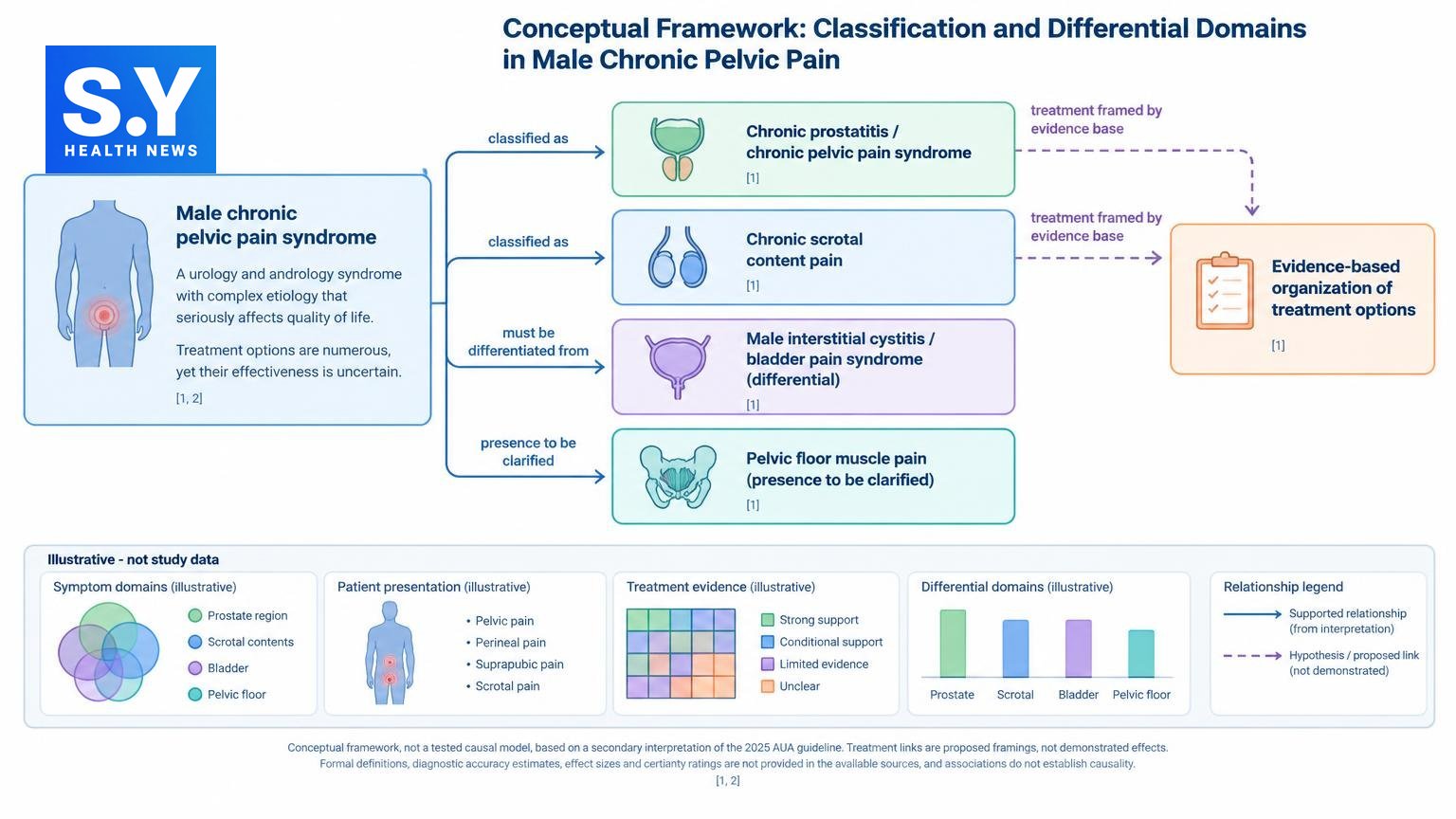
A 2025 American Urological Association guideline on the diagnosis and management of male chronic pelvic pain proposed a finer classification of the condition, according to a published Chinese-language interpretation of that guideline. The interpretation reports two principal categories: chronic prostatitis/chronic pelvic pain syndrome and chronic scrotal content pain.[1][2]
The same interpretation states that evaluation must also differentiate male chronic pelvic pain from male interstitial cystitis/bladder pain syndrome and must clarify whether pelvic floor muscle pain is present. It further indicates that the guideline organizes current treatment approaches on an evidence-based footing.
This article interprets those secondary reports. It does not reproduce the guideline document, and the available material supplies no diagnostic accuracy estimates, effect sizes, certainty ratings or formal category definitions. Those gaps are central to how the framework should be read: a classification can sharpen clinical reasoning without resolving uncertainty about treatment benefit.
Why This Matters
Male chronic pelvic pain is described in the interpretive literature as a urology and andrology syndrome with complex etiology that seriously affects patients' quality of life. The same description notes a central paradox: treatment options are numerous, yet their effectiveness is uncertain.
Men with persistent pelvic, perineal, suprapubic or scrotal pain often undergo extended evaluation that documents the absence of other disease without explaining the symptom itself. A framework that separates recognizable symptom patterns has practical value even before it changes outcomes, because it supplies shared vocabulary and directs attention to structures that may be generating pain rather than assuming a single organ of origin.
The interpretation's emphasis on bladder pain syndrome and pelvic floor muscle pain is consistent with that reframing, but the source does not quantify how often these alternative contributors are found or how much the distinction changes management.
Clinical Reasoning Behind the Categories
The reported categories track distinct clinical logics rather than a single pathophysiological chain. Chronic prostatitis/chronic pelvic pain syndrome describes a symptom complex in which prostate-region and pelvic symptoms cluster together without a necessary infectious explanation. Chronic scrotal content pain directs attention to the scrotal contents, where pain may relate to the testis, epididymis, spermatic cord or adjacent structures, and where the diagnostic sequence differs from that of prostatic pain.
Male interstitial cystitis/bladder pain syndrome points toward the lower urinary tract and bladder sensation. Pelvic floor muscle pain points toward the musculature and its tonic state. These domains may coexist in one patient, which is why the interpretation frames the bladder and pelvic floor questions as things to be clarified during assessment rather than as single diagnoses to exclude once and then set aside.
The supplied material does not explain how the guideline operationalizes overlap between domains, nor does it report how frequently overlap occurs. Statements implying that one mechanism causes another, or that treating one domain relieves another, would exceed the evidence summarized here.
What the Evidence Shows
The interpretation indicates that all current therapeutic approaches are organized according to evidence-based medicine, while the accompanying abstract framing repeats that options are numerous and effectiveness is not firmly established. These statements are compatible: an evidence-based structure can grade available evidence rigorously and still conclude that the evidence base for many interventions is thin.
What the sources do not provide matters as much as what they report. There are no comparative rankings between the two categories, no details of which interventions received strong versus conditional support, no reported patient outcomes, and no diagnostic accuracy data for distinguishing the categories or the differential domains. The interpretive excerpt is truncated at precisely the point where evidence organization would be described.
The practical implication is therefore procedural rather than prescriptive. An evidence-based framing suggests that management follows from the category and contributing domains identified during evaluation: a scrotal-pain presentation invites a different assessment sequence than a prostatitis-type presentation, and recognition of bladder pain syndrome or pelvic floor muscle pain redirects attention. The evidence summary supports this logic of differential diagnosis without quantifying how much each redirection improves outcomes.
| Construct | What the Interpretation Specifies | Role in Evaluation |
|---|---|---|
| Chronic prostatitis/chronic pelvic pain syndrome | Named as one of two categories in the proposed finer classification | Organizes a prostate-region and pelvic symptom pattern for assessment |
| Chronic scrotal content pain | Named as the second category | Directs assessment toward scrotal contents rather than the prostate |
| Male interstitial cystitis/bladder pain syndrome | Condition the clinician must differentiate from male chronic pelvic pain | Acts as a differential for pain of bladder origin |
| Pelvic floor muscle pain | Presence or absence to be clarified during evaluation | Identifies a muscular contributor that may coexist with other domains |
| Treatment organization | Current approaches organized on an evidence-based footing | Frames therapy selection within categories rather than as a uniform list |
Interpretation and Limitations
Three limitations frame this review. The primary material consists of an interpretive article and its bibliographic abstract rather than the guideline document; both are secondary, and one excerpt is explicitly truncated. The two records describe the same article and are not independent corroboration of clinical findings. And no outcome data, diagnostic accuracy estimates, sample sizes or certainty-of-evidence ratings appear in the supplied text.
A conceptual caution follows. A finer classification is not, by itself, evidence that outcomes improve. Guidelines often identify categories before they can recommend category-specific therapies with confidence, and the framing of treatment effectiveness as uncertain fits that stage of maturity. Whether the reported scheme changes management or mainly relabels it cannot be answered from the available interpretation.
This article interprets published secondary summaries for a general readership. It is not clinical guidance, has not undergone independent medical review, and should not be used to select or reject a treatment. Diagnostic and management decisions belong with qualified clinicians who can examine the patient and consult the primary guideline directly.
Research Outlook
The most useful next step for readers and clinicians is direct engagement with the primary guideline the interpretation set out to summarize. Questions worth putting to that document include how each category is defined operationally, how the differential with bladder pain syndrome and pelvic floor myalgia is structured, and which interventions carry strong versus conditional support. Those details cannot be reconstructed from the secondary record available here.
The supplied sources report no comparative outcome data on whether category-directed management performs better than a uniform approach. Because treatment effectiveness is described as uncertain, that comparative question remains an identified gap rather than a reported finding.
Key Takeaways
- The 2025 AUA guideline interpretation reports a finer classification of male chronic pelvic pain into chronic prostatitis/chronic pelvic pain syndrome and chronic scrotal content pain.
- Evaluation must also differentiate male interstitial cystitis/bladder pain syndrome and clarify whether pelvic floor muscle pain is present.
- Treatment options are described as numerous but of uncertain effectiveness, with all current approaches organized on an evidence-based footing.
- The available sources are secondary summaries; formal criteria, effect estimates and certainty grading are not provided and should not be assumed.
Questions and Answers
What is male chronic pelvic pain and why is it considered difficult to manage?
Interpretive literature describes male chronic pelvic pain as a urology and andrology syndrome with complex etiology that seriously affects quality of life. Its difficulty is twofold: symptoms may arise from several overlapping regions, including prostatic, scrotal, bladder and pelvic floor domains, and although treatment options are numerous, their effectiveness is described as uncertain. These descriptions come from secondary summaries, not primary outcome studies.
How does the 2025 AUA male chronic pelvic pain guideline classify patients?
According to the interpretation, the 2025 guideline proposes a finer classification with two principal categories: chronic prostatitis/chronic pelvic pain syndrome and chronic scrotal content pain. It also requires differentiation from male interstitial cystitis/bladder pain syndrome and clarification of whether pelvic floor muscle pain is present. The formal definitions and decision rules are not reproduced in the available source.
How does the 2025 AUA guideline interpretation separate male chronic pelvic pain from chronic prostatitis?
The interpretation places chronic prostatitis/chronic pelvic pain syndrome as one category within a broader scheme alongside chronic scrotal content pain, and adds bladder pain syndrome and pelvic floor muscle pain as domains to differentiate or clarify. This review reads that structure as implying pelvic pain in men should not automatically be attributed to the prostate, but the source does not state that in those words or explain bedside distinctions.
How strong is the evidence behind the 2025 male chronic pelvic pain recommendations?
The available sources do not report evidence grades, effect sizes or certainty ratings. They state only that treatment options are numerous while effectiveness is uncertain, and that the guideline organizes current approaches according to evidence-based medicine. This review therefore cannot characterize the strength of individual recommendations; that assessment requires the primary guideline.
What are the limitations of interpreting male chronic pelvic pain guidance from secondary summaries?
The two records describe the same interpretive article, so they are not independent corroboration. One excerpt is truncated where evidence organization would be explained, and neither provides diagnostic accuracy data or outcome estimates. The classification should be treated as a reported framework rather than a validated clinical algorithm, and not as guidance for individual patient care.
What should a man with persistent pelvic or scrotal pain understand before seeking care?
Persistent pelvic or scrotal pain can have several contributing sources, including prostate-region symptoms, scrotal structures, bladder-related pain and pelvic floor muscle pain. A structured evaluation aims to clarify which apply. Because treatment effectiveness is described as uncertain, realistic expectations and discussion of the primary guideline with a qualified clinician are appropriate; this article cannot advise on individual treatment.
Conceptual framework: Conceptual framework, not a tested causal model, based on a secondary interpretation of the 2025 AUA guideline. Treatment links are proposed framings, not demonstrated effects.
Academic References & Evidence
- 刘卓; 杨为民. 2025美国泌尿外科学会《男性慢性盆腔疼痛的诊断与管理》指南解读. 临床外科杂志
- 刘卓; 杨为民. 2025美国泌尿外科学会《男性慢性盆腔疼痛的诊断与管理》指南解读. 临床外科杂志. 2026
SANYUN Science Center explains published research on men's reproductive and sexual health, connecting scientific evidence with everyday questions while making sources and limitations clear.
Disclaimer: This article is for scientific education and research communication only. It does not provide medical advice, diagnosis, or individualized treatment recommendations, and does not endorse any medication, supplement, device, penile enlargement procedure, or other intervention. Decisions about sexual and reproductive health should be made in consultation with a qualified healthcare professional. Do not delay seeking professional care because of information in this article.
Original Content & Copyright Notice
- This article is prepared for SANYUN Science Center, drawing on published research and publicly available academic literature on men’s sexual and reproductive health. Its editorial explanations and presentation are developed for this platform.
- Copyright in the original editorial content, selection, and arrangement is reserved by SANYUN Science Center to the extent protected by applicable law. Referenced research, quotations, and third-party materials remain subject to the rights of their respective owners. This notice does not claim ownership of scientific facts or third-party research.
- Except where permitted by applicable law or an applicable license, prior written permission is required to reproduce, republish, translate, adapt, redistribute, or commercially reuse protected content. Attribution alone does not grant permission for such reuse.
- For permitted quotation or authorized reuse, clearly identify the source and retain a link to the original article.
- Source: SANYUN Science Center
- Original URL: Retain the original article URL on science.san-yun.com.
- Copyright Holder: SANYUN Science Center, for its own protected editorial content.
- Quotation, excerpts, or authorized reuse must not distort the scientific meaning, omit material limitations or disclaimers, or imply unverified medical claims, product efficacy, or endorsement by SANYUN Science Center.



