




Category: Clinical Insights
Core Research Direction: Whether the 2026 AUA BPH/LUTS guideline's evaluation and initial-management recommendations are dependable under real-world evidence constraints: what the guideline actually contains, what its underlying evidence base can establish, and how methodological weaknesses in RCTs and meta-analyses limit the clinical certainty of such recommendations.
Search Intent: What does the 2026 AUA benign prostatic hyperplasia guideline recommend for the initial assessment and early management of lower urinary tract symptoms, and how strong can that evidence really be given common flaws in trial interpretation?
Platform: SANYUN Science Center
Evidence reviewed through: 2026-10-31
Executive Summary
The American Urological Association's 2026 benign prostatic hyperplasia and lower urinary tract symptom guideline series begins with a part focused on initial evaluation and initial management. The supplied primary text states that this part covers the initial visit workflow and standard assessment, including history, physical examination, and additional tests such as prostate-specific antigen, uroflowmetry, and ultrasound, and that it rests on a systematic literature search through 2025. The same text presents the guideline's core principle: the degree of bother from lower urinary tract symptoms drives treatment decisions, and shared decision-making is essential when treatment is started or escalated.[1]
Much of the recommendation-level detail available in the packet comes from a secondary treatment guide rather than the primary excerpt. That guide reports that the 2026 update contains 62 recommendations across three parts, that the evaluation part covers symptom scoring with the International Prostate Symptom Score, shared-decision use of PSA, uroflowmetry, and post-void residual measurement, and that a six-month reassessment milestone is introduced for patients on medical therapy. These are presented here as secondary summaries, because the supplied primary text does not enumerate individual recommendations or their evidence grades.[2]
A separate editorial analysis of randomized trials, systematic reviews, and guidelines argues that common methodological problems in meta-analyses can make guideline conclusions clinically uncertain even when sophisticated statistics are used. That argument was developed in perioperative analgesia, not urology, and is an opinion piece rather than an empirical study. It is used here as a critical-reading frame, not as evidence about the BPH guideline itself.[3]
Why the First Assessment Carries So Much Weight
Benign prostatic hyperplasia is common and strongly age-related. The secondary treatment guide estimates prevalence of 5–6% among men aged 40–64 and 29–33% among men aged 65 and older, without supplying case definitions or survey years. It also states that only about 1% of men with BPH-related lower urinary tract symptoms ultimately require a surgical procedure, again without denominator or follow-up detail. Those figures cannot establish how much clinical time the condition consumes, but they do indicate that most symptomatic men are managed without an operation, which places weight on the quality of the first assessment and the first treatment decision.
That is why the dependability of the evaluation recommendations matters more than the length of the recommendation list. A decision to order or skip a test, to treat now or reassess later, and to involve the patient in choosing among options shapes the course of care for men who never reach an operating room. The guideline's stated emphasis on bother and on individualized initial management within a standardized framework reflects that logic.
What the 2026 Guideline Reports About Initial Evaluation
The simplest summary of the supplied evidence is this: the guideline is reported to recommend a structured initial visit built from history, physical examination, symptom quantification, and selective testing, with the choice of additional tests tied to the clinical picture and to shared decision-making. The primary text names the components—history, physical examination, prostate-specific antigen, uroflowmetry, and ultrasound—as part of the recommended initial visit workflow and standard assessment. The secondary guide adds that the symptom instrument is the International Prostate Symptom Score, that PSA is framed as a shared-decision conversation rather than a default step, and that uroflowmetry and post-void residual measurement are described as tests that may be used when the clinical picture is unclear.
The clinical rationale for that structure is not difficult to state. Symptoms arise from both bladder outlet obstruction and bladder dysfunction, so measuring the prostate alone cannot capture the problem, and recording symptoms alone can miss reversible contributors. The secondary guide notes that prostate size does not by itself determine symptom severity and that storage symptoms may reflect a concurrent overactive bladder component. A standardized assessment that includes history, examination, symptom scoring, and selected tests addresses both sides of that equation without turning every test into a routine step.
| Measure / finding | Result | Population / follow-up | Limitations |
|---|---|---|---|
| According to this secondary guide, the 2026 AUA update contains 62 recommendations across three parts (Presentation & Evaluation, Medical Management, Procedural/Surgical Management), replacing the 2023 version. | 62 recommendations | Secondary commercial/telehealth source; claim is not confirmed in the supplied primary guideline excerpt (S1). | |
| The updated AUA BPH/LUTS guideline was released May 7, 2026, replacing the 2023 version, incorporating a systematic review current through January 2025 with supplemental searches completed December 15, 2025. | evidence through January 2025; supplemental searches to December 15, 2025 | Release and search dates come from a secondary source, not the supplied primary text. | |
| Per this secondary summary, Part I of the guideline covers patient history, physical examination, IPSS scoring, shared-decision PSA use, uroflowmetry, and post-void residual measurement. | Secondary paraphrase of guideline content; S1 confirms only the general categories of assessment. | ||
| The 2026 guideline reportedly frames PSA testing as a shared decision-making conversation rather than a default evaluation step. | Secondary source interpretation; not verifiable from S1's supplied excerpt. | ||
| Uroflowmetry and post-void residual measurement are described as optional ("may be used") tests that add value when the clinical picture is unclear. | Partial quote within a secondary source; primary wording and strength of recommendation not supplied. | ||
| The guideline reportedly introduces a 6-month re-evaluation milestone for patients on medical therapy before escalation. | 6 months | patients on medical therapy for BPH/LUTS; 6 months | Secondary source; no supporting trial data or rationale supplied for the timing. |
What the Early-Management Evidence Can Support
Part I is an evaluation document, but the boundary between evaluation and initial management is porous, and the secondary guide attributes several early-management positions to the update. It reports that uroselective alpha blockers remain first-line therapy, with silodosin, alfuzosin, and tamsulosin named as preferred agents; that tadalafil 5 mg daily is an established option for symptoms with or without erectile dysfunction and may be combined with a 5-alpha reductase inhibitor in select patients; that acute urinary retention should prompt an alpha blocker at the time of catheterization with a trial without catheter after three days; and that high-intensity focused ultrasound and cryoablation are not recommended outside clinical trials. The supplied primary excerpt does not contain the medical-management recommendations, so these positions rest on the secondary summary.
The secondary guide cites supportive trial summaries. According to it, a meta-analysis of 19 randomized controlled trials with nearly 10,000 participants found consistent symptom improvement with alpha blockers over placebo, and a Cochrane review of 4 randomized controlled trials with 933 participants found tadalafil similarly effective to alpha blockers for symptom improvement. A 2024 trial with 100 participants comparing tadalafil plus finasteride with tamsulosin plus finasteride reportedly found comparable symptom-score improvement at 3 months with better sexual function outcomes in the tadalafil arm. These are secondhand descriptions: effect sizes, confidence intervals, heterogeneity statistics, and risk-of-bias assessments are not supplied, so the size and durability of benefit for an individual patient cannot be judged from the packet.
The same limitation applies to timing and magnitude claims. The secondary guide states that alpha blockers relieve symptoms within 24–48 hours, that 5-alpha reductase inhibitors require 6–12 months and shrink the prostate in men with volumes of at least 30 mL, and that over 6–12 months they reduce prostate volume by about 20–25%. It also states that at one year or less combination therapy with an alpha blocker is no more effective than an alpha blocker alone, while beyond one year the combination outperforms either agent. Each is a summary of reported average effects, not a prediction for an individual, and the underlying trial designs are not described.
Interpretation and Limitations
Three kinds of uncertainty should be kept distinct. The first is source uncertainty. The primary excerpt establishes scope, search timing, and guiding principles but not the recommendation-level content a clinician would use at the bedside. Much of what is described here as guideline content is a secondary author's rendering, and that secondary source is a commercial treatment guide. Its claims about recommendation counts, test optionality, reassessment timing, and procedure grading are not corroborated within the supplied primary text. That is a statement about what the packet can support, not an allegation of inaccuracy.
The second is evidence-synthesis uncertainty. The editorial analysis of perioperative analgesia argues that many meta-analyses suffer from loose inclusion criteria, uncritical quality assessment, heterogeneity, bias, inadequate follow-up, fragility, spin, and inaccurate interpretation, and that guidelines built on them may be inaccurate despite sophisticated statistics. The authors' prescription is a meticulous systematic review of homogeneous randomized trials with critical assessment of clinical relevance and clinically relevant outcome reductions. The argument was made in a different clinical field and is an opinion piece rather than an empirical demonstration, so it cannot be transferred to the BPH guideline as a finding. It can, however, be used as a reading frame: without access to the guideline's own systematic review methods, a reader cannot know whether the BPH evidence synthesis avoided these problems or shared them.
The third is clinical-outcome uncertainty. Several consequential claims in the secondary material—that most men never need surgery, that combination therapy separates from monotherapy only after a year, that a six-month reassessment is the right checkpoint—describe average trajectories or expert-chosen intervals. They are useful for planning care but do not establish that a given patient will follow the average path. The distinction between a population-level average and an individual prediction is the distinction between a guideline and a prescription.
Safety information is similarly secondhand and incomplete. The guide states that alpha blockers increase the risk of intraoperative floppy iris syndrome during cataract surgery, that tadalafil must not be combined with non-selective alpha blockers because of severe hypotension risk, and that anticholinergics can precipitate urinary retention, especially when post-void residual exceeds 250–300 mL, and are associated with cognitive side effects and increased dementia risk in older patients. The dementia association is described as an association, not a proven causal effect, and no effect size is given. A clinician should treat this material as a prompt to consult primary sources rather than as a complete safety summary.
One further limitation deserves explicit statement. The editorial analysis is not an empirical study, and this article is not a systematic review. The packet contains no BPH-specific trial-level data, no recommendation grades, and no formal quality appraisal of the BPH evidence base. Statements here about what the guideline's evidence can establish are bounded by what the supplied sources describe.
How to Appraise the Guideline's Evidence Report
The real test of dependability lies in the parts of the evidence base that a summary cannot convey: the search strategy, eligibility criteria, risk-of-bias assessments, certainty ratings, and the panel's translation of evidence into recommendation strength. For the 2026 AUA document, those details sit in the primary publication and its systematic review, and the supplied packet does not reproduce them. A reader who wants to judge the evaluation recommendations should read the primary guideline alongside its evidence report, asking the questions the editorial analysis raises: were included trials homogeneous, was quality critically assessed, were outcomes clinically rather than statistically defined, and was heterogeneity addressed rather than absorbed by the model?
For the testing questions specifically, this review infers that direct randomized evidence for test strategies is scarce, because the supplied sources describe no trial randomizing men to one testing strategy versus another and following hard outcomes. The guideline's shared decision-making framing for PSA, as reported by the secondary guide, is consistent with that gap, and the optional language reported for uroflowmetry and post-void residual is consistent with tests whose value depends on the clinical picture rather than on a fixed protocol. Recognizing that these recommendations are judgment-dependent, rather than ignoring it, is part of reading the guideline well.
For early management, the secondary trial summaries point to a field with substantial randomized evidence for symptom endpoints but thinner evidence for the long-term, patient-centered outcomes that matter most: progression to retention, need for surgery, and quality of life over years. The reported finding that combination therapy separates from monotherapy only after one year, and the reported five-year Aquablation data in large prostates, are examples of the longer-horizon evidence that changes clinical confidence. Whether the 2026 guideline weighted such evidence appropriately cannot be determined from the supplied material.
Key Takeaways
- The 2026 AUA guideline's first part focuses on initial evaluation and initial management, based on a systematic search through 2025 and organized around bother and shared decision-making.
- The supplied primary text confirms the general categories of assessment—history, examination, PSA, uroflowmetry, ultrasound—but does not enumerate recommendations or grades.
- Specific details such as the 62-recommendation count, shared-decision PSA framing, optional uroflowmetry and post-void residual, and the six-month reassessment milestone come from a secondary treatment guide.
- An editorial analysis from perioperative analgesia argues that flawed synthesis can make guideline conclusions clinically uncertain; it is useful as a reading checklist but is not BPH-specific evidence.
- Secondhand trial summaries report symptom benefit for alpha blockers and tadalafil, but the packet lacks the effect sizes and quality assessments needed to judge certainty.
- Safety statements about floppy iris syndrome, tadalafil with non-selective alpha blockers, and anticholinergic risks are secondhand and incomplete and should prompt consultation of primary sources.
The practical conclusion is not that the guideline is unreliable, but that its reliability cannot be established from a packet that omits the recommendation-level evidence. Reading it with attention to source, synthesis quality, and the difference between average effects and individual predictions is the appropriate response.
Questions and Answers
What does the 2026 AUA BPH/LUTS guideline recommend for the initial assessment of lower urinary tract symptoms?
The supplied primary text describes Part I as focusing on initial evaluation and initial management, with recommendations on the initial visit workflow and standard assessment including history, physical examination, and tests such as PSA, uroflowmetry, and ultrasound. A secondary summary adds symptom scoring, shared-decision PSA use, and optional uroflowmetry and post-void residual measurement when the clinical picture is unclear. The core principle is that bother drives treatment decisions and that shared decision-making is essential.
Why does the guideline emphasize bother and shared decision-making rather than a single test result?
Symptoms arise from both outlet obstruction and bladder dysfunction, so prostate size alone does not determine severity. When bother is the main driver, the patient's experience, preferences, and risk tolerance become part of the clinical data. The primary text states that the guideline tailors initial management to individual symptoms, preferences, and risk tolerance within a standardized assessment framework.
How certain can the early-management recommendations be, given the available evidence?
Certainty cannot be fully judged from the packet. The secondary guide cites a meta-analysis of 19 randomized trials with nearly 10,000 participants for alpha blockers and a Cochrane review of 4 trials with 933 participants for tadalafil, but effect sizes, confidence intervals, heterogeneity, and risk of bias are not supplied. The evidence supports average symptom benefit but does not establish the size or durability of benefit for an individual patient.
Do methodological flaws in meta-analyses mean this guideline's conclusions are unreliable?
Not necessarily. An editorial analysis in perioperative analgesia argues that many meta-analyses have limitations—loose inclusion, uncritical quality assessment, heterogeneity, bias, and spin—that can make guideline conclusions uncertain even with sophisticated statistics. That argument is not BPH-specific and is opinion rather than empirical demonstration. It is best used as a checklist for appraising the BPH guideline's own evidence report, which the packet does not include.
How should the guideline's reported timelines for medical therapy be understood?
As secondhand summaries of average effects, not individual predictions. The secondary guide reports that alpha blockers relieve symptoms within 24–48 hours, that 5-alpha reductase inhibitors take 6–12 months and reduce prostate volume by about 20–25%, and that combination therapy separates from monotherapy only after one year. Effect sizes and trial quality are not supplied, so these describe reported averages rather than guarantees for any patient.
What should a reader check in the primary guideline before relying on it?
Recommendation statements and their evidence grades, the search strategy and eligibility criteria, risk-of-bias assessments, certainty ratings, and how the panel translated evidence into strength. The editorial analysis suggests asking whether included trials were homogeneous, whether quality was critically assessed, and whether outcomes were clinically rather than merely statistically defined. Those details sit in the primary publication and its systematic review, not in the supplied packet.
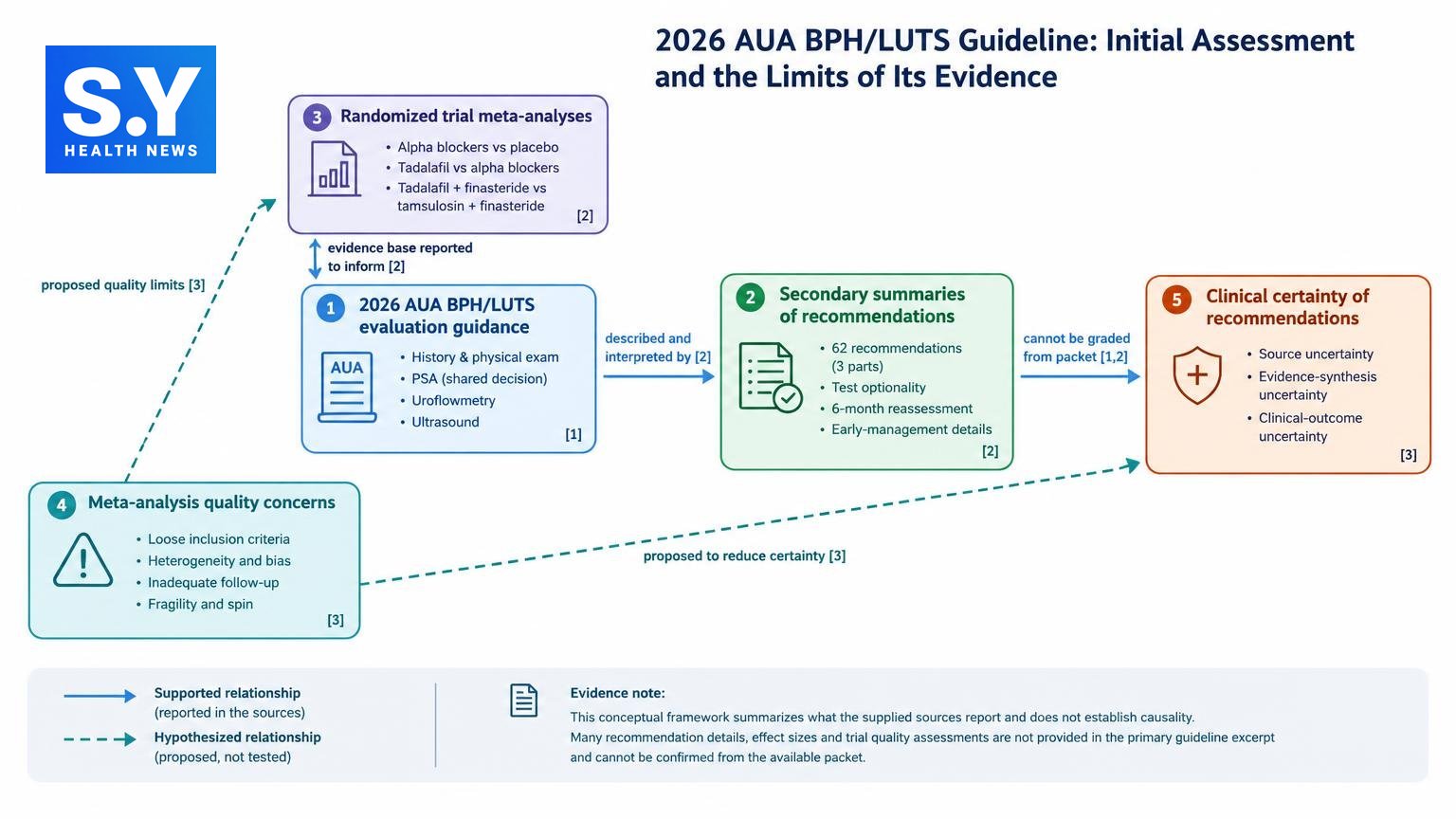
Conceptual framework: Conceptual framework of the review's variables: the 2026 AUA BPH/LUTS evaluation guidance, secondary summaries of its recommendations, the randomized trial meta-analyses reported to support early management, methodological quality concerns raised in an editorial analysis from another field, and the resulting clinical certainty of recommendations. Solid relations reflect what the supplied sources report; dashed relations are proposed interpretations, not tested causal links. The framework is a reading aid, not a tested causal model, and it does not rank studies or claim original research.
Academic References & Evidence
- 2026 AUA指南:良性前列腺增生所致下尿路症状的管理-第I部分:表现和评估. The Journal of urology. 2026 216(2)
- Benign Prostatic Hyperplasia (BPH) & Lower Urinary Tract Symptoms: 2026 Treatment Guide.
- Girish P. Joshi; Dileep N. Lobo; Henrik Kehlet. Challenges in interpretation of randomised clinical trials included in systematic reviews and clinical guidelines. British Journal of Anaesthesia. 2026 137(4):972-975 DOI: 10.1016/j.bja.2026.07.019.
SANYUN Science Center explains published research on men's reproductive and sexual health, connecting scientific evidence with everyday questions while making sources and limitations clear.
Disclaimer: This article is for scientific education and research communication only. It does not provide medical advice, diagnosis, or individualized treatment recommendations, and does not endorse any medication, supplement, device, penile enlargement procedure, or other intervention. Decisions about sexual and reproductive health should be made in consultation with a qualified healthcare professional. Do not delay seeking professional care because of information in this article.
Original Content & Copyright Notice
- This article is prepared for SANYUN Science Center, drawing on published research and publicly available academic literature on men’s sexual and reproductive health. Its editorial explanations and presentation are developed for this platform.
- Copyright in the original editorial content, selection, and arrangement is reserved by SANYUN Science Center to the extent protected by applicable law. Referenced research, quotations, and third-party materials remain subject to the rights of their respective owners. This notice does not claim ownership of scientific facts or third-party research.
- Except where permitted by applicable law or an applicable license, prior written permission is required to reproduce, republish, translate, adapt, redistribute, or commercially reuse protected content. Attribution alone does not grant permission for such reuse.
- For permitted quotation or authorized reuse, clearly identify the source and retain a link to the original article.
- Source: SANYUN Science Center
- Original URL: Retain the original article URL on science.san-yun.com.
- Copyright Holder: SANYUN Science Center, for its own protected editorial content.
- Quotation, excerpts, or authorized reuse must not distort the scientific meaning, omit material limitations or disclaimers, or imply unverified medical claims, product efficacy, or endorsement by SANYUN Science Center.



