




Category: Clinical Insights
Core Research Direction: The 2026 limited update of the EAU Sexual and Reproductive Health Guidelines: what changed across hypogonadism, testosterone therapy safety, Peyronie's disease, ejaculation disorders, and priapism, and how strong is the underlying evidence
Search Intent: What does the 2026 EAU Sexual and Reproductive Health guideline update change for the diagnosis of hypogonadism, testosterone therapy in prostate cancer survivors, conservative and surgical management of Peyronie's disease, and ischaemic priapism, and how solid is the evidence behind these recommendations?
Platform: SANYUN Science Center
Evidence reviewed through: 2026-11-24
Executive Summary
The European Association of Urology has published its Sexual and Reproductive Health guidelines for 2026 as an explicitly limited update of the 2025 edition; the guideline line itself was first issued in 2020. For this revision, new and relevant evidence was identified, collated and appraised through a structured literature assessment covering the hypogonadism, disorders of ejaculation, penile curvature and priapism sections, and that process added 116 updated studies across the guideline.[1]
The most useful way to read the update is as a recalibration of certainty rather than a set of new treatments. Where the panel could point to reproducible, low-controversy practice, the recommendation is strong: fasting morning total testosterone measured between 07:00 and 10:00 hours with a reliable assay, no testosterone therapy for male infertility or in men wishing to be fathers, surgery for Peyronie's disease only when disease is stable and intercourse is compromised, blood gas analysis of aspirated corporal blood to separate ischaemic from non-ischaemic priapism, and full counselling that intralesional platelet-rich plasma data remain limited.
Where the evidence is thin, the panel says so in the grading itself. Testosterone therapy in prostate cancer survivors is handled through a weak recommendation restricting treatment to men at low risk of recurrence after surgery, and peno-scrotal decompression as a first-line alternative to distal shunting for ischaemic priapism is likewise weak. The expert discussion accompanying the update is candid that high-quality evidence remains limited, particularly for testosterone therapy in prostate cancer survivors and for ejaculation-disorder treatments.[2]
Why This Matters
Guideline revisions change practice through wording and grading as much as through new interventions, because they decide which man is labelled hypogonadal, whether a prostate cancer survivor is offered testosterone, when a curvature is operated on, and what happens in the first hour of a priapism presentation. The EAU is careful about the limits of its own authority: guidelines present the best evidence available to the experts, but following recommendations does not necessarily produce the best outcome and cannot replace clinical expertise for an individual patient.
The 2026 edition also demonstrates a wider methodological point about guideline synthesis. Commentators outside urology have argued that guidelines built on flawed or heterogeneous meta-analyses may be inaccurate, since sophisticated statistics cannot compensate for inherent study flaws. That argument comes from the perioperative pain literature rather than urology, but it is a useful lens for reading strength ratings: a strong rating attached to a measurement standard is a different kind of claim from a strong rating attached to a treatment effect.[3]
The Biological and Clinical Logic Behind the Recommendations
In hypogonadism, the update concentrates on the measurement problem rather than on new pharmacology. Testosterone concentrations vary with time of day and with food intake, so an afternoon or non-fasting sample can misclassify a man before any diagnostic label is applied. The strong recommendation to measure total testosterone in the fasting state between 07:00 and 10:00 hours with a reliable laboratory assay is a mechanism-level intervention against predictable pre-analytical error. The accompanying expert discussion frames the next step as distinguishing functional from organic causes, because obesity, comorbidity and medication-related suppression behave differently from testicular or pituitary failure.
In prostate cancer survivors, the biology explains the caution. Prostate tissue is androgen-responsive, and residual disease after surgery could in principle be stimulated by exogenous testosterone. The panel's approach is therefore risk stratification rather than blanket permission or prohibition: treatment is restricted to men judged at low risk of recurrence after surgery, starting only after at least one year of follow-up with PSA below 0.01 ng/mL and no evidence of recurrence. For men on active surveillance or treated with non-surgical curative intent, the panel instead advises counselling that safety data are unclear. Both statements are weak, which reflects a safety database that cannot exclude small absolute risks.
Peyronie's disease is a fibrotic plaque disorder in which an unstable, inflamed phase precedes a stable phase; operating during instability risks recurrence and poor outcomes, which is the rationale for restricting surgery to stable disease with compromised intercourse. Priapism mechanisms differ fundamentally by type: ischaemic priapism is a compartment syndrome of the corpora with stagnant, deoxygenated blood, whereas non-ischaemic priapism is a high-flow arteriovenous shunt. That divide is why aspiration and blood gas analysis, rather than clinical appearance alone, anchor emergency diagnosis.
What the Evidence Shows
The headline quantity is modest but concrete: 116 updated studies were incorporated across four guideline sections after a structured literature assessment. That figure describes breadth of updating, not the quality of what was found, and the source does not report the design mix of those studies. It should be read as a map of activity rather than a measure of certainty.
The substantive changes are predominantly structural and textual. Supporting text was significantly revised throughout the hypogonadism section, the prostate cancer subsection was significantly revised, and two recommendations were relocated into that subsection because their conceptual framework and clinical implications aligned more directly with prostate cancer management. The erectile dysfunction recommendation summary was reorganised for logical flow, the ejaculation-disorder section received a full update of supporting text and references, and the penile curvature epidemiology, conservative treatment, oral treatment, other treatments and surgical treatment subsections were all significantly revised, as were the ischaemic priapism section, its second-line surgical management and priapism in special situations.
At recommendation level the signal is clearest. Fasting morning total testosterone measurement between 07:00 and 10:00 hours with a reliable assay is strongly endorsed for diagnostic evaluation and screening of late-onset hypogonadism. Testosterone therapy is strongly advised against for treating male infertility or in men wishing to be fathers. In safety and monitoring, therapy is weakly restricted in postoperative prostate cancer survivors to low-recurrence-risk men meeting the one-year, PSA below 0.01 ng/mL criterion, and men on active surveillance or treated with non-surgical curative intent should be advised that safety data are unclear. A separate strong recommendation supports further diagnostic testing in prostate cancer-naive men if PSA rises significantly or PSA velocity or total PSA increases.
In Peyronie's disease, one strong recommendation requires full counselling that data on intralesional platelet-rich plasma, alone or with oral treatment, remain limited for reducing pain or curvature; a second strong recommendation limits surgery to stable disease with compromised intercourse. For ischaemic priapism, blood gas analysis of aspirated corporal blood is strongly recommended in the emergency setting, while peno-scrotal decompression may be used as a first-line option instead of distal shunting with or without tunnelling under a weak recommendation.
| Domain | What the 2026 update states | Strength | How to read it |
|---|---|---|---|
| Hypogonadism diagnosis | Measure total testosterone in the morning, 07:00-10:00, fasting, with a reliable laboratory assay | Strong | Targets pre-analytical measurement error; a practice standard rather than a trial-derived effect size |
| Testosterone and fertility | Do not use testosterone therapy for male infertility or in men wishing to be fathers | Strong | Consistent with androgen suppression of spermatogenesis; no effect size reported in this source |
| Testosterone after prostate cancer surgery | Restrict to low recurrence risk; start after at least one year with PSA below 0.01 ng/mL and no recurrence | Weak | Signals limited long-term safety data, not demonstrated safety |
| Active surveillance or non-surgical curative intent | Advise that safety data on testosterone therapy are unclear | Weak | Absence of clear evidence is not evidence of safety |
| Peyronie's disease, platelet-rich plasma | Fully counsel that intralesional platelet-rich plasma data, alone or with oral treatment, are still limited | Strong | A counselling requirement about evidence quality; not a verdict on efficacy |
| Peyronie's disease, surgery | Operate only when disease is stable and intercourse is compromised by deformity | Strong | Phase-appropriate surgical timing; comparative outcome data not detailed |
| Ischaemic priapism diagnosis | Blood gas analysis of aspirated corporal blood is essential to distinguish ischaemic from non-ischaemic priapism | Strong | Mechanism-based diagnostic step; diagnostic accuracy metrics not supplied |
| Ischaemic priapism, first-line surgical option | Peno-scrotal decompression may be used first-line instead of distal shunting, with or without tunnelling | Weak | Weak grading signals genuine uncertainty about comparative outcomes |
Interpretation and Limitations
The central interpretive distinction is between recommendation strength and evidence volume. A strong recommendation for a fasting morning testosterone sample reflects physiological rationale and broad agreement, not a landmark trial. Conversely, a weak recommendation does not mean a treatment is ineffective; it means the panel judged the balance of benefits and harms to be sensitive to patient values, or the underlying data to be sparse or inconsistent. The prostate cancer survivor recommendations sit firmly in that second category, and the expert discussion confirms that limited high-quality evidence is the central challenge in exactly this area.
Scope is another limit. Because the 2026 document is a limited update rather than a wholesale rewrite, unchanged sections retain their earlier evidence base. The summary of changes reports which sections were revised and which recommendation tables were modified, but it does not reproduce the full evidence profiles behind each rating. Readers cannot infer effect sizes, confidence intervals or the number of trials underpinning any single recommendation from the change log alone.
The supporting expert commentary is useful but not a substitute for trial data. The podcast discussion describes removal of ineffective treatments, updates to conservative management and the introduction of new options such as hyaluronic acid for Peyronie's disease, yet it presents no comparative efficacy data for hyaluronic acid. Saying the update endorses such an option as effective would overstate the source; what the source supports is that the option has entered guideline discussion while high-quality evidence remains limited.
Finally, guidance is not a mandate. The panel states that guidelines cannot replace clinical expertise and do not purport to be a legal standard of care, which matters most where recommendations are weak and individual circumstances dominate. General methodological cautions about guideline synthesis reinforce the same point: critical appraisal and judicious application remain necessary before any recommendation is applied to a specific patient.
A Parallel Case: Varicocele in Nonobstructive Azoospermia
Outside the main update, the same guideline panel has published a commentary on varicocele treatment in nonobstructive azoospermia that shows how it handles weak evidence. The panel concludes that some evidence suggests potential benefit from varicocelectomy in these men, but that this evidence is not of sufficient quality to support a strong recommendation. It frames a possible benefit specifically in men without known genetic abnormalities whose partner shows no evidence of diminished ovarian reserve, and advises counselling that highlights variability of outcome data and the limited strength of the available evidence.[4]
Research Outlook
The update's own gap analysis points to where new research would change practice most. Testosterone therapy in prostate cancer survivors needs long-term recurrence and mortality data stratified by baseline risk rather than further small series. Ejaculation-disorder treatments need better comparative designs, and the full revision of that section's text and references implies the previous evidence base was considered inadequate. Conservative Peyronie's disease management, including newly discussed options, needs sham-controlled or at least standardised-outcome trials before recommendations can move from counselling to endorsement.
For ischaemic priapism, the weak recommendation on peno-scrotal decompression as an alternative to distal shunting is a direct invitation for comparative data on time to detumescence, complications and erectile function recovery. The updated algorithms should be read as permission to consider a less invasive first-line approach in selected cases, not as a demonstrated superiority claim.[5]
Key Takeaways
- The 2026 document is a limited update of the 2025 edition, first published in 2020, and incorporated 116 updated studies across hypogonadism, ejaculation disorders, penile curvature and priapism after a structured literature assessment.
- Strong recommendations cluster around measurement discipline, avoiding testosterone therapy for male infertility or in men wishing to be fathers, timing Peyronie's surgery to stable disease with compromised intercourse, and corporal blood gas analysis in suspected ischaemic priapism.
- Weak recommendations mark genuine uncertainty: testosterone therapy after prostate cancer surgery is restricted to low-risk men after at least one year with PSA below 0.01 ng/mL, safety data for active surveillance or non-surgical curative-intent patients are called unclear, and peno-scrotal decompression may be used first-line instead of distal shunting.
- Peyronie's guidance pairs a strong counselling requirement about limited platelet-rich plasma data with revised conservative and surgical sections, while expert discussion adds removal of ineffective treatments and hyaluronic acid as a new option without efficacy data.
- Limited high-quality evidence remains the central constraint, especially for testosterone therapy in prostate cancer survivors and ejaculation-disorder treatments, and the panel stresses that guidelines cannot replace individual clinical judgement.
Questions and Answers
How should total testosterone be measured for suspected hypogonadism under the 2026 EAU male sexual health guideline update?
The 2026 update strongly recommends measuring total testosterone in the morning between 07:00 and 10:00 hours, in the fasting state, using a reliable laboratory assay. The accompanying expert discussion also stresses distinguishing functional from organic causes before applying a diagnosis. This is a measurement standard aimed at reducing pre-analytical error rather than a treatment recommendation, and no diagnostic accuracy figures are reported in the change summary.
What does the 2026 EAU update say about testosterone therapy for men who have had prostate cancer?
It narrows rather than expands access, and does so weakly. Testosterone therapy should be restricted to men at low risk of recurrent prostate cancer after surgery, starting only after at least one year of follow-up with PSA below 0.01 ng/mL and no evidence of recurrence. For men on active surveillance or treated with non-surgical curative intent, clinicians should advise that safety data are unclear. The weakness reflects limited long-term safety evidence.
How strong is the evidence behind the 2026 EAU recommendations on Peyronie's disease treatment?
Mixed. Two recommendations are graded strong: fully counsel patients that intralesional platelet-rich plasma data remain limited, and operate only when disease is stable and intercourse is compromised by deformity. Yet the conservative, oral, other-treatment and surgical subsections were substantially revised, and expert discussion mentions new options such as hyaluronic acid without comparative efficacy data. Strong counselling advice about weak evidence is not an endorsement of any specific therapy.
How is ischaemic priapism distinguished and initially managed in the 2026 EAU guideline revision?
Blood gas analysis of aspirated corporal blood is strongly recommended in the emergency setting to separate ischaemic from non-ischaemic priapism, because the two have different mechanisms. For treatment, peno-scrotal decompression may be used as a first-line option instead of distal shunting with or without tunnelling, but only under a weak recommendation. That grading means an option to consider, not demonstrated superiority over shunting.
Why can't the 2026 EAU guideline change log support claims about effect sizes?
Because the 2026 document is a limited update of the 2025 edition, and the change summary reports which sections and recommendation tables were revised rather than the evidence profiles behind them. It states that 116 updated studies were appraised, but does not report their designs, effect sizes, confidence intervals or trial counts. Unchanged sections also retain the earlier evidence base, so the log maps activity, not certainty.
What changed in the 2026 EAU disorders of ejaculation section, and what limits that evidence?
The section received a full update of its supporting text and references, which implies the previous evidence base was considered inadequate. However, the expert discussion accompanying the update notes that high-quality evidence for treatment options in ejaculation disorders remains limited, and the change summary gives no comparative trial data. In practice, the revision signals renewed appraisal rather than a newly established treatment hierarchy.
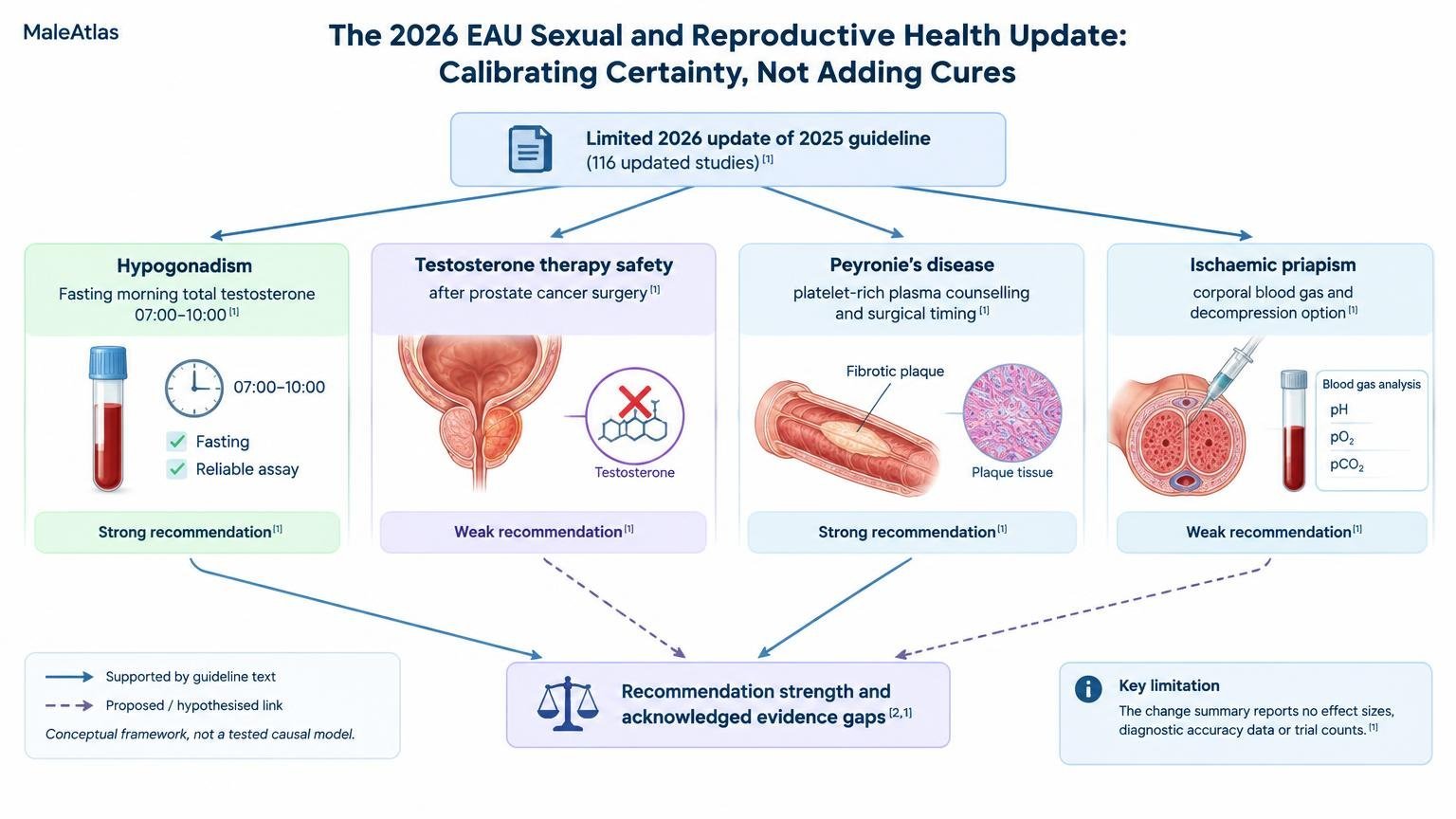
Conceptual framework: Conceptual framework, not a tested causal model. The 2026 EAU Sexual and Reproductive Health document is a limited update of the 2025 edition that appraised 116 updated studies across four sections. Nodes show the guideline domains; solid arrows mark statements supported by explicit recommendation text, while dashed reasoning links mark proposed explanations for weak grading. A key limitation is that the change summary reports no effect sizes, diagnostic accuracy data or trial counts.
Academic References & Evidence
- Introduction – EAU Guidelines on Sexual and Reproductive Health – Uroweb. EAU Guidelines on Sexual and Reproductive Health
- Paolo Capogrosso; Marij Dinkelman-Smit. 2026 update on EAU Guidelines for Sexual & Reproductive Health.
- Girish P Joshi; Dileep N Lobo; Henrik Kehlet. Challenges in interpretaion of randomised clinical trials included in systematic reviews and clinical guidelines. British Journal of Anaesthesia
- Luca Boeri; Marij Dinkelman-Smit; Christian Fuglesang S. Jensen; Suks Minhas; Andrea Salonia. Varicocele Treatment in Azoospermia Before Artificial Reproductive Techniques: Critical Considerations by the EAU Guidelines Panel on Sexual and Reproductive Health. European Urology. 2026 89(5):391-393 DOI: 10.1016/j.eururo.2025.12.017.
- Paolo Capogrosso; Marij Dinkelman-Smit. 2026 update on EAU Guidelines for Sexual & Reproductive Health – EAU Podcast.
SANYUN Science Center explains published research on men's reproductive and sexual health, connecting scientific evidence with everyday questions while making sources and limitations clear.
Disclaimer: This article is for scientific education and research communication only. It does not provide medical advice, diagnosis, or individualized treatment recommendations, and does not endorse any medication, supplement, device, penile enlargement procedure, or other intervention. Decisions about sexual and reproductive health should be made in consultation with a qualified healthcare professional. Do not delay seeking professional care because of information in this article.
Original Content & Copyright Notice
- This article is prepared for SANYUN Science Center, drawing on published research and publicly available academic literature on men’s sexual and reproductive health. Its editorial explanations and presentation are developed for this platform.
- Copyright in the original editorial content, selection, and arrangement is reserved by SANYUN Science Center to the extent protected by applicable law. Referenced research, quotations, and third-party materials remain subject to the rights of their respective owners. This notice does not claim ownership of scientific facts or third-party research.
- Except where permitted by applicable law or an applicable license, prior written permission is required to reproduce, republish, translate, adapt, redistribute, or commercially reuse protected content. Attribution alone does not grant permission for such reuse.
- For permitted quotation or authorized reuse, clearly identify the source and retain a link to the original article.
- Source: SANYUN Science Center
- Original URL: Retain the original article URL on science.san-yun.com.
- Copyright Holder: SANYUN Science Center, for its own protected editorial content.
- Quotation, excerpts, or authorized reuse must not distort the scientific meaning, omit material limitations or disclaimers, or imply unverified medical claims, product efficacy, or endorsement by SANYUN Science Center.



