




Category: Clinical Insights
Core Research Direction: Interpreting an abnormal semen analysis in the context of male fertility: what reference limits do and do not mean, how single results fluctuate, what repeat testing and couple-level assessment add, and which lifestyle or clinical interventions have measurable versus uncertain effects on semen parameters.
Search Intent: If my semen analysis shows a low value, what does that actually mean for my chance of fathering a child, and what should I do next?
Platform: SANYUN Science Center
Evidence reviewed through: 2026-11-21
Executive Summary
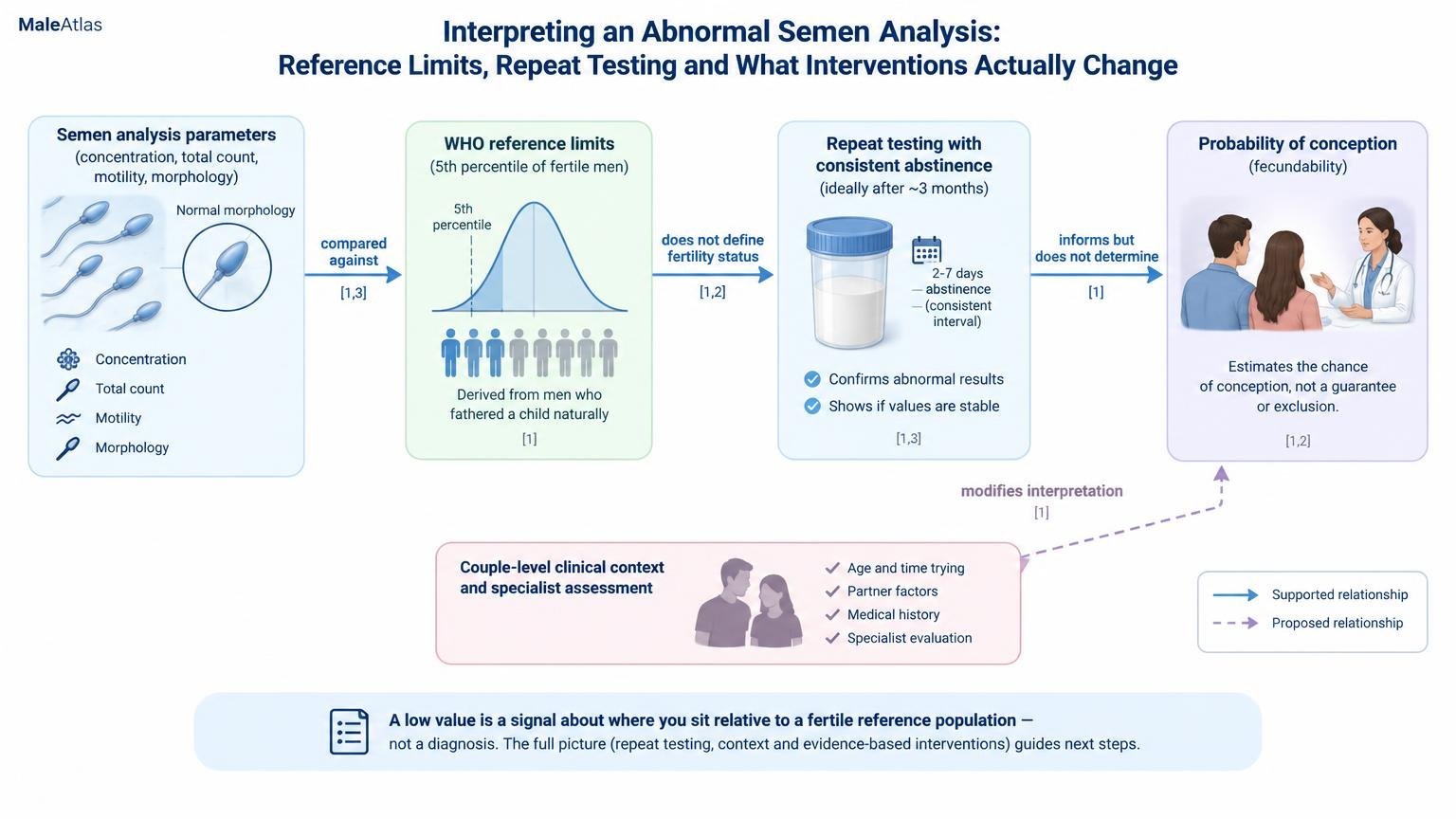
A semen analysis report is a specialist document presented in a friendly layout, with tidy numbers and a reference column that gives the impression it can be read without clinical context. That impression is the central interpretive hazard. The World Health Organization reference limits are derived from the 5th percentile of a large group of men who had fathered a child naturally, with partners conceiving within twelve months. The WHO manual explicitly states that the 5th percentile does not represent a threshold between fertility and infertility. A value below a lower limit therefore describes where a man sits relative to a fertile reference population; it does not diagnose infertility.[1]
Three further points reshape how a single result should be read. First, fertility is not an on-off switch: semen results help estimate the probability of conception without guaranteeing or excluding it. Second, sperm production takes roughly two to three months, and abstinence length changes measured values, so one sample is a snapshot of a moving target. Third, an initial abnormal result generally requires confirmation, with repeat testing ideally after three months and sooner if no sperm or severely reduced numbers are found. Intervention evidence is uneven: smoking, weight and clinically palpable varicocele have measurable associations, antioxidant supplements have a possible but very-low-certainty effect, and several popular heat-related measures lack human outcome data.[2]
Why This Matters
The commonest clinical error is not ignoring a low value; it is over-reading one. A man who is told his morphology is 2% while his concentration and motility are excellent may conclude that fatherhood is impossible, when an isolated low morphology is a weak signal in that context. Conversely, a reassuring standard report does not always close the case: sperm can appear numerous, fast and well-formed while carrying high levels of DNA damage that a conventional report cannot reveal. The practical task is therefore triage, not self-diagnosis: decide which values merit repetition, which merit specialist evaluation, and which merit a couple-level conversation.
Timing matters to that conversation. Infertility is conventionally defined as failure to conceive after twelve months of regular unprotected intercourse, so a couple trying for three months does not yet meet the definition, although earlier assessment can still be reasonable if something is worrying. Most concerning-looking results fall into the subfertility range, meaning lower probability rather than zero probability. The difference between subfertile and infertile is exactly the kind of judgment that requires the full clinical picture, not a glance at a reference column.
What the Reference Limits Actually Describe
WHO 6th edition limits are a reference distribution, not a pass/fail line; men below the lower limits can conceive naturally, and men above them may be infertile. This is not a quirk of one parameter. It follows from how the limits were built: by ranking results from men of known fertility and taking the value below which only the lowest 5% fell. Such a distribution tells a clinician where a result sits among fertile men. It does not tell anyone whether that particular man will or will not conceive.
| Concept | What it is | How to interpret it |
|---|---|---|
| WHO lower reference limit | The 5th percentile of a large group of men who had fathered a child naturally, partners conceiving within twelve months | A reference distribution marker, not a fertility/infertility threshold; values below it occur among fertile men |
| Morphology | The proportion of sperm with 'normal' form under strict criteria | The most frequently misinterpreted row; isolated low morphology with otherwise excellent parameters is a weak signal, whereas low morphology that is persistent and accompanied by other abnormal parameters may matter |
| Progressive motility[3] | The proportion of sperm swimming decisively forward | Described as the motility measure that matters most for natural conception; a single borderline motility value alone is not a reason for alarm |
| Fecundability ratio | A ratio comparing the per-cycle probability of conception in an exposed group with a reference group | In the PRESTO cohort, total sperm count ≤39 million gave a ratio of 0.58 and concentration ≤16 million/mL gave 0.74, while total motility ≤42% was statistically indistinguishable from normal; these are probabilities, not diagnoses |
| Spermatogenesis cycle | The interval from spermatogonia to ejaculation, about 72-74 days, plus epididymal maturation | A sample collected today reflects testicular activity from roughly two to three months earlier; this sets the minimum sensible interval before retesting after a lifestyle change |
| Abstinence interval | The number of days of ejaculatory abstinence before sampling | WHO requests two to seven days because volume, concentration, motility and even DNA quality vary with abstinence length; a consistent interval makes serial samples comparable |
From Reference Limits to Probability: The PRESTO Cohort
The most useful published attempt to connect a semen parameter to an actual pregnancy outcome in the supplied evidence is the North American PRESTO prospective cohort. Among 763 men providing 1,376 samples, total sperm count at or below 39 million was associated with a fecundability ratio of 0.58 (95% CI 0.38-0.88), and concentration at or below 16 million/mL with 0.74 (0.56-0.97). Total motility at or below 42%, by contrast, was statistically indistinguishable from the normal population.
Two interpretive points follow, and both are easy to get wrong. The first is that a fecundability ratio is a ratio of per-cycle conception probability, not a diagnostic label; a ratio of 0.58 means lower probability, not zero probability. The second is that the confidence intervals are wide enough to leave real uncertainty about the size of the association, and the design is observational, so confounding and exposure misclassification are not eliminated. Within those limits, the practical message is that concentration and total count are the parameters most worth tracking, while a single borderline motility value alone should not drive decisions.
Why One Sample Is a Snapshot, Not a Verdict
Semen parameters drift within the same man. The biological reason is the production timeline: sperm take roughly 72-74 days to develop, with a further maturation phase in the epididymis, so a sample collected today reflects what the body was doing two to three months ago. A febrile illness, a period of heavy work or stress, or a viral infection can therefore surface in a result long after the man has forgotten it. The classic '74 days' may itself carry about six days of uncertainty, which is why clinicians speak of 'three months' rather than an exact date.
Laboratory conditions add a second layer of variation. WHO requests two to seven days of ejaculatory abstinence before a semen analysis precisely because values change with abstinence length; the same man tested after two versus seven days can show significant differences in volume, concentration, motility and even DNA quality. A longer abstinence tends to increase volume and sperm number but may worsen motility and DNA integrity, while shorter abstinence does the reverse. This is why a consistent interval — the supplied clinical guidance suggests four to five days — makes repeated samples more comparable, and why a 30-day retest after starting a supplement measures fluctuation rather than treatment response.
The clinical consequence is straightforward. An initial abnormal result generally requires confirmation; NICE recommends repeating the test ideally after three months, and sooner if no sperm or severely reduced numbers are found. A first abnormal semen analysis is a starting point, not an endpoint, and the retest should be planned rather than reactive. Readers who want a more detailed walk-through of how individual rows map onto clinical decisions can consult the guide to reading a semen analysis against WHO reference limits.
What Interventions Have Measurable Effects on Semen Parameters
The intervention literature is best read as a hierarchy of certainty rather than a list of tips. At the stronger end sit exposures with consistent observational associations and plausible dose gradients: smoking, body weight and clinically palpable varicocele. In the middle sit interventions with small pooled effects and short trial horizons, notably moderate exercise. At the weak end sit antioxidant supplements, where the pooled estimate is statistically significant but the certainty of evidence is very low, and heat-related behavioural advice, where the mechanism is plausible but human outcome data are largely absent.
Smoking has the clearest quantified signal. A meta-analysis of 20 studies including 5,865 men found smokers had sperm concentration 9.72 million/mL lower (95% CI -13.32 to -6.12), total motility 3.48 percentage points lower, and normal morphology 1.37 percentage points lower than non-smokers. The effects appear larger in infertile men and in moderate-to-heavy smokers, which matters for counselling: a man already being investigated for infertility may gain more from quitting than a smoker in the general population. Electronic cigarettes are not an established safe substitute, because studies large enough to answer that question are still too small.
Body weight shows a graded association. Compared with normal-weight men, the odds ratios for oligozoospermia or azoospermia were 1.11 (95% CI 1.01-1.21) in overweight men, 1.28 (1.06-1.55) in obese men, and 2.04 (1.59-2.62) in severely obese men. The gradient is the point: a BMI of 27 and a BMI of 40 are not the same exposure. What the evidence does not establish is how much semen quality recovers after weight loss; that question is far less settled than the association itself. Weight therefore remains a modifiable target with a plausible effect size, but not a guaranteed repair.
Exercise has small-to-moderate pooled effects. A meta-analysis of exercise interventions in young men found improvements in sperm concentration (standardized mean difference 0.35, 95% CI 0.16-0.54) and motility (0.79, 0.31-1.28), with moderate intensity, 30-60 minutes per session, 3-4 times weekly, giving the best results. These are supportive-intervention effect sizes from relatively short trials, not treatment effects, and the pooled sample size is not stated in the supplied summary. At the other extreme, exogenous testosterone at any dose suppresses sperm production and is not a fertility treatment.
Antioxidant supplements deserve careful language. The 2022 Cochrane review pooled 90 trials and 10,303 men and found a live birth odds ratio of 1.43 (95% CI 1.07-1.91) and a clinical pregnancy odds ratio of 1.89 (1.45-2.47), but rated the certainty of evidence as very low. Very low certainty means the direction may be right while the magnitude is unreliable. That is a defensible reason to correct a detected deficiency, and a poor reason to buy a probability. Anyone comparing supplement claims with the exercise literature may find the review of exercise and sperm quality useful context.
Varicocele: Treatment Must Match the Planned Next Step
Varicocele is where intervention evidence becomes most decision-relevant, and also where it is most often over-generalised. A 2025 meta-analysis of 9 studies found that varicocele ligation before ICSI was associated with a mean fertilization rate increase of 10.9 percentage points (95% CI 5.94-15.89), a clinical pregnancy odds ratio of 1.38 (1.07-1.78), and a live birth odds ratio of 2.07 (1.45-2.97). The same review found no benefit of surgery before IUI (OR 1.01, 0.42-2.45).
The contrast is the teaching point. 'Fixing the varicocele' is not a universal instruction; the value of surgery depends on whether it is clinically palpable, whether semen parameters are abnormal, and what the couple's next treatment step will be. A meta-analysis can support a group-level association without settling an individual's decision, and the pooled sample size is not stated in the supplied summary. The decision belongs with a clinician who performs this surgery and can examine the patient, not with a report read in isolation.
What the Standard Report Cannot See
A conventional semen analysis counts sperm, observes movement and assesses shape. It does not inspect the genetic material inside them. Sperm may look numerous, fast and well-formed while carrying high levels of DNA damage that the standard report will never reveal. This is the clearest reason a 'normal' result does not always close the case, and it is why supplemental testing such as sperm DNA fragmentation is sometimes considered. The supplied sources describe this as a rationale for further testing rather than as a routine recommendation, and no quantitative threshold or outcome data are provided here. A dedicated review of sperm DNA fragmentation testing in male infertility covers the clinical role and evidence limits in more depth.
Interpretation and Limitations
The evidence summarised here has several boundaries that should be stated plainly. Most of the intervention estimates come from observational meta-analyses, which can be confounded by weight, tobacco, other exposures and health behaviours; the cannabis literature illustrates this well, with 44.9% of 1,158 users versus 24.5% of 2,856 non-users showing at least one abnormal semen parameter, yet a pooled relative risk of 1.159 (95% CI 0.840-1.599) that was not statistically significant. A confidence interval that includes 1.0 does not prove safety, and a statistically significant pooled estimate does not prove that an individual will benefit.
The exercise and antioxidant estimates are pooled across heterogeneous trials with short follow-up, and the antioxidant certainty is explicitly very low. The varicocele estimates are restricted to specific treatment contexts and do not transfer to every couple. Heat-related advice, including avoiding prolonged saunas, hot baths and occupational heat exposure during the three-month window, rests on plausible mechanism and zero cost rather than on trials showing changed live birth rates; no trial shows that switching underwear or moving a laptop off the lap changes live birth rate. The PRESTO fecundability ratios are observational and do not establish causation. Finally, the supplied material is educational and clinical-guidance synthesis, not a systematic review conducted for this article, and several primary publications are summarised second-hand rather than inspected directly.
Couple-Level Assessment and the Limits of the Male Report
A semen analysis describes half of a couple. Conception is a shared event, and the same male result carries different weight depending on the other half of the picture: a borderline value alongside an unremarkable female evaluation is not the same situation as the identical value alongside other factors. Any honest reading of a man's result keeps this in view, because he is one half of a couple rather than an isolated problem to be solved. This is also why fertility is better described as a shared probability than as a yes-or-no verdict stamped on a form. Readers thinking through the practical sequence of assessment may find the discussion of two semen analyses and reproducibility in young men relevant.
Azoospermia and severe oligozoospermia sit at the extreme end and follow a different pathway. A first result showing no sperm or severely reduced numbers should be repeated as soon as possible rather than after three months. Beyond that, specialist evaluation — including genetic testing in selected cases and surgical sperm retrieval where appropriate — belongs to an andrology or reproductive-medicine service. The supplied patient question illustrates why this matters: a man with an initial azoospermia result, a later cryptozoospermia result, a grade IV varicocele and a history of operated undescended testis faced a proposed testicular sperm extraction, and the published exchange does not contain the specialist's answer. The lesson is not a treatment recommendation; it is that extreme results require specialist sequencing, not a supplement.[4]
Research Outlook
Three questions would most change clinical practice if answered well. First, how much do semen parameters actually recover after weight loss, smoking cessation and varicocele repair, measured in randomized or well-controlled designs rather than inferred from cross-sectional associations? Second, which men with a normal conventional analysis nonetheless carry clinically relevant sperm DNA damage, and does identifying them change live birth outcomes? Third, how should couple-level models combine male and female factors into a single calibrated probability? The supplied sources point toward these questions without answering them, and the field's main weakness is not a shortage of plausible mechanisms but a shortage of outcome-anchored evidence.
Key Takeaways
- WHO reference limits are derived from the 5th percentile of fertile men and are not a fertility/infertility threshold; values below them occur in men who conceive naturally.
- Fertility is probabilistic: semen results estimate the chance of conception without guaranteeing or excluding it, and most concerning results reflect subfertility rather than sterility.
- One sample is a snapshot. Sperm production takes about 72-74 days, abstinence length changes measured values, and an initial abnormal result generally requires confirmation, ideally after three months and sooner if no sperm or severely reduced numbers are found.
- Smoking, body weight and clinically palpable varicocele have measurable associations with semen parameters, but varicocele surgery is most defensible before ICSI and showed no benefit before IUI in the same review.
- Antioxidant supplements show a pooled association with live birth but very low certainty evidence; heat-related behavioural advice rests on mechanism and lacks trial outcome data.
- A normal standard report does not exclude hidden sperm DNA damage, and a semen analysis describes only half of a couple; interpretation requires clinical context and, where results are extreme, specialist sequencing.
Questions and Answers
What do WHO semen analysis reference limits actually mean?
They are the 5th percentile of a large group of men who had fathered a child naturally, with partners conceiving within twelve months. The WHO manual explicitly states the 5th percentile is not a threshold between fertility and infertility. A result below a lower limit places a man within the lowest 5% of a fertile reference distribution; it does not diagnose infertility, and a result above the limits does not guarantee conception.
If my sperm morphology is low, does that mean I cannot father a child?
Not on its own. Morphology is the most frequently misinterpreted row on a semen report. An isolated low morphology value alongside excellent concentration and motility is a weak signal, whereas low morphology that is persistent across repeated tests and accompanied by other abnormal parameters may matter clinically. The decision about whether a value counts requires the full context and repeat testing, not a single flagged number.
Why can two semen analyses from the same man give different results?
Sperm take roughly 72-74 days to develop, so a sample reflects testicular activity from two to three months earlier, and the classic 74-day figure may itself carry about six days of uncertainty. Abstinence length also changes volume, concentration, motility and even DNA quality. The same man tested after two versus seven days can show significant differences, which is why WHO requests two to seven days and consistent intervals make repeat samples comparable.
How long should I wait before repeating an abnormal semen analysis?
NICE recommends repeating an abnormal result ideally after three months, because that interval matches the spermatogenesis cycle and allows a lifestyle change to be reflected in the sample. If no sperm or severely reduced numbers are found, the test should be repeated as soon as possible instead. A 30-day retest, sometimes offered after starting a supplement, mainly measures biological fluctuation rather than treatment response.
Do fertility supplements for men actually improve sperm or live birth rates?
The 2022 Cochrane antioxidant review pooled 90 trials and 10,303 men and found a live birth odds ratio of 1.43 (95% CI 1.07-1.91) and a clinical pregnancy odds ratio of 1.89 (1.45-2.47), but rated the certainty of evidence as very low. That means the direction may be right while the magnitude is unreliable. Correcting a detected deficiency is a defensible reason to use a supplement; buying a probability is not.
Does varicocele surgery improve fertility before IVF or IUI?
It depends on the planned next step. A 2025 meta-analysis of 9 studies found varicocele ligation before ICSI was associated with a 10.9 percentage point mean increase in fertilization rate (95% CI 5.94-15.89), a clinical pregnancy odds ratio of 1.38 (1.07-1.78) and a live birth odds ratio of 2.07 (1.45-2.97). The same review found no benefit before IUI (OR 1.01, 0.42-2.45), so surgery is not a universal instruction.
Conceptual framework: Conceptual framework. Semen analysis parameters are compared against WHO reference limits derived from the 5th percentile of fertile men; repeat testing with consistent abstinence informs, but does not determine, the probability of conception. Couple-level clinical context is shown as a proposed modifier of interpretation. The framework reflects educational synthesis of observational and clinical-guidance evidence, not a tested causal model.
Academic References & Evidence
- Spermiogramma: risultati, ripetizione e prossimi passi | GGOMed.
- 如何提高男性生育力:精子數量與活力的證據(2026). 2026
- 如何提高男性生育力:精子数量与活力的证据(2026). 2026
- Buongiorno, sono un ragazzo di 32 anni che a Dicembre 2025 ha fatto uno spermiogramma (a titolo di c.
SANYUN Science Center explains published research on men's reproductive and sexual health, connecting scientific evidence with everyday questions while making sources and limitations clear.
Disclaimer: This article is for scientific education and research communication only. It does not provide medical advice, diagnosis, or individualized treatment recommendations, and does not endorse any medication, supplement, device, penile enlargement procedure, or other intervention. Decisions about sexual and reproductive health should be made in consultation with a qualified healthcare professional. Do not delay seeking professional care because of information in this article.
Original Content & Copyright Notice
- This article is prepared for SANYUN Science Center, drawing on published research and publicly available academic literature on men’s sexual and reproductive health. Its editorial explanations and presentation are developed for this platform.
- Copyright in the original editorial content, selection, and arrangement is reserved by SANYUN Science Center to the extent protected by applicable law. Referenced research, quotations, and third-party materials remain subject to the rights of their respective owners. This notice does not claim ownership of scientific facts or third-party research.
- Except where permitted by applicable law or an applicable license, prior written permission is required to reproduce, republish, translate, adapt, redistribute, or commercially reuse protected content. Attribution alone does not grant permission for such reuse.
- For permitted quotation or authorized reuse, clearly identify the source and retain a link to the original article.
- Source: SANYUN Science Center
- Original URL: Retain the original article URL on science.san-yun.com.
- Copyright Holder: SANYUN Science Center, for its own protected editorial content.
- Quotation, excerpts, or authorized reuse must not distort the scientific meaning, omit material limitations or disclaimers, or imply unverified medical claims, product efficacy, or endorsement by SANYUN Science Center.



