




Category: Penile Size
Core Research Direction: Measurement and evidence boundaries in adult penile size assessment: what methodologically sound reviews of flaccid, stretched, and erect penile measurement can and cannot establish, and how these limitations constrain clinical interpretation and claims about size-modifying interventions.
Search Intent: When clinicians and researchers measure adult penile length and girth, what measurement methods exist, and does the evidence support one method over the others?
Platform: SANYUN Science Center
Evidence reviewed through: 2026-11-08
Executive Summary
Few topics in men's health carry as much measurement anxiety as penile size, yet the basic methodological question is surprisingly unresolved: if clinicians and researchers want a trustworthy number, how should they obtain it? A review published in the International Journal of Impotence Research in 2020 set out to answer this for three states — flaccid, stretched and erect — and concluded that the literature offers no definitive evidence favoring one measuring method over another.[1]
That review searched PubMed, Google Scholar and the Cochrane Library, limited to peer-reviewed English-language articles published before August 2018, and had all authors assess the methods and results sections of each publication. Its central finding was a null one: methods vary and conflict across the literature, and no single approach could be declared superior on the available evidence. The authors therefore proposed their own recommendations for future measurement rather than declaring a winner among existing techniques.[2]
This matters beyond academic tidiness. Without agreed measurement standards, studies of normal size ranges, of changes after surgery, and of any intervention claimed to alter size cannot be reliably compared or pooled. The evidence gap is not primarily about average values; it is about whether the numbers being compared describe the same thing measured the same way.
Why This Matters
Penile size data are described by the review authors as important to both clinicians and researchers. Clinically, size questions arise in several distinct contexts: men worried that they are abnormal, men considering procedures, and men whose size may change as a consequence of other treatment. In each context, the meaning of a measurement depends on how it was taken, in which state, and under what conditions. If the method is not standardized, a measurement cannot be interpreted with confidence even when the number itself is precise.
The research consequence is arguably larger. A review that cannot identify a superior method is telling the field something structural: the primary studies it covers use varied and conflicting approaches. Estimates of average length or girth, prevalence of perceived smallness, and effects of interventions are all sensitive to these choices. When methods diverge, apparent differences between studies may reflect measurement technique rather than biology, and apparent effects of an intervention may reflect changes in how or when measurement was performed.
For readers evaluating claims about size-modifying products or procedures, the practical message is that measurement methodology is a gatekeeper for evidence quality. A claim that an intervention changes size presupposes a measurement that can detect real change reliably and reproducibly. The review's null finding on method superiority means that this presupposition has not been firmly established across the field.
What the Review Examined and How
The review was designed as a structured evidence synthesis rather than a new experiment. Its stated aim was to review measurement methods for the flaccid, stretched and erect penis in order to construct a best-practice recommendation. This is an explicitly normative goal — the authors intended to produce guidance for future publications, not merely to describe current practice.
The search strategy was systematic in the sense of predefined databases and eligibility limits: PubMed, Google Scholar and the Cochrane Library, with inclusion restricted to peer-reviewed articles published in English before August 2018. All authors evaluated the methods and results sections of each publication. This multi-author screening arrangement supports consistency, though the available abstract does not describe a formal risk-of-bias instrument or a quantitative synthesis.
The design therefore sits between a conventional narrative review and a fully quantitative systematic review. It systematically identifies and appraises studies, but its output is a reasoned recommendation rather than a pooled effect estimate. That distinction is important: a recommendation derived from the absence of superiority evidence is a consensus proposal, not proof that the proposed method outperforms alternatives.
| Review feature | How it was handled | Interpretive consequence |
|---|---|---|
| Measurement states covered | Flaccid, stretched and erect penis | The review treats these as distinct measurement contexts rather than interchangeable proxies |
| Search sources | PubMed, Google Scholar and Cochrane Library | Broad coverage of biomedical and grey-adjacent literature, but limited to three sources |
| Eligibility limits | Peer-reviewed, English-language, published before August 2018 | Non-English and non-peer-reviewed work was excluded; later publications are outside the search window |
| Appraisal process | All authors evaluated methods and results sections | Consistent multi-author screening; formal risk-of-bias tool not described in available abstract |
| Main comparative finding | No definitive evidence favoring one measuring method | Method superiority remains unestablished; comparisons across studies are fragile |
| Output | Recommendations proposed for future publications | A normative protocol proposal, not an evidence-ranked winner |
Measurement States: Flaccid, Stretched and Erect
The review's scope makes a conceptual point before any result is discussed: penile size is not one measurement but several. Flaccid, stretched and erect assessments describe different physical states, and the review treats each as requiring its own methodological consideration. A number reported without its measurement state is therefore incomplete as a description of size.
Why does state matter so much? Flaccid size varies with temperature, stress and other transient conditions, and it need not track erect size closely; the relationship between flaccid and erect dimensions differs across individuals. Stretched length has historically been used as a practical proxy for erect length, but the review's framing of stretched measurement as a distinct method category implies that the proxy assumption itself deserves scrutiny rather than acceptance. The available abstract does not report quantitative comparisons between states, so the article cannot quantify how closely stretched measurements track erect measurements.
Girth is a separate dimension again. The review explicitly addresses penile length and girth measurement techniques, meaning circumference is treated as its own measurement problem rather than a byproduct of length assessment. For any claim about size-modifying intervention, length and girth should be evaluated separately, because a method that is adequate for one dimension may not be adequate for the other.
What the Evidence Shows
The core result is stated plainly: the authors did not find definitive evidence favoring one measuring method over the other. This is a comparative null finding. It does not assert that all methods are equally valid, nor that measurement is arbitrary; it asserts that the reviewed literature did not supply the kind of evidence needed to rank methods.
The supporting observation is that methods reported in the literature are various and conflicting. Conflicting methods are a stronger problem than merely diverse ones: diversity could be managed by reporting standards, whereas conflicting approaches raise the possibility that different studies are measuring different constructs under the same label. The review does not, in its available abstract, enumerate every technique or quantify disagreement between them, so the specific conflicts remain a gap this analysis cannot fill.
The absence of consensus is corroborated by the MEDLINE-indexed record of the same review, which repeats both the lack of a preferred method and the presence of conflicting methods in the literature. That corroboration confirms consistent indexing of the review's message but should not be mistaken for independent confirmation, because both records point to the same underlying publication.
Instead of declaring an existing method superior, the authors advocate their own recommendations for penile size measurement in future publications. This is a forward-looking proposal. Its justification rests on the need for standardization, not on demonstrated performance advantages over the alternatives it did not rank.
- Main finding: no definitive evidence favors one penile measurement method over another.
- Supporting observation: the literature reports various and conflicting measurement methods.
- Output: the authors propose their own measurement recommendations for future publications.
- Scope: flaccid, stretched and erect states, with both length and girth techniques addressed.
Interpretation and Limitations
The most important interpretive caution concerns what kind of claim the review supports. A null result on method superiority is not evidence of equivalence. Saying that no method has been shown superior leaves open the possibility that one method is in fact better but that studies have not been designed to demonstrate it. Clinicians and researchers should read the review's conclusion as a call for standardization, not as a statement that measurement choices are immaterial.
The review's methodology has boundaries that shape its conclusions. The search was limited to three databases and to peer-reviewed English-language articles, and the search window closed before August 2018. Important methodological work published in other languages or after that date is outside its evidence base. The available abstract does not describe a formal risk-of-bias assessment or a quantitative pooling of agreement statistics, so the synthesis is qualitative in character.
There is also a deeper measurement question the review cannot resolve from the published literature: reliability and agreement between observers, and consistency of measurement across occasions. These properties are method-specific, and without them a nominally standardized protocol can still generate inconsistent numbers. The review's recommendation is a starting point for accumulating that evidence, not a substitute for it.
Finally, the review does not evaluate interventions. It tells us about the measurement tools that intervention studies rely on. When someone claims that a product or procedure increases size, the pathway from claim to credible evidence runs through measurement validity and reproducibility. The review's conclusions constrain that pathway without itself testing any intervention.
Research Outlook
The logical next steps follow directly from the review's null finding. The field needs studies that directly compare measurement methods within the same men and at the same time points, so that differences attributable to technique can be separated from differences between individuals. Such comparisons should report reliability, observer agreement and sensitivity to real change, because these are the properties that make a measurement useful for both clinical care and research.
Adoption of the review's proposed recommendations in future publications is itself a testable natural experiment. If standardized methods are adopted and new studies produce more consistent estimates of length and girth, that consistency would support the practical value of standardization, even without a trial ranking methods against each other. Conversely, persistent heterogeneity under a common protocol would suggest that the problem lies in properties of measurement not yet captured.
Research on size-modifying interventions should be read with these methodological constraints in mind. The effect sizes reported for any intervention can only be as trustworthy as the measurement that produced them, and the review's conclusion is that the field has not yet established which measurement should be trusted most. That is the key limitation any future intervention claim must address rather than assume away.
Key Takeaways
- A 2020 review of penile length and girth measurement techniques covered flaccid, stretched and erect states and found no definitive evidence favoring any single method.
- The literature reports varied and conflicting measurement methods, which limits comparability across studies and reduces confidence in pooled size estimates.
- The review was a systematic search of three databases limited to peer-reviewed English articles published before August 2018, with all authors appraising methods and results.
- The authors proposed their own measurement recommendations for future publications; this is a consensus proposal, not an evidence-established winner.
- Claims about size-modifying interventions depend on measurement validity and reproducibility, which the current evidence base has not resolved.
Questions and Answers
What did the 2020 review conclude about penile length and girth measurement methods?
The review found no definitive evidence favoring one measuring method over another for flaccid, stretched or erect penile size. Its authors reviewed varied and conflicting methods, then proposed their own recommendations for future publications rather than ranking existing techniques. This is a consensus-based standardization proposal, not proof that any method is superior.
How were studies selected for the penile size measurement review?
A systematic search covered PubMed, Google Scholar and the Cochrane Library and was restricted to peer-reviewed English-language articles published before August 2018. All authors evaluated the methods and results sections of each publication. The available abstract does not describe a formal risk-of-bias tool or quantitative pooling, so the synthesis is qualitative.
Why does measuring penile size in flaccid, stretched and erect states matter?
These are different physical conditions, not interchangeable proxies. The review treats measurement of each state as its own methodological problem for both length and girth. A reported number without its measurement state is therefore incomplete, and studies using different states may not be directly comparable even when both use valid techniques.
Does the review prove that all penile measurement methods are equally valid?
No. A null finding on method superiority is not evidence of equivalence. The review concluded only that the literature did not supply evidence to rank methods. A method could still be better without existing studies having been designed to demonstrate it, which is why the authors emphasized standardization for future work rather than declaring measurement choices arbitrary.
What are the main limitations of this penile measurement evidence review?
Its search was limited to three databases, peer-reviewed English-language articles, and publications before August 2018. Later or non-English methodological work is excluded. The available abstract does not describe quantitative pooling or a formal bias-assessment instrument. The review also does not itself evaluate size-modifying interventions, only the measurement tools those intervention studies would depend on.
What do the review's findings mean for claims that a product or procedure increases penile size?
Any such claim depends on a measurement known to be reliable and reproducible. Because the field has not established which measurement method is superior, effect sizes reported for size-modifying interventions rest on methods that have not been comparatively validated. The review constrains the credibility of those claims without testing any intervention directly.
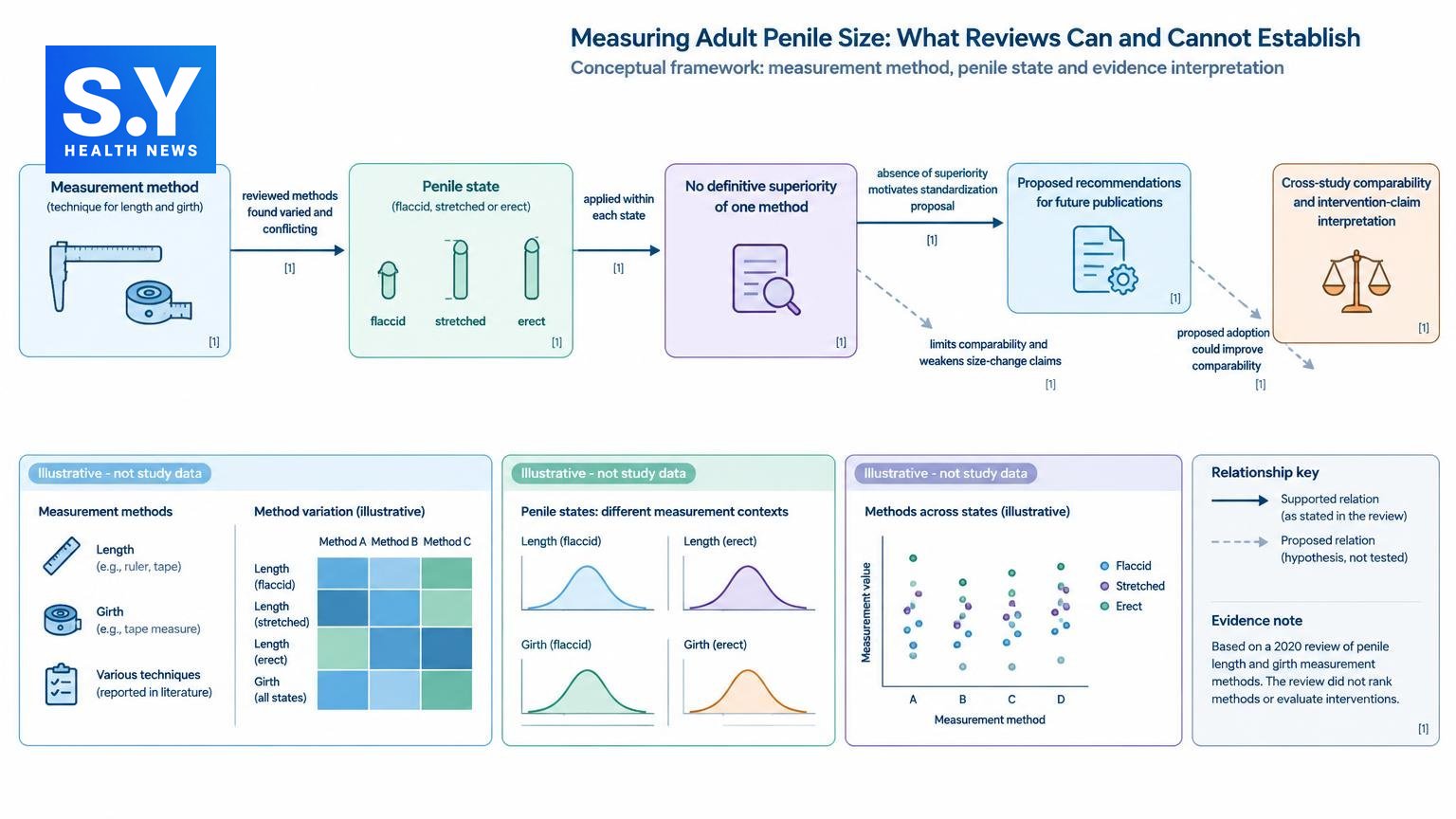
Conceptual framework: Conceptual framework. Evidence type: a 2020 review of penile length and girth measurement methods across flaccid, stretched and erect states. Solid relations are supported as worded by the review; dashed-style proposed relations (comparability and standardization effects) are hypotheses, not tested causal paths. Key limitation: the review did not rank methods or evaluate interventions.
Academic References & Evidence
- Alexander Greenstein; Snir Dekalo; Juza Chen. Penile size in adult men—recommendations for clinical and research measurements – International Journal of Impotence Research. International Journal of Impotence Research. 2020 32:153–158 DOI: 10.1038/s41443-019-0157-4.
- Greenstein A; Dekalo S; Chen J. MEDLINE Abstract. Int J Impot Res. 2020 32(2):153-158 PMID: 31171853.
SANYUN Science Center explains published research on men's reproductive and sexual health, connecting scientific evidence with everyday questions while making sources and limitations clear.
Disclaimer: This article is for scientific education and research communication only. It does not provide medical advice, diagnosis, or individualized treatment recommendations, and does not endorse any medication, supplement, device, penile enlargement procedure, or other intervention. Decisions about sexual and reproductive health should be made in consultation with a qualified healthcare professional. Do not delay seeking professional care because of information in this article.
Original Content & Copyright Notice
- This article is prepared for SANYUN Science Center, drawing on published research and publicly available academic literature on men’s sexual and reproductive health. Its editorial explanations and presentation are developed for this platform.
- Copyright in the original editorial content, selection, and arrangement is reserved by SANYUN Science Center to the extent protected by applicable law. Referenced research, quotations, and third-party materials remain subject to the rights of their respective owners. This notice does not claim ownership of scientific facts or third-party research.
- Except where permitted by applicable law or an applicable license, prior written permission is required to reproduce, republish, translate, adapt, redistribute, or commercially reuse protected content. Attribution alone does not grant permission for such reuse.
- For permitted quotation or authorized reuse, clearly identify the source and retain a link to the original article.
- Source: SANYUN Science Center
- Original URL: Retain the original article URL on science.san-yun.com.
- Copyright Holder: SANYUN Science Center, for its own protected editorial content.
- Quotation, excerpts, or authorized reuse must not distort the scientific meaning, omit material limitations or disclaimers, or imply unverified medical claims, product efficacy, or endorsement by SANYUN Science Center.



