




Category: Erectile Dysfunction
Core Research Direction: Comparative risk of healthcare-recorded sexual dysfunction in adult men after initiating specific antidepressants (citalopram, sertraline, venlafaxine, mirtazapine), considered alongside the overall quality and limitations of the evidence base for erectile dysfunction treatments
Search Intent: Among adult men starting different antidepressants, does the risk of healthcare-recorded sexual dysfunction differ between drugs, and how much can this kind of observational evidence tell us?
Platform: SANYUN Science Center
Evidence reviewed through: 2026-11-07
Executive Summary
A Danish register-based cohort compared the risk of healthcare-recorded sexual dysfunction among adult men who started citalopram, sertraline, venlafaxine or mirtazapine. The study was designed as a new-user, active comparator cohort covering initiations between 2001 and 2015, and it permitted more than one cohort entry per person.[1]
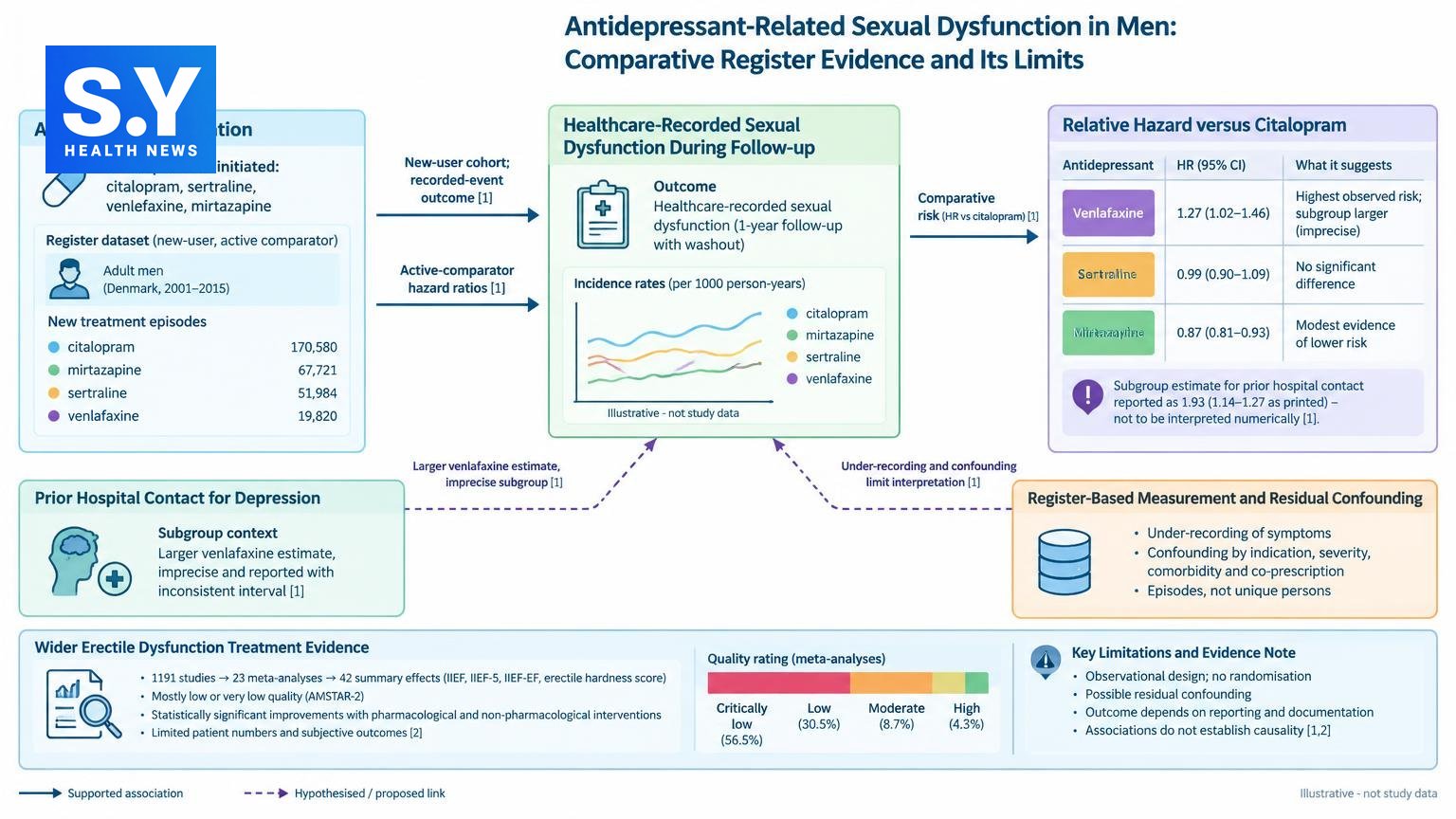
The dataset included 170,580 new citalopram treatment episodes, 67,721 mirtazapine episodes, 51,984 sertraline episodes and 19,820 venlafaxine episodes. In the primary analysis with one-year follow-up and washout periods, incidence rates of healthcare-recorded sexual dysfunction ranged from 18.80 to 28.5 per 1000 person-years.
Relative to citalopram, venlafaxine was associated with the highest risk (hazard ratio 1.27; 95% CI 1.02–1.46). A larger estimate was reported for men with previous hospital contact for depression, but the printed confidence interval is internally inconsistent and is not interpreted numerically here. Sertraline showed no significant difference (HR 0.99; 95% CI 0.90–1.09), and mirtazapine showed modest evidence of lower risk (HR 0.87; 95% CI 0.81–0.93). The authors report consistency across analyses.
A separate umbrella review of systematic reviews and meta-analyses on erectile dysfunction treatments concluded that the evidence base is predominantly of low or very low quality, even though statistically significant improvements were observed with both pharmacological and non-pharmacological interventions. That review addresses treatment effectiveness in erectile dysfunction, not antidepressant comparisons, but it illustrates why effect estimates need to be read alongside outcome measurement and study quality.[2]
Why This Matters
Sexual side effects are a recognised reason men stop or switch antidepressants, and they can undermine adherence during periods when sustained treatment matters. The clinically useful question is not only whether a drug class carries sexual side effects but whether individual agents differ enough to inform a discussion about alternatives. Population-scale register data can address that question in a way small trials often cannot.
The cohort's scale is a real strength: hundreds of thousands of citalopram episodes and tens of thousands for each comparator provide more precision than most single studies. The authors' recommendation that clinicians discuss potential sexual side effects, particularly when several treatment options are available, follows from the pattern of differing risk rather than from any single estimate.
Biological and Clinical Context
The cohort's comparative focus is pharmacological rather than mechanistic. Citalopram and sertraline are selective serotonin reuptake inhibitors, venlafaxine is a serotonin–noradrenaline reuptake inhibitor, and mirtazapine acts through different receptor pharmacology. The study was not designed to test why risks differ, and the available abstract does not report mediation analyses. Any mechanistic explanation should therefore be framed as hypothesis rather than established explanation.
Clinically, timing and attribution matter. Sexual dysfunction can be related to depression itself, to comorbid conditions, to other medications or to relational factors, as well as to antidepressant exposure. A new-user design with an active comparator anchors follow-up at treatment initiation and compares users of different drugs rather than users against non-users; it still does not resolve attribution in an individual case.
What the Evidence Shows
The study's stated objective was to compare the risk of healthcare-recorded sexual dysfunction among male patients after starting citalopram, sertraline, venlafaxine or mirtazapine. The design was a new-user, active comparator cohort of adult males in Denmark who started these drugs between 2001 and 2015, permitting multiple cohort entries per person. A separate analysis examined patients with prior depression-related hospital visits.
The primary analysis used one-year follow-up with washout periods. Incidence rates of healthcare-recorded sexual dysfunction ranged from 18.80 (95% CI 17.60–20.00) to 28.5 (95% CI 26.00–31.30) per 1000 person-years. Because the outcome required a healthcare record, these rates describe recorded events among men who came into contact with the health system, not the full burden of symptoms experienced.
Venlafaxine was associated with the highest risk of healthcare-recorded sexual dysfunction relative to citalopram (HR 1.27; 95% CI 1.02–1.46). The confidence interval excludes 1.00, but the lower bound sits close to it, so the comparison is statistically detectable yet not precisely estimated. A larger estimate was reported for men with previous hospital contact for depression (HR 1.93; 95% CI 1.14–1.27 as printed). That interval is internally inconsistent as printed — the lower bound of 1.14 exceeds the upper bound of 1.27 — and should be treated as a reporting problem rather than interpreted numerically.
Sertraline showed no significant difference relative to citalopram (HR 0.99; 95% CI 0.90–1.09), a narrow interval consistent with a well-estimated absence of meaningful difference on this recorded outcome. Mirtazapine showed modest evidence of lower risk (HR 0.87; 95% CI 0.81–0.93). The authors state findings remained consistent across all analyses, although the available abstract does not itemise the sensitivity analyses.
| Antidepressant versus citalopram | Reported hazard ratio (95% CI) | What the estimate indicates | Cautions |
|---|---|---|---|
| Venlafaxine | 1.27 (1.02–1.46); subgroup with prior depression-related hospital contact reported as 1.93 (1.14–1.27 as printed) | Highest observed risk of healthcare-recorded sexual dysfunction; subgroup estimate reported as noticeably larger | Lower bound near 1.00; subgroup interval printed inconsistently and not to be read numerically |
| Sertraline | 0.99 (0.90–1.09) | No significant difference from citalopram on the recorded outcome | Narrow null interval applies to recorded events, not to all subjective symptoms |
| Mirtazapine | 0.87 (0.81–0.93) | Modest evidence of lower risk than citalopram | Observational comparison; residual confounding cannot be excluded |
| New treatment episodes in the register dataset | 170,580 citalopram; 67,721 mirtazapine; 51,984 sertraline; 19,820 venlafaxine | Population scale of the active-comparator exposure groups | Episodes, not unique persons, because multiple entries per person were allowed |
Primary-analysis incidence rates across study groups ranged from 18.80 (95% CI 17.60–20.00) to 28.5 (95% CI 26.00–31.30) per 1000 person-years over one-year follow-up with washout periods. This absolute range is reported separately from the drug-versus-drug hazard ratios above so that the two dimensions are not compared head-to-head.
The Wider Erectile Dysfunction Treatment Evidence
The second source addresses a related but distinct question: how strong is the evidence for treatments of erectile dysfunction overall? An umbrella review searched PubMed, Web of Science, the Cochrane Library and Embase for studies published up to October 2025. From 1191 studies it extracted 23 published meta-analyses, yielding 42 summary effects on the IIEF (n=20), IIEF-5 (n=9), IIEF-EF (n=6) and erectile hardness score (n=7) across 36 interventions.
Quality appraisal with AMSTAR-2 rated 13 of the 23 meta-analyses (56.5%) as critically low, 7 (30.5%) as low, 2 (8.7%) as moderate and 1 (4.3%) as high. At the level of summary effects, only one was rated high quality and one moderate quality respectively, while 20 (47.6%) were low and 20 (47.6%) very low. The authors conclude that the evidence base for erectile dysfunction treatments is predominantly of low or very low quality.
This does not mean the interventions fail. Statistically significant improvements were observed with both pharmacological and non-pharmacological interventions, but the authors caution interpretation because patient numbers were limited and outcome indicators are subjective. They describe a diverse treatment landscape alongside poor evidence reliability and call for better-designed single-treatment studies and high-quality meta-analyses of comparisons between treatments.
Interpretation and Limitations
The Danish cohort is observational. Register-based designs reduce recall bias and capture population-scale exposure, but they cannot randomise treatment, so residual confounding by indication, severity, comorbidity and co-prescription may persist even with propensity-score matching. The subgroup finding in men with previous depression-related hospital contact suggests that prior illness severity may modify the observed association, but subgroup estimates are imprecise, one interval is misprinted, and the finding should be treated as hypothesis-generating.
Measurement is the central constraint. The outcome was healthcare-recorded sexual dysfunction, which depends on men reporting symptoms and clinicians documenting them. Differences in consultation behaviour, tolerability or awareness could produce apparent differences between drugs that do not mirror the underlying incidence of symptoms. Counts refer to treatment episodes rather than unique persons, so the same individual may contribute more than once.
The umbrella review's value is complementary: it tempers confidence in the broader erectile dysfunction treatment literature and shows that a statistically significant result reported in a meta-analysis can coexist with low certainty. Its limitations include reliance on published meta-analyses, likely overlap of primary studies, and subjective patient-reported endpoints. Its design cannot compare antidepressant effects and should not be read as doing so.
Research Outlook
An earlier repository description set out the planned study design in advance: a new-initiator design with an active comparator analysed using an intention-to-treat approach, with citalopram as the reference drug compared against sertraline, mirtazapine and venlafaxine, drawing on Danish registry data covering users of the study drugs from 2001 to 2015. It described planned aims to compare risks with a randomly selected general-population sample and to explore temporal trends. Those are planning statements; the published cohort report supplies the results summarised here.[3]
For the erectile dysfunction field, the umbrella review authors recommend further well-designed single-treatment studies and high-quality meta-analyses of comparisons between treatments. For the antidepressant question, the priority is triangulation — combining register outcomes with patient-reported symptom measures and, where feasible, randomised or quasi-experimental designs. Differences between drugs should be framed as relative differences in recorded events rather than as an established causal ordering.
Both sources support a practical conclusion for communication: patients can be told that sexual side effects are possible, that recorded-event data suggest differences between some drugs, and that the certainty of comparative claims varies. The cohort authors' primary recommendation is that healthcare providers discuss potential sexual side effects, particularly when several treatment options are available. This is a discussion prompt, not a prescribing algorithm.
Key Takeaways
- In a Danish new-user cohort, healthcare-recorded sexual dysfunction in men varied by antidepressant: venlafaxine showed higher risk than citalopram (HR 1.27; 95% CI 1.02–1.46), sertraline showed no difference (HR 0.99; 95% CI 0.90–1.09), and mirtazapine showed modest lower risk (HR 0.87; 95% CI 0.81–0.93).
- Primary-analysis incidence rates ranged from 18.80 to 28.5 per 1000 person-years over one-year follow-up with washout periods, describing recorded events among men who came into contact with the health system.
- The cohort's dataset comprised 170,580 new citalopram episodes, 67,721 mirtazapine episodes, 51,984 sertraline episodes and 19,820 venlafaxine episodes; episodes, not unique persons, were counted.
- An umbrella review of erectile dysfunction treatments rated 13 of 23 meta-analyses critically low on AMSTAR-2 and concluded the evidence base is predominantly low or very low quality, despite statistically significant improvement signals.
- The comparative hazard ratios are observational associations; healthcare-record measurement, possible residual confounding and episode-level rather than person-level counting limit causal interpretation.
- Clinicians are advised to discuss sexual side effects when options are available, while acknowledging uncertainty about individual risk and the comparative drug ranking.
Questions and Answers
How did the Danish register cohort measure sexual dysfunction risk in men starting antidepressants?
It used a new-user, active comparator cohort of adult men in Denmark who started citalopram, sertraline, venlafaxine or mirtazapine between 2001 and 2015, allowing multiple entries per person. The outcome was healthcare-recorded sexual dysfunction over one-year follow-up with washout periods, compared using incidence rates and hazard ratios relative to citalopram.
Which antidepressant was linked to the highest recorded sexual dysfunction risk in men compared with citalopram?
Venlafaxine was associated with the highest risk relative to citalopram (HR 1.27; 95% CI 1.02–1.46). A larger estimate was reported for men with previous hospital contact for depression, but that printed interval is internally inconsistent and should not be interpreted numerically. This is an observational association, not proof of causation.
Did sertraline and mirtazapine differ from citalopram in healthcare-recorded sexual dysfunction in men?
Sertraline showed no significant difference from citalopram on the recorded outcome (HR 0.99; 95% CI 0.90–1.09), while mirtazapine showed modest evidence of lower risk (HR 0.87; 95% CI 0.81–0.93). Both estimates apply to healthcare-recorded sexual dysfunction over one-year follow-up in this observational cohort, not to all subjective symptoms.
How strong is the overall evidence base for erectile dysfunction treatments?
An umbrella review of studies published up to October 2025 assessed 23 meta-analyses: 13 (56.5%) were critically low on AMSTAR-2 and only one (4.3%) was high quality. Of 42 summary effects, 20 (47.6%) were low and 20 (47.6%) very low. Statistically significant improvements were reported across pharmacological and non-pharmacological interventions, but the authors urge caution given limited patient numbers and subjective outcomes.
Do the Danish register findings prove that venlafaxine causes more sexual dysfunction than citalopram?
No. The cohort is observational, so associations may reflect confounding by indication, severity, comorbidity, co-prescription and differences in help-seeking. The outcome captures only healthcare-recorded events, and treatment episodes rather than unique persons are counted. The results support a relative difference in recorded risk and a prompt for clinical discussion, not a causal ranking.
What should a man starting an antidepressant understand about sexual side effects?
Sexual side effects can occur and are worth raising before or during treatment, particularly when several options are available. In this cohort, recorded risk differed between drugs, but estimates carry uncertainty and reflect health-system records. Individual symptoms may relate to depression, other conditions or medications, so decisions should be individualised in discussion with a treating clinician.
Conceptual framework: Conceptual framework for a Danish new-user, active comparator cohort of adult men starting citalopram, sertraline, venlafaxine or mirtazapine. Nodes show the studied constructs; solid links indicate supported associations and dashed links indicate proposed interpretation. Register-based outcome measurement, episode-level counting and possible residual confounding limit causal inference.
Academic References & Evidence
- Westphal, L.; Gräf, D. D.; Le, H.; Hallgreen, C. E.; Andersen, M.. Sexual Dysfunction in Male Patients After Initiating Treatment with Antidepressants. Drug Safety. 2026 49(4):493–503 DOI: 10.1007/s40264-025-01631-9.
- Current treatment for erectile dysfunction: an umbrella review of systematic reviews and meta-analyses. Figshare. 2026 DOI: 10.6084/m9.figshare.31562993.v1.
- Sexual Dysfunction in Male Patients after Initiating Treatment with Antidepressants (repository). 2024
SANYUN Science Center explains published research on men's reproductive and sexual health, connecting scientific evidence with everyday questions while making sources and limitations clear.
Disclaimer: This article is for scientific education and research communication only. It does not provide medical advice, diagnosis, or individualized treatment recommendations, and does not endorse any medication, supplement, device, penile enlargement procedure, or other intervention. Decisions about sexual and reproductive health should be made in consultation with a qualified healthcare professional. Do not delay seeking professional care because of information in this article.
Original Content & Copyright Notice
- This article is prepared for SANYUN Science Center, drawing on published research and publicly available academic literature on men’s sexual and reproductive health. Its editorial explanations and presentation are developed for this platform.
- Copyright in the original editorial content, selection, and arrangement is reserved by SANYUN Science Center to the extent protected by applicable law. Referenced research, quotations, and third-party materials remain subject to the rights of their respective owners. This notice does not claim ownership of scientific facts or third-party research.
- Except where permitted by applicable law or an applicable license, prior written permission is required to reproduce, republish, translate, adapt, redistribute, or commercially reuse protected content. Attribution alone does not grant permission for such reuse.
- For permitted quotation or authorized reuse, clearly identify the source and retain a link to the original article.
- Source: SANYUN Science Center
- Original URL: Retain the original article URL on science.san-yun.com.
- Copyright Holder: SANYUN Science Center, for its own protected editorial content.
- Quotation, excerpts, or authorized reuse must not distort the scientific meaning, omit material limitations or disclaimers, or imply unverified medical claims, product efficacy, or endorsement by SANYUN Science Center.



