


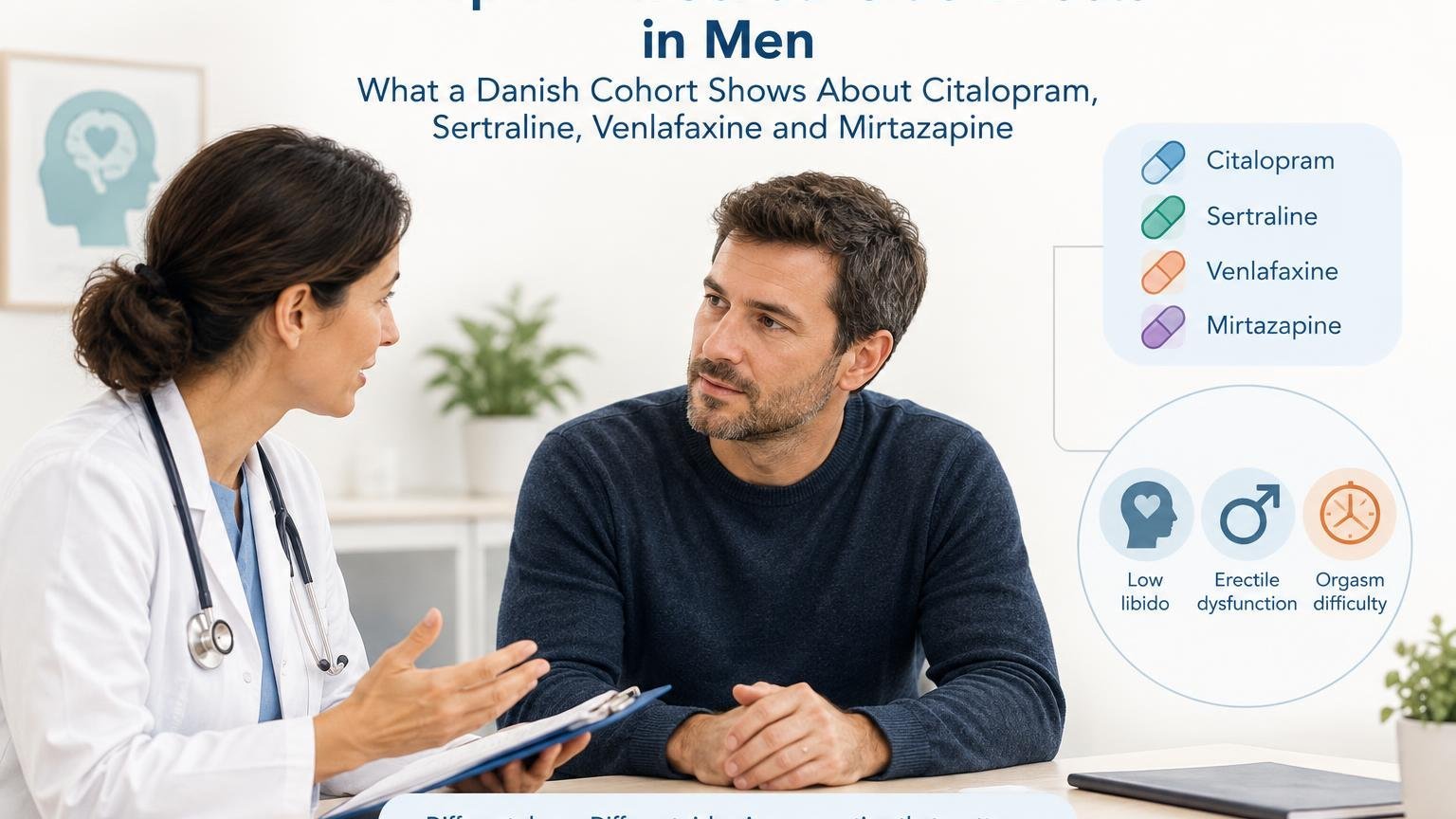


Category: Health Academy
Core Research Direction: Comparative risk of healthcare-recorded sexual dysfunction in adult men after starting citalopram, sertraline, venlafaxine, or mirtazapine, and what this means practically for discussing antidepressant-related sexual side effects with a clinician.
Search Intent: Among common antidepressants, how does the risk of developing recorded sexual dysfunction in men differ between citalopram, sertraline, venlafaxine and mirtazapine, and what are the limits of that evidence?
Platform: SANYUN Science Center
Evidence reviewed through: 2026-11-24
Executive Summary
A 2026 observational study published in Drug Safety used Danish national health registers to compare healthcare-recorded sexual dysfunction in adult men who began citalopram, sertraline, venlafaxine or mirtazapine. The new-user, active-comparator cohort included treatment episodes initiated between 2001 and 2015. The registers contributed a large volume of episodes, but the unit is the treatment episode rather than a unique person, because multiple cohort entries per person were allowed.[1]
Across the primary analysis, which applied one-year follow-up with washout periods, incidence rates of recorded sexual dysfunction ranged from 18.80 to 28.5 per 1000 person-years. Relative to citalopram, venlafaxine was associated with the highest hazard ratio (1.27; 95% CI 1.02–1.46). Sertraline showed no statistically significant difference (HR 0.99; 95% CI 0.90–1.09). Mirtazapine showed modest evidence of lower risk than citalopram (HR 0.87; 95% CI 0.81–0.93). These are observational associations, not proof that one drug causes more sexual dysfunction than another, and the authors conclude that clinicians should discuss sexual side effects when several options exist.
Why the Comparison Matters
Sexual side effects of serotonergic antidepressants are well documented, but direct observational comparisons between individual drugs have been sparse. That gap leaves both patients and prescribers relying heavily on labels, small studies or clinical impression when weighing one antidepressant against another. A large register comparison can sharpen the conversation by showing whether recorded rates differ across drugs in routine care. The study's objective was specifically to compare the risk of healthcare-recorded sexual dysfunction after initiation of the four named drugs.
For men, the practical question is often not whether antidepressants can affect sex but whether the choice of drug meaningfully changes the chance of problems. Sexual function has several separable components, and the distinction between them matters when describing a concern to a clinician. Educational material on antidepressants and erections separates low libido (reduced interest in intimacy), erectile dysfunction (difficulty getting or maintaining an erection) and orgasm difficulty (orgasm takes much longer than usual or does not happen); these can occur alone or together. A man may retain desire while erections become less reliable, or notice orgasm difficulty with little change in erection quality.[2]
How the Study Was Designed
The cohort was a new-user, active-comparator design among adult males in Denmark who started treatment with any of the study drugs between 2001 and 2015, with multiple cohort entries per person allowed. The treatment-episode counts were 170,580 new citalopram episodes, 67,721 mirtazapine episodes, 51,984 sertraline episodes and 19,820 venlafaxine episodes. Results were reported as incidence rates and as unmatched and propensity score-matched hazard ratios. A separate analysis examined the subgroup of patients with prior depression-related hospital visits. Propensity matching can adjust for measured differences between groups, but it cannot adjust for factors that were never measured or recorded.
What the Comparative Results Show
| Antidepressant | Hazard ratio versus citalopram (95% CI) | Reported interpretation | Main caveat |
|---|---|---|---|
| Venlafaxine | 1.27 (1.02–1.46) | Highest recorded risk relative to citalopram; confidence interval excludes 1.00 | Observational association; the subgroup estimate is reported with an interval that should be handled cautiously |
| Sertraline | 0.99 (0.90–1.09) | No statistically significant difference from citalopram | A null result is not proof of equivalence; the interval includes modest increases and decreases |
| Mirtazapine | 0.87 (0.81–0.93) | Modest evidence of lower recorded risk than citalopram | The authors describe the evidence as modest; absolute differences are small |
| Citalopram | Reference (1.00) | Comparator for all hazard ratios | The choice of reference drug does not imply citalopram is risk-free |
The recorded incidence range across the compared drugs was 18.80 to 28.5 per 1000 person-years. The hazard ratios compare rates of that order rather than describing a dramatic clinical separation, and they do not mean that every man on venlafaxine will develop sexual dysfunction or that citalopram is free of it. Statistical significance and clinical importance are not the same thing; a hazard ratio of 1.27 is useful for counseling, but a man's own experience and priorities still shape the decision. The authors state that findings remained consistent across all analyses, although the excerpt available here does not enumerate every sensitivity analysis.
The venlafaxine subgroup analysis deserves careful reading. Among patients with previous hospital contact for depression, the hazard ratio versus citalopram was reported as 1.93 (95% CI 1.14–1.27). A point estimate of 1.93 should sit within its own confidence interval, and the interval as quoted does not bracket that value cleanly. Readers should treat the exact subgroup interval with caution and rely on the main estimate when describing the overall pattern. The larger subgroup association may reflect more severe depression, more prior treatment exposure or greater symptom reporting in that population, but the study as excerpted does not settle those explanations.
What the Evidence Cannot Tell You
The outcome is healthcare-recorded sexual dysfunction, not a standardized symptom questionnaire. That definition likely undercounts low desire, subtle erectile changes and orgasm delay that never reach a clinical encounter. It also depends on whether patients felt comfortable raising sexual concerns and whether clinicians documented them, both of which can vary by setting, age and culture. The result is a signal about relative rates of clinically visible dysfunction, not a complete picture of how these drugs affect sexual function. Mild or transient changes, or changes a man finds difficult to mention, are likely underrepresented.
The design also cannot answer several questions men commonly ask. It does not explain mechanism, cannot fully separate drug effects from depression severity, and cannot describe how symptoms evolve after a dose increase or after stopping treatment. Depression and anxiety can affect sexual function, and physical health conditions and other medicines can contribute too, which complicates attributing a symptom to the antidepressant. Symptoms that begin after treatment starts may be related, but timing alone cannot establish causation; other factors can produce the same change.
Some sexual side effects may improve during continued treatment while others continue, and there is no reliable universal timetable. Regulators have acknowledged reports of sexual dysfunction that may continue after antidepressants are stopped, and European product information for SSRIs and SNRIs notes reports of long-lasting sexual dysfunction after discontinuation. These reports do not establish how often this occurs, why it happens or an individual prognosis. They are a reason to discuss persistent symptoms with a prescriber, not a reason to stop treatment without guidance.
Practical Implications for Clinical Conversations
The authors' conclusion is a communication recommendation rather than a prescribing algorithm: risk varies across antidepressants, and providers should discuss sexual side effects especially when multiple options exist. If a sexual change appears after starting or changing a dose, a clinician will compare the timing with treatment changes, review other medicines and health conditions, and consider whether depression or anxiety itself is contributing. A clear, specific description of what changed gives the prescriber a useful starting point, even though timing alone cannot confirm causation.
It helps to separate the symptom into its parts. Reduced interest in intimacy, difficulty getting or maintaining an erection, and delayed or absent orgasm may occur alone or together, and noting which aspect changed and when it began is more informative than a general statement that something feels different. Mentioning how the change affects daily life, any other medicines and any health changes also helps. Men should not stop or reduce an antidepressant on their own, because abrupt discontinuation can cause withdrawal symptoms and may allow the original mental health symptoms to return; prescribers typically reduce the dose in stages. Any treatment change should be planned with the prescriber.
Useful questions for a review include whether the antidepressant may be contributing or whether another cause should be checked, what wider health checks would be appropriate, what to monitor before the next review, and when to seek advice sooner. These keep the appointment focused on practical next steps without requiring the patient to diagnose the cause. The broader evidence on erectile dysfunction evaluation and treatment options can help men understand what a clinician may consider once the medication review has clarified which symptom remains.
Research Outlook
This cohort adds a comparatively large, real-world comparison where direct observational evidence had been sparse. Natural next steps would involve prospective collection of patient-reported sexual outcomes rather than register-coded diagnoses, longer follow-up to characterize persistence, and clearer reporting of subgroup estimates. Until such data exist, the current evidence supports a practical stance: treat the choice among antidepressants as a decision to discuss openly rather than as a search for a single best drug. The comparative hazard ratios inform that conversation, but they do not replace it.
Key Takeaways
- A Danish new-user cohort compared healthcare-recorded sexual dysfunction in adult men starting citalopram, sertraline, venlafaxine or mirtazapine, using 170,580 citalopram, 67,721 mirtazapine, 51,984 sertraline and 19,820 venlafaxine treatment episodes from 2001–2015.
- Relative to citalopram, venlafaxine had the highest hazard ratio (1.27; 95% CI 1.02–1.46), sertraline showed no significant difference (0.99; 0.90–1.09), and mirtazapine showed modest lower risk (0.87; 0.81–0.93).
- Recorded incidence ranged from 18.80 to 28.5 per 1000 person-years, so absolute differences between drugs are modest even where hazard ratios are statistically significant.
- Healthcare-recorded outcomes undercount milder or unreported symptoms, and observational hazard ratios reflect association, not proven causation.
- Do not stop an antidepressant abruptly; discuss timing, the type of symptom and next steps with the prescriber so any change is planned safely.
Questions and Answers
How common was healthcare-recorded sexual dysfunction in men taking citalopram, sertraline, venlafaxine or mirtazapine, and how did the drugs compare?
In the primary analysis with one-year follow-up and washout periods, recorded incidence ranged from 18.80 to 28.5 per 1000 person-years across the four drugs. Relative to citalopram, venlafaxine had the highest hazard ratio (1.27; 95% CI 1.02–1.46), sertraline showed no significant difference (0.99; 0.90–1.09), and mirtazapine showed modest lower risk (0.87; 0.81–0.93). These are observational associations, not proof of causation.
What kind of study produced the 2026 comparison of antidepressant sexual dysfunction in men?
It was a new-user, active-comparator cohort study of adult males in Denmark who started citalopram, sertraline, venlafaxine or mirtazapine between 2001 and 2015, allowing multiple cohort entries per person. Danish national healthcare registers supplied the treatment-episode counts and recorded outcomes. Results were reported as incidence rates and unmatched and propensity score-matched hazard ratios, with a separate analysis of patients who had prior depression-related hospital visits.
How strong is the evidence that venlafaxine causes more sexual dysfunction than citalopram?
The evidence is an observational association, not proof of causation. Venlafaxine had the highest hazard ratio versus citalopram (1.27; 95% CI 1.02–1.46), and the authors reported consistent findings across analyses. However, the outcome is healthcare-recorded dysfunction, which depends on reporting and documentation, and residual confounding by depression severity or other factors cannot be excluded. The larger subgroup estimate also came with an interval that should be treated cautiously.
Do these antidepressant sexual dysfunction findings apply to men outside Denmark?
The cohort studied adult males in Denmark using national registers, so the direction of the comparison may be informative elsewhere, but absolute rates depend on local prescribing, documentation and healthcare access. Men with different health profiles, other medicines or different depression severity may not match the register population. The study allowed repeat treatment episodes per person, so counts reflect episodes rather than unique individuals, which further limits direct translation to an individual man's risk.
What are the main limitations of the Danish cohort on antidepressants and sexual dysfunction?
The study used healthcare-recorded sexual dysfunction, which likely undercounts low desire, subtle erectile changes and orgasm delay that never reach a clinician. It relied on register data that may miss unmeasured confounders, reported associations rather than causation, and allowed multiple cohort entries per person. The quoted venlafaxine subgroup confidence interval (1.14–1.27) does not cleanly bracket the point estimate of 1.93, so that specific estimate warrants caution.
What should a man tell his doctor about sexual side effects after starting an antidepressant?
Describe which aspect changed, such as reduced interest, less reliable erections or delayed orgasm, and when it began relative to starting or changing the dose. Mention how it affects daily life and any other medicines or health changes. Ask whether the antidepressant may be contributing, whether other causes need checking, and how any change would be reviewed safely. Do not stop the antidepressant abruptly, because withdrawal symptoms and return of the original symptoms can follow.
Sources and References
- Westphal, L.; Gräf, D. D.; Le, H.; Hallgreen, C. E.; Andersen, M.. Sexual Dysfunction in Male Patients After Initiating Treatment with Antidepressants. Drug Safety. 2026 49(4):493-503 DOI: 10.1007/s40264-025-01631-9.
- Antidepressants and Erectile Dysfunction | Blog | VaxAid.
SANYUN Science Center explains published research on men's reproductive and sexual health, connecting scientific evidence with everyday questions while making sources and limitations clear.
Disclaimer: This article is for scientific education and research communication only. It does not provide medical advice, diagnosis, or individualized treatment recommendations, and does not endorse any medication, supplement, device, penile enlargement procedure, or other intervention. Decisions about sexual and reproductive health should be made in consultation with a qualified healthcare professional. Do not delay seeking professional care because of information in this article.
Original Content & Copyright Notice
- This article is prepared for SANYUN Science Center, drawing on published research and publicly available academic literature on men’s sexual and reproductive health. Its editorial explanations and presentation are developed for this platform.
- Copyright in the original editorial content, selection, and arrangement is reserved by SANYUN Science Center to the extent protected by applicable law. Referenced research, quotations, and third-party materials remain subject to the rights of their respective owners. This notice does not claim ownership of scientific facts or third-party research.
- Except where permitted by applicable law or an applicable license, prior written permission is required to reproduce, republish, translate, adapt, redistribute, or commercially reuse protected content. Attribution alone does not grant permission for such reuse.
- For permitted quotation or authorized reuse, clearly identify the source and retain a link to the original article.
- Source: SANYUN Science Center
- Original URL: Retain the original article URL on science.san-yun.com.
- Copyright Holder: SANYUN Science Center, for its own protected editorial content.
- Quotation, excerpts, or authorized reuse must not distort the scientific meaning, omit material limitations or disclaimers, or imply unverified medical claims, product efficacy, or endorsement by SANYUN Science Center.



