




Category: Erectile Dysfunction
Core Research Direction: Antihypertensive drug–associated erectile dysfunction risk signals and the overall quality/strength of evidence for current ED treatments
Search Intent: Which antihypertensive drugs show erectile dysfunction risk signals in real-world pharmacovigilance data, and how reliable is the broader evidence base for erectile dysfunction treatments?
Platform: SANYUN Science Center
Evidence reviewed through: 2026-11-26
Executive Summary
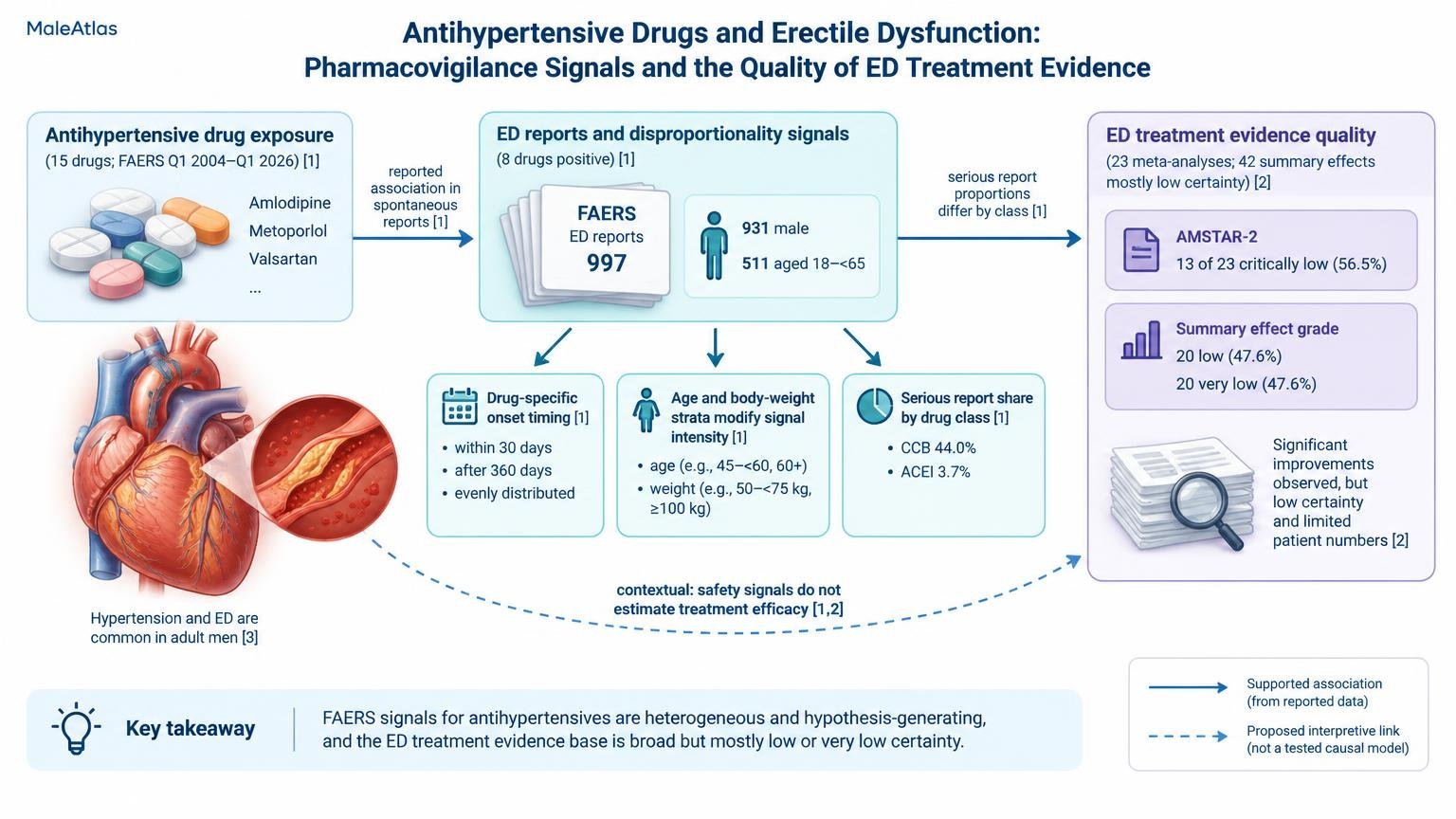
Two 2026 evidence syntheses speak to different halves of the same clinical conversation. The first is a pharmacovigilance disproportionality analysis that mined the US FDA Adverse Event Reporting System (FAERS) for erectile dysfunction (ED) reports linked to 15 antihypertensive drugs, covering the first quarter of 2004 through the first quarter of 2026. It included 997 ED reports, of which 931 involved male patients and 511 were in the 18 to under-65 age group. Amlodipine (413 reports), metoprolol (133) and valsartan (82) generated the most reports, and positive disproportionality signals were detected for 8 drugs, including amlodipine and metoprolol.[1]
The second is an umbrella review of 23 published meta-analyses covering 36 ED interventions and 42 summary effects. Its central finding is not that treatments fail but that the supporting evidence is thin: 13 of 23 meta-analyses (56.5%) were rated critically low on AMSTAR-2, and 20 of 42 summary effects (47.6%) were graded low and another 20 (47.6%) very low. Read together, the two papers describe a field where real-world safety signals are heterogeneous and hypothesis-generating, while the interventional evidence base is broad in scope but limited in certainty.[2]
Why This Matters
Hypertension and ED are common companions in adult men, and the question of whether the tablets are to blame is one of the most frequent practical concerns in the consultation room. That matters because the wrong answer can go two ways: attributing a vascular or metabolic problem to a drug and stopping effective blood-pressure treatment, or dismissing a genuine adverse effect and leaving a man with both uncontrolled pressure and untreated sexual dysfunction.[3]
The stakes extend beyond sexual function. ED is increasingly framed as a marker of systemic vascular risk, which means the conversation about antihypertensives and erectile function is also a conversation about cardiovascular prevention. A careful reading of both new papers helps separate what disproportionality signals can and cannot tell us from what the interventional literature has and has not established.[4]
What the Pharmacovigilance Analysis Actually Measured
The antihypertensive paper is a disproportionality study, not a cohort or trial. Reports of ED associated with 15 target antihypertensive drugs were extracted from FAERS for the period from the first quarter of 2004 to the first quarter of 2026. Three complementary measures were applied — the reporting odds ratio, the proportional reporting ratio and the empirical Bayesian geometric mean — and stratified analyses were run by patient age and body weight.[5]
A positive disproportionality signal means a drug appears more often than expected in ED reports relative to other drugs and events in the same database. It does not mean the drug caused the event, and it does not estimate how many users will develop ED. Reporting is voluntary, incomplete and shaped by media attention, drug popularity, patient awareness and the willingness of a clinician to file a form. These design features frame everything that follows.
The included reports were overwhelmingly male (931 of 997), concentrated in the 18 to under-65 age band (511 reports), and most often submitted by consumers or patients rather than health professionals. Amlodipine accounted for 413 reports, metoprolol 133 and valsartan 82, and the demographic distribution of reports was broadly similar across drugs.
Which Drugs Showed Signals, and How Timing Differed
Positive signals were detected for 8 of the 15 drugs, a group that included amlodipine and metoprolol. Report counts alone should not be read as a ranking: amlodipine is one of the most widely prescribed antihypertensives worldwide, so a higher raw count is expected on volume grounds alone. The disproportionality statistics are designed to partly account for this, but they cannot fully correct for differential prescribing, indication mix or publicity.
Onset timing showed striking heterogeneity. For atenolol, candesartan, metoprolol, hydrochlorothiazide and losartan, ED reports mostly occurred within 30 days of starting medication. For valsartan and perindopril, most reports described onset beyond 360 days. For amlodipine, onset was evenly distributed across all time periods — a pattern that is difficult to reconcile with a single simple pharmacological mechanism and may reflect the competing influences of drug effect, cumulative vascular disease and reporting behavior.
Of 835 serious reports, calcium channel blockers made up the highest proportion at 44.0% and angiotensin-converting enzyme inhibitors the lowest at 3.7%. This is a share of serious reports, not a rate per user, and class differences in prescribing volume and in what gets reported as serious could both contribute.
Age and Body Weight: Heterogeneous Stratified Signals
The stratified analyses produced drug-specific patterns rather than a single rule. Amlodipine-associated signal intensity increased with advancing age and higher body weight. Metoprolol signals were most pronounced in men aged 45 to under 60 years and weighing 100 kg or more. Positive valsartan signals appeared only in people aged 60 or older and in the 50 to under-75 kg or 100 kg and above weight bands.
These strata deserve caution. Weight fields are frequently missing or inconsistently entered in spontaneous reports, and small subgroups can generate unstable disproportionality estimates. The heterogeneity is best read as a prompt for better-designed studies of whether age and body size modify any drug–ED relationship, not as a clinical rule for predicting who will be affected.
Why the Class-Level Story Is Contested
Much conventional teaching separates antihypertensives into an older, less favorable group — high-dose thiazide diuretics such as hydrochlorothiazide and non-selective beta-blockers such as propranolol — and newer agents with less impact, including metoprolol, calcium channel blockers and ACE inhibitors or ARBs. A widely read educational pharmacy article states that calcium channel blockers such as nifedipine and ACEI/ARB drugs such as enalapril and valsartan have relatively minor sexual-function effects, and that some patients even improve once blood pressure is controlled.
The FAERS analysis points in a less tidy direction. Metoprolol, usually described as comparatively benign, showed a positive signal with a distinct age and weight pattern. Amlodipine generated the largest report volume and the largest share of serious reports among drug classes. Valsartan showed a positive signal only in specific strata. The discrepancy does not mean the older teaching is wrong, but it does mean class-level reassurance is too coarse; individual drugs within a class may differ, and reporting patterns may reflect local prescribing more than pharmacology.
The educational source also makes a point that survives the disagreement intact: sexual function is influenced by age, blood glucose and lipids, psychological stress, lifestyle and the long-term vascular damage of hypertension itself, so difficulty cannot be attributed simply to one drug. That multifactorial framing is essential when interpreting any single-drug signal.
The Other Half: How Strong Is ED Treatment Evidence?
The umbrella review asked a different question: how reliable is the evidence behind current ED treatments overall? Its authors screened 1191 studies and extracted 23 published meta-analyses, yielding 42 summary effects on the International Index of Erectile Function (IIEF) and its short forms, plus the erectile hardness score (EHS), across 36 interventions.
Methodological quality was assessed with AMSTAR-2. Thirteen meta-analyses (56.5%) were rated critically low, 7 (30.5%) low, 2 (8.7%) moderate and 1 (4.3%) high. When the 42 summary effects themselves were graded, only two reached high or moderate quality; 20 (47.6%) were low and 20 (47.6%) very low.
The authors' conclusion is pointed. Statistically significant improvements in ED were observed with both pharmacological and non-pharmacological interventions, but the evidence base is predominantly low or very low quality, and findings should be interpreted cautiously because of limited patient numbers and the subjective nature of outcome indicators. They call for well-designed single-treatment studies and high-quality meta-analyses comparing treatments against each other.
Statistical Significance Versus Clinical Meaning
The gap between a statistically significant IIEF improvement and a meaningful change in a man's sexual life is the central interpretive problem in this literature. Patient-reported erectile function scores are subjective, susceptible to placebo response and often measured over short durations; pooling many small trials can produce a precise-looking summary estimate from imprecise inputs. A low or very low GRADE rating is a formal acknowledgement of that fragility, not a claim that treatments are ineffective.
| Variable or Measure | Definition | Interpretation |
|---|---|---|
| ED reports in FAERS analysis | Reports linked to 15 antihypertensive drugs, Q1 2004 to Q1 2026 | Counts reflect reporting behavior and prescribing volume, not incidence |
| Positive disproportionality signal | Reporting odds ratio, proportional reporting ratio or empirical Bayesian geometric mean above threshold | Hypothesis-generating; does not prove the drug caused ED |
| Serious report share by class | Proportion of 835 serious ED reports attributed to each drug class | Share of serious reports, not risk per user; reporting bias possible |
| AMSTAR-2 rating | Tool scoring methodological quality of included systematic reviews | 56.5% of 23 meta-analyses rated critically low |
| Summary effect grade | Certainty rating applied to each pooled treatment estimate | 47.6% low and 47.6% very low across 42 effects |
Interpretation and Limitations
Neither paper is a trial. The antihypertensive analysis is a spontaneous-reporting database study, subject to under-reporting, duplicate reports, confounding by indication and channelling bias, and it cannot establish causality or estimate absolute risk. The umbrella review is a review of reviews, so its conclusions are bounded by the quality of the meta-analyses it summarized — and it found most of them seriously wanting. A shared conclusion is the need for better primary studies, not more confident pronouncements.
Clinical relevance should be handled with restraint. For the clinician, a new ED report in a man starting or changing antihypertensive therapy is a reasonable trigger to review the medication list, check blood pressure control, screen for metabolic and vascular risk factors, and discuss alternatives — but not to abandon treatment unilaterally. Blood-pressure control protects the heart, brain and kidneys, and the vascular consequences of uncontrolled hypertension outweigh the reversible impact on sexual function in most cases.
Research Outlook
The umbrella review authors' call is the clearest research agenda here: well-designed studies of individual treatments, and high-quality head-to-head syntheses rather than more small placebo-controlled trials. On the pharmacovigilance side, the next step is to test FAERS-derived hypotheses in cohorts where exposure and outcome are measured prospectively, with age and body weight examined as potential modifiers rather than descriptive strata.
For now, the practical message is one of calibration. The signals are real as signals, the treatment benefits are real as statistical effects, and the certainty around both is lower than patients and clinicians would like. That is a case for careful, individualized conversations — not for simplistic lists of which drugs are good or bad for sexual function.
Key Takeaways
- A FAERS disproportionality analysis covering Q1 2004 to Q1 2026 examined 997 ED reports for 15 antihypertensive drugs; 931 were male and 511 were aged 18 to under 65.
- Amlodipine (413 reports), metoprolol (133) and valsartan (82) had the most reports, and positive signals were detected for 8 drugs including amlodipine and metoprolol.
- ED onset was mostly within 30 days for atenolol, candesartan, metoprolol, hydrochlorothiazide and losartan, mostly after 360 days for valsartan and perindopril, and evenly distributed over time for amlodipine.
- Of 835 serious reports, calcium channel blockers accounted for 44.0% and ACE inhibitors for 3.7%; signal intensity varied by age and body weight in a drug-specific way.
- An umbrella review of 23 meta-analyses and 42 summary effects across 36 ED interventions found 56.5% of meta-analyses critically low quality and 95.2% of summary effects low or very low.
Questions and Answers
How were antihypertensive drugs linked to erectile dysfunction in the 2026 FAERS analysis?
Reports of ED for 15 antihypertensive drugs were extracted from the US FDA Adverse Event Reporting System covering Q1 2004 to Q1 2026. Three disproportionality measures — reporting odds ratio, proportional reporting ratio and empirical Bayesian geometric mean — were used to detect signals, with stratified analyses by age and body weight. This approach generates hypotheses about disproportionate reporting but cannot prove causation or estimate incidence.
Which antihypertensive drugs showed the most erectile dysfunction reports?
Amlodipine had 413 reports, metoprolol 133 and valsartan 82. Positive signals were detected for 8 of the 15 drugs, including amlodipine and metoprolol. However, raw report counts are heavily influenced by how widely a drug is prescribed and by reporting behavior, so these rankings should not be read as comparative incidence or as proof that one drug is more harmful than another.
How reliable is the evidence that current erectile dysfunction treatments work?
An umbrella review of 23 meta-analyses covering 36 interventions found statistically significant improvements in erectile function with both pharmacological and non-pharmacological treatments, but the evidence base is predominantly low or very low quality. On AMSTAR-2, 13 of 23 meta-analyses (56.5%) were critically low quality, and of 42 summary effects only two were graded high or moderate. Benefits are real as statistical findings, but certainty is limited.
Does finding a reporting signal in FAERS mean an antihypertensive drug caused erectile dysfunction?
No. Proportionality signals mean a drug appears more often than expected in ED reports relative to other drugs and events in the database. Reporting is voluntary and incomplete, and counts are shaped by prescribing volume, patient awareness and publicity. Signals are hypothesis-generating: they cannot establish causality, estimate absolute risk, or account fully for confounding by indication and comorbidities such as diabetes or vascular disease.
Why did metoprolol and amlodipine show erectile dysfunction signals when they are often considered low-risk?
Conventional teaching describes newer beta-blockers like metoprolol and calcium channel blockers as having relatively minor sexual side effects. The FAERS analysis complicates that at class level: metoprolol showed a positive signal most pronounced at age 45 to under 60 years and weight 100 kg or above, amlodipine had the largest report volume, and valsartan signals appeared only in specific age and weight strata. Differences may reflect prescribing patterns, reporting behavior or true drug-specific effects rather than a simple class rule.
What should a man on blood pressure medication do if he notices erectile problems?
He should raise it with his prescriber rather than stopping or adjusting medication himself. Sexual function is influenced by age, blood glucose and lipids, stress, lifestyle and hypertension-related vascular damage, so a single drug may not be responsible. A clinician can review blood pressure control, screen cardiovascular and metabolic risk, and consider whether an alternative agent or combination is appropriate while keeping blood pressure protected.
Conceptual framework: Conceptual framework. Context: a 2026 FAERS disproportionality analysis of 997 ED reports for 15 antihypertensives, set alongside an umbrella review of 23 meta-analyses. Solid edges denote supported reported associations within spontaneous-reporting data; the dashed conceptual link to treatment-evidence quality is proposed interpretive context, not a tested causal model. A key limitation is that disproportionality signals are hypothesis-generating and cannot establish incidence or causation.
Academic References & Evidence
- Peng Yue GAO. Search Results. China Pharmacy. 2026 37(18):2389-2394
- Current treatment for erectile dysfunction: an umbrella review of systematic reviews and meta-analyses. Figshare. 2026 DOI: 10.6084/m9.figshare.31562993.v1.
- 不同降压药对性功能的影响.
- Erectile Dysfunction. 2026
- 降压药物相关勃起功能障碍风险信号挖掘. 中国药房. 2026 (18):2389-2394
SANYUN Science Center explains published research on men's reproductive and sexual health, connecting scientific evidence with everyday questions while making sources and limitations clear.
Disclaimer: This article is for scientific education and research communication only. It does not provide medical advice, diagnosis, or individualized treatment recommendations, and does not endorse any medication, supplement, device, penile enlargement procedure, or other intervention. Decisions about sexual and reproductive health should be made in consultation with a qualified healthcare professional. Do not delay seeking professional care because of information in this article.
Original Content & Copyright Notice
- This article is prepared for SANYUN Science Center, drawing on published research and publicly available academic literature on men’s sexual and reproductive health. Its editorial explanations and presentation are developed for this platform.
- Copyright in the original editorial content, selection, and arrangement is reserved by SANYUN Science Center to the extent protected by applicable law. Referenced research, quotations, and third-party materials remain subject to the rights of their respective owners. This notice does not claim ownership of scientific facts or third-party research.
- Except where permitted by applicable law or an applicable license, prior written permission is required to reproduce, republish, translate, adapt, redistribute, or commercially reuse protected content. Attribution alone does not grant permission for such reuse.
- For permitted quotation or authorized reuse, clearly identify the source and retain a link to the original article.
- Source: SANYUN Science Center
- Original URL: Retain the original article URL on science.san-yun.com.
- Copyright Holder: SANYUN Science Center, for its own protected editorial content.
- Quotation, excerpts, or authorized reuse must not distort the scientific meaning, omit material limitations or disclaimers, or imply unverified medical claims, product efficacy, or endorsement by SANYUN Science Center.



