




Category: Erectile Dysfunction
Core Research Direction: Antihypertensive drug exposure and erectile dysfunction: real-world pharmacovigilance signal heterogeneity (drug class, onset timing, age/weight strata) and how it fits into the broader vascular-CV risk framing of ED and its treatment evidence base
Search Intent: Which blood-pressure medications carry documented erectile-dysfunction risk signals, of what quality is the evidence, and how should men and clinicians weigh this against the cardiovascular stakes of having ED?
Platform: SANYUN Science Center
Evidence reviewed through: 2026-11-26
Executive Summary
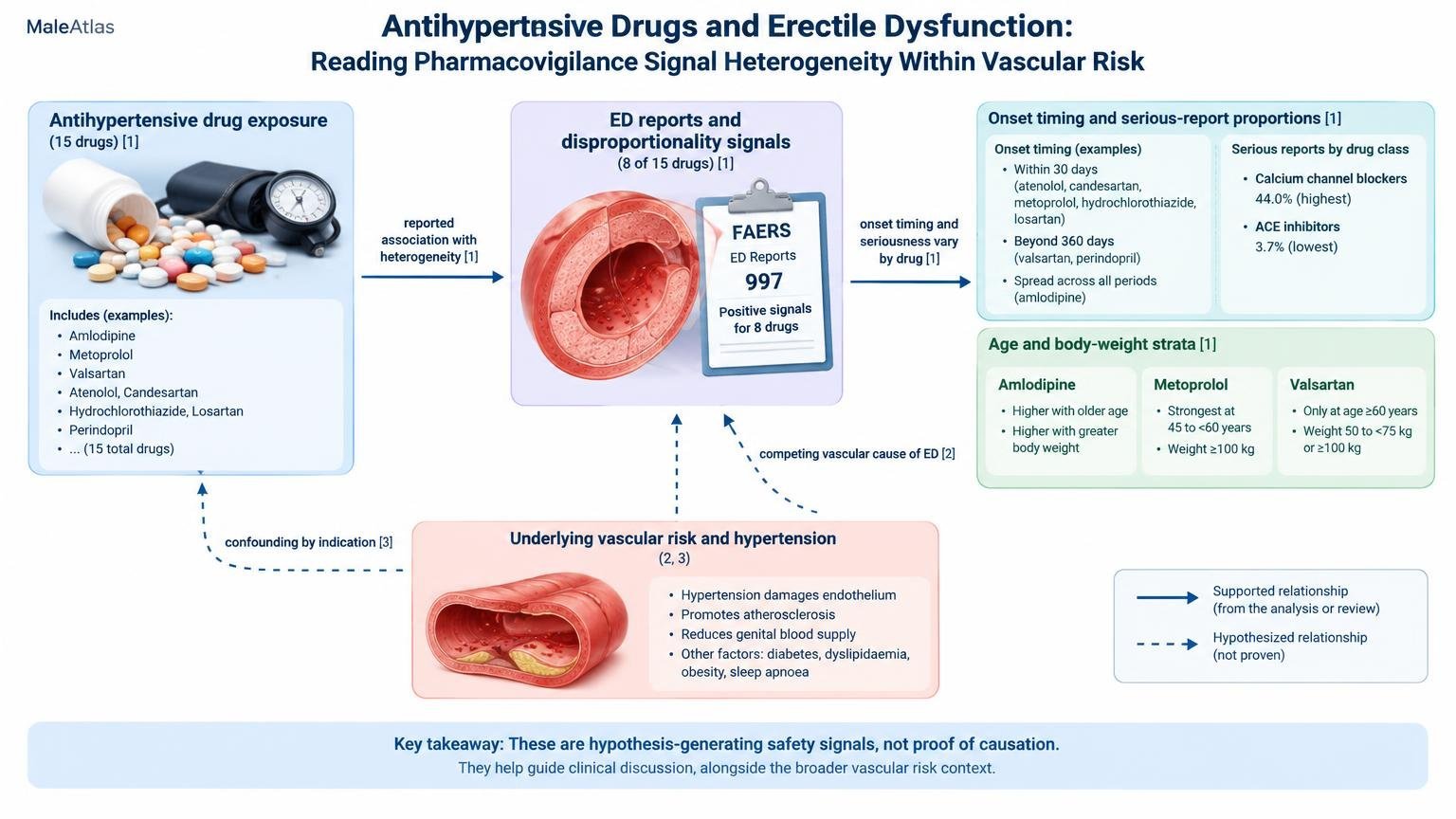
A 2026 pharmacovigilance analysis mined the US FDA Adverse Event Reporting System for erectile-dysfunction reports linked to 15 antihypertensive drugs from the first quarter of 2004 to the first quarter of 2026. Of 997 included reports linked to these 15 drugs, 931 involved male patients, 511 were in the 18 to <65 years age group, and 497 were submitted predominantly by consumers or patients. The authors detected positive disproportionality signals for 8 of the 15 drugs, including amlodipine and metoprolol.[1]
The most striking feature is heterogeneity. Amlodipine (413 reports), metoprolol (133) and valsartan (82) had the most reports. Reported onset clustered within 30 days for atenolol, candesartan, metoprolol, hydrochlorothiazide and losartan, beyond 360 days for valsartan and perindopril, and was spread across all periods for amlodipine. Among 835 serious reports, calcium channel blockers made up the highest proportion (44.0%) and ACE inhibitors the lowest (3.7%). Signal intensity varied by age and body weight: amlodipine signals rose with older age and higher weight, metoprolol signals were strongest at ages 45 to <60 years and weight ≥100 kg, and valsartan signals appeared only at age ≥60 years and in selected weight bands.
These are hypothesis-generating safety signals from spontaneous reports, not incidence rates or proof that any drug caused ED. They matter because they refine where clinicians might look when a man reports sexual change after starting blood-pressure treatment, and because they sit inside a larger body of evidence that ED itself is a cardiovascular warning sign. A 2021 umbrella review summarized in a physician-written guide reported higher cardiovascular risk in men with ED, including cardiovascular disease (RR 1.45, 95% CI 1.36 to 1.54), coronary heart disease (RR 1.50) and stroke (RR 1.36). The 2024 Princeton IV Consensus advises treating men with ED as at cardiac risk unless proven otherwise. The practical conclusion is not to stop antihypertensives, but to review the whole vascular picture.[2]
Why This Matters
Erectile dysfunction is common, distressing and often silent in clinic. It is also a vascular event. The penile arteries are described as 1 to 2 mm in diameter, compared with 3 to 4 mm for coronary arteries, so the same atherosclerotic process may produce symptoms in the penis before the heart. That artery-size hypothesis is a proposed explanation rather than a directly tested causal pathway, but it fits the observational epidemiology: men with ED carry higher relative risks of cardiovascular disease, coronary heart disease, myocardial infarction and stroke. The 2024 Princeton IV Consensus explicitly tells clinicians to treat men with ED as at risk for cardiac events until proven otherwise.
Against that background, antihypertensive drugs occupy an awkward position. Hypertension itself damages vascular endothelium and promotes atherosclerosis, reducing genital blood supply, while long-term anxiety, stress and sleep disturbance can lower libido. So the same condition that raises ED risk is also being treated. When a man notices erectile difficulty after starting or changing a blood-pressure drug, the honest clinical question is not simply whether the drug is guilty, but how much of the problem is the hypertension and its vascular consequences, how much is the medication, and how much is contextual. The FAERS analysis cannot answer that question for an individual, but its signal heterogeneity gives the conversation structure.[3]
Biological and Clinical Mechanism
An erection depends on nitric oxide signalling, cyclic GMP-mediated smooth-muscle relaxation and adequate arterial inflow. Anything that reduces endothelial function, impairs perfusion or disrupts autonomic and hormonal regulation can interfere. The consumer medication article notes that some traditional antihypertensives, such as non-selective beta-blockers like propranolol and some diuretics like hydrochlorothiazide, may cause erectile difficulty, ejaculatory problems or reduced libido in some patients, through effects on sympathetic activity, reduced perfusion or electrolyte disturbance. It also notes that calcium channel blockers such as nifedipine and amlodipine, ACE inhibitors such as enalapril and perindopril, and angiotensin receptor blockers such as losartan and valsartan have less data on sexual effects, with some studies suggesting neutral or even favourable endothelial effects. The physician-written guide similarly lists beta-blockers, especially older agents such as atenolol, and thiazide diuretics as well-established contributors, while describing ACE inhibitors and ARBs as generally better tolerated.
That mechanistic framing is plausible but not a clean map of the FAERS output. The FAERS analysis detected positive signals for amlodipine and metoprolol, and the highest proportion of serious reports came from calcium channel blockers, not beta-blockers. That apparent tension is informative. Spontaneous reporting reflects who takes which drug, how long they take it, how often they report, and what else is happening in their vasculature. A drug class labelled 'better tolerated' in narrative reviews can still generate disproportionality signals, especially for a widely prescribed agent. Mechanism explains why a signal is biologically plausible; it does not establish that the drug caused the report.
What the Evidence Shows
The FAERS analysis is a disproportionality study. It extracted reports of ED associated with 15 target antihypertensive drugs from 2004 Q1 to 2026 Q1 and applied three proportional measures: reporting odds ratio, proportional reporting ratio and empirical Bayesian geometric mean. A positive signal means the drug–event combination was reported more often than expected relative to other drugs and events in the database. It does not mean the drug causes ED at a known rate. Of 997 ED reports, 931 were male, 511 were aged 18 to <65 years, 366 were in the 50 to <100 kg weight group, and 497 were filed predominantly by consumers or patients. The top three drugs by report count were amlodipine (413), metoprolol (133) and valsartan (82). Positive signals were detected for 8 drugs, including amlodipine and metoprolol.
| Drug or group | Reported ED reports | Signal or timing pattern | Stratified observation |
|---|---|---|---|
| Amlodipine | 413 | Positive signal; onset spread evenly across all time periods | Signal intensity increased with advancing age and higher body weight |
| Metoprolol | 133 | Positive signal; onset mostly within 30 days after medication | Signal most pronounced at ages 45 to <60 years and weight ≥100 kg |
| Valsartan | 82 | Signal positive only in selected strata; onset mostly beyond 360 days | Signals observed at age ≥60 years and weight 50 to <75 kg or ≥100 kg |
| Atenolol, candesartan, hydrochlorothiazide, losartan | Reported onset mostly within 30 days after medication | ||
| Perindopril | Reported onset mostly beyond 360 days after medication | ||
| Calcium channel blockers overall | Highest proportion of serious reports (44.0%) | ||
| ACE inhibitors overall | Lowest proportion of serious reports (3.7%) |
The report counts should not be read as a league table. Amlodipine is widely prescribed, so more exposed patients mean more reports even if its per-user risk is modest. Metoprolol and valsartan are also common. The analysis does not supply denominators, so raw counts cannot rank drugs by incidence. The onset patterns are more interesting because they suggest different clinical stories. Early onset within 30 days for atenolol, candesartan, metoprolol, hydrochlorothiazide and losartan is compatible with a temporal association noticed soon after starting treatment. Late onset beyond 360 days for valsartan and perindopril is harder to attribute to the drug itself and may reflect accumulating vascular disease, ageing or other exposures. The even distribution for amlodipine could reflect a persistent low-level signal or simply reporting noise.
The serious-report breakdown adds another layer. Of 835 serious reports, calcium channel blockers accounted for 44.0% and ACE inhibitors for 3.7%. This is a proportion of serious ED reports, not a rate of serious outcomes among all users. It may reflect reporting patterns, prescribing volume or the way seriousness was coded. It should not be translated into a claim that calcium channel blockers are more dangerous than ACE inhibitors for sexual function. The age and weight stratification is similarly fragile: subgroup signals can be unstable when cell counts are small, and body weight was missing for many reports. The valsartan finding, restricted to people aged ≥60 years and selected weight bands, is a good example of a signal that needs cautious interpretation rather than a clinical rule.
Interpretation and Limitations
The central limitation is the data source. FAERS is a spontaneous reporting system. Reports are voluntary, incomplete and influenced by media attention, product labelling changes and patient expectations. There is no control group, no systematic follow-up and no verified diagnosis. A report of ED after starting a drug does not prove the drug caused it. Disproportionality analysis detects whether a drug–event pair is reported more than expected, which is a screening tool for further study, not a measure of risk. The authors themselves describe the findings as risk signals and call for safe clinical use and monitoring, not for changes in prescribing.
A second limitation is confounding by indication and comorbidity. Men taking antihypertensives have hypertension, which itself damages endothelium and impairs genital blood supply, and often have diabetes, dyslipidaemia, obesity or sleep apnoea. The consumer article stresses that sexual changes should not be blamed entirely on the drug and that effective blood-pressure control is itself protective. The physician guide similarly notes that hypertension, dyslipidaemia, diabetes and smoking all damage the endothelium and accelerate atherosclerosis. In a spontaneous-report database, these competing causes are largely invisible. The age and weight strata are an attempt to address heterogeneity, but they cannot adjust for the full clinical picture.
A third limitation is the broader evidence base for ED treatment and causation. An umbrella review of 23 published meta-analyses covering 36 interventions found that 13 meta-analyses (56.5%) were rated critically low quality on AMSTAR-2, 7 (30.5%) low, 2 (8.7%) moderate and 1 (4.3%) high. Of 42 summary effects, only two were rated high or moderate quality, while 47.6% were low and 47.6% very low. The authors concluded that the evidence base for ED treatments is predominantly low or very low quality and that statistically significant improvements should be interpreted cautiously because of limited patient numbers and subjective outcome measures. If the treatment evidence is this fragile, a pharmacovigilance signal should be held even more lightly. It points to a question worth studying, not to a conclusion.[4]
Finally, this article is an evidence review, not a systematic review or meta-analysis. It interprets a small set of supplied sources: a pharmacovigilance analysis, a physician-written narrative guide, a consumer medication article and an umbrella-review registry abstract. The primary FAERS study was not supplied in full, and several effect estimates are second-hand summaries. The results should be read as an attempt to map the terrain, not as a definitive risk ranking.
Research Outlook
The most useful next step would be a properly designed study with a denominator: a cohort or case-control analysis using electronic health records or claims data, with adjustment for age, body weight, diabetes, dyslipidaemia, smoking, sleep apnoea and baseline sexual function. Such a study could test whether the amlodipine, metoprolol and valsartan signals persist after confounding is addressed, and whether the age and weight strata replicate. It could also examine onset timing as a clinical clue, distinguishing early drug-attributable effects from late vascular progression. Until then, clinicians should treat the FAERS output as a prompt for careful medication review, not as a reason to avoid a drug class.
A second research gap concerns the interface between antihypertensives and ED treatment. PDE5 inhibitors are absolutely contraindicated with nitrates and recreational nitrites because the combination can cause severe, potentially fatal hypotension. Many men with hypertension and ED will therefore need careful coordination between cardiovascular and sexual-health care. The 2024 Princeton IV Consensus already advises treating men with ED as at cardiac risk, and future work could clarify how to counsel men whose blood-pressure regimen includes a drug with a positive ED signal without destabilising their cardiovascular protection.
Key Takeaways
- A 2026 FAERS disproportionality analysis extracted 997 ED reports linked to 15 antihypertensive drugs over 2004 Q1 to 2026 Q1; 931 involved male patients and 497 were filed predominantly by consumers or patients.
- Positive signals were detected for 8 of the 15 drugs, including amlodipine and metoprolol, with amlodipine (413 reports), metoprolol (133) and valsartan (82) having the most reports.
- Reported onset was mostly within 30 days for atenolol, candesartan, metoprolol, hydrochlorothiazide and losartan; beyond 360 days for valsartan and perindopril; and evenly distributed across time for amlodipine.
- Calcium channel blockers accounted for the highest proportion of serious reports (44.0%) and ACE inhibitors the lowest (3.7%), but these are proportions of serious reports, not incidence rates.
- Signal intensity varied by age and weight: amlodipine signals rose with older age and higher weight, metoprolol signals were strongest at 45 to <60 years and ≥100 kg, and valsartan signals appeared only at ≥60 years and selected weight bands.
- Men with ED carry higher relative risks of cardiovascular disease (RR 1.45, 95% CI 1.36 to 1.54), coronary heart disease (RR 1.50) and stroke (RR 1.36), and the 2024 Princeton IV Consensus advises treating them as at cardiac risk unless proven otherwise.
- Spontaneous-report signals cannot establish causation or incidence; medication changes should be physician-guided, and hypertension itself damages vascular endothelium and impairs genital blood supply.
Questions and Answers
What did the 2026 FAERS analysis find about antihypertensive drugs and erectile dysfunction?
It extracted 997 ED reports linked to 15 antihypertensive drugs from 2004 Q1 to 2026 Q1. Positive disproportionality signals were detected for 8 of the 15 drugs, including amlodipine and metoprolol. Amlodipine (413 reports), metoprolol (133) and valsartan (82) had the most reports. These are hypothesis-generating safety signals, not incidence rates or proof of causation.
Which antihypertensive drugs showed the strongest erectile dysfunction signals in the FAERS analysis?
The analysis detected positive signals for 8 of 15 drugs, but it did not rank all 15 by signal strength. Amlodipine and metoprolol are explicitly named as positive-signal drugs. Amlodipine had the most reports (413), followed by metoprolol (133) and valsartan (82). Report counts reflect prescribing volume and reporting behaviour, so they cannot be used as a league table.
How strong is the evidence that blood-pressure drugs cause erectile dysfunction?
The FAERS analysis provides signals, not causal evidence. Spontaneous reports are voluntary, incomplete and lack denominators or control groups. Disproportionality means a drug–event pair was reported more than expected, which is a screening tool. The broader ED treatment evidence is also weak: an umbrella review rated 13 of 23 meta-analyses critically low quality on AMSTAR-2, and most summary effects were low or very low quality.
Does the timing of erectile dysfunction after starting a blood-pressure drug matter?
In the FAERS analysis, reported onset clustered within 30 days for atenolol, candesartan, metoprolol, hydrochlorothiazide and losartan, beyond 360 days for valsartan and perindopril, and was evenly spread for amlodipine. Early onset is more compatible with a temporal drug association; very late onset may reflect accumulating vascular disease or other exposures. Timing is a clue for clinical review, not proof of cause.
Can men with erectile dysfunction safely take blood-pressure medication?
Yes, in general. The consumer medication article stresses that patients should not stop or reduce antihypertensives without medical guidance, because uncontrolled blood pressure raises stroke and heart-attack risk. Men who notice sexual changes should tell their clinician, who may assess whether the drug is contributing and consider alternatives. PDE5 inhibitors are absolutely contraindicated with nitrates and recreational nitrites, so coordination with cardiovascular care is essential.
Why is erectile dysfunction considered a cardiovascular warning sign?
The penile arteries (1–2 mm) are smaller than coronary arteries (3–4 mm), so the artery-size hypothesis proposes that atherosclerotic narrowing may cause symptoms in the penis first. A 2021 umbrella review summarized in a physician guide reported higher risks of cardiovascular disease (RR 1.45, 95% CI 1.36 to 1.54), coronary heart disease (RR 1.50) and stroke (RR 1.36) in men with ED. The 2024 Princeton IV Consensus advises treating men with ED as at cardiac risk unless proven otherwise.
Conceptual framework: Conceptual framework. A 2026 FAERS disproportionality analysis linked 15 antihypertensive drugs to 997 ED reports and detected positive signals for 8 drugs. Arrows show reported associations and proposed confounding; they do not establish causation. Age and weight strata modify signal intensity, and underlying vascular risk is a competing explanation for ED.
Academic References & Evidence
- Search Results.
- Erectile Dysfunction.
- 降压药对性功能有影响?.
- Current treatment for erectile dysfunction: an umbrella review of systematic reviews and meta-analyses.
SANYUN Science Center explains published research on men's reproductive and sexual health, connecting scientific evidence with everyday questions while making sources and limitations clear.
Disclaimer: This article is for scientific education and research communication only. It does not provide medical advice, diagnosis, or individualized treatment recommendations, and does not endorse any medication, supplement, device, penile enlargement procedure, or other intervention. Decisions about sexual and reproductive health should be made in consultation with a qualified healthcare professional. Do not delay seeking professional care because of information in this article.
Original Content & Copyright Notice
- This article is prepared for SANYUN Science Center, drawing on published research and publicly available academic literature on men’s sexual and reproductive health. Its editorial explanations and presentation are developed for this platform.
- Copyright in the original editorial content, selection, and arrangement is reserved by SANYUN Science Center to the extent protected by applicable law. Referenced research, quotations, and third-party materials remain subject to the rights of their respective owners. This notice does not claim ownership of scientific facts or third-party research.
- Except where permitted by applicable law or an applicable license, prior written permission is required to reproduce, republish, translate, adapt, redistribute, or commercially reuse protected content. Attribution alone does not grant permission for such reuse.
- For permitted quotation or authorized reuse, clearly identify the source and retain a link to the original article.
- Source: SANYUN Science Center
- Original URL: Retain the original article URL on science.san-yun.com.
- Copyright Holder: SANYUN Science Center, for its own protected editorial content.
- Quotation, excerpts, or authorized reuse must not distort the scientific meaning, omit material limitations or disclaimers, or imply unverified medical claims, product efficacy, or endorsement by SANYUN Science Center.



