




Category: Latest Research
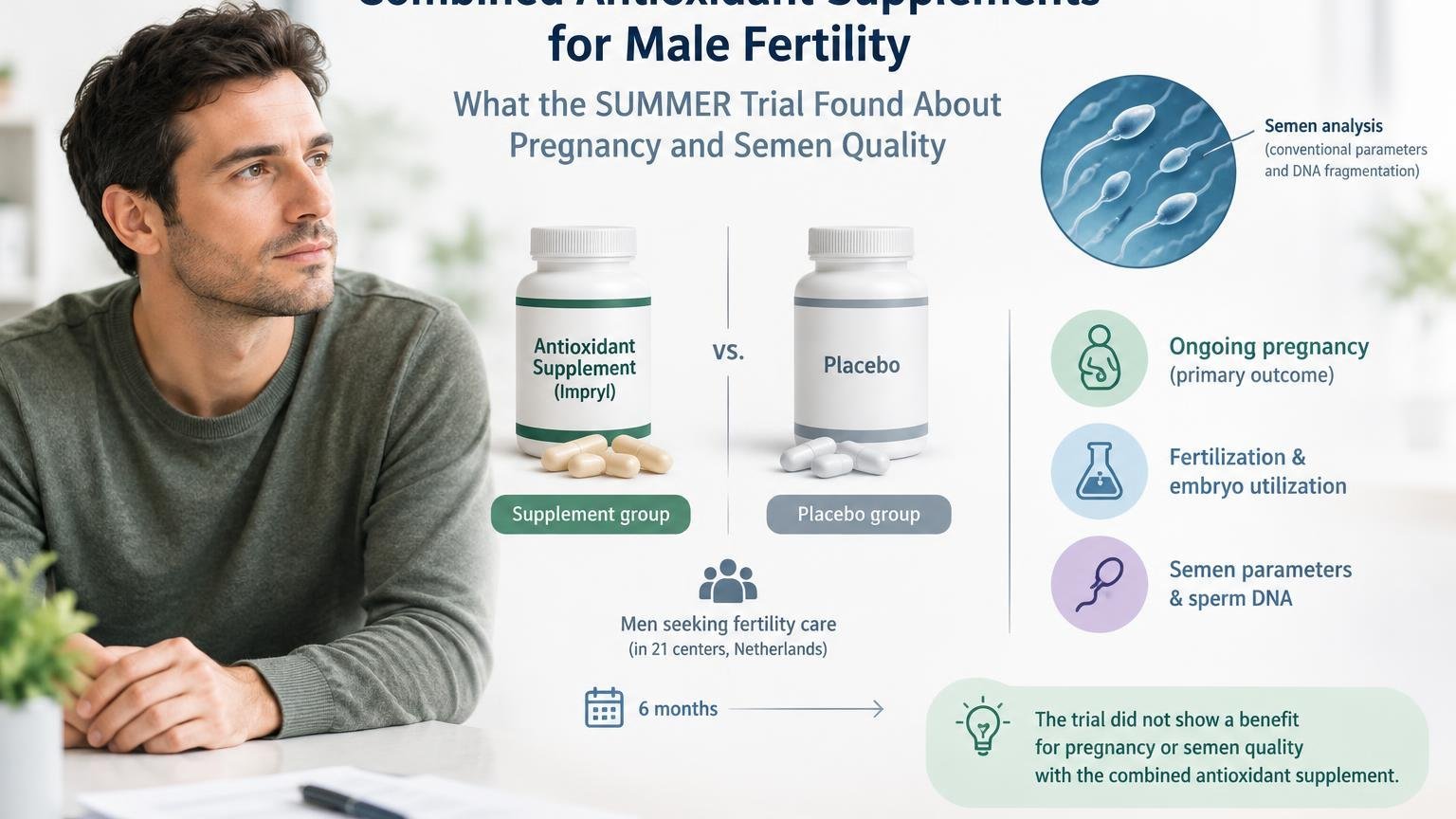
Core Research Direction: The SUMMER randomized placebo-controlled trial tested whether a six-month combined antioxidant supplement (Impryl) improves ongoing pregnancy among men seeking fertility care, and found no benefit versus placebo, with signals of lower ongoing pregnancy in the 4–6 month window and no improvement in semen parameters or sperm DNA fragmentation.
Search Intent: Do daily combined antioxidant supplements actually improve pregnancy chances or semen quality in men seeking fertility care, or could they be neutral or harmful?
Platform: SANYUN Science Center
Evidence reviewed through: 2026-11-25
Executive Summary
A large randomized, double-blind, placebo-controlled trial called SUMMER has tested whether a daily combined antioxidant supplement improves pregnancy chances for couples seeking fertility care. The trial was conducted across 21 centers in the Netherlands and enrolled 1,171 men whose partners were undergoing expectant management, intrauterine insemination (IUI), in vitro fertilization (IVF), or intracytoplasmic sperm injection (ICSI). Participants were randomized to the combined antioxidant supplement Impryl or placebo, taken daily for six months.[1]
The primary outcome was ongoing pregnancy, defined as a viable pregnancy at 12 weeks gestation, within six months. The observed ongoing pregnancy rate was 33.8% in the supplement group and 37.5% in the placebo group, a difference reported as non-significant. In a secondary analysis focused on the 4–6 month window after randomization, ongoing pregnancy was significantly lower with the supplement at 15.5% versus 21.5% with placebo (P = .02).
The trial also found no significant improvement in conventional semen parameters or sperm DNA fragmentation. Within the supplement group, median sperm vitality was significantly lower after treatment than at baseline, falling from 62.7% to 54.9%. These findings argue against routine use of this combined antioxidant product by men seeking fertility care, while leaving important questions about mechanism, generalizability, and the interpretation of secondary outcomes.
Why This Matters
Male fertility supplements are widely marketed as a low-risk way to improve sperm quality and pregnancy chances. The underlying rationale has seemed plausible: oxidative stress, an imbalance between reactive oxygen species and antioxidant defenses, has been associated with sperm damage in laboratory studies. If that process contributes to subfertility, then supplying antioxidants might improve sperm function. The SUMMER trial tests that practical claim directly, using pregnancy as the primary outcome rather than relying only on surrogate laboratory measures.
For clinicians and patients, the distinction between a plausible mechanism and a demonstrated clinical benefit matters. A supplement can change a laboratory marker without improving the chance of a healthy pregnancy, and it can also fail to change the marker. SUMMER is informative because it measured both: ongoing pregnancy and several semen-related outcomes, in a randomized design intended to reduce bias.
What Was Tested and How the Trial Was Designed
SUMMER enrolled men seeking fertility care, aged 18 to 50 according to a conference report, across 21 clinics and fertility centers in the Netherlands. Their partners were undergoing a range of treatments, from expectant management to IUI, IVF, or ICSI. This breadth matters because the trial was not restricted to a single fertility pathway; it reflects a real-world mix of couples at different stages of care.[2]
The intervention was a specific combined antioxidant supplement, Impryl. The supplement contained betaine 200 mg, L-cysteine 200 mg, niacin 16 mg, zinc 10 mg, folic acid 400 µg, vitamin B2 1.4 mg, vitamin B6 1.4 mg, and vitamin B12 2.5 µg. A conference report describes 571 men taking the daily supplement for six months and 555 men receiving placebo. The primary outcome was ongoing pregnancy at 12 weeks gestation within six months.
The design is important for interpreting the results. Randomization and blinding reduce the risk that differences between groups reflect baseline characteristics or expectations. The use of a placebo comparator is especially relevant for a supplement marketed directly to patients, because placebo responses and behavioral changes can otherwise be mistaken for treatment effects. At the same time, the trial tested one specific combination and dose schedule, not every antioxidant product or every antioxidant strategy.
What the Evidence Shows
| Outcome or variable | Supplement group | Placebo group | Interpretation |
|---|---|---|---|
| Ongoing pregnancy within six months (primary outcome) | 33.8% | 37.5% | Non-significant difference; no evidence of benefit from the supplement. |
| Ongoing pregnancy in the 4–6 month window (secondary analysis) | 15.5% | 21.5% | Significantly lower with the supplement (P = .02); a secondary signal that needs cautious interpretation. |
| Fertilization rate | 0.68 | 0.64 | No significant difference. |
| Embryo utilization rate | 0.50 | 0.48 | No significant difference. |
| Conventional semen parameters after 3–6 months | No significant difference | No significant difference | Semen volume, sperm concentration, progressive motility, and total motile sperm count did not improve significantly. |
| Sperm DNA fragmentation | No significant difference | No significant difference | The supplement did not significantly reduce sperm DNA fragmentation. |
| Median sperm vitality | Fell from 62.7% to 54.9% within the supplement group | Not reported in the summary | A within-group change reported as significant; it is not a between-group comparison in the source summary. |
The primary result is a clear negative finding for the tested supplement: ongoing pregnancy was not higher with the antioxidant combination than with placebo. The absolute difference was small and in the direction of placebo, but the reported analysis found it non-significant. This does not prove that the supplement reduced pregnancy overall; it shows that the trial did not detect the intended benefit.
The 4–6 month analysis is more provocative. Researchers chose this window because spermatogenesis takes approximately 72 days, so any effect of a sperm-level intervention might be expected to emerge after that cycle. The ongoing pregnancy rate in this window was significantly lower in the supplement group, 15.5% versus 21.5%, with P = .02. The statistical significance indicates that a difference of this size is unlikely to be explained by chance alone under the assumptions of the analysis. It does not, by itself, prove harm, because the comparison was a secondary outcome and secondary analyses can produce misleading signals.
The laboratory outcomes do not show a fertility benefit. Fertilization rate and embryo utilization rate were similar between groups: 0.68 versus 0.64 and 0.50 versus 0.48, respectively. Conventional semen parameters, including semen volume, sperm concentration, progressive motility, and total motile sperm count, showed no significant differences after 3–6 months. Sperm DNA fragmentation also showed no significant difference. These findings undercut the idea that the supplement improves sperm quality in a way that translates into better fertility outcomes.
The vitality finding deserves careful reading. Median sperm vitality was significantly lower in the antioxidant group after treatment compared with its own baseline, falling from 62.7% to 54.9%. This is a within-group change, not necessarily a significant difference between supplement and placebo groups in the source summary. Within-group changes can reflect measurement variability, time, or other factors, but the direction is consistent with the concern that the supplement did not help and might have been associated with worse sperm function.
Biological and Clinical Mechanism
The leading explanation for the unexpected pregnancy signal is a hypothesis rather than an established mechanism. The authors propose that excess antioxidants may cause reductive stress, the opposite of oxidative stress, by shifting the redox balance in a way that is also harmful to sperm function. Redox balance is not simply a matter of more antioxidants being better; reactive oxygen species also participate in normal signaling and sperm function. If the balance is pushed too far in the reducing direction, normal processes could be disrupted.
A related hypothesis is that the men in this trial may not have had high baseline oxidative stress. The authors note that the trial subgroup had low baseline sperm DNA fragmentation, which they interpret as evidence against widespread high oxidative stress in this population. If most participants did not have an antioxidant deficit, adding high levels of antioxidants might be unnecessary at best and potentially harmful at worst. This explanation is plausible but remains speculative; the trial was not designed to prove reductive stress as the cause of the pregnancy difference.
The pattern across assisted reproduction outcomes adds nuance. The source summary reports that pregnancy rates were significantly lower in the supplement group for couples undergoing IVF or ICSI after ovum pickup and after fresh embryo transfer, whereas pregnancy rates after frozen-thawed embryo transfer showed no significant difference. This could suggest an effect on fresh sperm handling or in vivo sperm function rather than a fixed change in embryo competence. However, the source summary does not provide the numerical pregnancy rates for these subgroups, so the size and precision of these differences cannot be assessed from the available text.
Interpretation and Limitations
The main strength of SUMMER is its randomized, double-blind, placebo-controlled design across many centers with a large sample. For a question that affects routine counseling, this is a more reliable design than uncontrolled observations or small before-and-after studies. The primary outcome, ongoing pregnancy at 12 weeks, is clinically meaningful because it goes beyond a chemical pregnancy or a laboratory surrogate.
Several limitations temper the conclusions. The 4–6 month finding and the fresh versus frozen transfer findings are secondary analyses, which are more prone to false positives and should be treated as hypothesis-generating. The source summaries do not report all subgroup numbers, confidence intervals, or the full statistical model, so the precision of these estimates is uncertain from the available text. The vitality result is a within-group comparison with baseline, which is weaker than a direct between-group comparison. In addition, the trial tested one specific supplement formulation and dose schedule; the results should not be generalized to all antioxidants, all doses, or all populations of men.
The reporting also matters. The available sources are news summaries and a conference report, not the full trial publication. The trial is described as published in JAMA Network Open, but this analysis relies on secondary summaries that may omit important details about randomization, adherence, adverse events, and prespecified analysis plans. The distinction between a prespecified secondary outcome and a post hoc analysis is especially important for interpreting the 4–6 month signal. Readers should treat the pregnancy signal as a serious but not definitive safety concern until the full trial report is examined.
The claim that antioxidant supplements are harmful should also be framed carefully. The primary outcome did not show a statistically significant difference, and the trial was not designed as a safety trial with harm as the primary endpoint. The lower pregnancy rate in the 4–6 month window and the fresh-transfer subgroup are concerning, but they do not establish causation or quantify risk precisely. A balanced conclusion is that the tested supplement did not demonstrate benefit and that the evidence does not support routine use, while the possibility of harm requires confirmation.
What This Means for Men and Couples
For men seeking fertility care, the practical implication is that this specific combined antioxidant supplement should not be assumed to improve pregnancy chances or semen quality. The trial found no improvement in conventional semen parameters or sperm DNA fragmentation, and the primary pregnancy outcome did not favor the supplement. Couples should discuss supplement use with their fertility clinician rather than relying on marketing claims or general oxidative-stress theory.
The researchers emphasize that standard fertility treatments such as IUI, IVF, and ICSI remain the main evidence-based options for couples seeking to conceive. A conference report also quotes the view that other measures, such as modulating risk factors and exercise, are probably more relevant than antioxidant supplementation. That is expert opinion rather than a trial result, but it is consistent with the trial's negative findings for the supplement.
Research Outlook
Several questions remain. The full trial report should clarify whether the 4–6 month analysis was prespecified, how many couples contributed to each subgroup, and whether the fresh-transfer difference persists after adjustment for relevant clinical factors. Mechanistic studies could test the reductive-stress hypothesis directly, for example by measuring redox status and sperm function before and during antioxidant exposure. Future trials might also test whether men with objectively high oxidative stress respond differently from men without it, rather than treating all subfertile men as a single group.
For now, SUMMER provides strong evidence against routine use of this particular combined antioxidant supplement in men seeking fertility care. It does not close the door on all antioxidant research, but it shifts the burden of proof: any future product should demonstrate a clinically meaningful pregnancy benefit in a randomized trial, not merely a plausible mechanism or a change in a laboratory marker.
Key Takeaways
- In the SUMMER trial, a six-month combined antioxidant supplement did not improve ongoing pregnancy within six months: 33.8% with the supplement versus 37.5% with placebo, a non-significant difference.
- A secondary analysis found significantly lower ongoing pregnancy in the 4–6 month window with the supplement (15.5% versus 21.5%, P = .02), a signal that needs confirmation and cautious interpretation.
- Conventional semen parameters and sperm DNA fragmentation showed no significant improvement after 3–6 months, undercutting the proposed sperm-quality rationale.
- Median sperm vitality fell within the supplement group from 62.7% to 54.9%, a within-group change that warrants attention but is not a direct between-group comparison in the source summary.
- The reductive-stress explanation and the idea that men without high baseline oxidative stress may be more susceptible to harm are hypotheses, not established mechanisms.
- The trial tested one specific supplement formulation; the findings do not establish the effects of all antioxidant products, doses, or populations.
Questions and Answers
What did the SUMMER trial test in men seeking fertility care?
SUMMER tested whether a daily combined antioxidant supplement (Impryl) taken for six months improves ongoing pregnancy compared with placebo in men seeking fertility care. It enrolled 1,171 men across 21 centers in the Netherlands whose partners were undergoing expectant management, IUI, IVF, or ICSI. The primary outcome was viable pregnancy at 12 weeks within six months.
Did the antioxidant supplement improve ongoing pregnancy rates in the SUMMER trial?
No. Ongoing pregnancy within six months occurred in 33.8% of the supplement group versus 37.5% of the placebo group, a non-significant difference. A secondary analysis found significantly lower ongoing pregnancy in the 4–6 month window with the supplement, 15.5% versus 21.5% (P = .02), but secondary findings require cautious interpretation and confirmation.
Did the SUMMER antioxidant supplement change semen quality or sperm DNA fragmentation?
The trial found no significant improvement in semen volume, sperm concentration, progressive motility, or total motile sperm count after 3–6 months. Sperm DNA fragmentation also showed no significant difference between groups. Median sperm vitality was significantly lower within the supplement group after treatment, falling from 62.7% to 54.9%, but this was a within-group comparison with baseline rather than a reported between-group difference.
How strong is the evidence that antioxidant supplements could harm male fertility?
The evidence is suggestive but not definitive. The primary pregnancy outcome was not significantly worse with the supplement, and the trial was not designed primarily as a safety trial. The lower pregnancy rate in the 4–6 month window and in fresh IVF/ICSI transfer subgroups is concerning, but these were secondary analyses. The reductive-stress explanation is a hypothesis, and the full trial report is needed to assess precision and prespecification.
Does the SUMMER trial apply to all antioxidant supplements or only the tested product?
The trial tested one specific combined supplement, Impryl, at a defined dose schedule for six months. Its results should not be generalized to every antioxidant product, dose, or combination. The findings argue against routine use of this particular formulation in men seeking fertility care, but other products would need their own randomized evidence. Men should discuss any supplement with their fertility clinician rather than assuming class-wide benefit or harm.
What should couples do with these findings when considering fertility treatment?
The trial supports relying on established fertility treatments such as IUI, IVF, and ICSI rather than assuming a combined antioxidant supplement will improve pregnancy chances. Couples should discuss supplement use openly with their clinician, especially before fresh IVF or ICSI cycles, given the secondary pregnancy signal. The findings do not provide personalized advice or prove harm for every man, so individual circumstances and the full trial report should guide decisions.
Sources and References
- IVF.net Newsdesk. IVF.net – Myth Busted: Why Antioxidant Supplements Might Be Hurting, Not Helping, Male Fertility. 2025
- Antioxidanzien enttäuschen bei Infertilität. unknown
SANYUN Science Center explains published research on men's reproductive and sexual health, connecting scientific evidence with everyday questions while making sources and limitations clear.
Disclaimer: This article is for scientific education and research communication only. It does not provide medical advice, diagnosis, or individualized treatment recommendations, and does not endorse any medication, supplement, device, penile enlargement procedure, or other intervention. Decisions about sexual and reproductive health should be made in consultation with a qualified healthcare professional. Do not delay seeking professional care because of information in this article.
Original Content & Copyright Notice
- This article is prepared for SANYUN Science Center, drawing on published research and publicly available academic literature on men’s sexual and reproductive health. Its editorial explanations and presentation are developed for this platform.
- Copyright in the original editorial content, selection, and arrangement is reserved by SANYUN Science Center to the extent protected by applicable law. Referenced research, quotations, and third-party materials remain subject to the rights of their respective owners. This notice does not claim ownership of scientific facts or third-party research.
- Except where permitted by applicable law or an applicable license, prior written permission is required to reproduce, republish, translate, adapt, redistribute, or commercially reuse protected content. Attribution alone does not grant permission for such reuse.
- For permitted quotation or authorized reuse, clearly identify the source and retain a link to the original article.
- Source: SANYUN Science Center
- Original URL: Retain the original article URL on science.san-yun.com.
- Copyright Holder: SANYUN Science Center, for its own protected editorial content.
- Quotation, excerpts, or authorized reuse must not distort the scientific meaning, omit material limitations or disclaimers, or imply unverified medical claims, product efficacy, or endorsement by SANYUN Science Center.



