




Category: Latest Research
Core Research Direction: News context on antioxidant supplements for male fertility: what a large placebo-controlled randomised trial (SUMMER) found about pregnancy rates, sperm-quality measures and absence of benefit
Search Intent: For men seeking fertility care, do over-the-counter antioxidant supplements improve ongoing pregnancy rates compared with placebo?
Platform: SANYUN Science Center
Evidence reviewed through: 2026-11-24
The Headline Finding
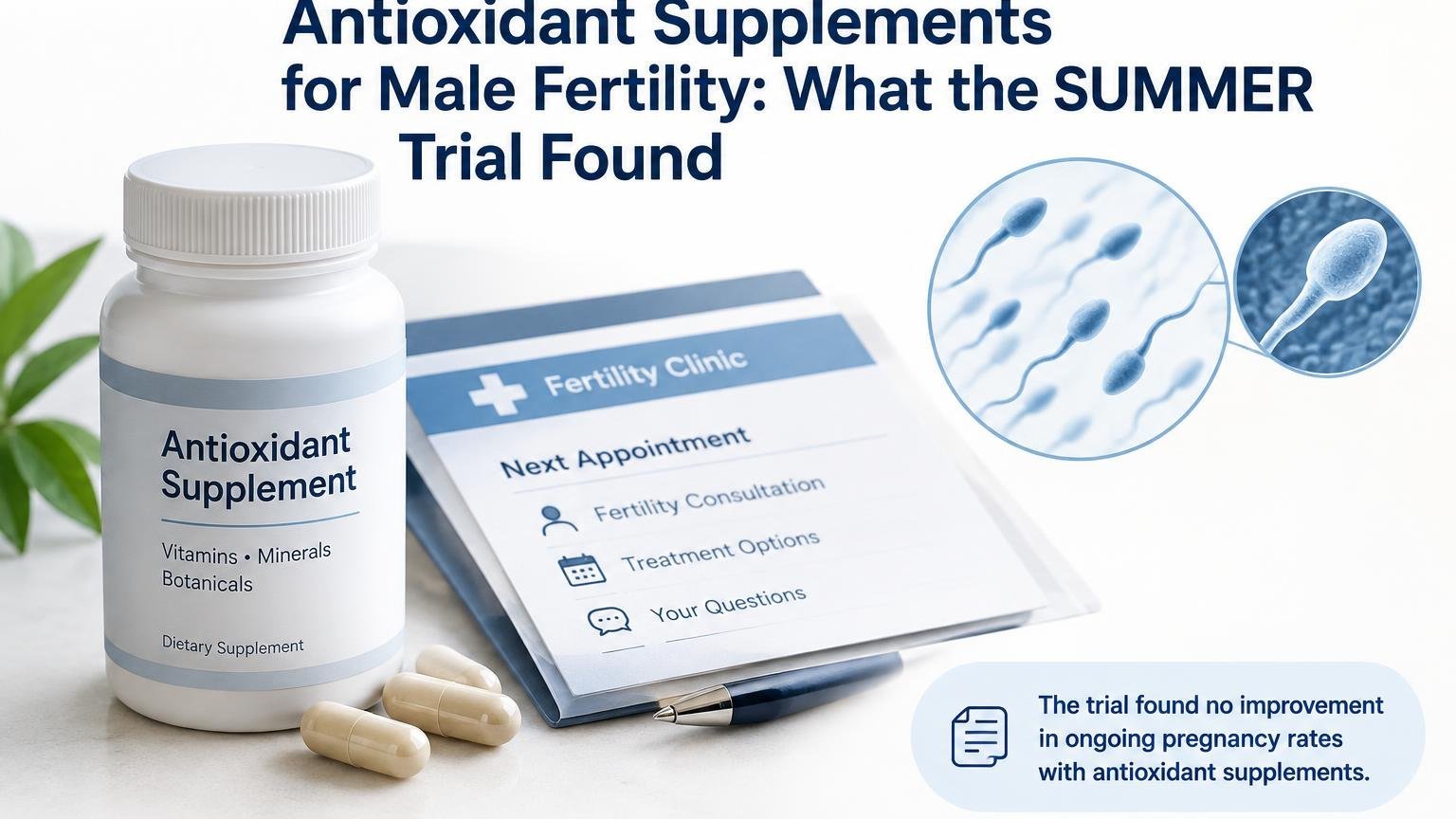
A large randomised, placebo-controlled trial has reported that a daily antioxidant supplement did not improve ongoing pregnancy rates in men seeking fertility care. The SUMMER trial assigned 1171 men aged 18 to 50, whose female partners were aged 18 to 43, to the supplement Impryl or to placebo for six months. Couples were recruited across 21 hospitals and fertility clinics in the Netherlands and were receiving either no assisted reproduction, intrauterine insemination, IVF, or IVF with intracytoplasmic sperm injection. The results, summarised in a news report from the Progress Educational Trust, did not support supplement use in this population.[1]
The context matters because antioxidant supplements have been widely marketed as a way to improve male fertility. Before this trial, studies were generally small and their results conflicted, leaving patients and clinicians without a reliable answer. A trial of this size in a real fertility-care setting directly tests the claim that most matters to couples: whether the chance of an ongoing pregnancy improves.
Why the Oxidative-Stress Idea Was Plausible
The rationale for antioxidant supplements rests on a long-standing hypothesis that male subfertility is often driven by oxidative stress, an imbalance between reactive oxygen species and the body's natural antioxidant defences. On this view, supplementing nutrients with antioxidant activity could protect sperm from damage and improve semen quality. That hypothesis underpins a large market of over-the-counter products marketed directly to patients as a non-invasive way to improve semen quality. It is important to be clear about the status of this reasoning: it is a biological hypothesis, not an established treatment mechanism. The SUMMER trial did not test whether oxidative stress contributes to subfertility; it tested whether one supplement formulation changes clinically meaningful outcomes.[2]
What the Trial Measured
SUMMER was designed to capture outcomes that matter both to couples and to clinicians. The primary question described in the news report was pregnancy. The trial also examined sperm quality, sperm DNA fragmentation, embryo transfer rates after IVF or ICSI, and miscarriage risk. These secondary measures are useful because they test whether the supplement has measurable biological effects even if pregnancy rates do not change. The report states that none of these outcomes differed significantly between the antioxidant and placebo groups after six months.
| Outcome or feature | What was reported | How to interpret it |
|---|---|---|
| Enrolment | 1171 men aged 18-50; female partners aged 18-43; 21 Dutch hospitals and fertility clinics | A large trial in a routine fertility-care population; findings reflect that setting and may not generalise to all men or all countries |
| Intervention | Daily Impryl, containing betaine, zinc, folic acid and B vitamins, versus placebo | Results describe this specific multinutrient product, not antioxidants as a broad class |
| Ongoing pregnancy | No significant difference between groups after six months | The primary clinical question was not answered in the supplement's favour; effect size and confidence interval are not given in this source |
| Sperm and treatment outcomes | No significant difference in sperm quality, sperm DNA fragmentation, embryo transfer after IVF or ICSI, or miscarriage risk | No signal of benefit across several biological and clinical measures |
| 4-to-6-month window | Pregnancy rate 16% with antioxidant versus 22% with placebo | A lower rate in the period when benefit was expected; described as a novel observation, but the source does not give denominators or a confidence interval |
The Unexpected Signal in the Four-to-Six-Month Window
One of the most discussed findings came from the period when the supplement would be expected to work best. Between four and six months, the pregnancy rate was 16 percent in the antioxidant group and 22 percent in the placebo group. The authors stated that, to their knowledge, their trial was the first to observe a significantly lower ongoing pregnancy rate within this optimal treatment window. That is a striking result, but it needs careful reading. The numerical comparison is presented as a secondary or exploratory analysis within a defined window, and the news report does not provide the denominators, absolute differences or confidence intervals needed to judge how robust the finding is. A single unexpected signal should not be over-interpreted, and it does not establish that the supplement reduces fertility.
How Does This Fit With Earlier Evidence?
The SUMMER investigators reported that their findings were consistent with a previous large US randomised trial, described as including more than 2000 couples, which found no pregnancy benefit from folic acid plus zinc within six months. That convergence is important because two large randomised trials testing overlapping nutrient strategies point in the same direction. However, the earlier trial is described here through the SUMMER paper and news summary, not through its own primary data, so its detailed results and limitations cannot be independently assessed from this source alone. Taken together, the evidence does not support the expectation that routine antioxidant or nutrient supplementation improves fertility outcomes.
Interpretation and Limitations
Several limitations shape how far the results can be taken. First, the trial tested one specific commercial formulation rather than antioxidants as a class, so it does not tell us whether a different supplement, dose or combination could have different effects. Second, the population was drawn from Dutch fertility clinics, and couples were following mixed treatment pathways, from no assisted reproduction to IVF with ICSI. Outcomes in that setting may not generalise to men not seeking care, to other health systems or to couples with different causes of subfertility. Third, the news report does not provide the full statistical detail, including effect estimates and confidence intervals, so the precision of the null result cannot be judged from this source.
The authors' conclusion was direct: ongoing pregnancy rates did not improve with the antioxidant supplement compared with placebo, and the investigators do not support its use in men seeking fertility care. They concluded that antioxidant supplement use in male fertility care is not supported and pointed instead to standard treatments such as intrauterine insemination, IVF and ICSI as the main evidence-based options. This is a conclusion about the product and population studied, not a statement that all dietary antioxidants are useless in every context.
What This Means for Men and Couples
For men considering supplements marketed for fertility, the practical message is that the best available large-scale evidence does not show a benefit for pregnancy outcomes and shows no improvement across several sperm and treatment measures. Supplements are not risk-free simply because they are sold over the counter, and an unexpected lower pregnancy rate in one analysis deserves attention rather than dismissal. Couples who are struggling to conceive should discuss evidence-based options with a fertility clinician rather than relying on unregulated products. The trial does not provide personalised guidance, and individual circumstances vary.
It is also worth separating statistical significance from clinical importance. A finding of no significant difference means the trial did not detect a benefit of the size it was powered to find; it does not prove that every possible supplement has zero effect. Conversely, the lower pregnancy rate in the four-to-six-month window should not be presented as proof of harm. The responsible interpretation is that the intervention has not earned a place in routine care on current evidence. Readers can explore wider context on sperm-quality supplements and trial evidence in the related analysis of randomised trials linked below.
Research Outlook
The SUMMER trial shifts the burden of proof. Future research would need to identify specific subgroups, doses or formulations with a plausible mechanism and to test them in adequately powered randomised trials with pregnancy as a primary outcome. Until then, the oxidative-stress hypothesis remains a reasonable area of laboratory and clinical investigation but not a justification for routine supplementation. The reported convergence with an earlier large US trial suggests that the field is moving away from broad nutrient supplementation and toward more targeted questions.
Key Takeaways
- In the SUMMER trial of 1171 men seeking fertility care, a daily antioxidant supplement did not improve ongoing pregnancy rates compared with placebo after six months.
- No significant differences were reported for sperm quality, sperm DNA fragmentation, embryo transfer rates after IVF or ICSI, or miscarriage risk.
- Within the four-to-six-month window, the pregnancy rate was 16 percent in the antioxidant group and 22 percent in the placebo group; this signal requires cautious interpretation because statistical detail is not provided in the source.
- The authors do not support antioxidant supplement use in men seeking fertility care and point to standard treatments as the main evidence-based options.
Questions and Answers
What did the SUMMER trial find about antioxidant supplements and male fertility?
The SUMMER trial found that a daily antioxidant supplement did not improve ongoing pregnancy rates compared with placebo in 1171 men seeking fertility care. It also reported no significant differences in sperm quality, sperm DNA fragmentation, embryo transfer rates after IVF or ICSI, or miscarriage risk after six months. The authors concluded that supplement use in this population is not supported by the evidence.
Why have antioxidant supplements been marketed for male fertility?
The marketing rests on a long-standing hypothesis that male subfertility is often driven by oxidative stress, an imbalance between reactive oxygen species and natural antioxidant defences. On that reasoning, antioxidant nutrients might protect sperm and improve semen quality. This remains a hypothesis rather than a proven treatment mechanism, and the SUMMER trial tested whether one supplement formulation changed clinical outcomes rather than testing the hypothesis itself.
How strong is the evidence that antioxidant supplements do not help male fertility?
The SUMMER trial is a large randomised placebo-controlled trial, which is a strong design for testing treatment effects, and its results are consistent with a previous large US trial of folic acid and zinc. However, it tested one specific supplement formulation in a Dutch fertility-care population, and the news report does not provide full statistical detail. The evidence is therefore persuasive for this product and setting but not definitive for every antioxidant or every group of men.
Was there any sign that antioxidant supplements could reduce pregnancy rates?
Within the four-to-six-month window when benefit was expected, the pregnancy rate was 16 percent in the antioxidant group and 22 percent in the placebo group. The authors described this as the first observation of a significantly lower ongoing pregnancy rate in that window. Because the source does not provide denominators or confidence intervals, the finding should be treated as an unexpected signal requiring cautious interpretation rather than proof of harm.
Does the SUMMER trial apply to all men with fertility problems?
No. The trial enrolled men aged 18 to 50 with female partners aged 18 to 43 who were seeking fertility care at Dutch hospitals and clinics, and couples were following different treatment pathways. Findings may not generalise to men not seeking care, to other countries or to couples with different causes of subfertility. The result also concerns one commercial supplement formulation rather than all antioxidant products.
What should men do if they are considering fertility supplements?
The best available large-scale evidence does not show that this antioxidant supplement improves pregnancy outcomes, so men should be cautious about products marketed to boost fertility. Supplements are not automatically harmless, and the unexpected lower pregnancy rate in one analysis deserves attention. Couples struggling to conceive should discuss evidence-based options with a fertility clinician and avoid relying on unregulated products for treatment decisions.
Sources and References
SANYUN Science Center explains published research on men's reproductive and sexual health, connecting scientific evidence with everyday questions while making sources and limitations clear.
Disclaimer: This article is for scientific education and research communication only. It does not provide medical advice, diagnosis, or individualized treatment recommendations, and does not endorse any medication, supplement, device, penile enlargement procedure, or other intervention. Decisions about sexual and reproductive health should be made in consultation with a qualified healthcare professional. Do not delay seeking professional care because of information in this article.
Original Content & Copyright Notice
- This article is prepared for SANYUN Science Center, drawing on published research and publicly available academic literature on men’s sexual and reproductive health. Its editorial explanations and presentation are developed for this platform.
- Copyright in the original editorial content, selection, and arrangement is reserved by SANYUN Science Center to the extent protected by applicable law. Referenced research, quotations, and third-party materials remain subject to the rights of their respective owners. This notice does not claim ownership of scientific facts or third-party research.
- Except where permitted by applicable law or an applicable license, prior written permission is required to reproduce, republish, translate, adapt, redistribute, or commercially reuse protected content. Attribution alone does not grant permission for such reuse.
- For permitted quotation or authorized reuse, clearly identify the source and retain a link to the original article.
- Source: SANYUN Science Center
- Original URL: Retain the original article URL on science.san-yun.com.
- Copyright Holder: SANYUN Science Center, for its own protected editorial content.
- Quotation, excerpts, or authorized reuse must not distort the scientific meaning, omit material limitations or disclaimers, or imply unverified medical claims, product efficacy, or endorsement by SANYUN Science Center.



