




Category: Latest Research
Core Research Direction: Efficacy of daily oral antioxidant supplementation (Impryl) versus placebo for ongoing pregnancy in men seeking fertility care, tested in the multicenter randomized placebo-controlled SUMMER trial
Search Intent: In couples undergoing fertility care, does giving the man a daily antioxidant supplement for six months improve the chance of ongoing pregnancy compared with placebo?
Platform: SANYUN Science Center
Evidence reviewed through: 2026-11-24
Executive Summary
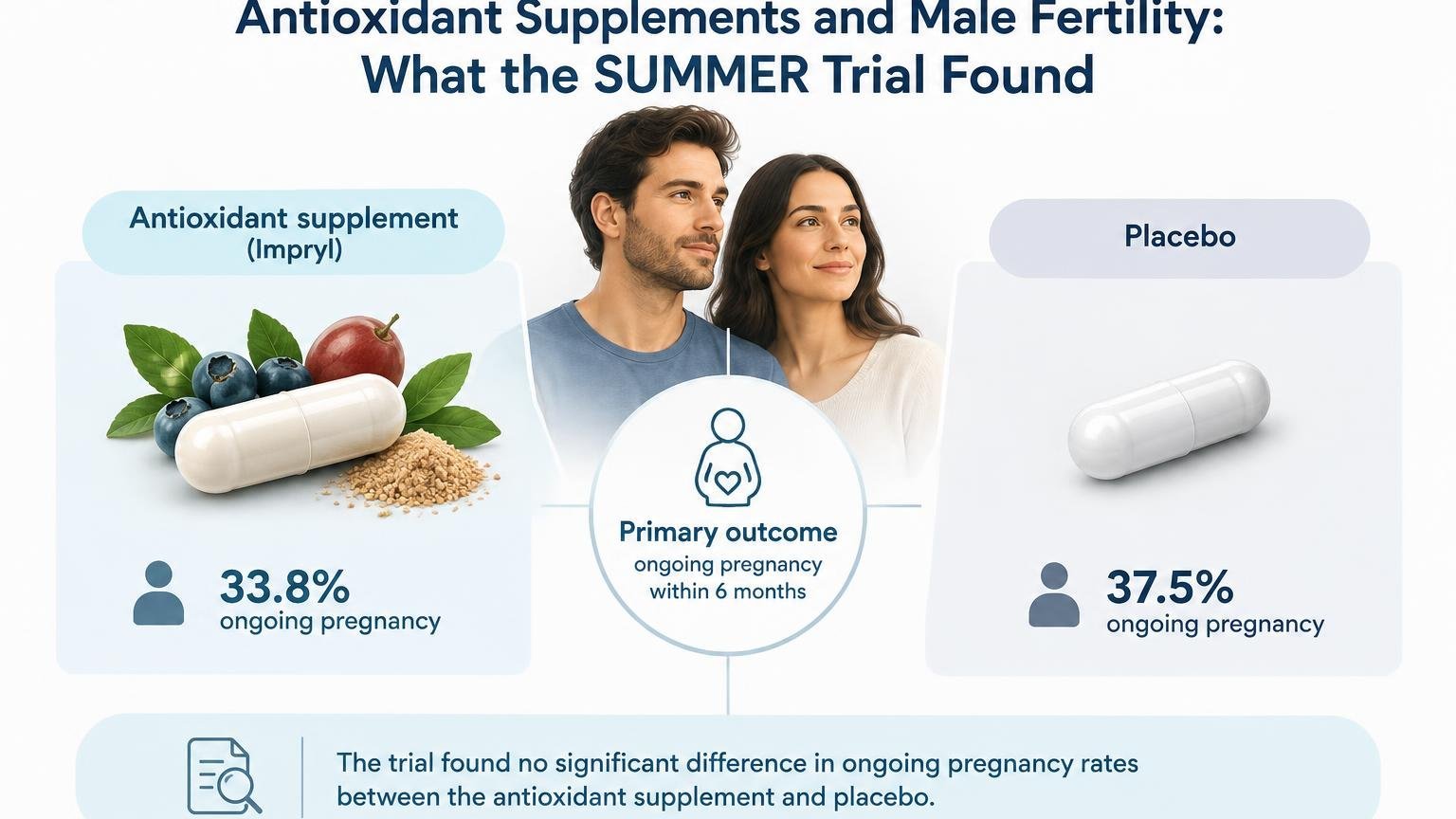
A large multicenter randomized trial has tested whether a daily antioxidant supplement improves the chance of pregnancy for couples in fertility care. The SUMMER trial enrolled 1,171 men whose female partners were undergoing fertility care and assigned them to a daily antioxidant supplement (Impryl) or placebo for 6 months. The primary outcome was ongoing pregnancy within 6 months. Rates were 33.8% with the supplement and 37.5% with placebo, a difference that was not statistically significant (adjusted odds ratio 0.85; P=.20).[1]
The investigators reported no significant improvement in semen quality or other secondary outcomes, and concluded that antioxidant supplements should not be recommended for men undergoing fertility treatment. One secondary analysis drew attention: during the 4-to-6-month window described as the optimal-effect period, pregnancy rates were significantly lower in the antioxidant group (15.5% vs 21.5%; adjusted odds ratio 0.66; P=.02). That finding needs cautious interpretation because it comes from a window analysis rather than the pre-specified primary comparison.
Why This Matters
Male fertility supplements are widely marketed, often with claims that antioxidants protect sperm from oxidative stress and thereby improve conception. For couples already navigating the cost, logistics and emotional strain of fertility care, a daily supplement can look like a low-risk addition. The SUMMER trial matters because it tests that assumption in a randomized, double-blind, placebo-controlled design across 21 fertility centers in the Netherlands, rather than relying on sperm-lab markers alone.
The trial also shifts the conversation from surrogate endpoints to a patient-relevant outcome. Semen parameters and sperm DNA fragmentation are useful research measures, but couples care about ongoing pregnancy. When a supplement fails to move that outcome and also fails to improve semen quality in the same trial, the case for routine use becomes much weaker.
The Biological Rationale, and Its Limits
The rationale for antioxidant supplementation rests on the idea that oxidative stress can damage sperm membranes and DNA, and that supplying antioxidants might protect sperm function. That is a plausible mechanism, but plausibility is not the same as demonstrated clinical benefit. Many oral antioxidants struggle to reach effective concentrations in reproductive tissues, and the body's redox balance is tightly regulated; more antioxidant is not automatically better.
The SUMMER results are consistent with the possibility that the mechanistic story does not translate into higher pregnancy rates in this population. The trial found no significant improvements in semen quality or other secondary outcomes, which weakens the idea that the supplement was acting on sperm as intended. The source summary does not report the specific secondary-outcome estimates, so the size and direction of any small changes remain uncertain.
What the Evidence Shows
| Variable | What the trial reported | How to interpret it |
|---|---|---|
| Design and setting | Multicenter, randomized, double-blind, placebo-controlled trial at 21 fertility centers in the Netherlands | A rigorous design that reduces bias compared with observational supplement studies |
| Participants | 1,171 men (median age 34 years) with female partners (median age 32 years) undergoing fertility care | A large sample for male fertility research, but specific to couples already in fertility care |
| Intervention | Daily antioxidant supplement (Impryl) or placebo for 6 months | The 6-month duration matches the pre-specified primary outcome window |
| Primary outcome | Ongoing pregnancy within 6 months: 33.8% with antioxidant vs 37.5% with placebo; adjusted odds ratio 0.85; P=.20 | No statistically significant difference; the confidence interval was not reported in the source |
| 4-to-6-month window | Pregnancy rate 15.5% with antioxidant vs 21.5% with placebo; adjusted odds ratio 0.66; P=.02 | A statistically significant difference favoring placebo in a secondary window; treat cautiously because it is not the primary analysis |
| Secondary outcomes | No significant improvements in semen quality or other secondary outcomes | Undermines the proposed sperm-level mechanism in this population; specific estimates not given in the source |
The primary result is a null finding: the supplement did not produce a statistically significant increase in ongoing pregnancy, and the point estimate was slightly lower than placebo. Statistical significance is not the only consideration, but a P value of .20 with an adjusted odds ratio below 1 does not support a benefit. The absence of a reported confidence interval in the source limits precision about how much benefit or harm remains compatible with the data.
The 4-to-6-month finding is the most provocative result, but it should not be read as proof that antioxidants reduce fertility. Window analyses can be sensitive to timing, multiple comparisons and the play of chance, and the source does not state whether this analysis was pre-specified or adjusted for multiplicity. It is a signal that deserves follow-up, not a standalone reason to avoid all antioxidants.
Interpretation and Limitations
Several limitations shape how far these findings generalize. The trial enrolled couples already undergoing fertility care, so the results may not apply to men trying to conceive without assistance or to men with specific diagnosed causes of infertility. The supplement was a fixed commercial formulation; other antioxidant combinations, doses or durations could behave differently, and this trial cannot rule that out.
The source is a summary of the trial rather than the full report, so details such as the confidence interval for the primary outcome, the specific secondary-outcome estimates and the exact analysis plan are not available here. That matters for readers who want to judge the strength of the 4-to-6-month signal. The researchers' conclusion that supplements should not be recommended is a reasonable interpretation of the primary and secondary results, but it applies to this formulation and population.
For clinicians, the practical message is that a daily antioxidant supplement should not be presented as an evidence-based way to improve pregnancy chances in couples in fertility care. That does not mean all antioxidants are harmful, and it does not replace evaluation for specific, treatable causes of male infertility. It does mean that supplement use should be discussed with the care team rather than assumed to be beneficial.
Research Outlook
The SUMMER trial raises useful questions for future research: whether any subgroup might benefit, whether different antioxidant formulations or doses matter, and whether the 4-to-6-month signal replicates in a pre-specified analysis. Future trials would also benefit from reporting full effect estimates and confidence intervals so that clinicians can judge the range of plausible effects. Until then, the most defensible reading is that this widely used supplement did not improve the outcome that matters most in this population.
Key Takeaways
- In the SUMMER trial, a daily antioxidant supplement did not significantly increase ongoing pregnancy rates versus placebo (33.8% vs 37.5%; adjusted odds ratio 0.85; P=.20).
- During the 4-to-6-month optimal-effect window, pregnancy rates were significantly lower with the antioxidant (15.5% vs 21.5%; adjusted odds ratio 0.66; P=.02), a secondary finding that requires cautious interpretation.
- No significant improvements were seen in semen quality or other secondary outcomes, weakening the proposed sperm-level mechanism.
- The researchers concluded that antioxidant supplements should not be recommended for men undergoing fertility treatment, based on this trial's population and formulation.
- Couples should discuss supplement use with their fertility care team rather than assuming benefit; the trial does not address all antioxidants, doses or populations.
Questions and Answers
What was the SUMMER trial testing in men seeking fertility care?
SUMMER tested whether a daily antioxidant supplement (Impryl) taken for 6 months improves ongoing pregnancy rates compared with placebo. It was a multicenter, randomized, double-blind, placebo-controlled trial across 21 fertility centers in the Netherlands, enrolling 1,171 men with female partners in fertility care.
Did antioxidant supplements improve ongoing pregnancy rates in the SUMMER trial?
No. Ongoing pregnancy occurred in 33.8% of the antioxidant group and 37.5% of the placebo group, a difference that was not statistically significant (adjusted odds ratio 0.85; P=.20). The researchers concluded that antioxidant supplements should not be recommended for men undergoing fertility treatment.
What did the SUMMER trial find about the 4-to-6-month optimal-effect window?
During the 4-to-6-month window described as the optimal-effect period, pregnancy rates were significantly lower in the antioxidant group than in the placebo group (15.5% vs 21.5%; adjusted odds ratio 0.66; P=.02). This was a secondary window analysis, and the source does not state whether it was pre-specified or adjusted for multiple comparisons, so it should not be treated as proof of harm.
Did the SUMMER trial show any improvement in semen quality with antioxidant supplements?
No significant improvements were observed in semen quality or other secondary outcomes, including sperm DNA fragmentation and IVF/ICSI metrics, according to the source summary. The specific estimates for these outcomes are not reported in the available summary, so the size of any small changes remains unclear.
Who do the SUMMER trial results apply to, and what are the main limitations?
The results apply to men with female partners already undergoing fertility care, using one specific daily antioxidant formulation for 6 months. Limitations include the lack of reported confidence intervals in the source, the secondary nature of the 4-to-6-month analysis, and uncertainty about whether other formulations, doses, durations or populations would behave differently.
Should men in fertility care take antioxidant supplements to improve pregnancy chances?
Based on the SUMMER trial, a daily antioxidant supplement should not be assumed to improve pregnancy chances, and the researchers concluded it should not be recommended for men undergoing fertility treatment. Supplement use should be discussed with the fertility care team, especially because unexplained supplements can add cost and may interact with other treatments.
Sources and References
- de Ligny WR. Are antioxidant supplements effective for men facing fertility challenges?. JAMA Netw Open. 2025 PMID: 40996763.
SANYUN Science Center explains published research on men's reproductive and sexual health, connecting scientific evidence with everyday questions while making sources and limitations clear.
Disclaimer: This article is for scientific education and research communication only. It does not provide medical advice, diagnosis, or individualized treatment recommendations, and does not endorse any medication, supplement, device, penile enlargement procedure, or other intervention. Decisions about sexual and reproductive health should be made in consultation with a qualified healthcare professional. Do not delay seeking professional care because of information in this article.
Original Content & Copyright Notice
- This article is prepared for SANYUN Science Center, drawing on published research and publicly available academic literature on men’s sexual and reproductive health. Its editorial explanations and presentation are developed for this platform.
- Copyright in the original editorial content, selection, and arrangement is reserved by SANYUN Science Center to the extent protected by applicable law. Referenced research, quotations, and third-party materials remain subject to the rights of their respective owners. This notice does not claim ownership of scientific facts or third-party research.
- Except where permitted by applicable law or an applicable license, prior written permission is required to reproduce, republish, translate, adapt, redistribute, or commercially reuse protected content. Attribution alone does not grant permission for such reuse.
- For permitted quotation or authorized reuse, clearly identify the source and retain a link to the original article.
- Source: SANYUN Science Center
- Original URL: Retain the original article URL on science.san-yun.com.
- Copyright Holder: SANYUN Science Center, for its own protected editorial content.
- Quotation, excerpts, or authorized reuse must not distort the scientific meaning, omit material limitations or disclaimers, or imply unverified medical claims, product efficacy, or endorsement by SANYUN Science Center.



 did not improve ongoing pregnancy rates versus placebo in men seeking fertility care. Learn the findings, limits and what they mean.)