




Category: Penis Enlargement
Core Research Direction: Summary of systematic-review evidence on augmentation phalloplasty outcomes, complications and satisfaction specifically in adult men with acquired penile shortening (not normal-size or micropenis populations)
Search Intent: In men with acquired penile shortening, what length gains, complication rates and satisfaction does augmentation phalloplasty achieve, and how strong is that evidence?
Platform: SANYUN Science Center
Evidence reviewed through: 2026-11-07
Executive Summary
Acquired penile shortening is an uncommon reason for a small-appearing penis in adult men, but it is clinically awkward because the anatomy is already altered by prior disease or surgery. A systematic review following PRISMA guidance searched Medline/PubMed, Scopus and Cochrane for aesthetic augmentation phalloplasty papers published between 1990 and 2018, and included only cis-male patients with acquired shortening deformities who had penile dimensions and surgical outcomes reported.[1]
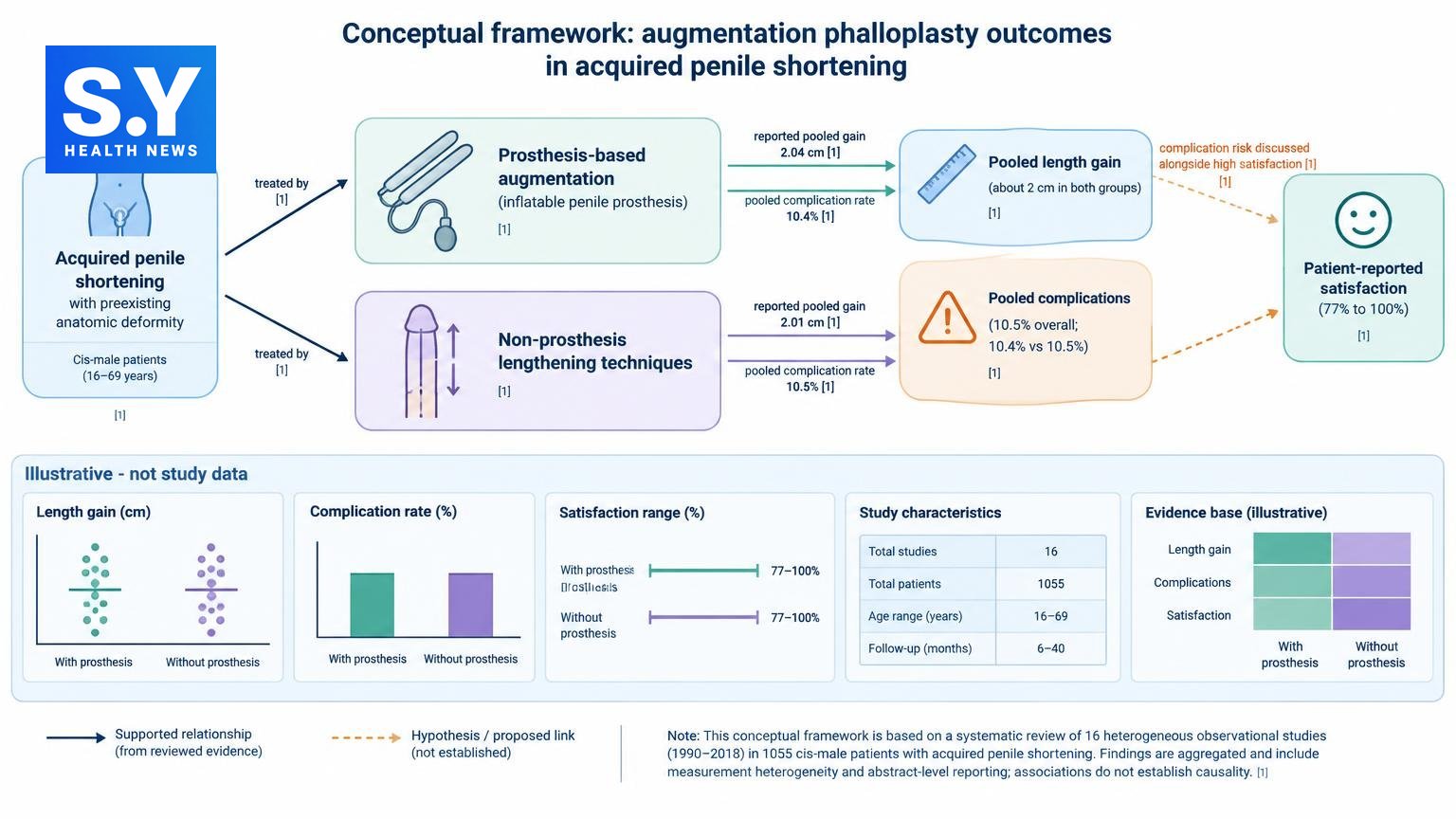
Sixteen articles involving 1055 patients met inclusion criteria out of 837 identified records; mean ages ranged from 16 to 69 years and follow-up from 6 to 40 months. Nine distinct procedures were grouped by whether an inflatable penile prosthesis was used. Pooled length gain was 2.04 cm in prosthesis-based procedures and 2.01 cm in non-prosthesis procedures, with pooled complication rates of 10.4% and 10.5% respectively. Satisfaction, reported in 12 articles, ranged from 77% to 100%.
Why This Matters
Men who notice penile shortening after prostate surgery, trauma, Peyronie's disease or other conditions may seek surgical correction, and they can encounter confident marketing claims that outrun the evidence. This review is useful because it restricts itself to that acquired-shortening population and separates prosthesis-based from non-prosthesis techniques, rather than mixing them with normal-size or micropenis groups. Its practical message is that measurable gains are reported, but they are modest and variable, and roughly one in ten pooled patients experienced a complication.
The review authors explicitly advise counseling patients about complication risk even when satisfaction figures are high, and they call for best-practice guidelines because techniques continue to be modified. That framing matters for informed consent: a satisfaction range is not a promise, and a pooled mean gain does not describe what any individual patient will experience.
Biological and Clinical Mechanism
Acquired shortening is described in the review as a distinct problem because preexisting penile anatomic deformities make reconstruction more demanding than in otherwise normal anatomy. The included procedures differ substantially in what they actually do: prosthesis-based approaches place or use an inflatable penile prosthesis as part of the technique, while non-prosthesis approaches lengthen the penis through other surgical means. Because the review grouped nine procedures into these two families, its pooled figures describe broad categories rather than a single operation.
This heterogeneity is not a technical detail. Length gain, complication profile and satisfaction depend on which tissue is altered, whether a device is implanted and what the baseline deformity is. The review did not report separate complication types or device-specific failure modes in its summary, so the mechanism-level comparison that a clinician would want is not available from this source alone.
What the Evidence Shows
| Outcome or variable | Reported result | Population or group | Interpretation |
|---|---|---|---|
| Included evidence base | 16 articles from 837 identified records; 1055 patients | Cis-males with acquired penile shortening and reported penile dimensions and surgical outcomes | Evidence is aggregated across heterogeneous observational studies rather than a single trial |
| Patient age and follow-up | Mean ages 16 to 69 years; follow-up 6 to 40 months | All included studies | Wide ranges limit assumptions about durability of results |
| Procedures | Nine distinct procedures, grouped by inflatable penile prosthesis use | All included studies | Pooled estimates describe procedural families, not individual operations |
| Length gain with inflatable penile prosthesis | Mean gain range 0.6 to 4.4 cm; pooled gain 2.04 cm | 9 articles, 632 patients | Reported gains vary widely; measurement conditions were not uniform |
| Length gain without inflatable penile prosthesis | Mean gain range 1.3 to 4.4 cm; pooled gain 2.01 cm | 7 studies, 423 patients | Similar pooled gain to prosthesis group, but not a randomized comparison |
| Complications | Range 0% to 25%; pooled rate 10.5% | All techniques | Absolute risk is clinically relevant and should be part of counseling |
| Complications by group | Pooled rate 10.4% with prosthesis vs 10.5% without (p=0.96) | Prosthesis vs non-prosthesis groups | Comparable pooled rates across heterogeneous studies; p value does not establish equivalence |
| Patient satisfaction | Range 77% to 100%; 12 articles reported satisfaction, 9 with a validated scale | All included studies | High reported satisfaction, but instruments and definitions varied |
Length outcomes were measured under inconsistent conditions: some studies used flaccid length, others erect and/or stretched length. That makes the pooled figures of about 2 cm approximate summary anchors rather than standardized measurements. A 2.04 cm pooled gain in the prosthesis group and a 2.01 cm pooled gain in the non-prosthesis group look nearly identical, but they derive from different study sets and different measurement practices, so the similarity should not be read as proof that the techniques perform equally.
The complication figures invite the same caution. A pooled rate of 10.5% with a range from 0% to 25% signals meaningful variation across techniques and centers, and the abstract does not specify what counted as a complication. The statistical comparison of prosthesis and non-prosthesis groups yielded p=0.96, which indicates no detectable difference in pooled rates in this dataset; it does not demonstrate that the two approaches are equivalent in risk, because the underlying studies were not randomized and complication definitions likely differed.
Satisfaction was generally high, ranging from 77% to 100%, and most of the 12 reporting articles used a validated scale. Even so, satisfaction is a patient-reported construct shaped by expectations, baseline distress and the meaning of the procedure to the individual. A high satisfaction rate does not cancel a 10.5% pooled complication rate, and the review authors accordingly recommend counseling on complications alongside discussion of expected benefit.
Interpretation and Limitations
The most important limitation is the nature of the source: these findings are reported in a conference abstract, which summarizes methods and results without the detail of a full journal article. The PRISMA-guided search and the inclusion criteria are described, but the abstract does not provide individual study quality assessments, risk-of-bias ratings, complication definitions, or standardized outcome data. Readers should treat the pooled numbers as descriptive summaries of a heterogeneous literature, not as precise effect estimates.
Applicability is deliberately narrow. Studies of patients with normal penile size, congenital micropenis or buried penis were excluded, so nothing here should be generalized to those groups or used to justify surgery for appearance concerns in anatomically normal men. The age range of 16 to 69 years and follow-up of 6 to 40 months also mean that long-term durability and late complications are not characterized by this review.
Finally, the comparison between prosthesis and non-prosthesis groups is an observational grouping imposed after the fact, not a planned randomized comparison. The comparable pooled complication rates and similar pooled length gains should be read as hypothesis-generating: they suggest the two families of technique may not differ dramatically in aggregate outcomes, but they cannot establish equivalence or superiority for any individual patient or surgeon.
Research Outlook
The review authors describe augmentation phalloplasty techniques as evolving and continuously modified, and they argue that best-practice guidelines are needed to achieve safe and satisfactory outcomes in this population. That is an agenda statement, not a finding of established guidelines. Future work would need standardized length-measurement protocols, clearly defined complication reporting, validated and consistently applied satisfaction instruments, and longer follow-up to clarify durability and late adverse events.
Key Takeaways
- In men with acquired penile shortening, pooled mean length gain was about 2 cm both with an inflatable penile prosthesis (2.04 cm) and without one (2.01 cm), but individual study means ranged from 0.6 to 4.4 cm and measurement conditions varied.
- The pooled complication rate across all techniques was 10.5%, with study-level rates from 0% to 25%, and the abstract does not detail what complications were counted.
- Pooled complication rates were similar between prosthesis (10.4%) and non-prosthesis (10.5%) groups (p=0.96), but this is an observational comparison, not evidence of equivalence.
- Reported satisfaction ranged from 77% to 100% across 12 articles, 9 of which used a validated scale, yet the authors still advise counseling patients about complication risk.
- Findings apply only to cis-male patients with acquired shortening deformities and exclude normal-size, congenital micropenis and buried penis populations; the evidence base is a 2019 conference abstract covering studies published 1990–2018.
Questions and Answers
What is augmentation phalloplasty for acquired penile shortening?
It refers to surgical procedures intended to increase penile length or girth in cis-male adults whose penis has shortened because of prior disease, surgery or trauma, rather than because of congenital micropenis or normal anatomy. The reviewed literature grouped nine distinct procedures into those using an inflatable penile prosthesis and those that do not.
How much length gain does augmentation phalloplasty produce in men with acquired penile shortening?
In the systematic review, pooled mean length gain was 2.04 cm in 632 patients whose procedure used an inflatable penile prosthesis and 2.01 cm in 423 patients whose procedure did not. Individual study means ranged widely, from 0.6 to 4.4 cm with a prosthesis and 1.3 to 4.4 cm without, and measurement conditions differed across studies.
What is the complication rate of penile lengthening surgery for acquired shortening?
Across all techniques, reported complication rates ranged from 0% to 25%, with a pooled rate of 10.5%. Procedures using an inflatable penile prosthesis had a pooled rate of 10.4% versus 10.5% without one (p=0.96). The abstract does not specify which complications were counted, so the pooled figure should be interpreted cautiously.
How satisfied are patients after augmentation phalloplasty for acquired penile shortening?
Twelve included articles reported satisfaction, with rates ranging from 77% to 100%; nine of those studies used a validated scale. Satisfaction therefore appears generally high, but instruments and definitions varied, and the authors still recommend counseling patients about the associated risk of complications before surgery.
How strong is the evidence that augmentation phalloplasty is safe and effective for acquired penile shortening?
The evidence is limited. It comes from a PRISMA-guided systematic review of 16 heterogeneous observational studies published 1990–2018, reported here as a conference abstract that does not detail study quality, complication definitions or standardized measures. Pooled estimates describe this literature but cannot establish causality, technique superiority or individualized outcomes.
Who do these augmentation phalloplasty findings not apply to?
The review excluded patients with normal penile size, congenital micropenis or buried penis, so its results apply only to cis-male adults with acquired penile shortening deformities. Age ranged from 16 to 69 years and follow-up from 6 to 40 months, so long-term outcomes and late complications remain uncertain for any group.
Conceptual framework: Conceptual framework (not a tested causal model). In a systematic review of 16 studies and 1055 cis-male patients with acquired penile shortening, procedures were grouped by inflatable penile prosthesis use. Pooled length gains were similar (2.04 cm with, 2.01 cm without), pooled complication rates were comparable (10.4% vs 10.5%), and satisfaction ranged 77–100%. Measurement heterogeneity and observational designs limit inference; abstract-level reporting is a key limitation.
Academic References & Evidence
- Amjed Abu-ghname; Joseph Banuelos; Krishna S. Vyas; Lucas Kreutz Rodrigues; Shane D. Morrison; Steven L. Moran; Jorys Martinez-Jorge; Oscar J. Manrique. PSRC – Augmentation Phalloplasty for Acquired Shortening: A Systematic Review of Techniques, Outcomes and Patient Satisfaction..
SANYUN Science Center explains published research on men's reproductive and sexual health, connecting scientific evidence with everyday questions while making sources and limitations clear.
Disclaimer: This article is for scientific education and research communication only. It does not provide medical advice, diagnosis, or individualized treatment recommendations, and does not endorse any medication, supplement, device, penile enlargement procedure, or other intervention. Decisions about sexual and reproductive health should be made in consultation with a qualified healthcare professional. Do not delay seeking professional care because of information in this article.
Original Content & Copyright Notice
- This article is prepared for SANYUN Science Center, drawing on published research and publicly available academic literature on men’s sexual and reproductive health. Its editorial explanations and presentation are developed for this platform.
- Copyright in the original editorial content, selection, and arrangement is reserved by SANYUN Science Center to the extent protected by applicable law. Referenced research, quotations, and third-party materials remain subject to the rights of their respective owners. This notice does not claim ownership of scientific facts or third-party research.
- Except where permitted by applicable law or an applicable license, prior written permission is required to reproduce, republish, translate, adapt, redistribute, or commercially reuse protected content. Attribution alone does not grant permission for such reuse.
- For permitted quotation or authorized reuse, clearly identify the source and retain a link to the original article.
- Source: SANYUN Science Center
- Original URL: Retain the original article URL on science.san-yun.com.
- Copyright Holder: SANYUN Science Center, for its own protected editorial content.
- Quotation, excerpts, or authorized reuse must not distort the scientific meaning, omit material limitations or disclaimers, or imply unverified medical claims, product efficacy, or endorsement by SANYUN Science Center.



