




Category: Clinical Insights
Core Research Direction: Guideline-based clinical evaluation and management of male infertility in Australia: initial assessment (history, examination, semen analysis, simultaneous female partner evaluation), targeted further testing (hormonal, genetic, sperm DNA fragmentation), and evidence-graded management of varicocele, azoospermia and surgical sperm retrieval
Search Intent: In men with infertility, what does the first Australian evidence-based male infertility guideline recommend for initial evaluation, further testing, and surgical management of varicocele and azoospermia, and how strong or uncertain is the evidence behind those recommendations?
Platform: SANYUN Science Center
Evidence reviewed through: 2026-11-05
Executive Summary
Australia's first evidence-based guideline on male infertility was developed by a multidisciplinary expert panel using a modified ADAPTE process, adapting existing European and American guidance to Australian practice. The panel reviewed each source statement between July 2022 and November 2024 and reached consensus on 80 revised statements tailored to the Australian setting.[1]
The headline recommendations are practical rather than technological: initial assessment should combine reproductive and medical history, physical examination including scrotal examination, and semen analysis, performed in parallel with evaluation of the female partner. Further testing is targeted rather than reflexive, and surgical management is positioned as a genuine option — microsurgical varicocelectomy for clinically significant varicocele in selected men, and micro-TESE as the preferred sperm retrieval method in non-obstructive azoospermia.
Two cautions frame the whole document. First, the guideline is an adaptation and consensus product, not a new systematic review: each statement was rated mandatory, recommended or suggested based on evidence level and panel judgment, so the label reflects both study quality and perceived clinical importance. Second, male infertility is common but frequently unexplained — a specific cause is unknown in 77% of cases — and the guideline itself describes the causative role of varicocele as contentious.
Why This Matters
Infertility affects about one in six couples, and a male factor may contribute to 50% of cases. Australian data summarised in the guideline indicate that one in three ART cycles are used because of male factor infertility, that male factors solely explain 20–30% of cases, and that they contribute to 50% of couple infertility overall.
Despite that burden, the guideline's authors note that Australia had no national male infertility guideline until this document, while male infertility has been managed across general practice, urology, endocrinology and, particularly through ART, obstetrics and gynaecology. The stated aim is a unifying set of stakeholder-endorsed statements relevant to Australian funding, access and population context, including regional disparities in access to care, Medicare funding arrangements and the diversity of the Australian population including Indigenous Australians.[2]
The clinical significance extends beyond conception. The guideline describes male infertility as a marker of overall health and links it with cancer, cardiovascular disease, metabolic disease and premature mortality, making the fertility consultation an opportunity for broader preventive assessment. Commentary from the surgical community frames the guideline as repositioning male factor care earlier in the couple's pathway; that framing is professional opinion rather than a demonstrated outcome.
How the Guideline Was Built
The panel did not conduct a fresh systematic review. Instead, it examined each statement in the European Association of Urology and American Urological Association/American Society for Reproductive Medicine guidelines, discussed concordance and Australian applicability, and modified statements until consensus was reached. The European guidance used GRADE-derived strength ratings and the American guidance used a separate grading approach, but the Australian document's own evidence labels are described at the level of high, moderate or low–very low for each statement.
This design has a clear implication for readers: the authority of the document rests on transparent adaptation and expert consensus rather than on independently re-analysed trial data. Methodological commentary outside this field has cautioned that guidelines built on flawed or heterogeneous meta-analyses can be inaccurate even when sophisticated statistics are used, and that critical appraisal must precede application. That caution is not specific to male infertility, but it is a reasonable lens for interpreting any adapted guideline.[3]
Initial Evaluation: History, Examination and Semen Analysis
The first guideline statement recommends offering male fertility assessment to concerned men or couples, comprising general and reproductive history, physical examination and semen analysis. The physical examination is treated as mandatory, reflecting its ability to detect signs of systemic disease and androgen deficiency, testicular volume and scrotal pathology such as a varicocele or testicular mass requiring prompt evaluation. Routine scrotal ultrasound is not recommended at initial assessment; ultrasound for testicular volume is reserved for situations where examination is not possible or is suboptimal, such as telehealth or body habitus limitations.
Testicular volume carries interpretable information: Prader orchidometer or ultrasound estimates correlate with testicular function, and ultrasound-assessed volumes below 12 mL are associated with poorer semen parameters. That is a correlational association rather than a diagnostic threshold for an individual man.
Semen analysis is described as the most important laboratory investigation for the male partner, reporting total sperm count, concentration, motility, morphology, volume, pH and viscosity. The guideline recommends 2 to 7 days of ejaculatory abstinence before collection, on-site production where possible, or delivery to the laboratory within 1 hour, with a repeat analysis about 6 weeks after an abnormal first result. Critically, a confirmed abnormal result indicates male contribution but does not identify a cause, so further evaluation follows.
Two organisational recommendations shape the pathway. Initial male evaluation should run in parallel with female partner assessment to avoid delays, and once male infertility is identified the man should be further evaluated by a specialist in male reproduction. Gonadotrophin and antisperm antibody testing are not routine at first assessment, and sperm DNA fragmentation testing is explicitly not part of initial evaluation.
| Assessment step | Guideline position | Evidence caveat |
|---|---|---|
| History, physical and scrotal examination, semen analysis | Recommended as the core initial evaluation; examination described as mandatory | Consensus-based recommendation; strength rating not detailed in the summary |
| Routine scrotal ultrasound | Not recommended at initial evaluation; reserved for volume estimation when examination is inadequate | Reflects yield and cost reasoning rather than trial evidence |
| Semen analysis technique | 2 to 7 days abstinence; repeat about 6 weeks after an abnormal result | Reference limits require clinical interpretation; abnormal result does not establish cause |
| Female partner evaluation | Performed in parallel with male assessment | Process recommendation aimed at avoiding delay |
| Antisperm antibody and sperm DNA fragmentation testing | Not routine in initial evaluation | Sperm DNA fragmentation may be used later in selected contexts |
Targeted Further Testing: Hormones, Genetics and Sperm DNA
Further evaluation is specialist-led and indication-driven. Hormonal testing is recommended when male factor infertility or androgen deficiency is suspected from abnormal semen parameters or clinical findings. The interpretation patterns matter: isolated FSH elevation suggests primary spermatogenic failure, elevated FSH and LH with low testosterone suggests primary testicular failure, and low or inappropriately normal FSH and LH with low testosterone suggests hypogonadotrophic hypogonadism. The guideline cites 8.4 IU/L as the most useful upper limit of normal FSH in a young man, while noting blood should be drawn before 10:00 am and ideally fasting.
Genetic testing is rationed by pretest probability. Y-chromosome microdeletions are reported in 5% of men with severe oligozoospermia (sperm concentration below 5 million/mL) and 10% of men with non-obstructive azoospermia, but in only about 0.8% of men with concentrations between 1 and 5 million/mL. Accordingly, screening is offered below 5 million/mL and mandatory below 1 million/mL. The guideline also flags that some genetic results carry serious implications for offspring and that genetic counselling must be offered when abnormalities are found.
Sperm DNA fragmentation testing occupies a narrow niche. It is not part of initial evaluation but is recommended in specific circumstances where it may change management — deciding whether a varicocele should be treated, or whether testicular rather than ejaculated sperm should be used for ART. This is a decision-support role, not a general screening test, and the guideline does not claim it improves outcomes independent of the management decision it informs.
The guideline also advises against routine antibiotics and antioxidants, which are stated not to improve live birth rates, and recommends thorough male reassessment when couples have had multiple failed ART cycles or recurrent pregnancy loss, since a clinically significant varicocele or high sperm DNA fragmentation may warrant attention before further cycles.
Varicocele: A Contentious Target
Varicocele is where the gap between prevalence and proof is widest. Varicoceles are present in one-third of infertile men and in 10–15% of men in the general population, yet the guideline describes their causative role in male infertility as contentious. Only varicoceles palpable on examination, not those detected exclusively by ultrasound, are considered clinically significant.
The guideline states that clinically significant varicoceles can cause or contribute to abnormal semen parameters, sperm DNA fragmentation, recurrent pregnancy loss and poor ART outcomes, and that treatment should be considered in these contexts. That statement should be read as the panel's position on contribution rather than as settled causal proof, given the same document's description of the causal question as contentious.
On technique, microsurgical varicocelectomy may improve pregnancy rates compared with other surgical treatments and has the lowest complication rate, though availability may require consideration of other surgical or embolisation approaches. The hedged wording is important: this is a comparative claim drawn from cited studies, not a quantified effect estimate in the summary. In non-obstructive azoospermia, the evidence for varicocelectomy before micro-TESE is mixed, so it is not recommended and should be considered only in select cases.
Azoospermia and Surgical Sperm Retrieval
Azoospermia accounts for about 10–15% of male infertility and requires a structured distinction between obstructive and non-obstructive causes. Features suggesting obstruction include low-volume ejaculate with normal testicular volumes and normal FSH; obstruction distal to the seminal vesicles, such as ejaculatory duct obstruction or bilateral absence of the vas deferens, characteristically produces acidic ejaculate. Non-obstructive azoospermia typically shows normal volume and pH with reduced testicular volume and either elevated FSH from primary testicular failure or normal-to-low FSH in hypogonadotrophic hypogonadism.
Routine diagnostic testicular biopsy is not recommended because it may compromise future sperm retrieval, particularly in non-obstructive azoospermia. In non-obstructive azoospermia, micro-TESE is the gold standard because it yields higher sperm retrieval rates than other techniques; a prior diagnostic biopsy or fine needle aspiration is not required, and fine needle aspiration should not be the definitive technique. The rationale is biological: sperm production can persist in some tubules despite a biopsy showing absent sperm elsewhere, and no known clinical or endocrine marker reliably predicts retrieval.
For obstructive azoospermia, vasectomy is the most common cause, with about 25% of Australian men older than 40 reported as having undergone the procedure. Both vasectomy reversal and surgical sperm extraction for ART should be discussed. Where reversal succeeds, cryopreservation of ejaculated sperm should be considered because delayed anastomotic fibrosis can occur in about 10% of men who initially have sperm return. In non-azoospermic men with high sperm DNA fragmentation or cryptozoospermia, particularly after prior ICSI failure, surgically retrieved sperm may improve pregnancy and live birth rates, but the guideline states high-quality data are lacking.
| Clinical scenario | Recommended approach | Strength of supporting evidence |
|---|---|---|
| Azoospermia, cause unclear | Differentiate obstructive from non-obstructive using a standardised framework | Guideline recommends a structured pathway; diagnostic accuracy not quantified in summary |
| Non-obstructive azoospermia, sperm retrieval | Micro-TESE preferred; diagnostic biopsy or fine needle aspiration not required beforehand | Supported as higher-yield comparative recommendation |
| Non-obstructive azoospermia with varicocele | Varicocelectomy before micro-TESE not recommended; consider only in select cases | Mixed evidence explicitly acknowledged |
| Post-vasectomy obstructive azoospermia | Discuss vasectomy reversal and sperm extraction; consider cryopreservation after successful reversal | Reversal supported; about 10% risk of delayed anastomotic fibrosis cited |
| Non-azoospermic high sperm DNA fragmentation or cryptozoospermia | Surgically retrieved sperm may be considered for ICSI, especially after prior failure | Hedged; high-quality data lacking |
Counselling, Comorbidity and Modifiable Risk
Counselling is embedded throughout rather than confined to a single statement. Clinicians are advised to discuss modifiable factors: in obesity, sustained weight loss is stated to improve sperm count, and regular physical activity with a nutrient-rich diet to improve sperm quality. The guideline also notes that sperm quality deteriorates with age, with increased risks of autism spectrum disorder and some autosomal dominant diseases in offspring, and recommends cardiometabolic assessment for comorbidities such as obesity, obstructive sleep apnoea, hypertension and undiagnosed or poorly controlled diabetes.
The psychological dimension is not measured in the guideline but is prominent in clinician commentary, which describes male infertility as a significant hit to masculinity and notes that distress is common in consultations. That is anecdotal observation, not systematic evidence, and should be treated as a prompt for sensitive communication rather than a quantified finding.
Interpretation and Limitations
Three limitations deserve emphasis. First, this is an adaptation: the panel did not independently synthesise primary evidence, so the strength of each statement inherits the strengths and weaknesses of the source guidelines and the studies they cited. Second, statement ratings mix evidence level with perceived importance, meaning a 'mandatory' label signals panel conviction as well as data quality. Third, several of the most clinically consequential areas — varicocele causality, varicocelectomy before micro-TESE, and surgically retrieved sperm after ICSI failure — are explicitly hedged or described as mixed or lacking high-quality data.
Epidemiological figures cited in the summary, including the 77% unknown-cause estimate and the prevalence figures for Y-chromosome microdeletions, come from external references rather than from new analyses in the guideline. They are useful for planning and counselling but depend on how extensively investigation was performed in the source populations. The document also does not provide pooled effect sizes for surgical outcomes, so clinicians cannot read quantitative benefit from the summary alone.
Research Outlook
The clearest research needs are the ones the guideline flags as uncertain: better evidence on varicocele treatment in non-obstructive azoospermia, on predictors of sperm retrieval, and on surgically retrieved sperm for ICSI in non-azoospermic men with high DNA fragmentation. The absence of validated clinical or endocrine predictors of retrieval is a specific gap that limits counselling. Wider implementation questions — whether earlier specialist involvement changes couple outcomes, and how access varies across Australian regions — are health-services questions that guideline publication alone cannot answer.
Key Takeaways
- Initial male evaluation combines history, scrotal examination and semen analysis, performed in parallel with female partner assessment; routine scrotal ultrasound is not part of that first step.
- Further testing is indication-driven: hormonal profiles when deficiency or male factor is suspected, Y-chromosome microdeletion screening below 5 million/mL (mandatory below 1 million/mL), and sperm DNA fragmentation only where it would change a management decision.
- Only palpable varicoceles are considered clinically significant; microsurgical varicocelectomy may improve pregnancy rates with the lowest complication rate, but causality remains contentious and pre-micro-TESE varicocelectomy is not recommended.
- Micro-TESE is the preferred retrieval method in non-obstructive azoospermia, without prior diagnostic biopsy, because sperm production can persist in some tubules and no marker reliably predicts retrieval.
- The guideline is an adapted consensus document with 80 statements rated by evidence level and panel judgment; several key surgical questions rest on mixed or limited-quality evidence.
Questions and Answers
What does the Australian male infertility guideline recommend for initial evaluation?
It recommends offering assessment that includes general and reproductive history, physical examination including scrotal examination, and semen analysis, performed in parallel with evaluation of the female partner. Routine scrotal ultrasound is not recommended initially, and a repeat semen analysis is advised about 6 weeks after an abnormal first result.
When should Y-chromosome microdeletion testing be performed in male infertility?
Screening should be offered when sperm concentration is below 5 million/mL and is mandatory below 1 million/mL. Reported frequencies are 5% in severe oligozoospermia, 10% in non-obstructive azoospermia, and about 0.8% at concentrations between 1 and 5 million/mL, so testing is targeted by pretest probability rather than universal.
Is varicocele surgery recommended for men with non-obstructive azoospermia before micro-TESE?
No. The guideline states that evidence for varicocelectomy before micro-TESE in non-obstructive azoospermia is mixed, so it is not recommended and should be considered only in select cases. This reflects genuine uncertainty about whether repairing a palpable varicocele improves retrieval or pregnancy outcomes in this group.
Why is micro-TESE preferred over diagnostic biopsy in non-obstructive azoospermia?
Micro-TESE is the gold standard because it yields higher sperm retrieval rates than other techniques. Prior diagnostic biopsy or fine needle aspiration is not required because sperm production can persist in some tubules even when others show absent spermatogenesis, and biopsy may compromise future retrieval. No clinical or endocrine marker reliably predicts retrieval.
How strong is the evidence behind the Australian male infertility guideline recommendations?
The guideline adapted European and American statements through expert consensus, producing 80 statements rated mandatory, recommended or suggested by evidence level and panel judgment. It is not a new systematic review. Several key areas, including varicocele causality, pre-micro-TESE varicocelectomy and surgically retrieved sperm after ICSI failure, rest on mixed or limited-quality evidence.
Does sperm DNA fragmentation testing belong in routine male infertility assessment?
Not routinely. The guideline does not recommend sperm DNA fragmentation testing in initial evaluation. It is reserved for specific situations where results may guide management, such as deciding whether a varicocele should be treated or whether testicular rather than ejaculated sperm should be used for ART.
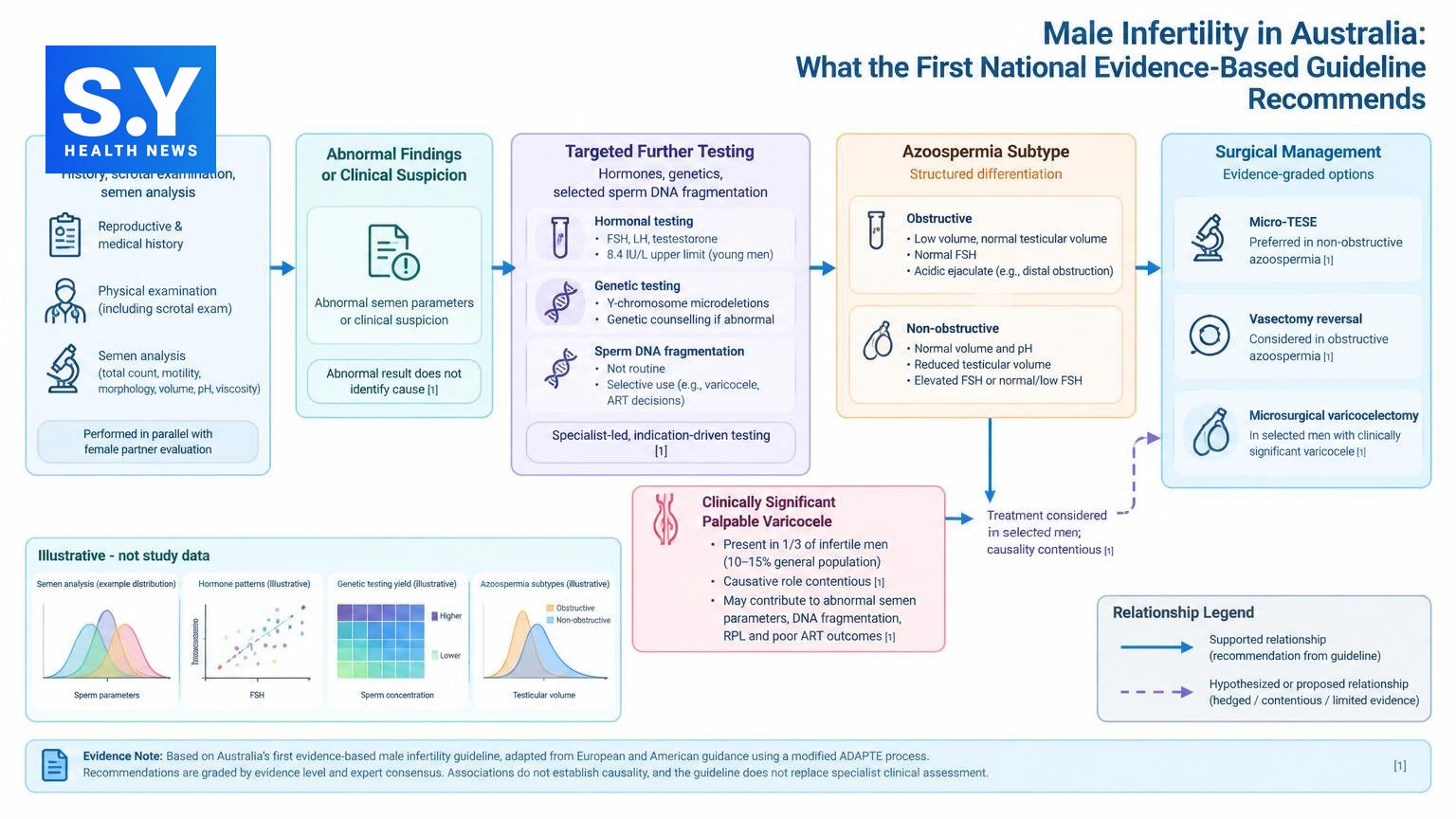
Conceptual framework: Conceptual framework of the variables discussed in this evidence review, based on Australia's first evidence-based male infertility guideline. Arrows show recommended assessment pathways and hedged or proposed relationships, such as the contentious contribution of varicocele to infertility and the limited role of sperm DNA fragmentation testing in varicocele decisions. This is an interpretive framework for a guideline adaptation and consensus document, not a tested causal model or a biological pathway; it does not quantify treatment effects and is not a substitute for specialist clinical assessment.
Academic References & Evidence
- Darren J Katz; Liza O’Donnell; Robert I McLachlan; Tim J Moss; Clare V Boothroyd; Veena Jayadev; Sarah R Catford. The first Australian evidence‐based guidelines on male infertility |…. Med J Aust. 2025 223(11) DOI: 10.5694/mja2.70080.
- Male infertility matters. 27(1)
- Girish P Joshi; Dileep N Lobo; Henrik Kehlet. Challenges in interpretaion of randomised clinical trials included in systematic reviews and clinical guidelines. British Journal of Anaesthesia. 2026
SANYUN Science Center explains published research on men's reproductive and sexual health, connecting scientific evidence with everyday questions while making sources and limitations clear.
Disclaimer: This article is for scientific education and research communication only. It does not provide medical advice, diagnosis, or individualized treatment recommendations, and does not endorse any medication, supplement, device, penile enlargement procedure, or other intervention. Decisions about sexual and reproductive health should be made in consultation with a qualified healthcare professional. Do not delay seeking professional care because of information in this article.
Original Content & Copyright Notice
- This article is prepared for SANYUN Science Center, drawing on published research and publicly available academic literature on men’s sexual and reproductive health. Its editorial explanations and presentation are developed for this platform.
- Copyright in the original editorial content, selection, and arrangement is reserved by SANYUN Science Center to the extent protected by applicable law. Referenced research, quotations, and third-party materials remain subject to the rights of their respective owners. This notice does not claim ownership of scientific facts or third-party research.
- Except where permitted by applicable law or an applicable license, prior written permission is required to reproduce, republish, translate, adapt, redistribute, or commercially reuse protected content. Attribution alone does not grant permission for such reuse.
- For permitted quotation or authorized reuse, clearly identify the source and retain a link to the original article.
- Source: SANYUN Science Center
- Original URL: Retain the original article URL on science.san-yun.com.
- Copyright Holder: SANYUN Science Center, for its own protected editorial content.
- Quotation, excerpts, or authorized reuse must not distort the scientific meaning, omit material limitations or disclaimers, or imply unverified medical claims, product efficacy, or endorsement by SANYUN Science Center.



