




Category: Clinical Insights
Core Research Direction: Clinical implications of the first Australian evidence-based male infertility guidelines: initial evaluation, varicocele and azoospermia management, and recognition of male infertility as a marker of broader health
Search Intent: What do the first Australian evidence-based male infertility guidelines recommend for evaluating and managing men with infertility, and how strong and applicable is the supporting evidence?
Platform: SANYUN Science Center
Evidence reviewed through: 2026-11-21
Executive Summary
In November 2025, the Medical Journal of Australia published the first Australian evidence-based guidelines on male infertility, developed by a multidisciplinary panel using a modified ADAPTE process that adapted existing European and American guidance to Australian practice. The panel produced 80 statements, each rated mandatory, recommended or suggested and stratified by GRADE evidence level. The guidelines cover initial evaluation, specialist further assessment, azoospermia, varicocele, cryptorchidism, genetic testing and counselling, and they explicitly frame male infertility as a marker of broader health.[1]
The headline clinical messages are practical rather than dramatic: evaluate the man and the woman in parallel; base initial assessment on history, scrotal examination and semen analysis; avoid routine scrotal ultrasound, antisperm antibody testing and routine sperm DNA fragmentation testing at first evaluation; refer to a male reproduction specialist for further work-up; distinguish obstructive from non-obstructive azoospermia before considering surgery; prefer micro-TESE for sperm retrieval in non-obstructive azoospermia; and treat clinically significant varicocele as a possible contributor rather than a proven universal cause.
The evidence base is mixed. Several recommendations rest on cited observational data or on consensus where randomised evidence is limited. The guidelines are a clinical aid, not a guarantee of improved live birth rates, and they do not replace individualised specialist assessment.
Why This Matters
Infertility affects about one in six couples, and male factors solely explain 20–30% of cases while contributing to about 50% of couple infertility overall. In Australia, one in three assisted reproductive technology cycles are used because of male factor infertility. Despite that burden, no Australian-specific male infertility guideline existed until this publication, and male infertility has often been managed within fertility services whose training is primarily in female reproduction.[2]
A specific cause remains unknown in 77% of male infertility cases despite thorough investigation. That figure shapes the guideline's purpose: much of the value lies in standardising a rational, non-overlapping evaluation, identifying the minority with treatable causes, and avoiding tests and procedures that add cost or risk without improving outcomes.
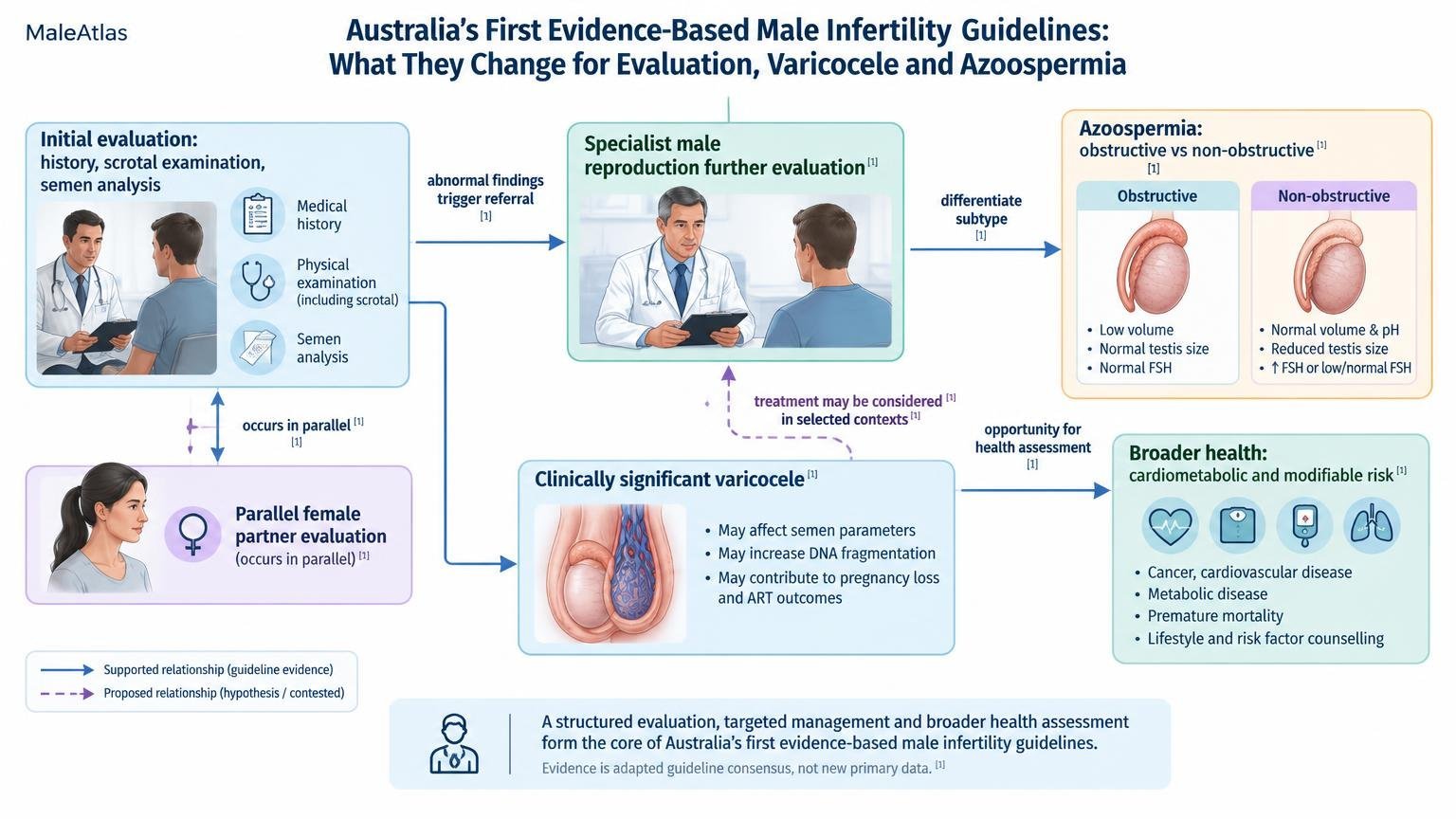
The guidelines also reposition male infertility as a health signal. Male infertility is associated with cancer, cardiovascular disease, metabolic disease and premature mortality, so the fertility consultation becomes an opportunity for cardiometabolic assessment and preventive care rather than a narrow sperm-count exercise.
How the Guidelines Were Built
The panel used a modified ADAPTE process, examining each statement from the European Association of Urology and the American Urological Association/American Society for Reproductive Medicine guidelines over meetings from July 2022 to November 2024. Where the international statements agreed, the panel judged applicability to Australia, considering access disparities, Medicare funding and population diversity, then reached consensus on 80 revised statements. Each statement was graded mandatory, recommended or suggested, and separately stratified by GRADE evidence level as high, moderate or low–very low.
This is adaptation, not de novo evidence synthesis. The advantage is pragmatic relevance and endorsement by Healthy Male, the Urological Society of Australia and New Zealand, the Endocrine Society of Australia and the Fertility Society of Australia and New Zealand. The limitation is that the underlying evidence base is inherited, and the summary article does not report the distribution of GRADE levels across all 80 statements. Confidence therefore varies statement by statement and cannot be assumed uniform.
Initial Evaluation: What to Do First
The first guideline statement recommends offering male fertility assessment to concerned men and couples, comprising general and reproductive history, physical examination including scrotal examination, and semen analysis. History should target risk factors and potential causes; examination should identify signs of systemic disease, androgen deficiency, testicular volume and scrotal pathology. Some causes, such as varicocele or a testicular mass, are detectable clinically and change management immediately.
Semen analysis remains the central laboratory test, interpreted alongside clinical assessment and the World Health Organization 2021 reference values rather than as a stand-alone diagnosis. An abnormal initial result should be repeated about six weeks later, consistent with the spermatogenic cycle. Routine scrotal ultrasound is not recommended at initial evaluation, although ultrasound retains a role for testicular volume when examination is unreliable, for example by telehealth or due to body habitus.
Routine antisperm antibody and sperm DNA fragmentation testing are not recommended at initial evaluation. Sperm DNA fragmentation testing is reserved for specific further-evaluation contexts, such as deciding whether to treat a varicocele or choosing testicular rather than ejaculated sperm for assisted reproduction. The parallel evaluation of the female partner is recommended to avoid delay; sequential rather than simultaneous assessment can waste months when a cause is found in either partner.
Specialist Further Evaluation and Hormonal Interpretation
Once male infertility is identified, further evaluation should be guided by a specialist in male reproduction. Hormonal assessment is recommended when abnormal semen parameters or clinical findings suggest male factor infertility or androgen deficiency, with blood collected before 10:00am and ideally fasting because testosterone peaks in the morning and glucose intake suppresses it.
The interpretation framework matters clinically. Isolated FSH elevation suggests primary spermatogenic failure; elevated FSH and LH with low testosterone suggests primary testicular failure, for which the guideline cites 8.4 IU/L as the most useful upper limit of normal FSH in a young man; low or inappropriately normal FSH and LH with low testosterone suggests hypogonadotrophic hypogonadism. These are interpretive patterns, not stand-alone diagnostic tests, and they direct subsequent genetic and imaging decisions.
Genetic testing is targeted rather than universal because of cost and offspring implications. Y-chromosome microdeletions occur in 5% of men with severe oligozoospermia below 5 million/mL and 10% of men with non-obstructive azoospermia, but in only about 0.8% of men with concentrations between 1 and 5 million/mL. Screening is therefore offered below 5 million/mL and described as mandatory below 1 million/mL.
Varicocele: A Contributor, Not a Uniform Cause
Varicoceles are present in about one-third of infertile men but also in 10–15% of the general male population, and the guidelines explicitly describe their causative role as contentious. This prevalence overlap is the core interpretive problem: finding a varicocele does not prove it is causing infertility. The guidelines therefore emphasise clinically significant, palpable varicoceles rather than those detected only by ultrasound.
Clinically significant varicoceles can cause or contribute to abnormal semen parameters, sperm DNA fragmentation, recurrent pregnancy loss and poor assisted reproduction outcomes, and treatment should be considered in those contexts. Microsurgical varicocelectomy may improve pregnancy rates compared with other surgical treatments and has the lowest complication rate, though availability may require alternative surgical or embolisation approaches. Evidence for varicocelectomy before micro-TESE in non-obstructive azoospermia is mixed, so it is not recommended and should be considered only in selected cases.
Azoospermia: Distinguish First, Then Retrieve
Azoospermia accounts for about 10–15% of male infertility and is the most severe presentation. The first decision is obstructive versus non-obstructive. Obstructive azoospermia typically shows low-volume ejaculate, normal testicular volume and normal FSH, with acidic ejaculate when obstruction is distal to the seminal vesicles. Non-obstructive azoospermia typically shows normal volume and pH with reduced testicular volume and either elevated FSH in primary testicular failure or low/normal FSH in hypogonadotrophic hypogonadism.
Routine diagnostic testicular biopsy is not recommended because it may compromise future sperm retrieval, particularly in non-obstructive azoospermia. For sperm retrieval in non-obstructive azoospermia, micro-TESE is the preferred and gold-standard technique because retrieval rates are higher than with other methods; when micro-TESE is unavailable, conventional open TESE can be used, but fine needle aspiration should not be the definitive technique. No known clinical or endocrine marker reliably predicts retrieval success, so counselling must remain honest about uncertainty.
Routine medical pretreatment with hCG, FSH, antioestrogens or aromatase inhibitors before TESE in non-obstructive azoospermia due to primary spermatogenic failure is not supported by current evidence, although selected cases may be considered. For men with prior vasectomy, the guidelines reinforce both vasectomy reversal and sperm retrieval as legitimate options, and after successful reversal, sperm cryopreservation should be considered because delayed anastomotic fibrosis can occur in about 10% of men who initially have sperm return to the ejaculate.
Male Infertility as a Health Marker
The guidelines include a distinct statement on non-gonadal health because this association is often under-recognised in fertility clinics. Male infertility is associated with cancer, cardiovascular disease, metabolic disease and premature mortality. A practical implication is cardiometabolic assessment covering obesity, obstructive sleep apnoea, hypertension and undiagnosed or poorly controlled diabetes, alongside counselling on modifiable factors.
Modifiable-factor counselling includes sustained weight loss in men with obesity, which improves sperm count, and regular physical activity with a nutrient-rich diet, which improves sperm quality. These are directional claims without effect sizes in the guideline summary, so they should be framed as plausible benefit rather than guaranteed reversal. Sperm quality also deteriorates with age, with increased risks of autism spectrum disorder and some autosomal dominant diseases in offspring, which is relevant to reproductive timing discussions.
What the Guidelines Do Not Support
Several common practices are explicitly not recommended: routine scrotal ultrasound at initial evaluation, routine antisperm antibody testing, routine sperm DNA fragmentation testing at first assessment, routine diagnostic testicular biopsy in azoospermia, and routine antibiotics or antioxidants, which do not improve live birth rates. These negative recommendations are as clinically important as positive ones because they reduce low-value care and iatrogenic risk.
| Clinical question | Guideline position | Evidence character |
|---|---|---|
| Initial evaluation components | History, physical including scrotal examination, semen analysis; parallel female evaluation | Consensus recommendation from adapted international guidance |
| Abnormal semen analysis | Repeat about 6 weeks after initial abnormal result | Recommendation reflecting spermatogenic cycle |
| Routine scrotal ultrasound | Not recommended at initial evaluation; retained for specific indications | Recommendation; avoids low-yield imaging |
| Clinically significant varicocele | Treatment may be considered when associated with abnormal semen, DNA fragmentation, recurrent loss or poor ART outcomes | Association described; causality explicitly contentious |
| Varicocelectomy before micro-TESE in NOA | Not recommended; selected cases only | Mixed evidence |
| Sperm retrieval in NOA | Micro-TESE preferred; routine diagnostic biopsy not recommended | Higher retrieval rates cited; no reliable predictors identified |
| Routine antibiotics or antioxidants | Not recommended | No improvement in live birth rates |
Interpretation and Limitations
The guidelines are an adaptation with real strengths: broad stakeholder endorsement, explicit grading, Australian access considerations and practical attention to who should refer and when. The main limitation is inherited evidence. Many statements depend on observational associations or expert consensus, and this summary does not report the proportion of statements graded high versus low–very low. Readers should not assume that a mandatory label implies high-certainty evidence; it reflects both evidence and perceived importance.
Several areas remain genuinely uncertain. The causal role of varicocele is contested despite plausible mechanisms. Surgically retrieved sperm for ICSI in non-azoospermic men with high DNA fragmentation or cryptozoospermia may improve pregnancy and live birth rates, but high-quality data are lacking, so this remains a hypothesis-generating option rather than an established standard. No marker reliably predicts micro-TESE success, which limits preoperative counselling.
Another limitation is scope. The summary article emphasises major categories and does not quantify outcomes such as live birth rates attributable to the guideline changes. Implementation will also depend on workforce and access, since male infertility in Australia is managed across general practice, urology, endocrinology and fertility services. The guidelines were developed for cis males, and applicability to other populations should not be assumed.
Research and Clinical Outlook
The clearest research priorities follow from the gaps: better prediction of sperm retrieval in non-obstructive azoospermia, higher-quality trials of surgical versus ejaculated sperm for ICSI in specific non-azoospermic groups, and clearer evidence on when varicocele treatment changes reproductive outcomes rather than only semen parameters. Implementation research will also matter, because a guideline only changes care if referral pathways and funding allow men to reach specialist evaluation early.
For clinicians, the practical shift is to treat the fertility consultation as a general men's health assessment with reproductive focus: examine the scrotum, interpret semen analysis cautiously, avoid reflexive testing, assess cardiometabolic risk, and involve male reproduction specialists early when indicated. For patients, the message is that male infertility is common, often unexplained, and not solely a fertility issue.
Key Takeaways
- Australia's first evidence-based male infertility guidelines adapt international guidance into 80 graded statements covering evaluation, azoospermia, varicocele, genetics and health counselling.
- Initial evaluation should combine history, scrotal examination and semen analysis, with parallel female partner assessment and repeat semen analysis about six weeks after an abnormal result.
- Routine scrotal ultrasound, antisperm antibody testing, sperm DNA fragmentation testing, testicular biopsy and antibiotics or antioxidants are not recommended in the contexts specified.
- Clinically significant palpable varicocele may warrant treatment in selected contexts, but causality is contested and varicocelectomy before micro-TESE in non-obstructive azoospermia is not recommended.
- Micro-TESE is the preferred retrieval method in non-obstructive azoospermia, while no clinical or endocrine marker reliably predicts retrieval success.
- Male infertility is associated with cardiometabolic disease, cancer and premature mortality, supporting broader health assessment and modifiable-risk counselling.
Questions and Answers
What do the first Australian male infertility guidelines recommend for initial evaluation?
They recommend offering male fertility assessment with general and reproductive history, physical examination including scrotal examination, and semen analysis, performed in parallel with female partner evaluation. An abnormal semen analysis should be repeated about six weeks later. Routine scrotal ultrasound, antisperm antibody testing and sperm DNA fragmentation testing are not recommended at initial evaluation; testing is targeted by indication.
How strong is the evidence behind the Australian male infertility guidelines?
The guidelines adapted European and American guidance through a modified ADAPTE process, producing 80 statements graded mandatory, recommended or suggested and stratified by GRADE. This is adaptation rather than new systematic review, and the summary does not report how many statements are high versus low–very-low certainty. Several recommendations rest on observational associations or consensus, so certainty varies by statement.
Should a varicocele be treated in men with infertility?
Treatment should be considered when a clinically significant palpable varicocele is associated with abnormal semen parameters, sperm DNA fragmentation, recurrent pregnancy loss or poor assisted reproduction outcomes. Causality remains contentious because varicoceles are also common in fertile men. Microsurgical varicocelectomy may offer the best pregnancy rates with the lowest complications, but varicocelectomy before micro-TESE in non-obstructive azoospermia is not recommended.
What is micro-TESE and when is it recommended for non-obstructive azoospermia?
Micro-TESE is microsurgical testicular sperm extraction, used to find sperm in men with non-obstructive azoospermia. It is the preferred and gold-standard retrieval method because reported retrieval rates are higher than with other techniques. Routine diagnostic biopsy beforehand is not recommended because it may compromise future retrieval, and no clinical or endocrine marker reliably predicts success.
Is male infertility linked to other health conditions?
Yes, as an association rather than proven causation. The guidelines note links between male infertility and cancer, cardiovascular disease, metabolic disease and premature mortality. They recommend cardiometabolic assessment for conditions such as obesity, obstructive sleep apnoea, hypertension and poorly controlled diabetes, plus counselling on modifiable factors such as weight, diet and physical activity.
Which tests and treatments are not recommended in the Australian male infertility guidelines?
The guidelines do not recommend routine scrotal ultrasound, antisperm antibody testing or sperm DNA fragmentation testing at initial evaluation, routine diagnostic testicular biopsy in azoospermia, or routine antibiotics and antioxidants, which do not improve live birth rates. Varicocelectomy before micro-TESE in non-obstructive azoospermia and routine hormonal pretreatment before TESE are also not supported outside selected cases.
Conceptual framework: Conceptual framework, not a tested causal model. The diagram summarises relationships described in the Australian male infertility guidelines: initial evaluation proceeds in parallel with female partner assessment; abnormal findings prompt specialist referral; azoospermia requires obstructive versus non-obstructive subtyping; clinically significant varicocele may be considered for treatment in selected contexts, though causality is contested; and the fertility visit is an opportunity for broader health assessment. Evidence is adapted guideline consensus, not new primary data.
Academic References & Evidence
- Darren J Katz; Liza O’Donnell; Robert I McLachlan; Tim J Moss; Clare V Boothroyd; Veena Jayadev; Sarah R Catford. The first Australian evidence‐based guidelines on male infertility |…. Med J Aust. 2025 223(11) DOI: 10.5694/mja2.70080.
- Male infertility matters. 2026 27(1)
SANYUN Science Center explains published research on men's reproductive and sexual health, connecting scientific evidence with everyday questions while making sources and limitations clear.
Disclaimer: This article is for scientific education and research communication only. It does not provide medical advice, diagnosis, or individualized treatment recommendations, and does not endorse any medication, supplement, device, penile enlargement procedure, or other intervention. Decisions about sexual and reproductive health should be made in consultation with a qualified healthcare professional. Do not delay seeking professional care because of information in this article.
Original Content & Copyright Notice
- This article is prepared for SANYUN Science Center, drawing on published research and publicly available academic literature on men’s sexual and reproductive health. Its editorial explanations and presentation are developed for this platform.
- Copyright in the original editorial content, selection, and arrangement is reserved by SANYUN Science Center to the extent protected by applicable law. Referenced research, quotations, and third-party materials remain subject to the rights of their respective owners. This notice does not claim ownership of scientific facts or third-party research.
- Except where permitted by applicable law or an applicable license, prior written permission is required to reproduce, republish, translate, adapt, redistribute, or commercially reuse protected content. Attribution alone does not grant permission for such reuse.
- For permitted quotation or authorized reuse, clearly identify the source and retain a link to the original article.
- Source: SANYUN Science Center
- Original URL: Retain the original article URL on science.san-yun.com.
- Copyright Holder: SANYUN Science Center, for its own protected editorial content.
- Quotation, excerpts, or authorized reuse must not distort the scientific meaning, omit material limitations or disclaimers, or imply unverified medical claims, product efficacy, or endorsement by SANYUN Science Center.



