




Category: Clinical Insights
Core Research Direction: The first Australian evidence-based clinical practice guidelines for male infertility: how the guideline panel translated prior European and American recommendations into Australian-context statements, what the key diagnostic and management recommendations are, and the limits of the underlying evidence.
Search Intent: What do Australia's first evidence-based guidelines recommend for evaluating and managing male infertility, and how were those recommendations developed?
Platform: SANYUN Science Center
Evidence reviewed through: 2026-11-10
Executive Summary
In 2025, a multidisciplinary Australian panel published the country's first evidence-based clinical practice guidelines on male infertility, summarised in the Medical Journal of Australia and endorsed by Healthy Male, the Urological Society of Australia and New Zealand, the Endocrine Society of Australia, and the Fertility Society of Australia and New Zealand.[1][2]
The panel did not conduct new primary research. It used a modified ADAPTE process, systematically reviewing each statement in existing European and American male infertility guidelines over meetings from July 2022 to November 2024, then adapting them for Australian access, funding, and population considerations. Consensus produced 80 revised statements, each rated as mandatory, recommended, or suggested and stratified by GRADE evidence level.
Key recommendations cover initial evaluation with history, scrotal examination and semen analysis alongside simultaneous female partner assessment; selective rather than routine additional testing; specialist-guided hormonal evaluation; clinical rather than ultrasound-only varicocele criteria; differentiation of obstructive and non-obstructive azoospermia; micro-TESE as the preferred retrieval method in non-obstructive azoospermia; and counselling on modifiable risk factors and associated health conditions.
The guidelines are a genuine structural advance for a condition where male factors contribute to about half of couple infertility and a specific cause remains unknown in 77% of cases. Their central limitation is inherited: they are adaptations of prior guidelines, and the evidence base behind many surgical and laboratory recommendations is graded low to very low, with several statements explicitly hedged or described as lacking high-quality data.
Why This Matters: A Gap in Australian Care
Infertility, defined as failure to achieve spontaneous pregnancy despite at least 12 months of regular unprotected intercourse, affects about one in six couples. In Australian data cited by the guideline summary, male factors solely explain 20–30% of cases and contribute to about 50% of couple infertility overall. One in three Australian assisted reproductive technology cycles is used because of male factor infertility.
Male infertility is usually characterised by quantitative or qualitative defects in spermatogenesis arising from primary spermatogenic failure, genital tract obstruction, sexual dysfunction, or rarely hypogonadotrophic hypogonadism. Despite thorough investigation, a specific cause is unknown in 77% of cases. The guidelines also frame male infertility as a biomarker for overall health, creating an opportunity for preventive and remedial health intervention.
The practical problem the guidelines address is structural rather than biological. In Australia, male infertility has traditionally been managed by a range of clinicians, including general practitioners, urologists, endocrinologists, and particularly obstetricians and gynaecologists working through assisted reproduction. Commentary published by the Royal Australasian College of Surgeons argues that the field has lagged behind Europe and North America, where male infertility is more often managed by subspecialised urologists.
That commentary is a professional-organisation news piece, not independent research, and it carries an advocacy perspective, including the view that the new guidelines place male infertility specialists at the forefront of care. Its claim that men are just as likely as women to struggle with infertility is not statistically supported within the quoted passage. It is best read as context for why the guidelines matter professionally, not as epidemiological evidence.
How the Guidelines Were Built
The development method matters for interpreting the recommendations. A modified ADAPTE process was used — an established approach for adapting existing guidelines to a new context rather than generating recommendations de novo. The panel recognised two well-established evidence-based guidelines, from the European Association of Urology and from the American Urological Association with the American Society for Reproductive Medicine, and examined each statement from both.
Where the European and American guidelines agreed, the panel discussed whether the statement applied to Australia, weighing regional disparities in access to care, Medicare funding arrangements, and the composition of the Australian population, including Indigenous people. Statements were modified through group agreement or dissent, caveats, and comment, with consensus reached on 80 revised statements.
The panel comprised a urologist with a special interest in male infertility, reproductive endocrinologists with andrology expertise, a reproductive endocrinologist and gynaecologist with assisted reproduction expertise, and consumer representation from Healthy Male. Conflicts of interest were disclosed. The commentary describes the process as three years in the making and led by a Melbourne urologist who was the only Royal Australasian College of Surgeons representative on the panel.
Each statement was rated as mandatory, recommended, or suggested based on the level of evidence and the panel's perceived importance of adherence, and stratified using GRADE categories of high, moderate, or low to very low. External review by relevant Australian professional organisations was integrated before finalisation. The summary article does not report the number of statements in each GRADE category or the formal consensus threshold used, which limits how transparently readers can judge the strength distribution.
What the Evidence Shows: Diagnostic Recommendations
Table 1 summarises the principal evaluation and management recommendations discussed in the guideline summary, with the source-grounded caveats attached to each.
| Recommendation area | Guideline statement | Evidence or practice caveat |
|---|---|---|
| Initial evaluation | Offer history, physical examination including scrotal examination, and semen analysis to concerned men and couples; assess the female partner in parallel. | Stated as GS1 and GS2; the excerpt does not report the recommendation strength or GRADE rating. |
| Repeat semen analysis | If an initial semen analysis is abnormal, repeat it about 6 weeks later. | GS4; criteria beyond reference values and the rationale for the interval are not detailed in the excerpt. |
| Routine additional tests | Routine scrotal ultrasound, antisperm antibody testing, and sperm DNA fragmentation testing are not recommended in initial evaluation. | Stated as GS8, GS6 and GS17; sperm DNA fragmentation testing is reserved for specific decisions such as varicocele treatment or choice of testicular sperm. |
| Hormonal evaluation | Recommended when male factor infertility or androgen deficiency is suspected from abnormal semen parameters or clinical findings. | GS11; bloods ideally before 10:00am and fasting. Isolated FSH elevation suggests primary spermatogenic failure; low testosterone with elevated FSH and LH suggests primary testicular failure; low or inappropriately normal FSH and LH suggests hypogonadotrophic hypogonadism. |
| Testicular volume | An estimate of testicular volume is part of specialist further evaluation. | Ultrasound-assessed volume below 12 mL is associated with poorer semen parameters in infertile men; correlation, not proof of causation. |
| Genetic testing | Targeted rather than universal testing; Y-chromosome microdeletion screening offered below 5 million/mL and mandatory below 1 million/mL. | Prevalence estimates of 5% in severe oligozoospermia and 10% in non-obstructive azoospermia; cost and out-of-pocket burden are explicit considerations. |
| Varicocele | Only palpable varicoceles, not those detected exclusively by ultrasound, are considered clinically significant; treatment may be considered when clinical indications are present. | GS40 and GS41; prevalence is about one-third in infertile men versus 10–15% in the general population, but the causative role remains contentious. |
| Azoospermia | Differentiate obstructive from non-obstructive azoospermia; micro-TESE is the preferred retrieval method in non-obstructive azoospermia. | Azoospermia accounts for about 10–15% of male infertility. No known clinical or endocrine markers reliably predict sperm retrieval rate. |
Several design choices in the diagnostic recommendations are notable. Routine scrotal ultrasound is explicitly not recommended at initial evaluation, in contrast to a tendency toward imaging-driven workups. Ultrasound is reserved for situations where physical examination is not possible or adequate, such as telehealth assessment or limitations from body habitus. Similarly, routine antisperm antibody and sperm DNA fragmentation testing are discouraged, with DNA fragmentation testing positioned for specific management decisions rather than screening.
The hormonal recommendations include practical timing advice: serum testosterone peaks in the early morning and glucose consumption suppresses testosterone production, so blood should be collected before 10:00am and ideally fasting. The guideline cites 8.4 IU/L as the most useful upper limit of normal for FSH in a young man, though the reference population and assay standardisation behind that figure are not detailed in the summary.
Genetic testing is framed around cost-effectiveness and targeted use, with explicit acknowledgment of out-of-pocket costs. Y-chromosome microdeletion screening is offered to men with sperm concentration below 5 million/mL and mandatory below 1 million/mL, reflecting prevalence estimates of 5% in severe oligozoospermia and 10% in non-obstructive azoospermia, with a much lower frequency of about 0.8% between 1 and 5 million/mL.
Management and Surgical Recommendations
On varicocele, the guideline draws a firm clinical line: only varicoceles palpable on examination, not those detected exclusively by ultrasound, are considered clinically significant. Clinically significant varicoceles are described as potentially contributing to abnormal semen parameters, sperm DNA fragmentation, recurrent pregnancy loss, and poor assisted reproduction outcomes, and treatment may be considered in those contexts. Microsurgical varicocelectomy may improve pregnancy rates compared with other surgical treatments and has the lowest complication rate, but the hedged language and absent effect sizes indicate limited certainty.
The varicocele evidence is genuinely contested. Prevalence is about one-third among infertile men versus 10–15% in the general population, a difference that could reflect causation, selection, or both. The guideline panel itself describes the causative role as contentious. For men with non-obstructive azoospermia, varicocelectomy before micro-TESE is not recommended because the supporting evidence is mixed; it should be considered only in select cases, a category the summary does not define.
Surgical sperm retrieval recommendations are the most consequential changes in practice. Micro-TESE is described as the gold standard for non-obstructive azoospermia because it achieves higher sperm retrieval rates than other techniques. Prior diagnostic biopsy or fine needle aspiration is not required, because every potential histology finding in non-obstructive azoospermia may still be associated with sperm production owing to heterogeneity between tubules, and because biopsy may compromise future retrieval.
The guideline also acknowledges what cannot be predicted. No known clinical or endocrine markers reliably predict sperm retrieval rates in non-obstructive azoospermia, which means counselling before micro-TESE necessarily involves uncertainty. Fine needle aspiration should not be used as the definitive technique in non-obstructive azoospermia, although conventional random open TESE can be used where micro-TESE is unavailable.
For non-azoospermic men with high sperm DNA fragmentation in ejaculated sperm or cryptozoospermia, particularly couples with previous intracytoplasmic sperm injection failure using ejaculated sperm, surgically retrieved sperm may improve pregnancy and live birth rates. The guideline is explicit that high-quality data are lacking. This is a hypothesis-level recommendation, not an established treatment effect, and it should be presented to patients as such.
Vasectomy is the most common cause of obstructive azoospermia, with about 25% of Australian men older than 40 having undergone the procedure, and about 3–6% of men consider having another child afterwards. Both vasectomy reversal and sperm extraction for assisted reproduction should be discussed. If reconstructive surgery succeeds, cryopreservation of ejaculated sperm should be considered because delayed anastomotic fibrosis can occur in about 10% of men who initially have sperm return to the ejaculate.
Counselling recommendations extend beyond fertility. Clinicians are advised to counsel on modifiable factors, and to recognise associations between male infertility and non-gonadal conditions including cancer, cardiovascular disease, metabolic disease, and premature mortality. A cardiometabolic assessment is advised to identify obesity, obstructive sleep apnoea, hypertension, and undiagnosed or poorly controlled diabetes. In obesity, sustained weight loss is described as improving sperm count, and regular physical activity and a nutrient-rich diet as improving sperm quality.
The guideline also warns against low-value interventions. Routine antibiotics and antioxidants are not recommended because they do not improve live birth rates, a statement that applies even in the context of pyospermia, where infection is only one possible cause. Given how commonly supplements are marketed to men with infertility, this recommendation has direct practical value.
Interpretation and Limitations
The most important interpretive point is that these are adapted guidelines, not a new evidence synthesis. The panel's contribution was contextual translation and consensus, not generation of primary data. That makes the guidelines valuable for standardising Australian care and for legitimising male-focused assessment, but it does not upgrade the underlying evidence. Where the European or American source statements rested on weak evidence, the Australian adaptation inherits that weakness.
The summary article does not report the distribution of statements across GRADE categories, the formal consensus threshold, or the full evidence tables. Readers therefore cannot easily judge whether the strongest recommendations rest on high-quality evidence or on panel judgment. This is a transparency limitation of the summary rather than necessarily of the full guideline, which is published separately and freely available.
Several recommendations use hedged language that patients and clinicians should not overread. Microsurgical varicocelectomy may improve pregnancy rates; surgically retrieved sperm may improve pregnancy and live birth rates in selected non-azoospermic men. The phrasing reflects genuine uncertainty rather than editorial caution. Where the guideline says high-quality data are lacking, the appropriate clinical message is that a strategy is plausible and selectively offered, not proven superior.
A broader caution about guideline strength comes from outside male infertility. An exploratory methodologic study of guidelines on decompensated cirrhosis in the United States and Europe found that agreement between guideline authors and independent assessment against Cochrane reviews was 14.5% (95% CI 7.7% to 25.6%), with most disagreements reflecting overstatement of recommendation strength. That study examined a different clinical topic, used purposive sampling, and does not evaluate the Australian male infertility guidelines. It is not transferable evidence of a flaw here, but it is a useful reminder that recommendation strength and evidence certainty are not the same thing.[3]
Applicability beyond Australia is partial. The commentary argues that the principles and evidence apply equally to Aotearoa New Zealand because referral patterns, training pathways, and clinical challenges closely mirror those across the Tasman. That claim is plausible but is a professional commentary assertion, not a formal cross-jurisdiction validation. For readers in other health systems, the diagnostic logic is broadly transferable, but the recommendations shaped by Medicare funding and local access are not.
Research Outlook and Unresolved Questions
The guidelines identify several areas where evidence is insufficient rather than settled. The role of varicocelectomy before micro-TESE in non-obstructive azoospermia remains mixed. The use of surgically retrieved sperm in non-azoospermic men with high DNA fragmentation or cryptozoospermia lacks high-quality comparative data. Reliable prediction of sperm retrieval in non-obstructive azoospermia is not available. These are research questions, not merely implementation gaps.
Implementation is a separate challenge. Recommendations that depend on specialist referral, microsurgical expertise, and genetic testing availability will not be equally deliverable across regional Australia, which the panel explicitly considered when adapting statements. The commentary notes growing demand for fertility-literate surgeons and raises emerging technologies, including artificial intelligence assisting sperm identification, as future directions. Those are forward-looking professional expectations, not current evidence of benefit.
For clinicians, the most useful reading is procedural: the guidelines standardise what to do first, what not to do routinely, when to refer, and how to counsel about health beyond fertility. For patients, the most useful reading is that male evaluation is legitimate and necessary, that not every available test is recommended, and that several surgical options are reasonable to discuss while remaining supported by limited evidence.
Key Takeaways
- The guidelines are the first Australian evidence-based guidance on male infertility, built by adapting European and American guidelines through a modified ADAPTE process and consensus over meetings from July 2022 to November 2024, producing 80 revised statements stratified by GRADE.
- Initial evaluation should include reproductive and medical history, physical and scrotal examination, and semen analysis, with the female partner assessed in parallel; routine scrotal ultrasound and routine antisperm antibody or sperm DNA fragmentation testing are not recommended at this stage.
- Only palpable varicoceles are considered clinically significant, and treatment may be considered when clinical indications such as abnormal semen parameters, sperm DNA fragmentation, recurrent pregnancy loss, or poor assisted reproduction outcomes are present.
- Micro-TESE is the preferred retrieval method in non-obstructive azoospermia, prior diagnostic biopsy is unnecessary, and no known clinical or endocrine marker reliably predicts retrieval success.
- Routine antibiotics and antioxidants are not recommended because they do not improve live birth rates, and male infertility should prompt counselling on modifiable risk factors and associated cardiometabolic and other health conditions.
- Several recommendations rest on low-certainty or mixed evidence and are hedged accordingly; the guideline summary does not report the distribution of GRADE ratings, so strength of recommendation should not be read as proof of efficacy.
Questions and Answers
How were Australia's first male infertility guidelines developed?
A multidisciplinary panel used a modified ADAPTE process, examining each statement in the European and American male infertility guidelines over meetings from July 2022 to November 2024. Where recommendations agreed, the panel assessed applicability to Australia, considering access disparities, Medicare funding and population diversity. Consensus produced 80 revised statements, each rated mandatory, recommended or suggested and stratified by GRADE. External professional review was integrated before finalisation.
What does the initial evaluation of male infertility involve according to the Australian guidelines?
The first statement recommends offering a general and reproductive history, a physical examination including scrotal examination, and semen analysis to concerned men and couples, with the female partner assessed simultaneously. Routine scrotal ultrasound, antisperm antibody testing and sperm DNA fragmentation testing are not recommended at initial evaluation. An abnormal semen analysis should be repeated about 6 weeks later, and suspected cases should be referred to a specialist in male reproduction.
When is varicocele treatment recommended in male infertility?
Only varicoceles palpable on examination, rather than those detected exclusively by ultrasound, are considered clinically significant. Treatment may be considered when a clinical varicocele is associated with indications such as abnormal semen parameters, sperm DNA fragmentation, recurrent pregnancy loss or poor assisted reproduction outcomes. Microsurgical varicocelectomy may improve pregnancy rates and has the lowest complication rate, but the evidence is hedged. Varicocelectomy before micro-TESE in non-obstructive azoospermia is not recommended because evidence is mixed.
Why is micro-TESE preferred for sperm retrieval in non-obstructive azoospermia?
Micro-TESE is described as the gold standard because it achieves higher sperm retrieval rates than other techniques in non-obstructive azoospermia. Prior diagnostic biopsy or fine needle aspiration is not required, since tubule heterogeneity means any histology finding may still coexist with sperm production, and biopsy may compromise future retrieval. No known clinical or endocrine markers reliably predict retrieval success, so counselling must acknowledge uncertainty.
How strong is the evidence behind the Australian male infertility guidelines?
The guidelines adapt existing European and American recommendations rather than generating new evidence, and each statement is graded using GRADE from high to low–very low. Several recommendations are explicitly hedged or described as lacking high-quality data, including surgically retrieved sperm in selected non-azoospermic men and varicocelectomy before micro-TESE. The summary article does not report how many statements fall into each GRADE category, limiting readers' ability to judge overall certainty.
Does the Australian guidance apply outside Australia, and what are its main limits?
The diagnostic logic is broadly transferable, but recommendations shaped by Medicare funding and local access are Australia-specific. Professional commentary argues the principles apply equally to Aotearoa New Zealand given similar referral patterns and training pathways, though that is a commentary assertion rather than formal validation. The main limits are inherited weak evidence, absent GRADE distribution data in the summary, and unresolved questions such as predicting sperm retrieval or the role of varicocelectomy before micro-TESE.
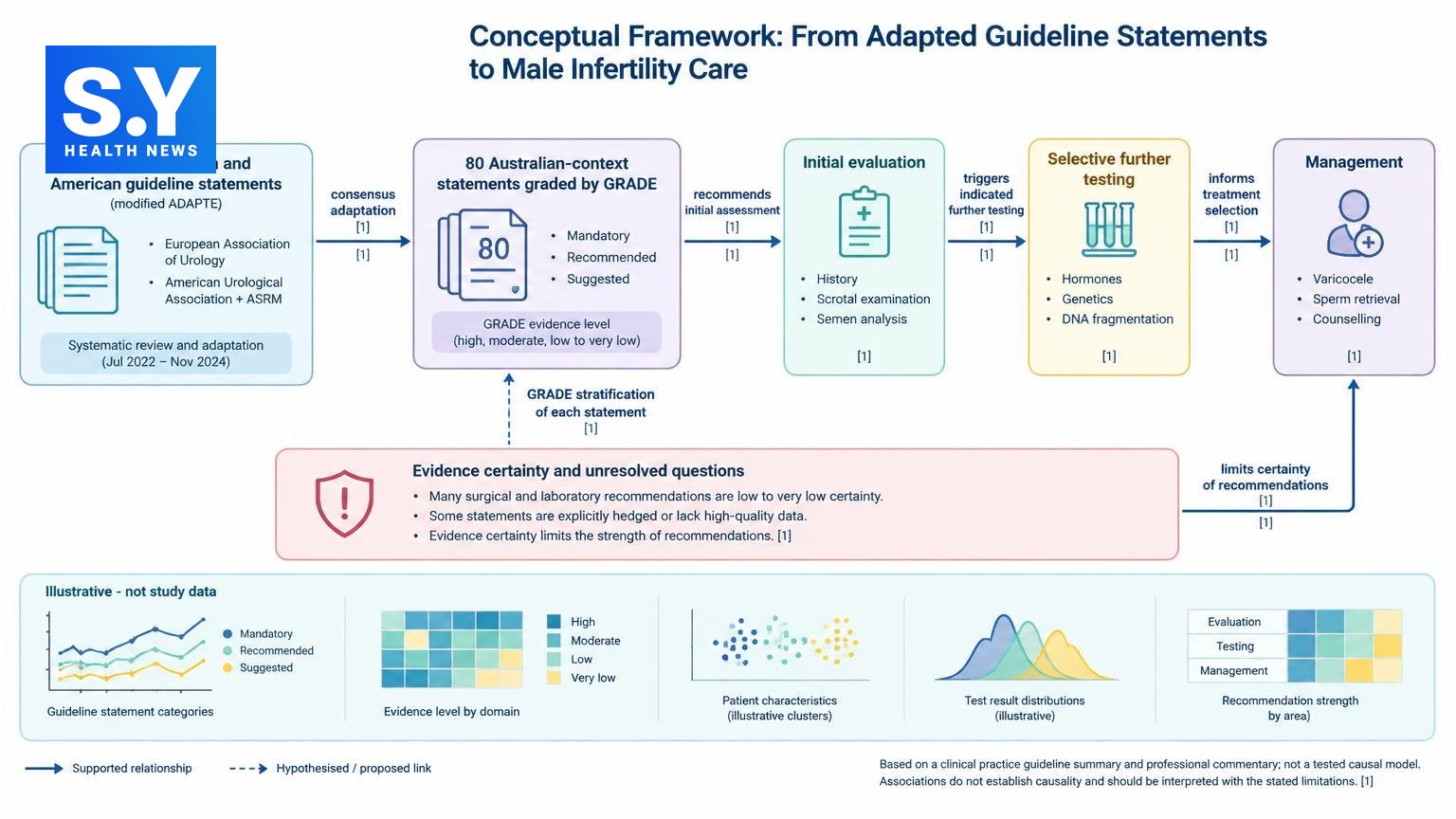
Conceptual framework: Conceptual framework. Adapted guideline statements were translated into 80 Australian-context statements, which structure initial evaluation, selective further testing and management of male infertility. Solid arrows indicate relationships described in the guideline summary; evidence certainty, including low-certainty and mixed evidence, is shown as a constraint rather than a tested causal pathway. Based on a clinical practice guideline summary and professional commentary; not a tested causal model.
Academic References & Evidence
- Darren J Katz; Liza O'Donnell; Robert I McLachlan; Tim J Moss; Clare V Boothroyd; Veena Jayadev; Sarah R Catford. The first Australian evidence‐based guidelines on male infertility |…. Med J Aust. 2025 223(11) DOI: 10.5694/mja2.70080.
- Male infertility matters. Surgical News (Royal Australasian College of Surgeons). 2026 27(1)
- Clinical practice guidelines recommendations compared to the findings of the Cochrane systematic reviews on the management of decompensated liver cirrhosis in the USA and Europe.
SANYUN Science Center explains published research on men's reproductive and sexual health, connecting scientific evidence with everyday questions while making sources and limitations clear.
Disclaimer: This article is for scientific education and research communication only. It does not provide medical advice, diagnosis, or individualized treatment recommendations, and does not endorse any medication, supplement, device, penile enlargement procedure, or other intervention. Decisions about sexual and reproductive health should be made in consultation with a qualified healthcare professional. Do not delay seeking professional care because of information in this article.
Original Content & Copyright Notice
- This article is prepared for SANYUN Science Center, drawing on published research and publicly available academic literature on men’s sexual and reproductive health. Its editorial explanations and presentation are developed for this platform.
- Copyright in the original editorial content, selection, and arrangement is reserved by SANYUN Science Center to the extent protected by applicable law. Referenced research, quotations, and third-party materials remain subject to the rights of their respective owners. This notice does not claim ownership of scientific facts or third-party research.
- Except where permitted by applicable law or an applicable license, prior written permission is required to reproduce, republish, translate, adapt, redistribute, or commercially reuse protected content. Attribution alone does not grant permission for such reuse.
- For permitted quotation or authorized reuse, clearly identify the source and retain a link to the original article.
- Source: SANYUN Science Center
- Original URL: Retain the original article URL on science.san-yun.com.
- Copyright Holder: SANYUN Science Center, for its own protected editorial content.
- Quotation, excerpts, or authorized reuse must not distort the scientific meaning, omit material limitations or disclaimers, or imply unverified medical claims, product efficacy, or endorsement by SANYUN Science Center.



