




Category: Penile Size
Core Research Direction: Pooled evidence on average erect penile girth (circumference), why self-measured vs. professionally measured samples diverge, and how a range-based estimate should be interpreted rather than treated as a diagnostic cutoff
Search Intent: What is the average erect penile girth according to pooled measurements, and how wide is the normal variation around that average?
Platform: SANYUN Science Center
Evidence reviewed through: 2026-11-25
Executive Summary
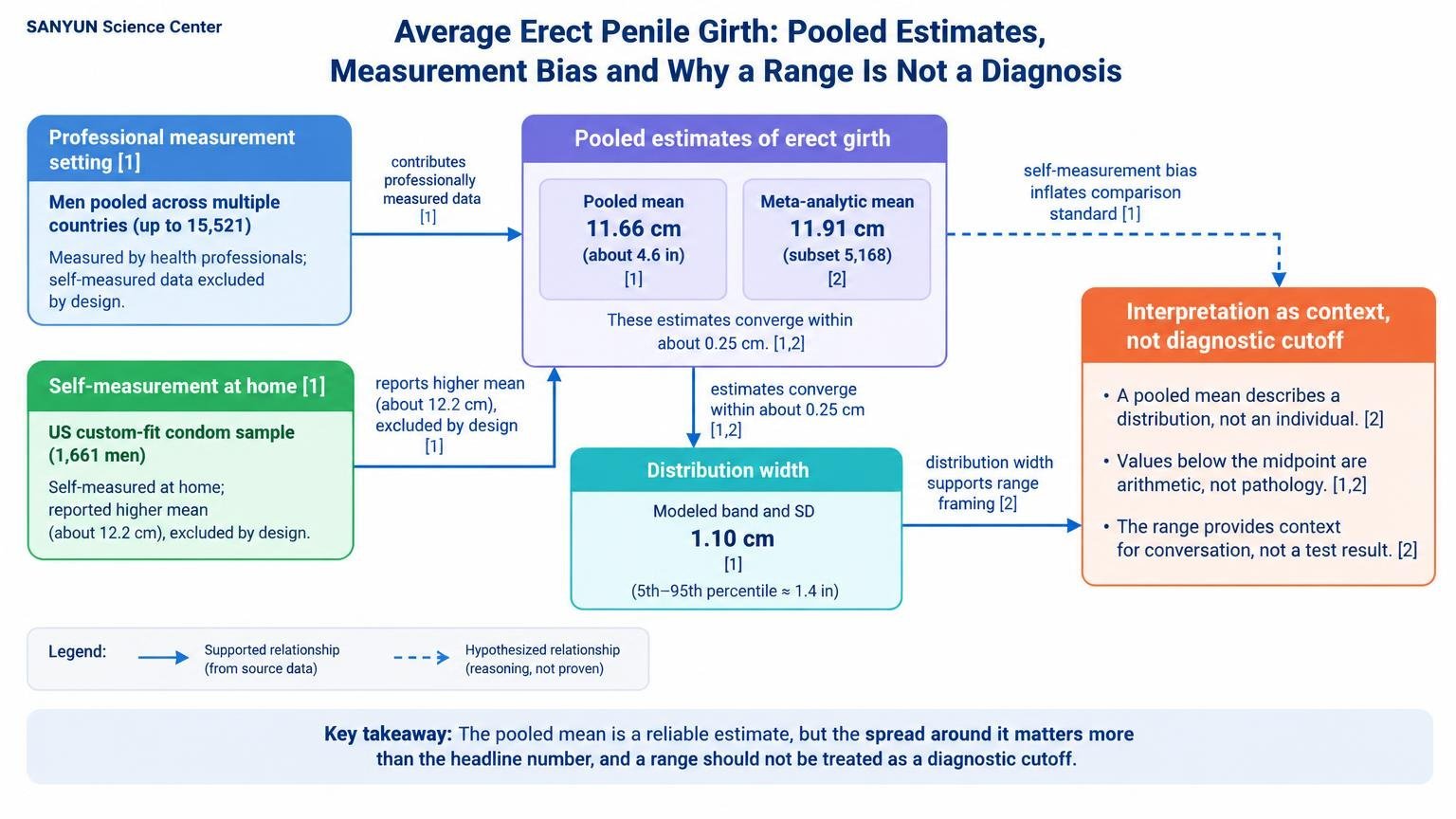
The most widely circulated estimate of average erect penile girth (circumference) comes from a pooled analysis of professionally obtained measurements in up to 15,521 men, which reported a mean of 11.66 cm, or about 4.6 inches. A more recent meta-analysis of 33 studies covering 36,883 men reported a mean erect circumference of 11.91 cm, based on a girth subset of 5,168 participants. The two figures sit within a few millimetres of each other and point to the same practical conclusion: the central estimate is real but the spread around it matters more than the headline number.[1][2]
The gap between these professionally measured figures and the higher numbers circulating online is largely a measurement-story. In a US sample of 1,661 men who measured themselves at home while ordering custom-fit condoms, average erect girth was about 12.2 cm, roughly 0.2 inches above the professionally measured pooled figure, and erect length also ran higher. That difference is small in absolute terms but large enough to shift where a man believes he sits relative to others, which is exactly the comparison that drives concern.
The interpretation problem is the central one. A pooled mean describes a population; it does not classify an individual. The source reporting the 11.66 cm figure explicitly treats its percentile table as a calculated distribution derived from a mean of 11.66 cm and a standard deviation of 1.10 cm rather than directly observed percentiles, and the meta-analysis coverage cautions that pooled averages should not be used as a normal-versus-abnormal cutoff. Reading a range correctly means treating it as context for a conversation, not as a test result.
Why This Matters
Girth is the dimension with a concrete practical consequence that length does not share to the same degree: condom fit. It is also the dimension men most often estimate from memory, comparison and downward self-view rather than from a tape measure, which is why measurement education and accurate central estimates have real value. When the working number in a man's head is inflated by self-measured or self-reported samples, an ordinary and healthy measurement can feel like a deficit.[3]
There is also a clinical reason to keep the numbers in proportion. Size concern is common, but objectively small penile size is uncommon, and one study of men presenting for penile-lengthening procedures found that most measured within the normal range. That mismatch is the reason clinicians who work in this area tend to start with an accurate measurement and a conversation about expectations rather than with a procedure.[4]
None of this means the numbers are useless. A well-supported central estimate, presented as a band with its uncertainty intact, corrects exaggerated comparison standards. It simply cannot do the second job people want it to do, which is to pronounce a verdict on one man's anatomy.
How Girth Is Defined and Measured
Penile girth, or circumference, is the distance around the shaft, conventionally taken at the midshaft or at the widest point with a flexible, non-stretchable tape while the penis is fully erect. Investigators who pool measurements usually restrict inclusion to readings taken by health professionals, which is why the professionally measured figure is the more defensible anchor for a population average. Self-measured data are not worthless, but they answer a different question: what men report, rather than what a standardized examination finds.
Methodological heterogeneity is a persistent theme. The recent 33-study meta-analysis searched literature published up to February 2024, and its authors acknowledged that measurement methods differed across studies and that sufficient data were not obtained for some regions. That matters for interpretation because a circumference reading depends on where on the shaft the tape sits, how tightly it is pulled, and how rigid the erection is at the moment of measurement.
| Study or dataset | Population and setting | Measurement method | Reported erect girth | Key limitation |
|---|---|---|---|---|
| Pooled review of professionally measured men (up to 15,521) | Men pooled across multiple countries | Measured by health professionals; self-measured data excluded by design | Mean 11.66 cm (about 4.6 in); about two thirds between roughly 4.2 and 5.0 in | Volunteer bias acknowledged by the review's authors |
| Meta-analysis of 33 studies (36,883 men pooled) | Men across included studies, publications up to February 2024 | Heterogeneous across studies; methods varied | Mean 11.91 cm, based on a girth subset of 5,168 participants | Not all participants measured for both length and girth; uneven regional coverage |
| US custom-fit condom sample (1,661 men) | Men ordering custom-fit condoms in the United States | Self-measured at home | About 12.2 cm | Self-measurement; not professionally verified |
| Italian conscript cohort (3,300 men aged 17-19) | Military conscripts in one country | Measured by investigators | No erect data recorded | Young single-country sample; flaccid and stretched measures only |
What the Pooled Evidence Shows
The best-known anchor remains the pooled professionally measured mean of 11.66 cm, or about 4.6 inches. The same source reports that roughly two thirds of men fall between about 4.2 and 5.0 inches erect, and its percentile table, explicitly a modeled distribution built from a mean of 11.66 cm and a standard deviation of 1.10 cm, places the 5th percentile at 9.9 cm and the 95th at 13.5 cm. The full 5th-to-95th span is therefore about 1.4 inches, narrower than most men expect when they imagine the population.
The 2024 meta-analysis, reported in 2026 coverage, largely agrees. Across 33 studies and 36,883 pooled participants, mean erect length was 13.84 cm and mean erect circumference 11.91 cm, with the girth estimate based on 5,168 participants because not every man in the pooled dataset had both dimensions measured. The difference between 11.66 cm and 11.91 cm is a quarter of a centimetre, well within the range one would expect from differing inclusion criteria, populations and measurement protocols. Two independent syntheses converging this closely is reassuring; it does not mean either figure is exact for any given population.
Reported values across individual studies span a wider band, roughly 8 to 14 cm, and standard deviations in the literature are around 1 to 1.5 cm. The wider the assumed spread, the more men sit far from the mean without any pathology involved. This is the arithmetic behind the repeated observation that many men who assume they are below average fall within the normal range once they measure correctly.
The regional question is frequently asked and weakly answered. The meta-analysis found no statistically significant regional differences in erect length or girth, but its authors noted that the number of studies and sample sizes within regions may have been small. Absence of a significant difference under low power is not evidence of equivalence, so country-level or ancestry-level rankings should be treated as unsupported by this dataset.
Why Self-Measured Samples Read Larger
The divergence between self-measured and professionally measured samples is the clearest methodological signal in this literature. The condom-ordering sample, measured at home, reported a mean of about 12.2 cm against the professionally measured pooled mean of 11.66 cm, with erect length also about half an inch higher. Several mechanisms plausibly contribute: tape placement at the widest rather than the midshaft point, tape tension, selection of the most favourable of several readings, fuller arousal at a private moment, and the general tendency of self-report to drift toward socially desirable values. The packet supports the size and direction of the gap; it does not decompose it into these components experimentally.
A second selection layer sits above measurement technique. The pooled review's authors acknowledged volunteer bias, meaning men who consent to be measured for research may not represent men who decline. Self-selection into a condom-ordering sample is a different and probably stronger filter. Neither bias has a known magnitude, which is why the central estimate should be described as well supported rather than definitive.
Physiological state adds variance that no measurement protocol fully removes. Arousal level is effectively the entire difference between a flaccid and an erect reading, temperature influences flaccid dimensions and the ease of full erection, and a partially rigid erection measures smaller than a fully rigid one. These are transient effects measured in minutes to hours, but they mean a single reading is a snapshot, not a fixed property.
Interpretation and Limitations
Three interpretive rules follow from the evidence. First, a pooled mean is a description of a distribution, not a threshold; the source of the 11.66 cm figure presents its percentiles as a calculated distribution, and the meta-analysis coverage states plainly that such averages should not distinguish normal from abnormal. Second, a value below the midpoint is arithmetic, not pathology, since by definition about half of a normally distributed population sits below the median. Third, the clinically relevant threshold for abnormally small penile size sits far below the percentile bands discussed here and is uncommon.
The strength of the evidence is moderate and uneven. The two large syntheses are consistent, but both are secondary summaries in this packet; the underlying primary analyses, their inclusion criteria and their heterogeneity statistics are not restated. The professionally measured pooled estimate excludes self-measured data by design, which improves internal validity while potentially narrowing the sampled population. The meta-analysis has a girth subset roughly one-seventh the size of its pooled sample, uneven regional coverage and acknowledged variation in measurement method.
A separate limitation concerns what the numbers cannot address. Girth measurements do not capture erection quality, and a man whose erections are consistently partial may measure below his own anatomical potential for a vascular rather than a size reason. Concern about size that persists despite a normal measurement is also not resolved by showing someone a percentile table; that pattern is recognised clinically and warrants its own conversation rather than a procedure.
Finally, the commercial context of several sources in this packet deserves acknowledgment. Patient-education pages from clinics that offer girth enhancement can report accurate published means while also framing the numbers in ways that lead toward a service. The pooled values themselves are consistent across commercial and non-commercial summaries, which is reassuring for the estimate; the interpretive framing should be read with its origin in mind.[5]
What Does Not Change Girth
The evidence on enhancement claims is unusually consistent for a topic this noisy. The packet contains no support for oral or topical products changing penile circumference, and one source states that some supplement studies have shown danger with ongoing use. Manual techniques such as jelqing are characterised as having limited, low-quality evidence alongside documented potential for injury including bruising and fibrosis.
Vacuum devices occupy a middle position. The packet describes a possible temporary increase in girth, with daily use over months possibly yielding slight improvements, but frames this as a hypothesis without a specific trial or numeric result, and notes bruising, numbness and pain with misuse. Clinician-placed hyaluronic acid filler is described as temporarily adding circumference but not length, with results typically lasting around 1 to 2 years and varying by product and individual.
For men of normal measured size, a 2020 systematic review concluded that many enlargement interventions carry high complication rates and uncertain satisfaction. That conclusion does not forbid intervention; it establishes that accurate measurement, expectation screening and full risk disclosure should precede any decision.
Research Outlook
The most useful near-term research would not be another mean. It would be work that quantifies the self-measurement gap prospectively, using the same men measured at home and then by an examiner under a standard protocol, which would let the field correct self-reported datasets rather than merely discount them. Standardising tape placement, tension and arousal criteria across studies would also reduce the heterogeneity the meta-analysis authors flagged.
A second gap concerns denominators. The girth estimate in the recent meta-analysis rests on 5,168 participants out of 36,883 pooled, and regional coverage was uneven, so the field still lacks a genuinely representative global distribution. Until such data exist, statements about how girth varies by country or ancestry should be regarded as hypotheses rather than findings, particularly given that the observed regional differences were not statistically significant in a dataset with limited power.
A third direction is perceptual rather than anatomical. Survey data indicate a gap between how men view their own size and how partners view it, with about half of men satisfied with their own size while 85% of women reported satisfaction with their partner's. Research that pairs measured values with validated measures of body image distress would help clinicians decide when the appropriate intervention is educational, psychological or surgical.
Key Takeaways
- Professionally measured pooled data put average erect girth at 11.66 cm (about 4.6 inches), and a larger 33-study meta-analysis reported 11.91 cm based on 5,168 participants measured for girth.
- Roughly two thirds of men fall between about 4.2 and 5.0 inches erect, a band derived from a modeled distribution with a standard deviation of 1.10 cm rather than directly observed percentiles.
- Self-measured samples read larger: a 1,661-man condom-ordering sample averaged about 12.2 cm, roughly 0.2 inches above the professionally measured pooled mean.
- Pooled averages and calculated percentiles are descriptive context, not diagnostic cutoffs; the clinically abnormal threshold sits far below these bands and is uncommon.
- No oral or topical product has evidence of changing circumference, manual techniques carry injury reports with weak efficacy evidence, and clinician-placed filler adds temporary girth lasting roughly 1 to 2 years.
Questions and Answers
What is the average erect penile girth according to pooled measurements?
Professionally measured pooled data in up to 15,521 men report a mean erect girth of 11.66 cm, about 4.6 inches. A more recent meta-analysis of 33 studies reported 11.91 cm based on a girth subset of 5,168 participants. The two estimates differ by roughly a quarter of a centimetre and should be read as a well-supported central estimate rather than an exact constant.
How wide is the normal range of erect penile girth?
About two thirds of men fall between roughly 4.2 and 5.0 inches erect, according to a modeled distribution built from a mean of 11.66 cm and a standard deviation of 1.10 cm. Reported values across studies span roughly 8 to 14 cm, and standard deviations in the literature are around 1 to 1.5 cm, so much of the spread reflects ordinary variation rather than pathology.
Why do self-measured penis girth studies report higher averages than professionally measured ones?
A US sample of 1,661 men who measured themselves at home reported about 12.2 cm, roughly 0.2 inches above the professionally measured pooled mean of 11.66 cm, with length also higher. Tape placement, tension, choosing the best of several readings, arousal at the moment and social desirability plausibly contribute, though the packet does not decompose the gap experimentally. Volunteer bias may also differ between samples.
Can a pooled average penile girth be used to diagnose abnormally small size?
No. The meta-analysis coverage explicitly states that pooled averages should not distinguish normal from abnormal, because a mean from many studies is not a criterion for judging an individual. The source of the 11.66 cm figure also presents its percentiles as a calculated distribution. The clinical threshold for abnormally small penile size sits far below these bands and is uncommon.
Do the pooled penile girth figures differ significantly between regions or countries?
The 33-study meta-analysis found no statistically significant regional differences in erect length or girth. However, its authors noted that measurement methods varied and that some regions had limited data, so the number of studies and sample sizes per region may have been too small to detect a real difference. Country-level rankings are not supported by this dataset.
Do pills, pumps or filler actually change penile girth?
No oral or topical product has evidence of changing circumference, and manual techniques such as jelqing have limited, low-quality evidence with documented injury risk. Vacuum devices may produce temporary swelling, framed as a hypothesis rather than a demonstrated gain. Clinician-placed hyaluronic acid filler temporarily adds circumference but not length, typically lasting around 1 to 2 years with individual variation.
Conceptual framework: Conceptual framework, not a tested causal model. Pooled professionally measured data (up to 15,521 men) and a 33-study meta-analysis (girth subset 5,168) converge on means of 11.66 cm and 11.91 cm. Self-measurement reads higher, roughly 12.2 cm in one 1,661-man sample. Proposed links reflect measurement bias reasoning, not proven statistical mediation; pooled means are not diagnostic cutoffs.
Academic References & Evidence
- Kiara DeWitt. What Is Average Penile Girth? Numbers and Myths. 2026
- 윤태희. 생각보다 작다고?…男 ‘중요 부위’ 진짜 평균 크기는 [라이프+]. 2026
- Is Your Girth Below Average? Stop Worrying & Find Out Now | Ubie Doctor's Note. 2026
- Noppon Arunkajohnsak. เพิ่มขนาดน้องชาย: ขนาดปกติ อะไรได้ผลจริง ความเสี่ยง. 2026
- Penile Length & Girth: Penis Anatomy and Average Girth Size | Himplant®.
SANYUN Science Center explains published research on men's reproductive and sexual health, connecting scientific evidence with everyday questions while making sources and limitations clear.
Disclaimer: This article is for scientific education and research communication only. It does not provide medical advice, diagnosis, or individualized treatment recommendations, and does not endorse any medication, supplement, device, penile enlargement procedure, or other intervention. Decisions about sexual and reproductive health should be made in consultation with a qualified healthcare professional. Do not delay seeking professional care because of information in this article.
Original Content & Copyright Notice
- This article is prepared for SANYUN Science Center, drawing on published research and publicly available academic literature on men’s sexual and reproductive health. Its editorial explanations and presentation are developed for this platform.
- Copyright in the original editorial content, selection, and arrangement is reserved by SANYUN Science Center to the extent protected by applicable law. Referenced research, quotations, and third-party materials remain subject to the rights of their respective owners. This notice does not claim ownership of scientific facts or third-party research.
- Except where permitted by applicable law or an applicable license, prior written permission is required to reproduce, republish, translate, adapt, redistribute, or commercially reuse protected content. Attribution alone does not grant permission for such reuse.
- For permitted quotation or authorized reuse, clearly identify the source and retain a link to the original article.
- Source: SANYUN Science Center
- Original URL: Retain the original article URL on science.san-yun.com.
- Copyright Holder: SANYUN Science Center, for its own protected editorial content.
- Quotation, excerpts, or authorized reuse must not distort the scientific meaning, omit material limitations or disclaimers, or imply unverified medical claims, product efficacy, or endorsement by SANYUN Science Center.



