




Category: Penile Size
Core Research Direction: What measured penile length and girth are typical in adults, how are they correctly measured, and what does the evidence show about the gap between measured size, self-perceived smallness, and the limited outcomes of enhancement interventions in men with normal size?
Search Intent: What does the research actually say about average penis size, how it should be measured, and whether size concerns or enhancement procedures are justified?
Platform: SANYUN Science Center
Evidence reviewed through: 2026-11-06
Executive Summary
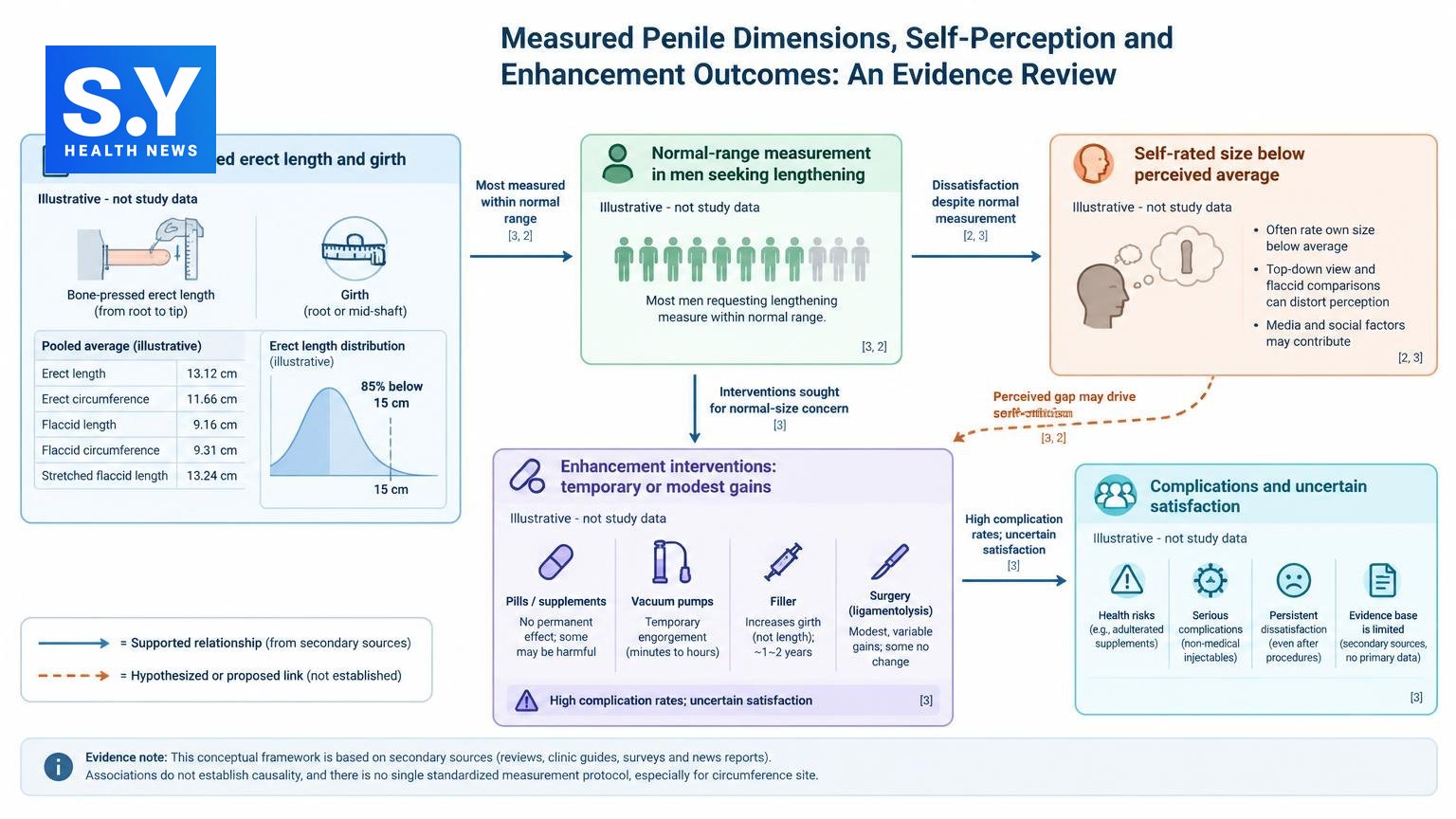
The most widely cited pooled dataset on adult penile dimensions reports average erect length of 13.12 cm and average erect circumference of 11.66 cm, alongside flaccid averages of 9.16 cm and 9.31 cm respectively. These figures come from a synthesis of 20 studies covering 15,521 men from 16 countries, and secondary sources present them as a reference frame rather than a standard of normality.[1][2][3]
Two findings dominate the clinical literature summarized here. First, the measurement method matters: bone-pressed erect length taken along the upper surface is the technique used in relevant studies, because flaccid size varies with temperature, blood flow and time of day. Second, the men most worried about size are frequently not the men with unusual anatomy. A clinical series of men requesting lengthening surgery found most measured within the normal range, and large surveys suggest a broad gap between women's satisfaction with a partner's size and men's satisfaction with their own.
Evidence for enhancement is thin in exactly the population most likely to ask about it. No pill, cream or supplement has documented permanent effect, vacuum pumps produce only temporary engorgement, and a systematic review of interventions in normally sized men reported high complication rates with uncertain satisfaction. Surgical and filler options exist but are bounded by modest, variable and partly temporary gains.
Why This Matters
Penile size is a rare topic where the gap between measured anatomy and felt inadequacy is itself the clinical problem. The evidence summarized here suggests that a sizeable proportion of men seeking help already fall within statistical norms, which reframes the clinical task: accurate measurement, honest framing of distributions, screening for distressing body-image preoccupation, and a clear account of what interventions can and cannot deliver.
The stakes are not trivial. Unregulated products carry documented regulatory risk, including male dietary supplements adulterated with erectile-drug compounds without labeling, which can endanger people with heart disease or those using nitrates. Non-medical injectable substances are described in the clinical literature with serious complications. Poorly evidenced enhancement is therefore not a neutral consumer choice.
How Penile Size Is Measured
The pooled literature analyzed five dimensions: erect length, flaccid length, stretched flaccid length, and erect and flaccid circumference. Length was measured from the penile root to the tip, with circumference taken at the root or mid-shaft, so measurement site is not fully standardized across studies. That variation matters when comparing an individual against a published average.
Current clinical guidance describes bone-pressed erect length as the medically correct method: the ruler sits on the upper surface and is pressed lightly against the pubic bone, which offsets differences in pubic fat distribution. Flaccid measurements are described as less meaningful because size depends on temperature, blood flow and time of day.
Girth is measured separately from length, using a flexible non-stretch tape or a marked strip of paper around the penile shaft without tightening, at a consistent anatomical point and in a consistent erection state. Clinician measurement rather than self-report is the reference standard implied by the pooled dataset, since studies relying on self-reported size were excluded as unreliable.[4][5]
| Measure | Pooled average reported | State and method | Interpretation note |
|---|---|---|---|
| Erect length | 13.12 cm | Erect; bone-pressed from root to tip | Central reference value; wide normal range |
| Erect circumference | 11.66 cm | Erect; at root or mid-shaft | Site variation limits exact comparability |
| Flaccid length | 9.16 cm | Flaccid | Varies with temperature and conditions |
| Flaccid circumference | 9.31 cm | Flaccid | Not predictive of erect dimensions |
| Stretched flaccid length | 13.24 cm | Flaccid, fully stretched | Analyzed among the five pooled measures |
| Distribution above 15 cm erect | 85% of men below | Pooled nomogram | Thresholds describe groups, not individuals |
What the Evidence Shows About Typical Size
The headline numbers are consistent across the secondary sources that cite the same underlying review: mean erect length of 13.12 cm, mean erect circumference of 11.66 cm, mean flaccid length of 9.16 cm and mean flaccid circumference of 9.31 cm, with over 15,500 men summarized. The distribution is wide: 85% of men in the pooled sample had an erect penis under 15 cm. That figure describes a population, not a target for an individual.
The review reportedly found no significant difference in penile size between nationalities in reliable studies, but the source explicitly cautions that this null result does not prove no differences exist. Measurement data were sparse for some regions, notably African men south of the Sahara, where the only two included studies reportedly fell close to the international average.
Attempts to infer size from other body features remain weak. One study found a weak foot-size association while another found none, and a small study of 26 recently deceased Japanese men reported an association between nose size and stretched penile length without an established mechanism. These are exploratory observations in small or inconsistent samples, not usable predictors.
Definitions of micropenis are themselves inconsistent across secondary sources: one threshold is stretched flaccid length under about 8.5 cm, reported as occurring in about one in 160 men, while another source defines it as more than 2.5 standard deviations below average, roughly under 7 cm stretched. Neither threshold should be applied by an individual to themselves.
Measured Size Versus Felt Smallness
The most clinically important mismatch is between normal measurement and persistent dissatisfaction. A clinical series of men requesting penile lengthening found most measured within the normal range, and a clinic guide states that most men who ask about size measure well within normal limits. Separately, studies repeatedly report that most men rate their own penis as below average even when statistically normal.
Several perceptual mechanisms are proposed rather than demonstrated causally. A top-down viewing angle foreshortens what a man sees of himself; flaccid comparisons in shared spaces are uninformative because flaccid size varies widely; and adult media present a selected group. The source describes these as explanations for distorted self-assessment rather than as measured mediators.
Partner-preference data are frequently misread. In a 2013 study, 105 women rated 53 computer-generated male models varying in height, body shape and penis size, and larger model size had some effect, especially in taller men. A 2015 study had 75 women rate 33 3D-printed penises; for long-term relationships they preferred 16 cm length with 12.2 cm girth, and for short-term relationships 16.3 cm with 12.7 cm. These are stated preferences in rating tasks, slightly above pooled averages, and are not evidence about satisfaction in real relationships.
By contrast, a 2006 survey of 52,031 heterosexual men and women found that 84% of women were satisfied with their partner's penis size, 14% wished it were larger and 4% wished it were smaller. The same survey is described as finding only about half of men satisfied with their own size. Interpretation is limited by self-report and survey design, but the direction of the gap is consistent: dissatisfaction concentrates on the self-assessment side.
Enhancement Interventions: What Is Supported, What Is Not
The negative evidence is comparatively clear. No pill, cream or supplement has evidence of permanent size gain, and some products may be harmful; pills containing vitamins or hormones have no documented effect. Thailand's FDA found some male dietary supplements adulterated with erectile-drug class compounds without labeling, a serious hazard for people with heart disease or nitrate use.
Devices fare little better. A cited trial found six months of penile pump use did not change penile size, and pumps are described as producing temporary engorgement lasting minutes to hours with a legitimate role in erectile dysfunction care, not permanent enlargement.
Medical options are real but bounded. Hyaluronic acid filler temporarily increases girth, not length, with results typically lasting about one to two years. Ligamentolysis is reported to increase visible flaccid length by an average of roughly one to two centimeters, with high variability and some men showing little or no change. A 2020 systematic review concluded that in men of normal size many enhancement interventions carry high complication rates and uncertain satisfaction.
A separate point concerns persistence of dissatisfaction. The clinic guide states that research repeatedly finds men of normal size but high anxiety often remain dissatisfied after procedures, because the issue to address is perception rather than anatomy. This is a secondary synthesis rather than a pooled estimate, and it should be read as a strong caution for pre-procedure screening rather than a prediction about any individual.
Interpretation and Limitations
The evidence base summarized here is almost entirely secondary: news explainers, commercial clinic blogs, a physician-reviewed clinic guide and a clinic knowledge base. Several cite the same underlying systematic review, so concordant numbers reflect shared provenance rather than independent replication. No primary dataset was re-analyzed for this article, and no systematic review was performed here.[6]
Specific limitations deserve emphasis. Pooled circumference was measured at the root or mid-shaft, limiting comparability. Nationality comparisons are constrained by sparse data. Comfort-women preference studies used models and printed objects rather than partners. The 2006 satisfaction survey is self-reported. Micropenis thresholds differ between sources. Regulatory findings about adulterated supplements are not clinical trials.
Commercial sources in this packet have an obvious interest in enhancement products, and their measurement advice should be weighed accordingly. Their descriptions of the pooled averages nonetheless align with citing clinic sources. The distinction between a mean and a normal range is central: a value below the mean is not a disorder, and no single measurement determines function, satisfaction or the need for intervention.
Research Outlook
Several open questions follow directly from the gaps above. Better standardized measurement protocols, including consistent circumference sites, would improve comparability. Data from underrepresented regions remain insufficient to settle questions about population differences. Most importantly, the field lacks strong evidence on how best to support men whose measured size is normal but whose distress is persistent; the sources describe psychological support as appropriate in such cases but do not report trial evidence here.
Key Takeaways
- Pooled clinician measurements report average erect length of 13.12 cm, erect circumference of 11.66 cm, flaccid length of 9.16 cm and flaccid circumference of 9.31 cm.
- Bone-pressed erect length measured along the upper surface is the method used in relevant studies; flaccid measures vary with temperature, blood flow and time of day.
- Most men requesting lengthening surgery in a cited clinical series measured within the normal range, and studies repeatedly find men underrate their own size.
- In a 2006 survey, 84% of women were satisfied with their partner's size, while only about half of men were satisfied with their own.
- No pill, cream or supplement has evidence of permanent size gain; a cited trial found six months of pump use did not change size.
- Filler adds temporary girth lasting about one to two years; ligamentolysis averages roughly one to two centimeters of visible flaccid length with high variability.
- A 2020 systematic review found high complication rates and uncertain satisfaction for many enhancement interventions in normally sized men.
Questions and Answers
What is the average erect penis length and girth in adult men?
Pooled clinician measurements report an average erect length of 13.12 cm and erect circumference of 11.66 cm, with flaccid averages of 9.16 cm and 9.31 cm. The distribution is wide, and 85% of men in the pooled sample had an erect penis under 15 cm. A value below the mean is not a disorder.
How should penile length and girth be measured correctly?
Guidance describes bone-pressed erect length: a ruler on the upper surface pressed lightly against the pubic bone, which offsets pubic fat differences. Girth is measured with a non-stretch tape around the shaft at a consistent point. Flaccid measurements are less meaningful because size varies with temperature, blood flow and time of day.
Why do many men with normal penis size still feel small?
Studies repeatedly find most men rate their own penis as below average even when statistically normal, and a clinical series found most men requesting lengthening measured within normal range. Proposed explanations include top-down viewing angle, uninformative flaccid comparisons and adult media. These are described as perceptual mechanisms rather than proven causes.
Do pills, pumps or supplements permanently increase penis size?
No pill, cream or supplement has evidence of permanent size gain, and some products may be harmful; regulatory findings include unlabeled adulteration with erectile-drug compounds. A cited trial found six months of pump use did not change size, and pumps produce only temporary engorgement. Pumps retain a legitimate role in erectile dysfunction care.
How strong is the evidence for penile enhancement surgery and fillers?
It is limited. Hyaluronic acid filler adds girth temporarily, typically about one to two years, not length. Ligamentolysis averages roughly one to two centimeters of visible flaccid length with high variability and some men gaining little. A 2020 systematic review reported high complication rates and uncertain satisfaction in normally sized men.
Are women less satisfied with partner penis size than men assume?
In a 2006 survey of 52,031 heterosexual adults, 84% of women were satisfied with their partner's penis size, 14% wished it larger and 4% smaller, while only about half of men were satisfied with their own. Rating-task preference studies asked about models and printed objects, not real relationships, so they do not contradict this.
Conceptual framework: Conceptual framework. Adult men's penile dimensions are summarized from pooled clinician measurements; most men requesting lengthening measure within normal range, self-ratings often fall below perceived average, partner satisfaction is generally high, and enhancement interventions yield temporary, modest or uncertain gains with real complications. Relations are associations or proposed links from secondary sources, not a tested causal model.
Academic References & Evidence
- Penisstorlek – så stor är den genomsnittliga och världens största penis.
- Tamaño medio del pene: datos y hechos científicos.
- Noppon Arunkajohnsak. เพิ่มขนาดน้องชาย: ขนาดปกติ อะไรได้ผลจริง ความเสี่ยง. 2026
- Circunferência peniana: medidas e opções | Himplant®.
- Penile Length & Girth: Penis Anatomy and Average Girth Size | Himplant®.
- Como medir comprimento e circunferência do pênis.
SANYUN Science Center explains published research on men's reproductive and sexual health, connecting scientific evidence with everyday questions while making sources and limitations clear.
Disclaimer: This article is for scientific education and research communication only. It does not provide medical advice, diagnosis, or individualized treatment recommendations, and does not endorse any medication, supplement, device, penile enlargement procedure, or other intervention. Decisions about sexual and reproductive health should be made in consultation with a qualified healthcare professional. Do not delay seeking professional care because of information in this article.
Original Content & Copyright Notice
- This article is prepared for SANYUN Science Center, drawing on published research and publicly available academic literature on men’s sexual and reproductive health. Its editorial explanations and presentation are developed for this platform.
- Copyright in the original editorial content, selection, and arrangement is reserved by SANYUN Science Center to the extent protected by applicable law. Referenced research, quotations, and third-party materials remain subject to the rights of their respective owners. This notice does not claim ownership of scientific facts or third-party research.
- Except where permitted by applicable law or an applicable license, prior written permission is required to reproduce, republish, translate, adapt, redistribute, or commercially reuse protected content. Attribution alone does not grant permission for such reuse.
- For permitted quotation or authorized reuse, clearly identify the source and retain a link to the original article.
- Source: SANYUN Science Center
- Original URL: Retain the original article URL on science.san-yun.com.
- Copyright Holder: SANYUN Science Center, for its own protected editorial content.
- Quotation, excerpts, or authorized reuse must not distort the scientific meaning, omit material limitations or disclaimers, or imply unverified medical claims, product efficacy, or endorsement by SANYUN Science Center.



