




Category: Clinical Insights
Core Research Direction: Genetic evaluation of male infertility: Y-chromosome AZF microdeletions, CFTR/ADGRG2 in obstructive azoospermia, and their implications for sperm retrieval (TESE) and assisted reproduction
Search Intent: In men with non-obstructive azoospermia or severe oligozoospermia, how common are Y-chromosome AZF microdeletions and what do they mean for the chance of retrieving sperm, and which genetic tests are recommended for obstructive azoospermia involving CFTR or ADGRG2?
Platform: SANYUN Science Center
Evidence reviewed through: 2026-11-22
Executive Summary
Genetic testing has become a standard component of male infertility evaluation when semen analysis points to severe spermatogenic failure or when the reproductive tract anatomy suggests obstruction. Two testing pathways dominate the clinical discussion: screening for Y-chromosome azoospermia factor (AZF) microdeletions in non-obstructive azoospermia or severe oligozoospermia, and CFTR gene analysis when obstructive azoospermia or congenital absence of the vas deferens is suspected. SANYUN Science Center interprets the available guideline-derived recommendations below; this article is an evidence review of a laboratory service summary, not a new study or systematic review.[1]
The reported prevalence figures are substantial: approximately 15–20% of men with non-obstructive azoospermia and about 7–10% of men with severe oligozoospermia are described as carrying AZF microdeletions. For obstructive disease, CBAVD or the rarer CUAVD is present in about 2% of all men with azoospermia, and at least one CFTR mutation is detectable in around 80% of men with CBAVD. These numbers come from a clinical laboratory service page citing a German S2K guideline, not from a primary epidemiological study, so they should be read as service-level summary estimates rather than independently verified prevalence.
The clinical distinction that matters most is between finding a cause and predicting a treatment response. AZFc deletions are associated with a reported chance of roughly 50% of obtaining sperm through testicular sperm extraction (TESE), whereas deletions in other AZF regions are described as not permitting sperm retrieval. In obstructive azoospermia with CFTR-related CBAVD, the source describes assisted reproduction prospects as promising, but does not quantify them. These are expectations drawn from a service summary and should be presented to patients as such.
Why This Matters
Male-factor infertility is often evaluated through semen analysis alone until assisted reproduction is considered. Genetic testing changes that sequence by identifying a cause that carries implications beyond the current couple: inheritance risk for future children, the likelihood that sperm can be retrieved surgically, and whether a treatable or untreatable form of spermatogenic failure is present. The distinction between non-obstructive and obstructive azoospermia is the first branch point, because the two pathways lead to different genes, different counselling and different reproductive techniques.
For clinicians, the practical value of a genetic result is that it replaces a probabilistic guess with a more specific category. A man with non-obstructive azoospermia and an AZFc deletion has a different surgical counselling conversation from a man with the same semen phenotype and no deletion. Similarly, a man with obstructive azoospermia and a CFTR result has a different family-planning conversation from one whose obstruction has another cause. The evidence reviewed here is not strong enough to support precise outcome prediction, but it does support structured testing and counselling.
Biological and Clinical Mechanism
The AZF region of the Y chromosome contains genes such as DAZ and RBM that are described as essential for spermatogenesis. Loss of function in these genes is associated with either abnormal development of spermatogonia in the testes or the formation of immature, condensed sperm. This is a mechanism-level description from a laboratory service page, not a primary experimental finding, and it explains why AZF deletions produce a spermatogenic phenotype rather than an obstructive one. The specific region involved matters because AZFa, AZFb and AZFc deletions have different reported consequences for sperm retrieval.
In obstructive azoospermia, the testicular tissue is described as showing intact spermiogenesis, but the vas deferens is blocked or not properly developed. CFTR mutations, the same gene implicated in cystic fibrosis, are described as responsible in most cases of CBAVD. The source states that only homozygous or compound heterozygous CFTR mutations have been shown to lead to CBAVD, which is why complete sequencing, including the 5T allele, is recommended when CBAVD is present. ADGRG2 is described as another locus known to be causative for CBAVD and is recommended for analysis when CFTR results are unremarkable.
What the Evidence Shows
The evidence base here is a single clinical laboratory service summary that reproduces recommendations from the German S2K guideline on diagnostics and therapy before assisted reproductive treatment (AWMF Registry No. 015/085, 02/2019). It is not a systematic review, a meta-analysis or a primary cohort study. The prevalence figures and the TESE retrieval estimate are presented without sample sizes, confidence intervals or time windows. That does not make them unusable, but it does mean they should be treated as summary estimates for counselling rather than as precise probabilities for an individual patient.
The testing thresholds in the source are specific. For non-obstructive azoospermia or severe oligozoospermia, chromosome analysis is recommended after other causes have been excluded, and the severe oligozoospermia threshold is given as fewer than 5 million sperm per millilitre. For context, oligozoospermia itself is defined as a sperm concentration below the normal range, usually fewer than 15 million sperm per millilitre. AZF microdeletion analysis across AZFa, AZFb and AZFc is recommended in non-obstructive azoospermia and severe oligozoospermia below that 5 million per millilitre threshold, again after other causes are excluded.
For obstructive azoospermia, CFTR analysis is recommended after other causes have been excluded, including all relevant pathogenic mutations and the TG-T repeat in intron 8, with complete sequencing if only a heterozygous mutation is found. If CFTR analysis is unremarkable, ADGRG2 analysis is recommended. In men with non-obstructive azoospermia and no AZF deletion, a multi-gene panel using next-generation sequencing may be considered if a rare monogenic disorder of spermatogenesis is suspected. These are testing recommendations, not observed outcomes, and the source frames the monogenic panel as optional.
| Clinical scenario | Recommended genetic analysis | Reported figure or threshold | What it informs |
|---|---|---|---|
| Non-obstructive azoospermia or severe oligozoospermia | Chromosome analysis after other causes excluded; AZF microdeletion analysis (AZFa, AZFb, AZFc) | Severe oligozoospermia threshold <5 million/ml; AZF prevalence 15–20% in non-obstructive azoospermia and 7–10% in severe oligozoospermia | Whether a Y-chromosome cause is present and whether TESE is likely to be considered |
| AZFc deletion versus other AZF-region deletions | Region-specific interpretation of the microdeletion result | About 50% of men with AZFc deletions may obtain sperm via TESE; other regions described as not permitting retrieval | Surgical counselling and realistic expectations before TESE |
| Obstructive azoospermia or suspected CBAVD | CFTR analysis after other causes excluded, including TG-T repeat in intron 8 and complete sequencing if only heterozygous | CBAVD/CUAVD in about 2% of all men with azoospermia; at least one CFTR mutation in around 80% of men with CBAVD | Confirmation of a genetic cause of obstruction and family-planning risk |
| Obstructive azoospermia with unremarkable CFTR analysis | ADGRG2 analysis | ADGRG2 described as another locus causative for CBAVD | Whether a second genetic cause of obstruction can be identified |
| Non-obstructive azoospermia without AZF deletion and suspected monogenic disorder | Multi-gene panel using next-generation sequencing, may be considered | Optional recommendation, not quantified in the source | Whether a rare monogenic cause can be identified |
Interpretation and Limitations
The most important limitation is the nature of the source. A laboratory service page that reproduces guideline recommendations is useful for understanding what is recommended and why, but it is not a primary study. The prevalence estimates for AZF deletions and CFTR mutations are presented without denominators, recruitment methods or diagnostic criteria. The TESE retrieval figure of about 50% for AZFc deletions is described as approximate and is not accompanied by a definition of successful retrieval, a surgical protocol or a follow-up period. Readers should not convert these figures into individual probabilities.
A second limitation concerns the distinction between association and causation. The source describes AZF genes as essential for spermatogenesis and CFTR mutations as responsible for most CBAVD cases, but these are mechanistic statements rather than experimental demonstrations in the reviewed material. The statement that other AZF-region deletions do not permit sperm retrieval is categorical and may not reflect the full range of clinical experience; it should be presented as a reported generalisation rather than an absolute rule. The same caution applies to the description of assisted reproduction prospects in CFTR-related CBAVD as promising, which is not quantified.
A third limitation is the absence of a current-year primary evidence base in the reviewed packet. The recommendations are tied to a 2019 German guideline, reproduced on a laboratory page without a stated update date. Clinical practice may have evolved since then, and other jurisdictions may have different testing thresholds. The source also does not address cost, access, insurance coverage or the psychological impact of genetic findings, all of which affect real-world implementation. These gaps should be acknowledged in counselling rather than filled with assumptions.
Research Outlook
The most useful next step for the field would be primary studies that report AZF microdeletion prevalence with clear denominators and consistent diagnostic methods, and that link specific deletion regions to defined TESE outcomes. The same applies to CFTR and ADGRG2: the current recommendations are plausible and guideline-supported, but the outcome data behind them are not presented in the reviewed source. Prospective cohorts that report retrieval rates, live birth rates and inheritance outcomes together would give clinicians a stronger basis for counselling than the current summary estimates.
There is also a need for clearer guidance on the monogenic panel pathway. The source states that in men without an AZF deletion, a multi-gene panel using next-generation sequencing may be considered if a rare monogenic disorder of spermatogenesis is suspected. How often such variants are found, which genes should be included and how results change management are not addressed. Until those questions are answered, the panel should be presented as an option for selected cases rather than a routine step.
Key Takeaways
- AZF microdeletions are reported in approximately 15–20% of men with non-obstructive azoospermia and about 7–10% of men with severe oligozoospermia, based on a laboratory service summary rather than a primary study.
- About 50% of men with AZFc deletions may be able to obtain sperm via TESE, whereas deletions in other AZF regions are described as not permitting retrieval; this is an approximate summary figure.
- CBAVD or CUAVD is present in about 2% of all men with azoospermia, and at least one CFTR mutation is detectable in around 80% of men with CBAVD.
- Guideline-derived recommendations advise CFTR analysis in suspected obstructive azoospermia, including the TG-T repeat in intron 8 and complete sequencing if only a heterozygous mutation is found, and ADGRG2 analysis if CFTR is unremarkable.
- The reviewed evidence is a service-level summary of a 2019 German guideline; it does not provide primary outcome data, confidence intervals or a current-year evidence update, so figures should be treated as counselling estimates rather than individual probabilities.
Questions and Answers
What are Y-chromosome AZF microdeletions and why do they matter in male infertility?
AZF microdeletions are losses of genetic material in the azoospermia factor region of the Y chromosome. This region contains genes such as DAZ and RBM that are described as essential for spermatogenesis. Loss of function is associated with abnormal spermatogonial development or immature condensed sperm, which can produce non-obstructive azoospermia or severe oligozoospermia. Testing identifies a genetic cause and informs counselling, but the reviewed source is a laboratory summary rather than a primary study.
How common are AZF microdeletions in non-obstructive azoospermia and severe oligozoospermia?
A laboratory service summary reports AZF microdeletions in approximately 15–20% of men with non-obstructive azoospermia and about 7–10% of men with severe oligozoospermia. These figures are presented without sample sizes or confidence intervals and are not drawn from a primary epidemiological study. They are useful as general counselling estimates but should not be treated as precise individual probabilities. Testing is recommended after other causes have been excluded.
Does an AZFc deletion mean sperm can be found with TESE?
The reviewed source states that about 50% of men with AZFc deletions may be able to obtain sperm via testicular sperm extraction, whereas deletions in other AZF regions are described as not permitting retrieval. This is an approximate summary figure without a defined retrieval protocol, sample size or follow-up period. It supports a cautious counselling conversation about surgical options, not a guarantee of success. Individual outcomes vary and should be discussed with a fertility specialist.
When should CFTR testing be performed in obstructive azoospermia?
Guideline-derived recommendations reproduced in the reviewed source advise CFTR analysis when obstructive azoospermia is suspected, after other causes have been excluded. Testing should include all relevant pathogenic mutations and the TG-T repeat in intron 8, with complete sequencing if only a heterozygous mutation is found. If CFTR analysis is unremarkable, ADGRG2 analysis is recommended. These are testing recommendations, not observed study outcomes, and they come from a laboratory service page citing a 2019 German guideline.
How strong is the evidence linking CFTR mutations to congenital bilateral absence of the vas deferens?
The reviewed source reports that CBAVD or CUAVD is present in about 2% of all men with azoospermia and that at least one CFTR mutation is detectable in around 80% of men with CBAVD. It states that only homozygous or compound heterozygous mutations have been shown to lead to CBAVD. However, these figures come from a laboratory service summary without cited primary studies, sample sizes or time windows, so the evidence should be described as guideline-supported but not independently verified in this packet.
What are the main limitations of genetic testing recommendations for male infertility?
The main limitations are the source type and the lack of primary outcome data. The reviewed recommendations come from a laboratory service page reproducing a 2019 German guideline, without sample sizes, confidence intervals or a current-year update. Prevalence and TESE retrieval figures are approximate. The source does not address cost, access or psychological impact. Genetic results should therefore be integrated into specialist counselling rather than used as standalone predictions of treatment success.
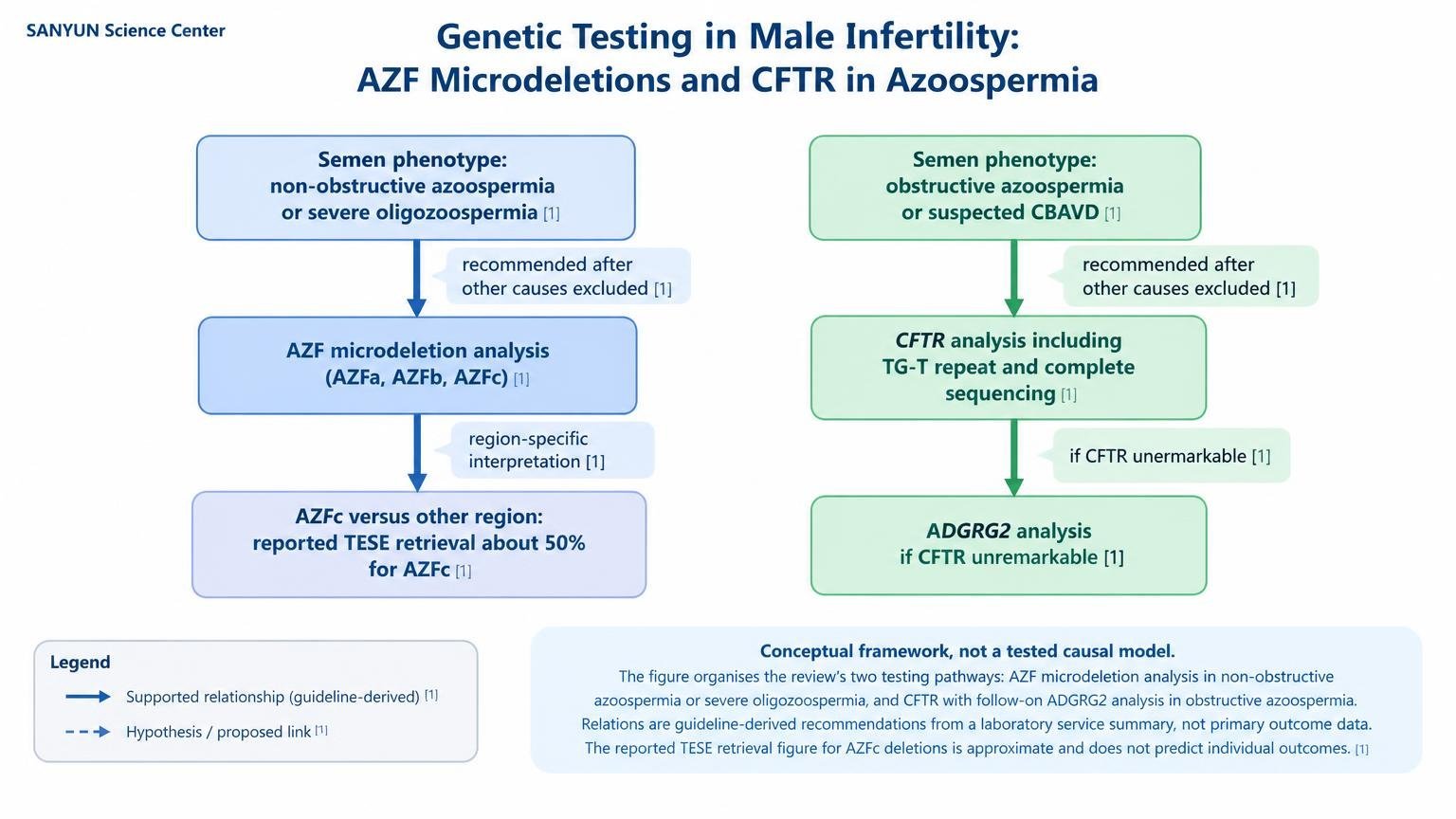
Conceptual framework: Conceptual framework, not a tested causal model. The figure organises the review's two testing pathways: AZF microdeletion analysis in non-obstructive azoospermia or severe oligozoospermia, and CFTR with follow-on ADGRG2 analysis in obstructive azoospermia. Relations are guideline-derived recommendations from a laboratory service summary, not primary outcome data. The reported TESE retrieval figure for AZFc deletions is approximate and does not predict individual outcomes.
Academic References & Evidence
SANYUN Science Center explains published research on men's reproductive and sexual health, connecting scientific evidence with everyday questions while making sources and limitations clear.
Disclaimer: This article is for scientific education and research communication only. It does not provide medical advice, diagnosis, or individualized treatment recommendations, and does not endorse any medication, supplement, device, penile enlargement procedure, or other intervention. Decisions about sexual and reproductive health should be made in consultation with a qualified healthcare professional. Do not delay seeking professional care because of information in this article.
Original Content & Copyright Notice
- This article is prepared for SANYUN Science Center, drawing on published research and publicly available academic literature on men’s sexual and reproductive health. Its editorial explanations and presentation are developed for this platform.
- Copyright in the original editorial content, selection, and arrangement is reserved by SANYUN Science Center to the extent protected by applicable law. Referenced research, quotations, and third-party materials remain subject to the rights of their respective owners. This notice does not claim ownership of scientific facts or third-party research.
- Except where permitted by applicable law or an applicable license, prior written permission is required to reproduce, republish, translate, adapt, redistribute, or commercially reuse protected content. Attribution alone does not grant permission for such reuse.
- For permitted quotation or authorized reuse, clearly identify the source and retain a link to the original article.
- Source: SANYUN Science Center
- Original URL: Retain the original article URL on science.san-yun.com.
- Copyright Holder: SANYUN Science Center, for its own protected editorial content.
- Quotation, excerpts, or authorized reuse must not distort the scientific meaning, omit material limitations or disclaimers, or imply unverified medical claims, product efficacy, or endorsement by SANYUN Science Center.



