




Category: Health Academy
Core Research Direction: Education explainer on what a man should record before a prostate/urinary-symptom visit (symptom diary, frequency-volume bladder diary, medication and prior-test history), why the record helps, and what it can and cannot establish
Search Intent: What should a man track before a urology visit for urinary symptoms — and what can a symptom or bladder diary actually tell his clinician?
Platform: SANYUN Science Center
Evidence reviewed through: 2026-11-23
Why a Written Record Helps
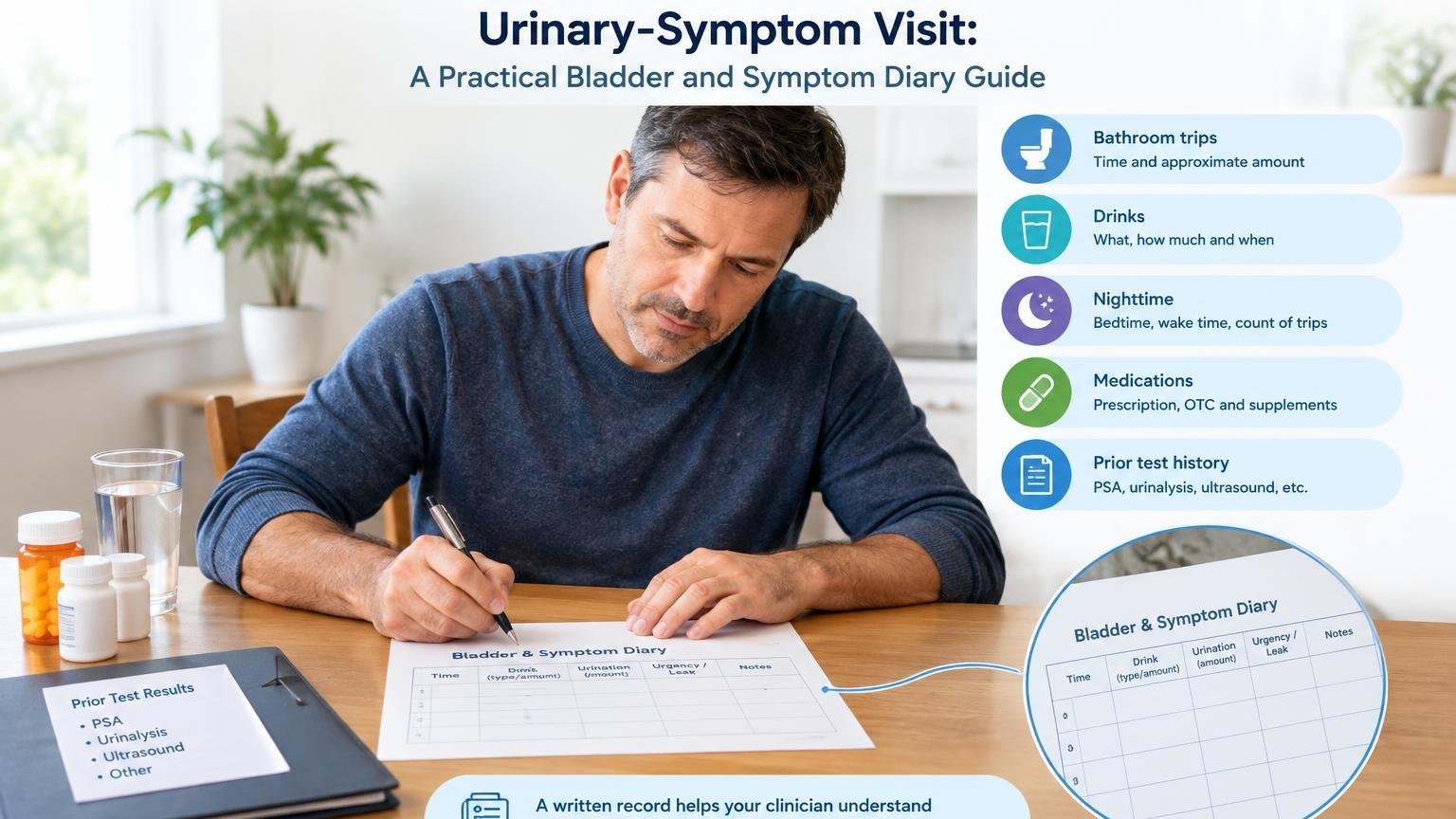
Urinary symptoms are easy to describe vaguely and hard to recall precisely. A man may remember that he is up several times each night, but not how many times, at what hours, or how much he drank before bed. A written record gives the clinician a week of observations rather than a single impression. Consumer education sources recommend writing down each trip to the bathroom, what and when you drink, any urgency or leaking, and your medicines, then counting nighttime trips for each night and bringing the pages and medication list to the visit.[1]
The point is not to replace the clinical interview. Rather, a diary provides specific answers to questions that clinicians commonly ask: what symptoms you have, when they began, how often they occur, which medicines you take, and how much fluid you drink each day, including caffeine and alcohol. The claim that these details are hard to recall is a reasonable assertion in educational writing, but it is not a measured finding from a study supplied here.
Safety First: When Not to Keep a Diary
A diary is for planning a routine visit, not for delaying urgent care. The advice attributed to NIDDK is to contact a health care professional right away if you cannot urinate at all; have painful, frequent, urgent urination together with fever and chills; see blood in your urine; or feel marked discomfort or pain in the lower abdomen or urinary tract. If you cannot reach a clinician quickly, urgent or emergency care is the usual next step. In those situations, do not spend a week logging symptoms.
What to Track Day by Day
A practical record includes the time of each bathroom trip, a rough urine amount (small, medium or large, or measured if a clinician supplied a container), the type and amount of drinks and when they were consumed, whether a strong sudden urge occurred, any leaking and what you were doing at the time, and whether starting, maintaining or finishing the stream was difficult. Nighttime notes should include bedtime and wake time, how many times you woke to urinate, how much you drank in the two to three hours before bed, and whether you could fall back asleep afterward.
The NIDDK printable Daily Bladder Diary is described as an hourly sheet from 6 a.m. through the night that tracks drinks, bathroom trips and urine amount, accidental leaks, strong urge, and activity at the time. It was written for bladder-control trouble. Applying it to frequency and nighttime symptoms is an adaptation used by the education article, not a standard NIDDK format for prostate-related urinary symptoms, so a clinician may prefer a different sheet or duration.
Why a Frequency-Volume Diary Can Clarify Nighttime Symptoms
A diary can help separate nocturia caused by a bladder that stores only small volumes from nocturia caused by the kidneys producing excess urine at night, known as nocturnal polyuria. Consumer education content explains that a frequency-volume diary can support this distinction. One commonly cited rule of thumb is that nighttime urine exceeding 20 percent of total 24-hour urine in younger adults, or more than 33 percent in adults over 65, may suggest nocturnal polyuria. Those cutoffs are presented in secondary education material and should be treated as prompts for clinical interpretation, not diagnostic thresholds that a man can apply to himself.[2]
This distinction matters because nocturia from polyuria does not always improve with standard prostate medications. A diary that shows a high proportion of urine output at night may therefore redirect the conversation toward fluid timing, other medical conditions, sleep, or medicines rather than assuming an enlarged prostate is the whole explanation.
Medication and Prior-Test History
Some medicines can worsen enlarged-prostate symptoms, and the article citing NIDDK asks men to tell a clinician if they take over-the-counter cold and cough products such as decongestants or antihistamines, tranquilizers, antidepressants, or diuretics. A complete list should include every prescription, over-the-counter product and supplement, with doses and timing. Do not stop or change a prescribed medicine on your own because of general education material; bring the question to the clinician.
Prior test results can also save time. Bringing previous PSA blood tests, urinalysis results, kidney-function tests, ultrasounds, post-void residual measurements or uroflowmetry reports helps the clinician see the trajectory rather than a single snapshot. Uroflowmetry and post-void residual are often ordered at the same visit but answer different questions, so keeping the reports distinct is useful.[3]
Medicines, Drinks and Daily Habits
NIDDK lists drinking fewer liquids before bedtime and limiting alcohol and caffeine as changes that may help reduce symptoms. The word may matters. These are plausible adjustments, not guaranteed treatments, and the diary can show whether evening drinks line up with nighttime trips. A man with other health conditions should ask his clinician before making large changes in fluid intake. Herbal supplements are worth listing even though no supplement is routinely recommended in clinical guidelines for treating BPH, because supplements can interact with other medicines.
What a Diary Cannot Establish
A record shows patterns; it does not diagnose. Enlarged-prostate symptoms are not always tied to prostate size, and similar symptoms can come from bladder problems, urinary tract infections, prostatitis, diabetes, medicines, sleep disorders, or prostate cancer. Sorting out the cause takes a clinical history, a physical examination, and sometimes tests such as urinalysis or a PSA blood test. The diary is an input to that process, not a substitute for it.
The education source also advises against restricting fluids just to make the diary look better, because that hides the real problem. A diary kept under usual conditions is more informative than one shaped to produce a tidy result.
The PSA Question
If PSA testing comes up, context matters. The National Cancer Institute, as summarized in the education source, says PSA can rise with prostate cancer and also with benign conditions, particularly enlarged prostate and prostatitis, so the number alone does not tell which is present. A prostate infection or inflammation, or a recent biopsy, can raise PSA for a month or two. Vigorous exercise such as cycling and ejaculation can raise it temporarily, and people are generally advised to avoid activities that may raise PSA for two days before testing. Finasteride and dutasteride lower PSA levels.
The same source reports that PSA is not recommended for routine screening in the general population and that people considering screening should discuss risks and benefits with a doctor first. These are secondary attributions to NCI, not original findings of the education article, and the original recommendation text is not supplied in the packet.
How This Fits the Clinic Visit
Clinicians will likely ask a man with lower urinary tract symptoms to complete the International Prostate Symptom Score, which measures symptom severity and includes a quality-of-life question capturing bother. A diary complements, but does not replace, that structured questionnaire. The guide also notes that treatment decisions depend partly on bother but also on medical complications, so a low bother score does not mean ignoring risks such as recurring infections or incomplete emptying.
Not every test is automatically required. PSA testing, post-void residual measurement, uroflowmetry and ultrasound are selected based on symptoms, risk factors, and whether the result would change the treatment plan. A well-kept record can make that selection more deliberate by showing what the symptoms actually look like across days and nights.
Evidence Limitations
The main sources here are consumer education articles, not primary studies of diary accuracy or clinical outcomes. The seven-day duration is one article's suggestion rather than a standard, while another source recommends a three-day diary for nocturia or frequent urination. That disagreement is a signal that diary duration and format are practical choices a clinician may tailor. The claim that a diary helps determine the cause is plausible and widely endorsed in education material, but the packet does not supply diagnostic-accuracy data comparing diary-guided care with usual care.
The packet also includes a results table from a questionnaire study of men with PSA and biopsy experience, but only the table is supplied. It reports 335 respondents, with 192 of 335 (57.3 percent) under 65 at questionnaire completion, and 119 of 335 (35.5 percent) symptomatic at the time of PSA testing. Side-effect and information items are also tabulated. Because study design, setting and recruitment are not provided, those figures cannot be generalized and do not directly test diary use.[4]
Practical Takeaways
- Keep the record under usual conditions, including usual drinks, rather than restricting fluids to produce a cleaner-looking diary.
- Bring the pages, an up-to-date medication and supplement list with doses and timing, and prior test reports to the visit.
- Do not wait to complete a diary if you cannot urinate, have fever and chills with urinary symptoms, see blood in urine, or have severe lower abdominal or urinary pain.
- Write down your top one or two bothersome symptoms and the questions you want answered, so the visit addresses what matters most to you.
Questions and Answers
What is a bladder diary before a prostate visit?
It is a written record of bathroom trips, drinks, urgency, leaking, nighttime awakenings and medicines kept for a few days before a urology appointment. One education source suggests seven days; another suggests three days for nocturia or frequency. It is a communication tool that shows patterns, not a diagnostic test.
What should a man write down for urinary symptoms before seeing a urologist?
Record the time and approximate amount of each urination, what and how much you drink and when, strong urgency, leaking and the activity at the time, and difficulty starting, maintaining or finishing the stream. At night, note bedtime, wake time, nighttime trips, evening drinks and whether you fell back asleep. Bring your medication list and prior test reports.
How can a frequency-volume diary help distinguish nocturnal polyuria from bladder storage problems?
By comparing nighttime urine volume with total 24-hour volume, a diary can suggest whether the kidneys are producing too much urine at night rather than the bladder storing too little. Secondary education material cites thresholds of more than 20 percent in younger adults and more than 33 percent in adults over 65, but these are interpretive prompts, not self-diagnostic cutoffs.
Can a symptom diary diagnose an enlarged prostate?
No. A diary shows patterns but does not establish a cause. Enlarged-prostate symptoms are not always tied to prostate size, and similar symptoms can come from bladder problems, urinary tract infections, prostatitis, diabetes, medicines, sleep disorders or prostate cancer. Diagnosis requires a clinical history, examination and sometimes tests such as urinalysis or PSA.
When should urinary symptoms be treated as urgent rather than logged in a diary?
Seek prompt care if you cannot urinate at all, have painful frequent urgent urination with fever and chills, see blood in your urine, or have severe lower abdominal or urinary tract pain. In those situations, do not spend a week completing a diary; contact a clinician right away or use urgent or emergency care if a clinician is not reachable.
Does a PSA test alone tell whether urinary symptoms are caused by cancer or an enlarged prostate?
No. PSA can rise with prostate cancer and also with benign conditions, particularly enlarged prostate and prostatitis. Infection, inflammation, recent biopsy, vigorous cycling and ejaculation can raise PSA temporarily, and finasteride or dutasteride can lower it. The number needs clinical context, and NCI does not recommend routine general-population screening.
Sources and References
- TriCountyUrology.org Editorial Team. Preparing for a Prostate-Symptom Visit: A Seven-Day Record.
- Preparing for a BPH Evaluation: What to Track Before Your Visit.
- TriCountyUrology.org Editorial Team. urology.
- Table 1..
SANYUN Science Center explains published research on men's reproductive and sexual health, connecting scientific evidence with everyday questions while making sources and limitations clear.
Disclaimer: This article is for scientific education and research communication only. It does not provide medical advice, diagnosis, or individualized treatment recommendations, and does not endorse any medication, supplement, device, penile enlargement procedure, or other intervention. Decisions about sexual and reproductive health should be made in consultation with a qualified healthcare professional. Do not delay seeking professional care because of information in this article.
Original Content & Copyright Notice
- This article is prepared for SANYUN Science Center, drawing on published research and publicly available academic literature on men’s sexual and reproductive health. Its editorial explanations and presentation are developed for this platform.
- Copyright in the original editorial content, selection, and arrangement is reserved by SANYUN Science Center to the extent protected by applicable law. Referenced research, quotations, and third-party materials remain subject to the rights of their respective owners. This notice does not claim ownership of scientific facts or third-party research.
- Except where permitted by applicable law or an applicable license, prior written permission is required to reproduce, republish, translate, adapt, redistribute, or commercially reuse protected content. Attribution alone does not grant permission for such reuse.
- For permitted quotation or authorized reuse, clearly identify the source and retain a link to the original article.
- Source: SANYUN Science Center
- Original URL: Retain the original article URL on science.san-yun.com.
- Copyright Holder: SANYUN Science Center, for its own protected editorial content.
- Quotation, excerpts, or authorized reuse must not distort the scientific meaning, omit material limitations or disclaimers, or imply unverified medical claims, product efficacy, or endorsement by SANYUN Science Center.



