




Category: Clinical Insights
Core Research Direction: Defining referral criteria and referral quality at the primary–secondary care interface for men with benign prostatic hyperplasia (BPH) and lower urinary tract symptoms (LUTS)
Search Intent: When should a man with BPH/LUTS be referred for specialist or surgical urological assessment, and what makes such a referral of high quality?
Platform: SANYUN Science Center
Evidence reviewed through: 2026-11-10
Executive Summary
Referral of men with benign prostatic hyperplasia (BPH) and lower urinary tract symptoms (LUTS) rests on two distinguishable questions. The first is clinical: when does the symptom profile, treatment history or presence of complications justify specialist urological assessment? The second is procedural: what makes the referral itself useful to the receiving team? Guideline-aligned material indicates that men whose LUTS fail to respond to drug treatment should be referred for specialist urological assessment and management, and that surgery is typically considered only when voiding symptoms are severe or conservative and drug options have been unsuccessful or are not appropriate.[1]
A parallel strand of evidence addresses referral quality rather than referral timing. A systematic scoping review with qualitative content analysis proposed a framework in which a quality referral combines patient clinical characteristics, explicit clinical reasoning, patient factors and awareness of referral barriers. Elements include a clear referral indication or question, appropriate urgency classification, relevant investigations and a complete history, documented patient preferences, and information flow back to the referring clinician.[2]
Two cautions frame the interpretation. The BPH referral criteria derive from a guideline-aligned clinical answer rather than primary outcome research, and the referral-quality framework is descriptive, not a tested intervention. Separately, an exploratory hepatology study found that guideline statements and Cochrane review conclusions agreed in only 14.5% (95% CI 7.7% to 25.6%) of assessed statements, with guideline authors often overstating recommendation strength. That finding concerns decompensated cirrhosis, not BPH, and should not be transferred directly; it is a reminder that guideline recommendations vary in certainty.[3]
Why This Matters
BPH-related LUTS is a common reason for primary care consultation in adult men, and the decision to refer shapes both patient experience and the use of secondary care capacity. Referring too late risks leaving complications such as urinary retention or renal impairment unaddressed. Referring without a clear question or adequate investigation risks an unproductive consultation, repeat testing and delayed decisions. The referral-quality literature explicitly identifies repeat unnecessary referral and clinical errors as problems that better information flow is intended to prevent, although that benefit is a stated rationale rather than a tested outcome.
The distinction between referral for assessment and referral for surgery also matters. A man may need specialist assessment because of diagnostic uncertainty or a complication without yet being a surgical candidate. Conversely, a man with severe voiding symptoms and failed drug treatment may be referred specifically to consider bladder outlet surgery. Naming which question is being asked is a core component of referral quality.
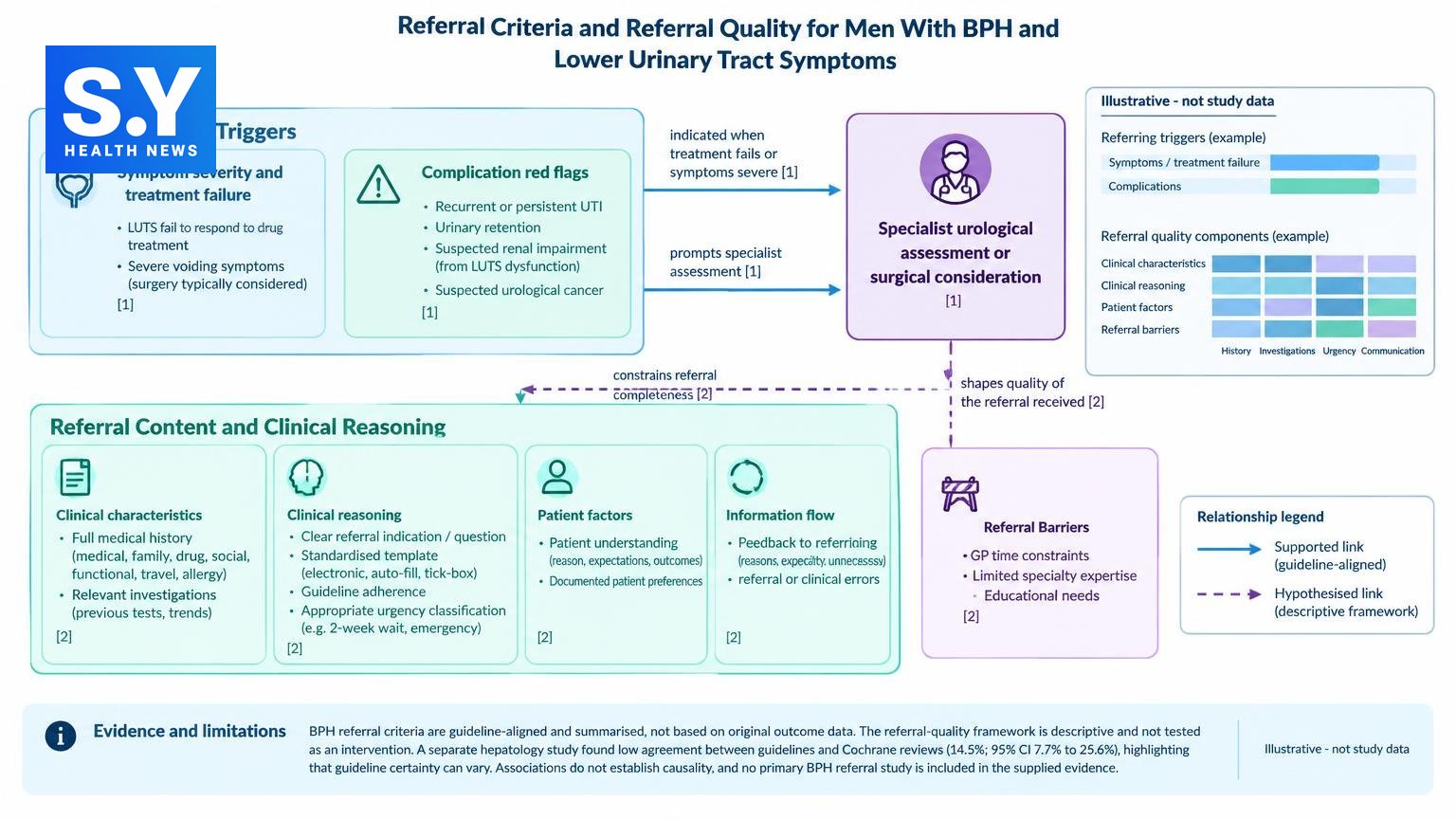
Referral Triggers: Symptoms, Treatment Failure and Complications
The guideline-aligned source frames surgical referral around two principal axes: the severity of LUTS and the effectiveness of prior treatments. Failure of conservative and drug management is an explicit trigger for specialist urological assessment and management. Surgery is typically considered only where voiding symptoms are severe, or where conservative and drug treatment options have been unsuccessful or are not appropriate. This wording is conditional and does not specify symptom score thresholds, drug classes or durations of prior treatment.
A separate set of triggers concerns complications rather than symptom burden. Referral for specialist assessment is indicated when LUTS are complicated by recurrent or persistent urinary tract infection, urinary retention, renal impairment suspected to be caused by lower urinary tract dysfunction, or suspected urological cancer. These are complication-based red flags, and their presence changes the referral from a discussion about symptom control to an assessment of potentially reversible or serious pathology.
Chronic urinary retention occupies an intermediate position. For men with chronic urinary retention who also have other bothersome LUTS but no impairment of renal function or upper renal tract abnormality, referral for surgery on the bladder outlet may be considered. Intermittent or indwelling catheterisation may also be considered before offering surgery. Both statements are conditional, and the source does not report comparative outcomes for either pathway.
| Referral scenario | Stated trigger | Condition or caveat |
|---|---|---|
| Failed drug or conservative management | LUTS fail to respond to drug treatment; refer for specialist urological assessment and management | Stated in guideline-aligned summary without specified drug classes or treatment duration |
| Surgical consideration | Surgery typically considered only if voiding symptoms are severe, or conservative and drug options unsuccessful or not appropriate | Conditional wording; no symptom score threshold given |
| Complicated LUTS | Recurrent or persistent urinary tract infection, urinary retention, suspected renal impairment from lower urinary tract dysfunction, or suspected urological cancer | Complication-based red flags prompting specialist assessment |
| Chronic urinary retention with bothersome LUTS | Referral for bladder outlet surgery may be considered | Applies when renal function and upper renal tract are not impaired |
| Chronic urinary retention before surgery | Intermittent or indwelling catheterisation may be considered | Presented as an option before offering surgery |
What Constitutes a High-Quality Referral
The scoping review framework organises referral quality into four domains: patient clinical characteristics, clinical reasoning, patient factors and referral barriers. Within clinical characteristics, the framework calls for clear use of a full medical history, including medical, family, drug, social, functional, travel and allergy history relevant to the referral destination. It also calls for all relevant investigations, including previously completed tests and trends, relevant to the specialty destination and differential diagnosis.
Under clinical reasoning, the framework requires a clear referral indication, described as the referral reason or question posed to the secondary care professional, for example diagnostic uncertainty, further investigations, optimisation of patient care or consideration for surgery. It also identifies use of a standardised referral template, ideally electronic with auto-fill and tick-box features, adherence to local or national guidelines for the destination service, and appropriate urgency classification, including use of the 2-week wait cancer fast-track or emergency pathway when needed.
Patient factors include patient understanding of the referral, covering the clinical reason, expectations and likely outcomes, and patient involvement, including documentation of preferences in the referral. Information flow is treated as part of referral quality: time to referral, and relaying clinical information, decisions, investigations and relevant outcomes back to the general practitioner. The framework states that this feedback loop is intended to prevent repeat unnecessary referral or clinical errors.
Interpretation and Limitations
The evidence here has clear boundaries. The BPH referral criteria come from a guideline-aligned clinical answer that is described as clinically reviewed and high confidence, but it reports no study population, sample size or outcome data. It summarises cited national guidance rather than presenting new comparative evidence. Statements such as surgery being "typically considered" only under certain conditions reflect guideline framing, not measured effects of referral timing on outcomes.
The referral-quality framework comes from a systematic scoping review with qualitative content analysis. It is a conceptual framework derived from synthesis of existing descriptions; it does not establish that any single component, such as template use or urgency labelling, improves patient outcomes. The barriers it identifies, including time constraints in general practice and limited specialty expertise with associated educational needs, are described qualitatively rather than quantified in the supplied material.
The hepatology study offers a wider caution about guideline certainty, but its design limits transfer. It was an exploratory comparison of nine clinical practice guidelines containing 62 statements against seven Cochrane reviews, with a purposive sample from decompensated cirrhosis topics. Agreement between guideline authors and independent assessment was 14.5% (95% CI 7.7% to 25.6%), and most disagreements concerned overstated strength of recommendation; differences in search dates did not explain the disagreements. The authors suggest a systematic issue, which is a hypothesis from a non-urological field, not an established finding about BPH guidance.
Because the reference date for this review is November 2026, readers should note that no primary BPH referral study is included in the supplied evidence. The criteria and framework are best read as structured prompts for clinical reasoning and communication, not as validated prediction rules or performance measures.
Clinical Relevance and Research Outlook
For practicing clinicians, the practical implication is to separate the two questions explicitly in the referral letter. The first line should state the clinical trigger: failed drug treatment, severe voiding symptoms, a complication such as recurrent urinary tract infection or urinary retention, suspected renal impairment, or suspected urological cancer. The second should state the question being asked of the specialist: diagnostic clarification, further investigation, optimisation, or consideration for bladder outlet surgery.
Urgency deserves particular care because the framework treats it as a quality dimension. A man with suspected urological cancer requires the cancer fast-track pathway, whereas an emergency pathway applies to acute presentations such as urinary retention with complications. The supplied material does not specify which urgency category applies to each BPH scenario, so local and national guidance for the destination service remains the operative reference.
Research gaps follow directly from the evidence reviewed. There is a need for studies that test whether structured, question-led referrals for BPH/LUTS change time to assessment, rates of repeat investigation, or clinical outcomes. The scoping review provides a conceptual map rather than outcome evidence, and the BPH criteria are guideline summaries. Until such studies exist, quality improvement should focus on the measurable process elements the framework names, while avoiding claims that these elements are proven to improve outcomes.
Key Takeaways
- Refer men with BPH/LUTS for specialist urological assessment when symptoms fail to respond to drug treatment, or when complications such as recurrent urinary tract infection, urinary retention, suspected renal impairment from lower urinary tract dysfunction, or suspected urological cancer are present.
- Surgery is typically considered only when voiding symptoms are severe, or when conservative and drug treatments have been unsuccessful or are not appropriate; chronic urinary retention with bothersome LUTS but preserved renal function may prompt consideration of bladder outlet surgery.
- A quality referral states a clear indication or question, includes relevant history and investigations with trends, uses an appropriate urgency pathway, documents patient understanding and preferences, and supports information flow back to the referring clinician.
- The referral-quality framework is conceptual and descriptive; it does not establish that individual components improve patient outcomes, and time pressure and limited specialty expertise are recognised barriers.
- An exploratory hepatology study found low agreement between guideline statements and Cochrane review conclusions, but those findings concern decompensated cirrhosis and cannot be generalised to BPH referral criteria.
Questions and Answers
When should a man with BPH and lower urinary tract symptoms be referred to a urologist?
Guideline-aligned criteria indicate referral for specialist urological assessment when LUTS fail to respond to drug treatment, or when symptoms are complicated by recurrent or persistent urinary tract infection, urinary retention, suspected renal impairment from lower urinary tract dysfunction, or suspected urological cancer. Surgery is typically considered only if voiding symptoms are severe or conservative and drug options have been unsuccessful or are not appropriate.
What makes a referral for suspected BPH complications high quality?
A quality referral states a clear indication or question for the specialist, provides a complete relevant history and all relevant investigations including trends, follows local or national guidance, uses an appropriate urgency category such as the cancer fast-track or emergency pathway when needed, documents patient understanding and preferences, and supports information flow back to the referring clinician. This framework is descriptive and has not been tested as an intervention.
How strong is the evidence behind BPH referral criteria?
The referral criteria are presented in a guideline-aligned clinical answer described as clinically reviewed and high confidence, summarising cited national guidance. It reports no study population, sample size, effect estimates or comparative outcomes. The criteria should therefore be read as expert guideline synthesis rather than as primary research establishing that specific referral thresholds improve outcomes.
Do the referral-quality framework components improve patient outcomes?
The framework comes from a systematic scoping review with qualitative content analysis and is descriptive. It identifies components such as a clear referral question, standardised templates, appropriate urgency and patient involvement, but the supplied material does not show that any component improves outcomes. The stated benefits, such as avoiding repeat referral or clinical errors through information flow, are rationales rather than tested effects.
Why do time pressure and limited specialty training affect referral quality for BPH and LUTS?
The referral-quality framework identifies general practice time constraints as a barrier, raising the question of whether clinicians can consistently produce detailed referrals within limited administrative time. It also identifies limited specialty expertise and associated educational needs as a barrier. Both are described qualitatively rather than quantified in the supplied material, so their relative contribution to referral quality is unknown.
What can a study of cirrhosis guidelines tell us about BPH referral guidance?
Very little directly. The exploratory study compared nine cirrhosis guidelines containing 62 statements with seven Cochrane reviews and found agreement of 14.5% (95% CI 7.7% to 25.6%), with most disagreements involving overstated recommendation strength. Because it concerns decompensated cirrhosis and used a purposive sample, its findings cannot be transferred to BPH referral criteria, though it illustrates why guideline certainty should be examined.
Conceptual framework: Conceptual framework of referral criteria and referral quality for men with BPH and LUTS. The framework separates clinical referral triggers (symptom severity and treatment failure, complication red flags) from the quality of referral content and communication. Supported links reflect guideline-aligned statements; proposed links reflect descriptive framework elements that have not been tested as interventions.
Academic References & Evidence
- What Criteria Should I Use to Decide Whether to Refer a Patient With B.
- Defining a theoretical framework for a quality referral at the primary–secondary care interface: a systematic scoping review with qualitative content analysis.
- Gurusamy, K; Roberts, D; Leung, J; O’Brien, A; Gluud, C; Pavlov, C; Davidson, BR. Clinical practice guidelines recommendations compared to the findings of the Cochrane systematic reviews on the management of decompensated liver cirrhosis in the USA and Europe. Frontline Gastroenterology. 2026 DOI: 10.1136/flgastro-2026-103856.
SANYUN Science Center explains published research on men's reproductive and sexual health, connecting scientific evidence with everyday questions while making sources and limitations clear.
Disclaimer: This article is for scientific education and research communication only. It does not provide medical advice, diagnosis, or individualized treatment recommendations, and does not endorse any medication, supplement, device, penile enlargement procedure, or other intervention. Decisions about sexual and reproductive health should be made in consultation with a qualified healthcare professional. Do not delay seeking professional care because of information in this article.
Original Content & Copyright Notice
- This article is prepared for SANYUN Science Center, drawing on published research and publicly available academic literature on men’s sexual and reproductive health. Its editorial explanations and presentation are developed for this platform.
- Copyright in the original editorial content, selection, and arrangement is reserved by SANYUN Science Center to the extent protected by applicable law. Referenced research, quotations, and third-party materials remain subject to the rights of their respective owners. This notice does not claim ownership of scientific facts or third-party research.
- Except where permitted by applicable law or an applicable license, prior written permission is required to reproduce, republish, translate, adapt, redistribute, or commercially reuse protected content. Attribution alone does not grant permission for such reuse.
- For permitted quotation or authorized reuse, clearly identify the source and retain a link to the original article.
- Source: SANYUN Science Center
- Original URL: Retain the original article URL on science.san-yun.com.
- Copyright Holder: SANYUN Science Center, for its own protected editorial content.
- Quotation, excerpts, or authorized reuse must not distort the scientific meaning, omit material limitations or disclaimers, or imply unverified medical claims, product efficacy, or endorsement by SANYUN Science Center.



