




Category: Clinical Insights
Core Research Direction: Structured, guideline-aligned approach to distinguishing benign prostatic hyperplasia (BPH) from other causes of lower urinary tract symptoms (LUTS) in adult men, including initial assessment, red flags, and when to refer
Search Intent: How can clinicians differentiate BPH from other causes of lower urinary tract symptoms in men, and which findings should prompt further workup or referral?
Platform: SANYUN Science Center
Evidence reviewed through: 2026-11-09
Executive Summary
Lower urinary tract symptoms (LUTS) in adult men are common, but they are a clinical presentation rather than a diagnosis. Benign prostatic hyperplasia (BPH) is a frequent contributor, yet infection, malignancy, stones, medication effects, diabetes, neurologic disease and overactive bladder can produce overlapping symptoms. The central clinical task is therefore not to label LUTS as BPH by default, but to use a structured assessment that separates storage, voiding and post-micturition symptoms, reviews medications, screens for infection and haematuria, and identifies complications of obstruction.[1]
Guideline-aligned summaries recommend a comprehensive history, medication review including herbal and over-the-counter products, physical examination including digital rectal examination (DRE), urine dipstick testing, a frequency-volume chart and individualized prostate-specific antigen (PSA) discussion at initial assessment. Routine cystoscopy, upper tract imaging, flow-rate measurement and post-void residual (PVR) measurement are generally not offered at first assessment for uncomplicated LUTS, but become relevant when complications, diagnostic uncertainty or specialist referral arise.[2]
Specialist referral is indicated when bothersome LUTS do not respond to conservative or drug treatment, or when LUTS are complicated by recurrent or persistent urinary tract infection, retention, suspected renal impairment from lower urinary tract dysfunction, or suspected urological cancer. Red flags such as acute retention, gross haematuria, abnormal DRE, bone pain or weight loss, and neurologic signs should prompt urgent escalation rather than routine BPH management.
Why This Matters
The default assumption that LUTS in an older man equals BPH carries diagnostic risk. Storage-predominant symptoms may reflect overactive bladder, infection, diabetes or medication effects rather than obstruction. Voiding symptoms may arise from urethral stricture or bladder stone. More seriously, haematuria in an older smoker may signal bladder cancer, and urinary retention with saddle anaesthesia may indicate cauda equina syndrome. Each of these requires a different pathway, and some are time-critical.
The evidence supporting structured assessment is largely guideline-based and educational rather than derived from randomized trials of diagnostic strategies. This distinction matters: recommendations about which tests to offer reflect expert synthesis of clinical experience and available evidence, not proof that one assessment pathway outperforms another in every setting. Clinicians should therefore apply guidance with attention to the individual patient's presentation, comorbidity and preferences.
Classifying Symptoms Before Naming a Cause
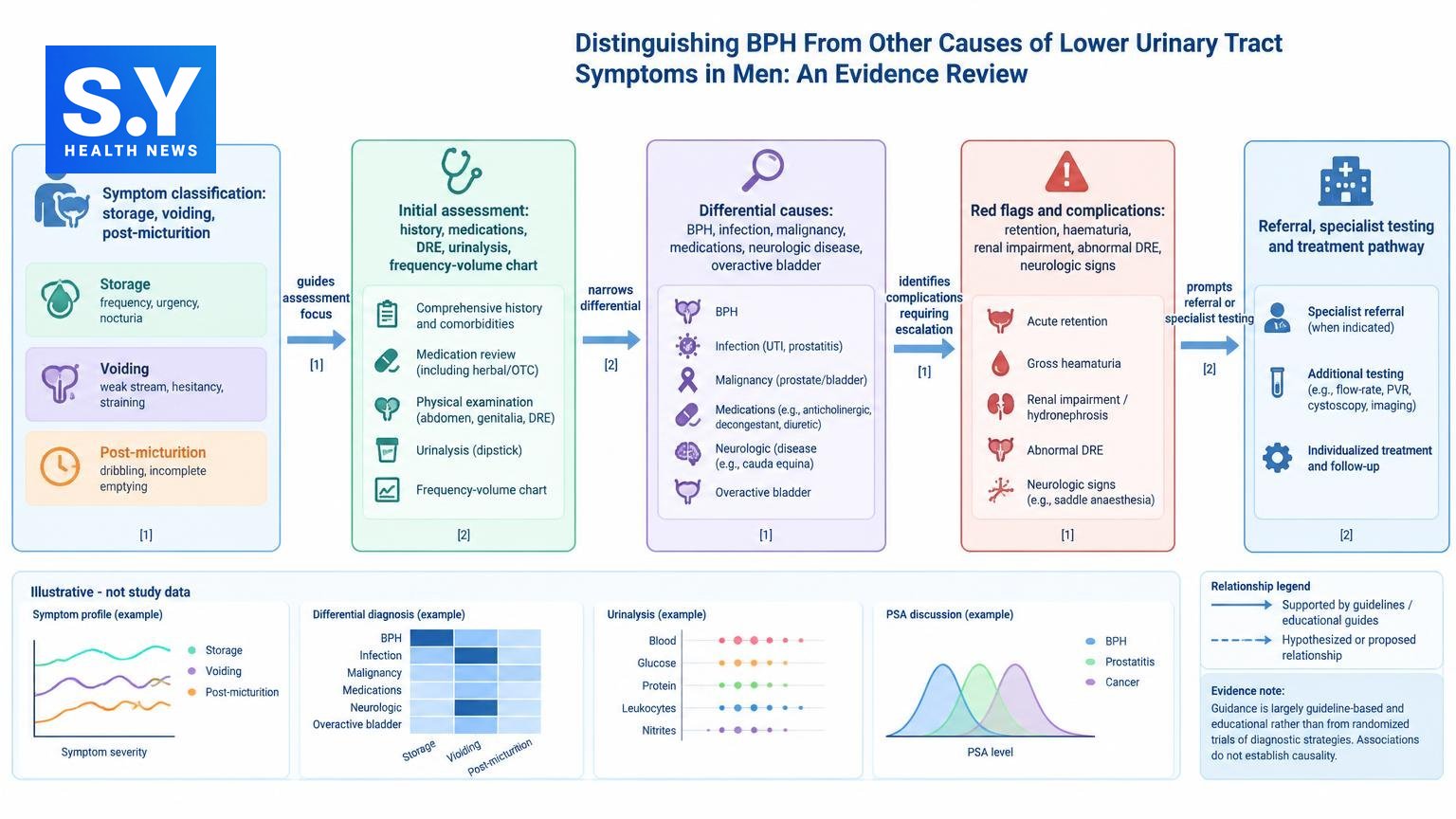
A practical first step is to classify symptoms into storage (frequency, urgency, nocturia), voiding (weak stream, hesitancy, straining) and post-micturition (dribbling, incomplete emptying) groups. This classification does not establish a diagnosis, but it directs attention. Predominantly storage symptoms raise the possibility of overactive bladder, infection, diabetes or medication effects. Predominantly voiding symptoms are more consistent with bladder outlet obstruction, including BPH, urethral stricture or, less commonly, bladder stone.
Symptom severity and bother should be quantified, for example with a validated symptom score, because severity guides whether watchful waiting, lifestyle measures, pharmacotherapy or referral is appropriate. The presence of complications changes the pathway irrespective of symptom score: retention, renal impairment, recurrent infection or haematuria require escalation.
Initial Assessment: History, Medications and Examination
Initial assessment in general practice begins with a comprehensive medical history to identify possible causes of LUTS and associated comorbidities. Medication review is a core component because anticholinergics, decongestants, opioids, tricyclic antidepressants, antihistamines, sympathomimetics and diuretics can all contribute to LUTS or retention. Herbal and over-the-counter remedies should also be reviewed, since patients may not regard these as medicines.
Physical examination includes the abdomen, external genitalia and DRE. The abdominal examination assesses for a palpable distended bladder; genital examination identifies meatal stenosis, phimosis or other local pathology; DRE assesses prostate size, texture, symmetry and tenderness, and provides an opportunity to detect a hard, nodular or asymmetric gland. Neurologic examination is relevant when symptoms suggest bladder dysfunction or cauda equina compromise.
A urinary frequency-volume chart is recommended for men with bothersome LUTS. It helps distinguish polyuria from urgency and frequency, documents nocturnal urine output and provides objective context for symptom reports. Urine dipstick testing is offered to detect blood, glucose, protein, leucocytes and nitrites, which may indicate infection, glycosuria or haematuria requiring further evaluation.
Laboratory and Imaging Decisions
PSA testing is offered when LUTS suggest bladder outlet obstruction secondary to BPH, when DRE is abnormal, or when the man is concerned about prostate cancer. Interpretation must be contextual: PSA may be elevated during prostatitis, urinary tract infection, retention or after recent instrumentation, so a single elevated value in an acute setting should not be treated as diagnostic of cancer.
Serum creatinine with estimated glomerular filtration rate is offered only when renal impairment is suspected, for example with a palpable bladder, nocturnal enuresis, recurrent urinary tract infection or a history of renal stones. At specialist assessment, men with chronic urinary retention, defined as a residual volume greater than 1 litre or a palpable bladder, should undergo serum creatinine testing and upper urinary tract imaging.
Routine cystoscopy, upper urinary tract imaging, flow-rate measurement and post-void residual measurement are generally not offered at initial assessment for uncomplicated LUTS. These are reserved for situations where the diagnosis is uncertain, complications are present, or specialist evaluation is underway. This staged approach avoids unnecessary investigation while preserving access to appropriate tests when indicated.
What the Evidence Shows: Differential Diagnosis and Red Flags
The differential diagnosis of LUTS in men is broad. Acute urinary retention and post-renal acute kidney injury are must-not-miss diagnoses characterized by painful inability to void, suprapubic fullness and overflow incontinence. Prostate or bladder cancer may present with abnormal DRE, gross haematuria, weight loss, bone pain or irritative symptoms with haematuria. Cauda equina syndrome or neurogenic bladder may present with urinary retention, saddle anaesthesia, bilateral sciatica, leg weakness, reduced anal tone or new bowel dysfunction and requires urgent MRI and neurosurgical consultation.
Acute bacterial prostatitis or complicated urinary tract infection may present with fever, chills, pelvic or perineal pain, dysuria and a tender boggy prostate; vigorous prostate massage should be avoided. Overactive bladder produces predominantly storage symptoms without obstructive voiding symptoms. Urethral stricture is suggested by a weak spraying stream, prior instrumentation, trauma or sexually transmitted infection history. Bladder stone may cause intermittent stream, suprapubic pain and recurrent infection. Diabetes mellitus or diabetes insipidus can mimic LUTS through polyuria rather than obstruction.
Red flags that should prompt urgent or specialist assessment include acute urinary retention, gross haematuria, recurrent urinary tract infection, renal impairment, hydronephrosis, abnormal DRE, bone pain or weight loss, and neurologic signs. These features distinguish complicated from uncomplicated presentations and determine the appropriate tempo of investigation.
| Clinical scenario | Suggested cause or concern | Assessment or action |
|---|---|---|
| Painful inability to void, suprapubic fullness, overflow leakage | Acute urinary retention or post-renal acute kidney injury | Bladder decompression; check creatinine and consider renal ultrasound if impairment or chronic retention suspected |
| Gross haematuria, abnormal DRE, weight loss, bone pain, smoking history | Prostate or bladder cancer | DRE, PSA discussion when appropriate, urinalysis, haematuria pathway and urology referral |
| Retention with saddle anaesthesia, bilateral sciatica, leg weakness, reduced anal tone, bowel dysfunction | Cauda equina syndrome or neurogenic bladder | Urgent MRI spine and neurosurgical consultation |
| Fever, chills, perineal pain, dysuria, tender boggy prostate | Acute bacterial prostatitis or complicated UTI | Urinalysis and urine culture; avoid vigorous prostate massage; treat infection promptly |
| Predominantly urgency, frequency, nocturia without obstructive voiding symptoms | Overactive bladder | Urinalysis to exclude infection or haematuria; assess PVR if obstruction risk before antimuscarinic therapy |
| Anticholinergic, decongestant, opioid, TCA, antihistamine, sympathomimetic or diuretic use | Medication-induced LUTS or retention | Medication review and safe trial withdrawal or substitution where appropriate |
| Weak spraying stream, prior instrumentation, trauma, STI history, recurrent UTI | Urethral stricture | Uroflowmetry and cystoscopy or retrograde urethrogram by urology |
| Polyuria and polydipsia rather than urgency or obstruction | Diabetes mellitus or diabetes insipidus | Glucose or HbA1c; electrolytes and osmolality if diabetes insipidus suspected |
Referral Thresholds and Specialist Assessment
Referral for specialist assessment is indicated when bothersome LUTS have not responded to conservative management or drug treatment, or when LUTS are complicated by recurrent or persistent urinary tract infection, retention, suspected renal impairment caused by lower urinary tract dysfunction, or suspected urological cancer. At specialist assessment, history, medication review, physical examination including DRE and frequency-volume charting are repeated. PSA is offered under the same criteria as at initial assessment.
Specialist assessment may include flow-rate measurement and post-void residual volume measurement, and cystoscopy is performed only when clinically indicated, such as with recurrent infection, sterile pyuria, haematuria, profound symptoms or pain. For men with chronic urinary retention, defined as residual volume greater than 1 litre or a palpable bladder, serum creatinine testing and upper urinary tract imaging are carried out. These thresholds help distinguish men who need urological evaluation from those who can be managed in primary care.
Treatment Context and Diagnostic Pitfalls
Treatment is stepwise and should follow, not precede, a clear diagnostic assessment. Conservative measures include fluid timing, reduced evening fluids, caffeine and alcohol, double voiding and bladder training where storage symptoms dominate. Alpha-blockers act quickly for bothersome voiding symptoms, whereas 5-alpha-reductase inhibitors reduce progression, take months to act and are best suited to enlarged glands. Antimuscarinics or beta-3 agonists may be used for storage-predominant symptoms after excluding significant retention.
A key pitfall is calling all LUTS BPH. Storage-predominant symptoms may be overactive bladder, infection, diabetes, medication-related or malignancy-associated. Missing retention is another pitfall, because overflow incontinence and chronic retention can masquerade as frequency or incontinence. PSA timing requires care, since values may be elevated during prostatitis, urinary tract infection, retention or after instrumentation. Before using antimuscarinics when obstruction is suspected, retention risk and post-void residual should be assessed. Neurologic red flags such as cauda equina with urinary retention are time-critical and should not be managed as routine prostatism.
Interpretation and Limitations
The principal sources for this review are guideline-aligned summaries and educational clinical-presentation guides rather than primary diagnostic accuracy studies. They describe recommended pathways and differential diagnoses but do not provide sensitivity, specificity or outcome data for specific assessment strategies in uncomplicated LUTS. The recommendations should therefore be read as expert synthesis, not as proof that any single test or sequence improves outcomes.
The packet also contains studies from unrelated fields, including perioperative blood pressure management, cardiac-index-guided therapy and guideline methodology in decompensated cirrhosis. These are not directly applicable to BPH or male LUTS and are not used to support clinical claims here. Their presence illustrates the importance of matching evidence to the clinical question rather than importing findings across specialties. An exploratory comparison of cirrhosis guidelines with Cochrane reviews found that agreement between guideline authors and independent assessment was 14.5% (95% CI 7.7% to 25.6%), with most disagreements reflecting overstated recommendation strength; this is a caution about guideline synthesis generally, not a finding about BPH guidance.[3][4][5]
Another limitation is that symptom classification and differential diagnosis are inherently probabilistic. A man may have more than one contributor, such as BPH with overactive bladder or medication-related worsening of storage symptoms. The assessment framework should therefore be iterative, with re-evaluation when symptoms change, do not respond to treatment, or new red flags appear.
Research Outlook
Better evidence is needed on the diagnostic yield and clinical impact of structured LUTS assessment in primary care, including which patients benefit from early PVR, uroflowmetry or PSA testing and which can be safely managed with history, examination and urinalysis alone. Studies should also clarify how often BPH and overactive bladder coexist and how medication review changes symptom trajectories. Until such evidence is available, guideline-aligned assessment with explicit red-flag checking remains the most defensible approach.
Key Takeaways
- LUTS are a presentation, not a diagnosis; classify storage, voiding and post-micturition symptoms before attributing them to BPH.
- Initial assessment includes comprehensive history, medication review including herbal and over-the-counter products, examination including DRE, urinalysis and a frequency-volume chart.
- Routine cystoscopy, upper tract imaging, flow-rate measurement and PVR are generally not offered at initial assessment for uncomplicated LUTS.
- Refer when LUTS are complicated by recurrent or persistent UTI, retention, suspected renal impairment from lower urinary tract dysfunction, or suspected urological cancer, or when bothersome symptoms do not respond to conservative or drug treatment.
- Red flags including acute retention, gross haematuria, abnormal DRE, bone pain or weight loss and neurologic signs require urgent or specialist assessment.
- Chronic urinary retention with residual volume greater than 1 litre or a palpable bladder warrants serum creatinine testing and upper urinary tract imaging.
Questions and Answers
What is the difference between BPH and lower urinary tract symptoms in men?
BPH is a histological and clinical enlargement of the prostate that can contribute to bladder outlet obstruction, whereas lower urinary tract symptoms are a presentation that may arise from BPH or from infection, malignancy, stones, medications, diabetes, neurologic disease or overactive bladder. LUTS should therefore be evaluated as a symptom complex rather than assumed to equal BPH.
Which initial tests help distinguish BPH from other causes of LUTS in men?
Guideline-aligned assessment includes a comprehensive history, medication review including herbal and over-the-counter remedies, physical examination including DRE, urine dipstick testing and a frequency-volume chart. PSA is offered in selected circumstances, and serum creatinine is reserved for suspected renal impairment. Routine cystoscopy, upper tract imaging, flow-rate measurement and PVR are generally not offered at initial assessment for uncomplicated LUTS.
What red flags in male LUTS should prompt urgent referral?
Red flags include acute urinary retention, gross haematuria, recurrent UTI, renal impairment, hydronephrosis, abnormal DRE, bone pain or weight loss, and neurologic signs. Urinary retention with saddle anaesthesia, bilateral sciatica, leg weakness, reduced anal tone or new bowel dysfunction suggests cauda equina syndrome and requires urgent MRI and neurosurgical consultation.
When should a man with BPH-like symptoms be referred to urology?
Referral is indicated when bothersome LUTS have not responded to conservative management or drug treatment, or when LUTS are complicated by recurrent or persistent UTI, retention, suspected renal impairment caused by lower urinary tract dysfunction, or suspected urological cancer. Chronic retention with residual volume greater than 1 litre or a palpable bladder also warrants specialist assessment with creatinine testing and upper tract imaging.
How strong is the evidence behind guideline-aligned BPH and LUTS assessment?
The available sources are guideline-aligned summaries and educational clinical-presentation guides rather than primary diagnostic accuracy studies. They describe recommended pathways but do not report sensitivity, specificity or outcome data for specific assessment strategies. They should be read as expert synthesis; an exploratory study in a different specialty found that guideline recommendations may sometimes overstate the strength of evidence.
Can medications cause lower urinary tract symptoms that mimic BPH?
Yes. Anticholinergics, decongestants, opioids, tricyclic antidepressants, antihistamines, sympathomimetics and diuretics can contribute to LUTS or retention and may mimic BPH. Medication review, including herbal and over-the-counter remedies, is therefore part of initial assessment, with safe trial withdrawal or substitution where appropriate. Symptoms should be reassessed after any change.
Conceptual framework: Conceptual framework for distinguishing BPH from other causes of LUTS. The diagram shows study variables and clinical constructs rather than a biological pathway. Relationships are supported by guideline-aligned summaries and educational guides; this is not a tested causal model. Key limitation: sources are not primary diagnostic accuracy studies.
Academic References & Evidence
- Dr Kola Tytler MBBS CertHE MBA MSt MRCGP. Lower Urinary Tract Symptoms (LUTS / Prostatism) — MCCQE1 Clinical Presentation Guide 2026 | iatroX.
- Dr Kola Tytler. BPH vs Other Potential Causes of Lower Urinary Tract Symptoms: Guideli. 2025
- Gurusamy, K; Roberts, D; Leung, J; O’Brien, A; Gluud, C; Pavlov, C; Davidson, BR. Clinical practice guidelines recommendations compared to the findings of the Cochrane systematic reviews on the management of decompensated liver cirrhosis in the USA and Europe. Frontline Gastroenterology. 2026 DOI: 10.1136/flgastro-2026-103856.
- Katie Chiou; Sovann Vikram; Kiana Rowshan; Smeet Shah; Dolly Modha; Edgard Engelman; David Guthrie; Anil Tiwari; Joseph Rinehart; Alexandre Joosten; Bernd Saugel; Sean Coeckelenbergh. Higher versus Routine Intraoperative Blood… : Anesthesiology. Anesthesiology. 2026 145(4):872-888 DOI: 10.1097/ALN.0000000000006190.
- Philipp Kazuo Omuro. Effect of cardiac-index guided intraoperative haemodynamic therapy on postoperative outcome in non-cardiac surgery patients – a systematic review and meta-analysis. Perioper Med (Lond) DOI: 10.1186/s13741-026-00760-8. PMID: 42995637.
SANYUN Science Center explains published research on men's reproductive and sexual health, connecting scientific evidence with everyday questions while making sources and limitations clear.
Disclaimer: This article is for scientific education and research communication only. It does not provide medical advice, diagnosis, or individualized treatment recommendations, and does not endorse any medication, supplement, device, penile enlargement procedure, or other intervention. Decisions about sexual and reproductive health should be made in consultation with a qualified healthcare professional. Do not delay seeking professional care because of information in this article.
Original Content & Copyright Notice
- This article is prepared for SANYUN Science Center, drawing on published research and publicly available academic literature on men’s sexual and reproductive health. Its editorial explanations and presentation are developed for this platform.
- Copyright in the original editorial content, selection, and arrangement is reserved by SANYUN Science Center to the extent protected by applicable law. Referenced research, quotations, and third-party materials remain subject to the rights of their respective owners. This notice does not claim ownership of scientific facts or third-party research.
- Except where permitted by applicable law or an applicable license, prior written permission is required to reproduce, republish, translate, adapt, redistribute, or commercially reuse protected content. Attribution alone does not grant permission for such reuse.
- For permitted quotation or authorized reuse, clearly identify the source and retain a link to the original article.
- Source: SANYUN Science Center
- Original URL: Retain the original article URL on science.san-yun.com.
- Copyright Holder: SANYUN Science Center, for its own protected editorial content.
- Quotation, excerpts, or authorized reuse must not distort the scientific meaning, omit material limitations or disclaimers, or imply unverified medical claims, product efficacy, or endorsement by SANYUN Science Center.



