




Category: Clinical Insights
Core Research Direction: Differentiating benign prostatic hyperplasia (BPH) from other causes of male lower urinary tract symptoms (LUTS): the distinction between symptoms, prostatic enlargement, and bladder outlet obstruction, and how this shapes assessment and medical management.
Search Intent: In an older man presenting with lower urinary tract symptoms, how can clinicians distinguish BPH-related obstruction from other causes such as overactive bladder, infection, medication effects, or malignancy—and does that distinction change treatment?
Platform: SANYUN Science Center
Evidence reviewed through: 2026-11-09
Executive Summary
Male lower urinary tract symptoms (LUTS) are frequently attributed to benign prostatic hyperplasia (BPH), yet the two are not interchangeable. Guideline-based reviews describe LUTS as a functional clinical syndrome that may arise from bladder or prostate pathology, and histology does not track symptoms: roughly half of men aged 50 show histological hyperplasia, rising to about 80% by age 80, yet histological change does not necessarily correlate with symptom severity and prostate size alone does not determine obstruction.[1]
The practical consequence is that symptom pattern alone cannot reliably identify the underlying pathophysiology or predict treatment response. A structured assessment that includes history, symptom scoring, digital rectal examination and urinalysis is used to separate benign prostatic obstruction from infection, malignancy, bladder dysfunction, medication effects and neurological disease.[2][3]
Medical therapy then follows the mechanism being targeted. Alpha-blockers relax prostatic and bladder-neck smooth muscle for rapid symptom relief but do not modify the natural history of enlargement, whereas 5-alpha reductase inhibitors reduce prostate volume over months and lower long-term risk of acute urinary retention and surgery, most clearly in men with larger glands and higher baseline PSA.
Why This Matters
LUTS is one of the most frequent reasons for consultation in ageing men, and the clinical burden extends beyond inconvenience: symptoms impair sleep, restrict daily activities and reduce quality of life. In a proportion of men, BPH-associated LUTS follow a progressive course culminating in acute urinary retention (AUR) or the need for surgery, so contemporary management aims at both symptom control and modification of progression risk.
Labeling every older man's urinary symptoms as BPH is a recognized pitfall. Storage-predominant symptoms in particular may reflect overactive bladder, infection, diabetes, medication effects or malignancy, and infection, cancer, stones, medications, diabetes, neurological disease and overactive bladder can all mimic prostatic obstruction. Getting the label wrong can direct treatment at the wrong target, delay diagnosis of serious disease, or expose a man with unrecognized retention to drugs that worsen it.
The distinction also matters for prevention. Alpha-blocker monotherapy does not significantly reduce the long-term risk of AUR or surgery compared with volume-reducing therapies, so men with enlarged prostates and elevated PSA may be undertreated for progression if only an alpha-blocker is used. Recognizing who has enlargement and progression risk, rather than who merely has symptoms, is therefore central to selecting therapy.
Symptoms, Enlargement and Obstruction Are Not the Same Thing
The conceptual anchor is often illustrated by Hald's rings, a Venn diagram in which LUTS, benign prostatic enlargement (BPE) and bladder outlet obstruction (BOO) are overlapping but distinct entities. A man may have enlargement without obstruction, obstruction without symptoms, or symptoms in the absence of either. This framework is the reason a symptom score cannot substitute for a diagnostic assessment, and it explains why the term BPH should be reserved for the typical histological pattern rather than used loosely for any urinary complaint.
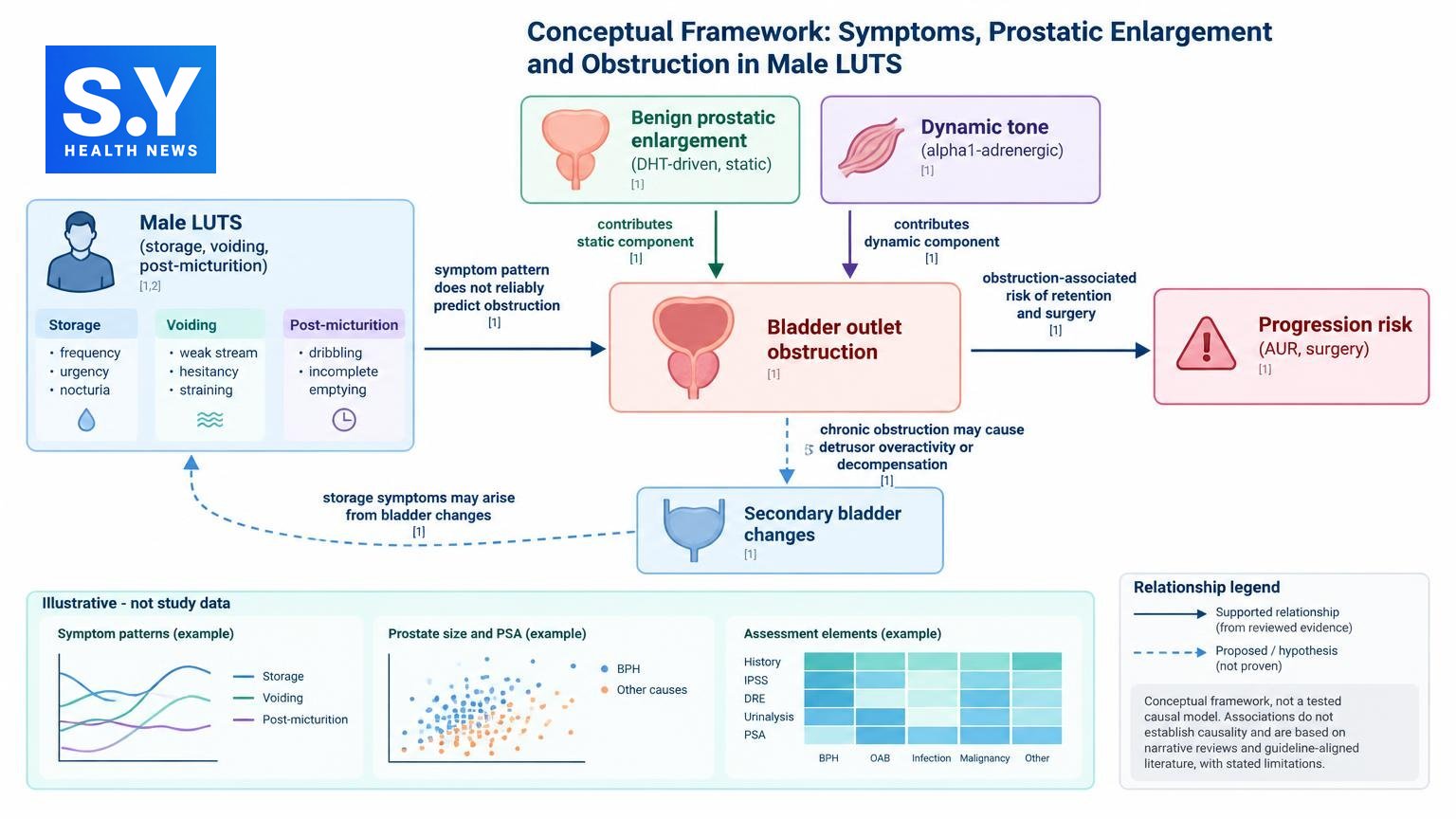
BOO is the generic term for obstruction during voiding, characterized by increased detrusor pressure and reduced urine flow rate. Benign prostatic obstruction (BPO) is a form of BOO diagnosed when the cause is known to be BPE due to histological benign hyperplasia. LUTS themselves are categorized as storage (frequency, urgency, nocturia), voiding (weak stream, hesitancy, straining) and post-micturition (dribbling, incomplete emptying) symptoms; symptom distribution does not reliably predict the presence or severity of BOO.
Biological and Clinical Mechanism
BPH arises predominantly in the transition zone of the prostate. Dihydrotestosterone, produced from testosterone through the action of 5-alpha reductase, is described as the pathophysiological driver: it stimulates proliferation of both stromal and epithelial components, producing nodular enlargement that contributes the static component of obstruction.
Alongside static enlargement, increased alpha1-adrenergic smooth-muscle tone within the prostate and bladder neck produces a dynamic component of obstruction. The relative contribution of static and dynamic factors varies between individuals, which is the rationale for combining volume-reducing and tone-relaxing drugs rather than assuming one mechanism dominates.
Chronic obstruction also induces secondary bladder changes. Early in the process, detrusor overactivity may develop and produce storage symptoms such as urgency and frequency; with prolonged obstruction, detrusor decompensation may occur, leading to incomplete emptying and elevated post-void residual urine. This two-way relationship helps explain why storage symptoms do not automatically point to the prostate, and why an overactive bladder label may be incomplete in a man with unrecognized obstruction.
What the Evidence Shows: Assessment That Separates the Diagnoses
Guideline-aligned guidance recommends beginning with a thorough clinical assessment: history covering symptom characteristics, comorbidities and current medications; abdominal and external genital examination plus digital rectal examination; quantification with a validated instrument such as the International Prostate Symptom Score (IPSS); and urinalysis. Urine dipstick testing for blood, glucose, protein, leucocytes and nitrites is used to exclude infection or other pathology, and PSA testing is offered when results would influence management, when the prostate feels abnormal, or when prostate cancer is a concern.
Initial flow-rate measurement, post-void residual volume and upper-tract imaging are not routinely recommended at first assessment unless complications or serious pathology are suspected; other guidance treats uroflowmetry and residual measurement as useful in selected patients, particularly when invasive treatment is being considered. These positions are not contradictory so much as differently weighted, and they reinforce that testing should follow a question rather than a habit.
The differential is broad and includes must-not-miss diagnoses. Acute urinary retention or post-renal injury presents with painful inability to void; prostate or bladder cancer may present with abnormal rectal examination, gross haematuria, weight loss or bone pain; cauda equina syndrome presents with retention plus saddle anaesthesia, leg weakness or bowel dysfunction and requires urgent MRI and surgical consultation; and acute bacterial prostatitis presents with fever and a tender boggy prostate. Medication review is a routine component because anticholinergics, decongestants, opioids, tricyclics, antihistamines, sympathomimetics and diuretics can cause or worsen symptoms and retention.
PSA deserves specific caution. Beyond cancer detection, it correlates with prostate volume and predicts progression risk, which is why it informs therapy selection. However, PSA may be elevated during prostatitis, urinary tract infection, retention or after recent instrumentation and should be interpreted in context rather than acted on in isolation.
What the Evidence Shows: Does the Distinction Change Treatment?
It changes which mechanism is targeted and what outcome is expected. Alpha-blockers reduce smooth-muscle tone in the prostate and bladder neck, improving flow and voiding symptoms, but their principal benefit is symptomatic relief rather than modification of the natural history of prostatic enlargement. Consistent with this, alpha-blocker monotherapy does not significantly reduce long-term AUR or surgical risk relative to volume-reducing strategies.
5-alpha reductase inhibitors act on the static component by inhibiting conversion of testosterone to dihydrotestosterone, reducing prostate volume gradually over months and lowering the risk of AUR and surgical intervention. In the four-year PLESS placebo-controlled trial of over 3,000 men with moderate to severe symptoms and enlarged prostates, finasteride significantly reduced the risk of AUR and the need for BPH-related surgery, and subgroup analysis found greater benefit in men with baseline PSA of at least 1.4 ng/mL, a surrogate for larger prostate volume. Sexual side effects are the main trade-off: over prolonged treatment, reductions in sexual interest and satisfaction have been observed compared with placebo.
Combination therapy addresses both components. In MTOPS, doxazosin plus finasteride reduced overall clinical progression by 66%, compared with 39% for doxazosin alone and 34% for finasteride alone, where progression included symptom deterioration, AUR, incontinence, renal insufficiency or recurrent urinary tract infection. The CombAT trial similarly reported superiority of dutasteride plus tamsulosin over tamsulosin alone for reducing AUR and surgery, and predictors of progression used in practice include age over 60, prostate volume over 30 mL, PSA over 1.4, IPSS above 7, peak flow below 12 mL/sec and post-void residual above 50 mL.
Tadalafil 5 mg once daily is approved for BPH-associated LUTS, and symptom improvement occurs without significant change in maximum urinary flow rate, suggesting that mechanisms beyond simple mechanical relief contribute. This is a useful illustration of the article's central point: a therapy can help symptoms without altering obstruction, which is why symptom response alone cannot be used to infer that obstruction was present or has been relieved.
AUR marks a pivotal point. Immediate decompression by catheterization is followed by a trial without catheter (TWOC), and initiating an alpha-adrenergic antagonist at catheterization improves the likelihood of successful TWOC. In men with a first episode of spontaneous BPH-related retention, alfuzosin significantly increased TWOC success versus placebo and reduced short-term progression to surgery when continued after catheter removal. Older age and larger drained volumes at catheterization are associated with TWOC failure, and elevated post-TWOC residual urine with relapse and later surgery.
Interpretation and Limitations
The evidence summarized here comes from narrative clinical reviews and guideline-aligned summaries rather than a new systematic review, and this article did not perform independent evidence synthesis. Several effect estimates are described qualitatively: the source reports that finasteride, alfuzosin and combination therapy altered retention, surgery or progression outcomes without reproducing full effect sizes and confidence intervals for every trial. The MTOPS figures are presented as relative reductions in progression, and the source does not give the sample size or absolute event rates in the summary used here.
Epidemiological statements about histological prevalence are cited from referenced studies rather than generated by the review, and the mechanistic descriptions of dihydrotestosterone, adrenergic tone and detrusor decompensation are narrative pathophysiology rather than tested causal models. Guidance on initial testing also differs in emphasis between sources, with one advising against routine flow-rate, residual and upper-tract imaging at first assessment while another supports selective use. Clinicians should treat these as complementary frameworks rather than competing rules.
One further limitation involves association versus causation. Statements that larger drained volumes predict TWOC failure or that post-TWOC residual predicts relapse are associations from observational evidence, not proof that modifying those variables changes outcome. Similarly, the use of PSA as a surrogate for prostate volume is a practical approximation, not a direct measurement of gland size.
Research Outlook
The unresolved questions are practical rather than conceptual. Better tools are needed to identify, among men with similar symptom scores, who actually has obstruction and who will progress, so that volume-reducing therapy and combination treatment reach the men most likely to benefit while others are spared unnecessary sexual side effects. The observation that tadalafil improves symptoms without changing peak flow also highlights how incompletely the mechanisms of symptom benefit are understood.
On the assessment side, the field would benefit from clearer evidence about when uroflowmetry and residual measurement change management rather than merely confirm a clinical impression, and about how PSA should be interpreted in men with concurrent infection or retention. Until then, the defensible approach remains structured evaluation, explicit risk stratification and individualized therapy rather than reflexive labeling of symptoms as BPH.
| Entity | Definition | Why the distinction matters | Typical treatment target |
|---|---|---|---|
| Lower urinary tract symptoms (LUTS) | Functional clinical syndrome of storage, voiding and post-micturition symptoms | Symptom pattern does not reliably predict obstruction severity | Symptom burden and quality of life |
| Benign prostatic enlargement (BPE) | Prostatic enlargement due to histological BPH | Enlargement can exist without obstruction or symptoms | Static component; volume reduction in larger glands |
| Bladder outlet obstruction (BOO) | Obstruction during voiding with increased detrusor pressure and reduced flow | Generic term; cause must be established, not assumed | Confirm diagnosis before attributing symptoms to prostate |
| Benign prostatic obstruction (BPO) | BOO where the cause is known to be BPE from benign hyperplasia | Links a mechanism to a specific treatment rationale | Static and dynamic components |
| Overactive bladder and detrusor overactivity | Storage-predominant urgency and frequency; may arise secondary to chronic obstruction | Storage symptoms are easily mislabeled as BPH | Exclude significant retention before antimuscarinic therapy |
| Reversible mimics | Medications, infection, diabetes, neurological disease, stones | Common and must-not-miss alternatives to prostatic obstruction | Medication review, urinalysis and targeted testing |
Key Takeaways
- LUTS are a clinical syndrome, not a diagnosis; histological BPH is present in roughly half of men by age 50 and around 80% by age 80, yet histology does not necessarily track symptom severity or obstruction.
- Hald's rings framework keeps LUTS, benign prostatic enlargement and bladder outlet obstruction conceptually separate, because enlargement without obstruction and obstruction without symptoms both occur.
- Initial assessment combines history, IPSS, digital rectal examination and urinalysis, with PSA offered when it would change management; flow-rate, residual volume and upper-tract imaging are not routinely required at first assessment unless complications are suspected.
- Alpha-blockers act on dynamic tone for rapid symptom relief but do not significantly reduce long-term AUR or surgical risk, whereas 5-alpha reductase inhibitors reduce volume and progression risk, particularly with baseline PSA of at least 1.4 ng/mL.
- Combination therapy reduced overall clinical progression by 66% in MTOPS versus 39% with doxazosin alone and 34% with finasteride alone, supporting risk-based rather than symptom-only selection.
- Storage-predominant symptoms may reflect overactive bladder, infection, diabetes, medication effects or malignancy; checking retention risk before antimuscarinic therapy and recognizing red flags such as retention with saddle anaesthesia are essential safeguards.
Questions and Answers
What is the difference between LUTS, BPH, benign prostatic enlargement and bladder outlet obstruction?
LUTS is a functional clinical syndrome of storage, voiding and post-micturition symptoms. BPH refers to the characteristic histological pattern, BPE is enlargement due to that histology, and BOO is obstruction during voiding with raised detrusor pressure and reduced flow. Hald's rings depicts these as overlapping but distinct, so enlargement can occur without obstruction and symptoms without either.
Does prostate size predict how severe a man's urinary symptoms will be?
Not reliably. Roughly half of men aged 50 have histological hyperplasia, rising to about 80% by age 80, but histological change does not necessarily correlate with symptom severity and prostate size alone does not determine obstruction. Symptom distribution also does not reliably predict the presence or severity of bladder outlet obstruction, which is why structured assessment is needed rather than inference from gland size.
How are BPH-related lower urinary tract symptoms assessed at first presentation?
Guideline-aligned assessment includes a detailed history, symptom quantification with the International Prostate Symptom Score, digital rectal examination, and urinalysis with dipstick testing for blood, glucose, protein, leucocytes and nitrites. PSA is offered when it would influence management. Flow-rate measurement, post-void residual and upper-tract imaging are not routinely recommended initially unless complications or serious pathology are suspected.
Does distinguishing obstruction from other causes of male LUTS change drug treatment?
Yes, by identifying which mechanism to target. Alpha-blockers relax prostatic and bladder-neck smooth muscle for rapid symptom relief but do not significantly reduce long-term retention or surgical risk, whereas 5-alpha reductase inhibitors reduce prostate volume and progression risk, with greater benefit at baseline PSA of at least 1.4 ng/mL. Combination therapy reduced progression by 66% versus 39% and 34% for monotherapies in MTOPS.
Which serious conditions can mimic benign prostatic hyperplasia in older men?
Must-not-miss alternatives include acute urinary retention, prostate or bladder cancer, cauda equina syndrome, and acute bacterial prostatitis, alongside overactive bladder, urethral stricture, bladder stone, diabetes and medication effects. Red flags such as retention with saddle anaesthesia, gross haematuria, fever with a tender prostate, or abnormal rectal examination require urgent rather than routine management.
What are the main limitations of the evidence on managing male lower urinary tract symptoms?
The available summaries are narrative reviews and guideline-aligned guidance, not a new systematic review, and several trial effects are reported qualitatively without full estimates. Prevalence figures are cited from referenced epidemiology, mechanistic explanations are narrative, and associations such as drained volume predicting trial-without-catheter failure are observational. Sources also differ in emphasis on initial flow-rate, residual and imaging tests.
Conceptual framework: Conceptual framework, not a tested causal model. It summarizes how male LUTS, benign prostatic enlargement, dynamic smooth-muscle tone and bladder outlet obstruction relate in the reviewed narrative and guideline-aligned literature; dashed or proposed links reflect mechanistic hypotheses rather than proven mediation.
Academic References & Evidence
- Lynn Casey; Donnacha Hogan; Niall F Davis. Contemporary management of male LUTs – Medical Independent. Medical Independent. 2026 12(7):35
- Lower Urinary Tract Symptoms (LUTS / Prostatism) — MCCQE1 Clinical Presentation Guide 2026 | iatroX. 2026
- Kola Tytler. Benign Prostatic Hyperplasia (BPH) vs Other Causes of Luts: Guideline-.
SANYUN Science Center explains published research on men's reproductive and sexual health, connecting scientific evidence with everyday questions while making sources and limitations clear.
Disclaimer: This article is for scientific education and research communication only. It does not provide medical advice, diagnosis, or individualized treatment recommendations, and does not endorse any medication, supplement, device, penile enlargement procedure, or other intervention. Decisions about sexual and reproductive health should be made in consultation with a qualified healthcare professional. Do not delay seeking professional care because of information in this article.
Original Content & Copyright Notice
- This article is prepared for SANYUN Science Center, drawing on published research and publicly available academic literature on men’s sexual and reproductive health. Its editorial explanations and presentation are developed for this platform.
- Copyright in the original editorial content, selection, and arrangement is reserved by SANYUN Science Center to the extent protected by applicable law. Referenced research, quotations, and third-party materials remain subject to the rights of their respective owners. This notice does not claim ownership of scientific facts or third-party research.
- Except where permitted by applicable law or an applicable license, prior written permission is required to reproduce, republish, translate, adapt, redistribute, or commercially reuse protected content. Attribution alone does not grant permission for such reuse.
- For permitted quotation or authorized reuse, clearly identify the source and retain a link to the original article.
- Source: SANYUN Science Center
- Original URL: Retain the original article URL on science.san-yun.com.
- Copyright Holder: SANYUN Science Center, for its own protected editorial content.
- Quotation, excerpts, or authorized reuse must not distort the scientific meaning, omit material limitations or disclaimers, or imply unverified medical claims, product efficacy, or endorsement by SANYUN Science Center.



