




Category: Health Academy
Core Research Direction: Evidence-based explanation of what cancer screening can and cannot establish, focused on benefits, harms (false positives, false negatives, overdiagnosis), and the distinction between disease-specific mortality reductions and overall mortality in randomized trials
Search Intent: Does cancer screening actually help people live longer, and what are the benefits and limitations I should weigh before being screened?
Platform: SANYUN Science Center
Evidence reviewed through: 2026-11-22
Executive Summary
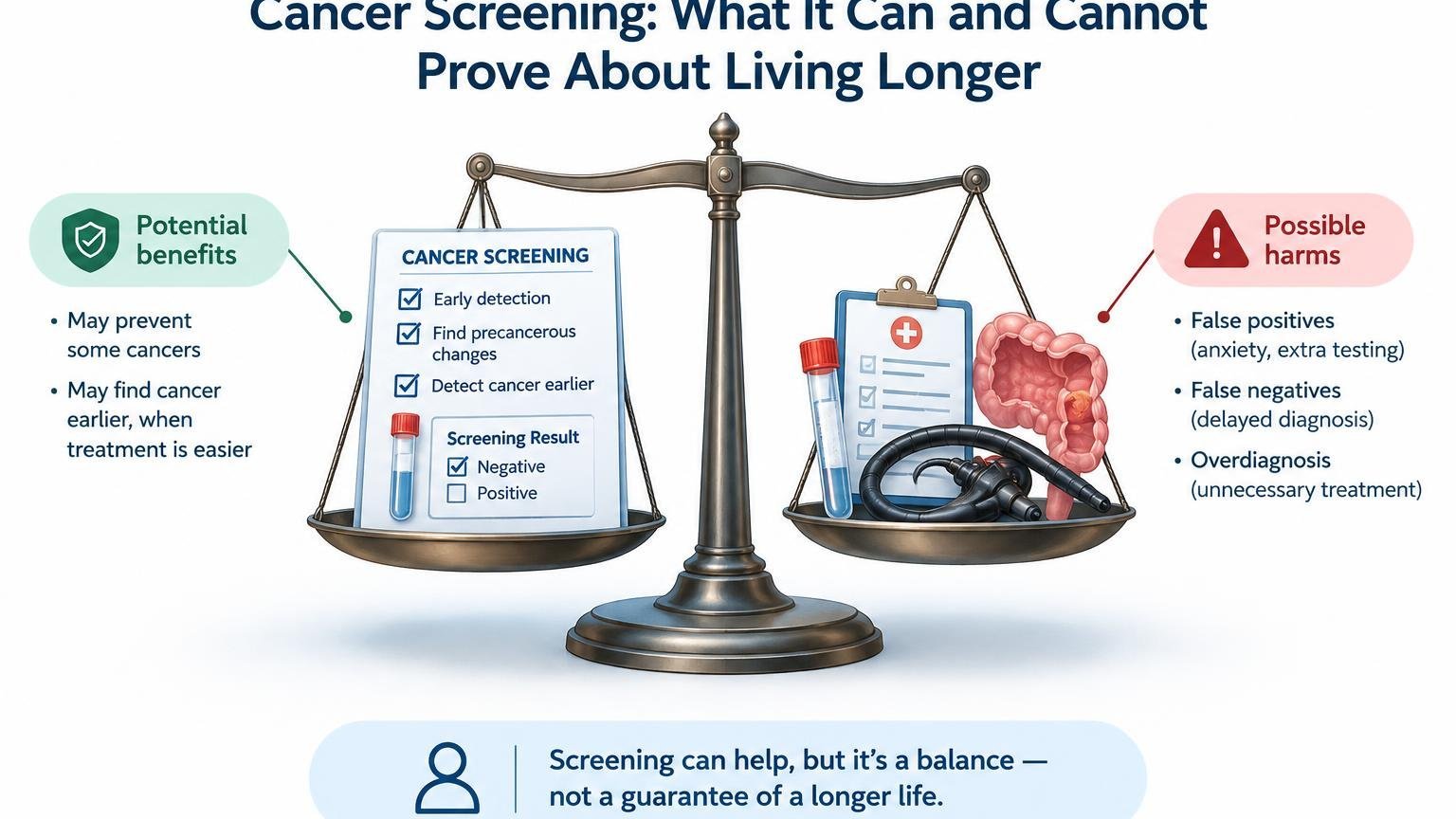
Cancer screening is usually presented as early detection, and early detection sounds straightforwardly good. The evidence is more nuanced. Screening may prevent some cancers by finding precancerous changes that could become cancer if untreated, and it may find cancer before symptoms appear, when treatment is considered easier. Those are genuine potential benefits.[1]
The same tests carry defined harms: false positives that cause anxiety and may lead to invasive unnecessary follow-up, false negatives that can falsely reassure and delay diagnosis, and overdiagnosis, in which a slow-growing cancer that would never have caused harm is found and treated anyway.
The hardest question is whether screening helps people live longer overall. A secondhand summary of randomized trial meta-analyses reports no statistically clear reduction in all-cause mortality for mammography, biennial fecal occult blood testing, colonoscopy, PSA testing or low-dose CT lung screening, with relative risks ranging from 0.97 to 1.00. Sigmoidoscopy was the exception at 0.98 (95% CI 0.95–1.00), an estimated 110 days of life extension (95% CI 0–274 days).[2]
That does not mean screening should be abandoned. The cited authors advise judging each programme on the balance of benefits and harms, including reductions in target-cancer incidence and mortality. The practical task is to understand which outcome a study measured, in whom, and with what certainty.
Why This Matters
Screening is offered to people who feel well. That makes the ethical bar different from treating someone with symptoms: the person must be helped on average, and the chance of being harmed by the process must be small enough to accept. Anxiety after a false positive, a colonoscopy complication after an abnormal stool test, or treatment of a cancer that would never have progressed are not abstract. They are the costs side of the ledger.
Public messaging often compresses this ledger into a single claim: early detection saves lives. The claim is not false so much as incomplete. It describes a mechanism and a selected outcome, not the net effect on how long people actually live. Understanding the difference helps readers ask better questions when a screening invitation arrives.
This article interprets published summaries of screening evidence; it is not a new trial, systematic review or clinical guideline. The quantitative figures come from a secondary blog summary of trial meta-analyses and one cluster trial, so the primary publications should be consulted before applying any number to an individual decision.
The Mechanisms Screening Relies On
Screening rests on three linked ideas. First, a test can detect a precancerous lesion before it becomes invasive, and removing that lesion prevents cancer. Second, a test can detect an established cancer at an earlier stage, when treatment is more effective. Third, earlier treatment translates into fewer deaths from that cancer and possibly longer life.
Each link can weaken. Not every precancerous change would have progressed. Not every cancer found early would have been lethal if found later. And not every death prevented from the target cancer translates into an extra year of life, because people may die of other causes in the meantime. That final gap is the central reason disease-specific and all-cause mortality can diverge.
Screening also introduces its own clinical pathway. An abnormal result typically triggers repeat testing, imaging, biopsy or endoscopy. Those steps can confirm health, but they can also cause bleeding, infection, perforation, anxiety or simply time and cost. A screening programme's net benefit depends on how often those downstream events occur and how severe they are, not only on the accuracy of the first test.
What the Evidence Shows: Disease-Specific Versus Overall Mortality
Randomized trials of screening usually report two families of outcome. Disease-specific mortality counts deaths caused by the cancer being screened for. All-cause mortality counts all deaths, whatever the cause. Disease-specific mortality is more sensitive to a real effect of screening, but it can be distorted by how causes of death are classified. All-cause mortality is harder to manipulate but requires larger trials and longer follow-up to show a difference.
A review of randomized trials and meta-analyses in asymptomatic adults found that across nine meta-analyses, some significantly reduced disease-specific mortality, but none significantly reduced all-cause mortality. In individual trials, significant disease-specific mortality reductions were estimated at 30%, whereas the all-cause mortality figure was 11%. The summary does not make clear whether that 11% estimate was itself statistically significant or how many trials contributed to it, so it should be read as a description of the reported pattern rather than a precise pooled effect.
The meta-analysis summarized secondhand reports all-cause mortality relative risks of 1.00 (95% CI 0.95–1.04) for mammography, 1.00 (0.99–1.01) for biennial fecal occult blood testing, 0.99 (0.96–1.04) for colonoscopy, 0.99 (0.98–1.01) for PSA testing and 0.97 (0.88–1.08) for low-dose CT lung screening. None of these confidence intervals excludes 1, so none demonstrates a clear overall mortality reduction.
Sigmoidoscopy was the only test with a point estimate below 1 and a confidence interval that did not clearly cross it: 0.98 (95% CI 0.95–1.00), corresponding to an estimated 110 days of life extension (95% CI 0–274 days). The lower bound of that life-extension interval touches zero, so even this signal is fragile rather than a large, certain benefit.
| Screening test | All-cause mortality relative risk (95% CI) | Interpretation |
|---|---|---|
| Mammography | 1.00 (0.95–1.04) | No clear overall mortality reduction detected |
| Biennial fecal occult blood testing | 1.00 (0.99–1.01) | No clear overall mortality reduction detected |
| Colonoscopy | 0.99 (0.96–1.04) | No clear overall mortality reduction detected |
| PSA testing | 0.99 (0.98–1.01) | No clear overall mortality reduction detected |
| Low-dose CT lung screening | 0.97 (0.88–1.08) | No clear overall mortality reduction detected |
| Sigmoidoscopy | 0.98 (0.95–1.00); estimated life extension 110 days (95% CI 0–274) | Only test with a confidence interval not clearly crossing 1; lower life-extension bound touches zero |
The Mumbai Cervical Screening Trial
One cluster randomized trial illustrates how the two outcome families can diverge within a single study. In Mumbai, India, visual inspection with acetic acid for cervical cancer screening was followed for approximately 12 years. Cervical cancer deaths were 67 versus 98, a relative risk of 0.69 (95% CI 0.54–0.88). That is a statistically significant reduction in deaths from the target cancer.
All-cause deaths in the same trial were 4,909 versus 5,275, a relative risk of 0.93 (95% CI 0.79–1.10). The summary reports a significant 31% reduction in cervical cancer deaths alongside a non-significant 7% lower all-cause mortality point estimate (P=0.41). The confidence interval crosses 1, so the trial does not demonstrate that screened women lived longer overall.
This pattern is exactly what a modest, cancer-specific benefit looks like when total mortality is dominated by other causes. Cervical cancer accounts for a minority of all deaths among adult women, so even a real reduction in cervical cancer mortality may be diluted below detectability in all-cause counts. The absence of an all-cause effect is therefore not proof that screening failed; it is a limit on what that trial could show.
Harms That Must Be Counted
A false positive is a result suggesting cancer when cancer is not present. The immediate harm is anxiety and stress from believing, even briefly, that one may have cancer. The downstream harm is the follow-up testing needed to rule cancer out, which may be invasive and unnecessary. How often this happens varies widely by test and population, and the supplied source does not give false-positive rates, so no numerical risk should be inferred from it.
A false negative is a test that fails to detect cancer that is present. Its distinctive harm is false reassurance: a person may attribute new symptoms to a recently normal test and delay seeking diagnosis and treatment. That pathway is described as plausible in the source but not quantified in the supplied text.
Overdiagnosis is the detection of a cancer that would not necessarily have led to death or reduced quality of life. Some cancers grow slowly or never cause problems. Finding them can trigger surgery, radiation, hormone therapy or surveillance that the person never needed, with side effects and no survival gain. Overdiagnosis is not the same as a false positive: the abnormality is real, but its future threat was overestimated.
- False positive: abnormal result without cancer; anxiety and possibly invasive follow-up.
- False negative: missed cancer; false reassurance and possible delay in care.
- Overdiagnosis: a real but non-threatening cancer found and treated; unnecessary treatment and side effects.
Interpretation and Limitations
Several cautions apply. The quantitative evidence here is a secondhand summary; the packet does not include the primary meta-analysis, sample sizes, follow-up durations or full methods. Numbers attributed to 2023, 2016, 2015 and 2007 summarize earlier work and are not new findings.
All-cause mortality is a blunt instrument. A cancer that causes a small share of deaths can produce a real screening benefit that a trial is underpowered to detect. Conversely, a disease-specific reduction can be inflated by misclassification of cause of death or by detecting cancers that would never have been fatal. Neither outcome alone settles the question.
The cancer charity source states its organizational view that benefits of regular screening for breast, cervical and colorectal cancer outweigh the limitations. That is a value judgment informed by evidence, not a measured outcome, and it should be presented as the source's position rather than as a trial result.
Finally, the evidence base is programme-specific. Findings for mammography, stool testing, colonoscopy, PSA, lung CT and sigmoidoscopy cannot be transferred to newer multi-cancer blood tests or to other populations. Age, baseline risk, prior screening and local treatment quality all modify the balance.
Research Outlook
The core research questions are not whether screening can find cancer, but how much overdiagnosis a programme generates, how severe the downstream harms are, and whether modern treatment and longer follow-up change the all-cause mortality picture. Trials designed with all-cause mortality as a primary endpoint, and analyses that report both outcome families transparently, would make the trade-off easier to communicate.
Until then, the most honest summary is conditional. Some screening tests reduce deaths from the cancer they target, and the sigmoidoscopy data hint at a small overall mortality benefit. For the major programmes summarized here, a clear reduction in overall mortality has not been demonstrated in randomized evidence.
Key Takeaways
- Screening can prevent some cancers and find others earlier, but earlier detection is a mechanism, not proof of longer life.
- False positives cause anxiety and may lead to invasive follow-up; false negatives can falsely reassure; overdiagnosis leads to unnecessary treatment.
- Meta-analyzed randomized trials show no statistically clear all-cause mortality reduction for mammography, fecal occult blood testing, colonoscopy, PSA or lung CT; sigmoidoscopy showed 0.98 (95% CI 0.95–1.00).
- In the Mumbai VIA trial, cervical cancer deaths fell significantly (RR 0.69, 95% CI 0.54–0.88) while all-cause mortality did not (RR 0.93, 95% CI 0.79–1.10).
- The cited authors recommend balancing target-cancer reductions against screening harms rather than stopping all screening.
Questions and Answers
What does cancer screening aim to achieve, and how does it work?
Screening looks for cancer or precancerous changes before symptoms appear. It may prevent cancer by finding changes that could become cancer if untreated, and it may find established cancer earlier, when treatment is considered easier. Both are potential benefits; whether they translate into longer life is a separate question that randomized trials must answer.
Do randomized trials show that cancer screening reduces overall mortality?
For most major programmes, a clear reduction has not been demonstrated. Summarized trials report all-cause mortality relative risks of 1.00 for mammography, 1.00 for biennial fecal occult blood testing, 0.99 for colonoscopy, 0.99 for PSA and 0.97 for lung CT, with confidence intervals crossing 1. Sigmoidoscopy was 0.98 (95% CI 0.95–1.00), a fragile signal.
Why can cancer-specific mortality fall without overall mortality falling?
Cancer-specific deaths are a subset of all deaths. A real reduction in deaths from one cancer can be diluted by other causes, especially in older populations. Cause-of-death classification can also bias disease-specific counts, while overdiagnosis and treatment harms add deaths or reduce quality of life. The Mumbai cervical trial illustrates the divergence.
What are false positives and false negatives in cancer screening?
A false positive suggests cancer when none is present, causing anxiety and possibly invasive unnecessary follow-up. A false negative misses cancer that is present, offering false reassurance and potentially delaying diagnosis when symptoms appear. Both are recognized limitations; the supplied sources do not provide numerical rates, so individual risk depends on the specific test and population.
What is overdiagnosis in cancer screening and why does it matter?
Overdiagnosis is finding a cancer that would not necessarily have caused death or reduced quality of life. Some cancers grow slowly or never cause problems. Detecting them can lead to surgery, radiation or other treatment with side effects but no survival benefit. It differs from a false positive because the abnormality is real; the error is in estimating its future threat.
How should someone weigh cancer screening benefits against harms?
The cited authors advise judging screening on the balance of target-cancer reductions and harms, not on early detection alone. Ask which outcome the evidence reports, in which population, and with what uncertainty. The cancer charity source states its view that breast, cervical and colorectal screening benefits outweigh limitations; that is a value judgment, not a trial result.
Sources and References
- Benefits and limitations of regular cancer screening.
- がん検診でがん死亡率は下がるが、なぜ総死亡率は下がらないのか? – 天王寺の漢方内科・心療内科・神経内科・栄養療法|こいでクリニック.
SANYUN Science Center explains published research on men's reproductive and sexual health, connecting scientific evidence with everyday questions while making sources and limitations clear.
Disclaimer: This article is for scientific education and research communication only. It does not provide medical advice, diagnosis, or individualized treatment recommendations, and does not endorse any medication, supplement, device, penile enlargement procedure, or other intervention. Decisions about sexual and reproductive health should be made in consultation with a qualified healthcare professional. Do not delay seeking professional care because of information in this article.
Original Content & Copyright Notice
- This article is prepared for SANYUN Science Center, drawing on published research and publicly available academic literature on men’s sexual and reproductive health. Its editorial explanations and presentation are developed for this platform.
- Copyright in the original editorial content, selection, and arrangement is reserved by SANYUN Science Center to the extent protected by applicable law. Referenced research, quotations, and third-party materials remain subject to the rights of their respective owners. This notice does not claim ownership of scientific facts or third-party research.
- Except where permitted by applicable law or an applicable license, prior written permission is required to reproduce, republish, translate, adapt, redistribute, or commercially reuse protected content. Attribution alone does not grant permission for such reuse.
- For permitted quotation or authorized reuse, clearly identify the source and retain a link to the original article.
- Source: SANYUN Science Center
- Original URL: Retain the original article URL on science.san-yun.com.
- Copyright Holder: SANYUN Science Center, for its own protected editorial content.
- Quotation, excerpts, or authorized reuse must not distort the scientific meaning, omit material limitations or disclaimers, or imply unverified medical claims, product efficacy, or endorsement by SANYUN Science Center.



